Why in News?
The Seventh Review Conference of the Convention on Certain Conventional Weapons opened in Geneva on 16 November 2026, putting autonomous weapons and possible rule-making in focus.
- The UN Geneva listing confirms the opening date; the conference reviews the Convention on Certain Conventional Weapons, or CCW.
- The Hindu reported that delegates would consider whether to launch negotiations on rules for lethal autonomous weapons.
- The reported proposal sought a legally binding agreement; the opening of the conference did not itself create a new ban.
- The central issue is who exercises judgment over force when sensors and software select a target after activation.
- Existing international humanitarian law applies during armed conflict; negotiations concern additional limits and practical safeguards, not a legal vacuum.
UPSC Relevance
Prelims Relevance
- CCW: Convention on Certain Conventional Weapons.
- GGE: Group of Governmental Experts examining lethal autonomous weapons within the CCW framework.
- Critical functions: selecting targets and applying force.
- IHL: distinction, proportionality and precautions in attack.
- Consensus: a decision-making requirement that can impede agreement.
Mains Relevance
GS Paper 2
- Multilateral governance: consensus, arms regulation and state responsibility.
GS Paper 4
- Ethics of technology: retaining human judgment and accountability over lethal force.
Essay
- Technological capability does not settle moral responsibility.
Background and Context
What makes a weapon autonomous?
The decisive question concerns control over an attack, rather than whether a machine can move without a pilot.
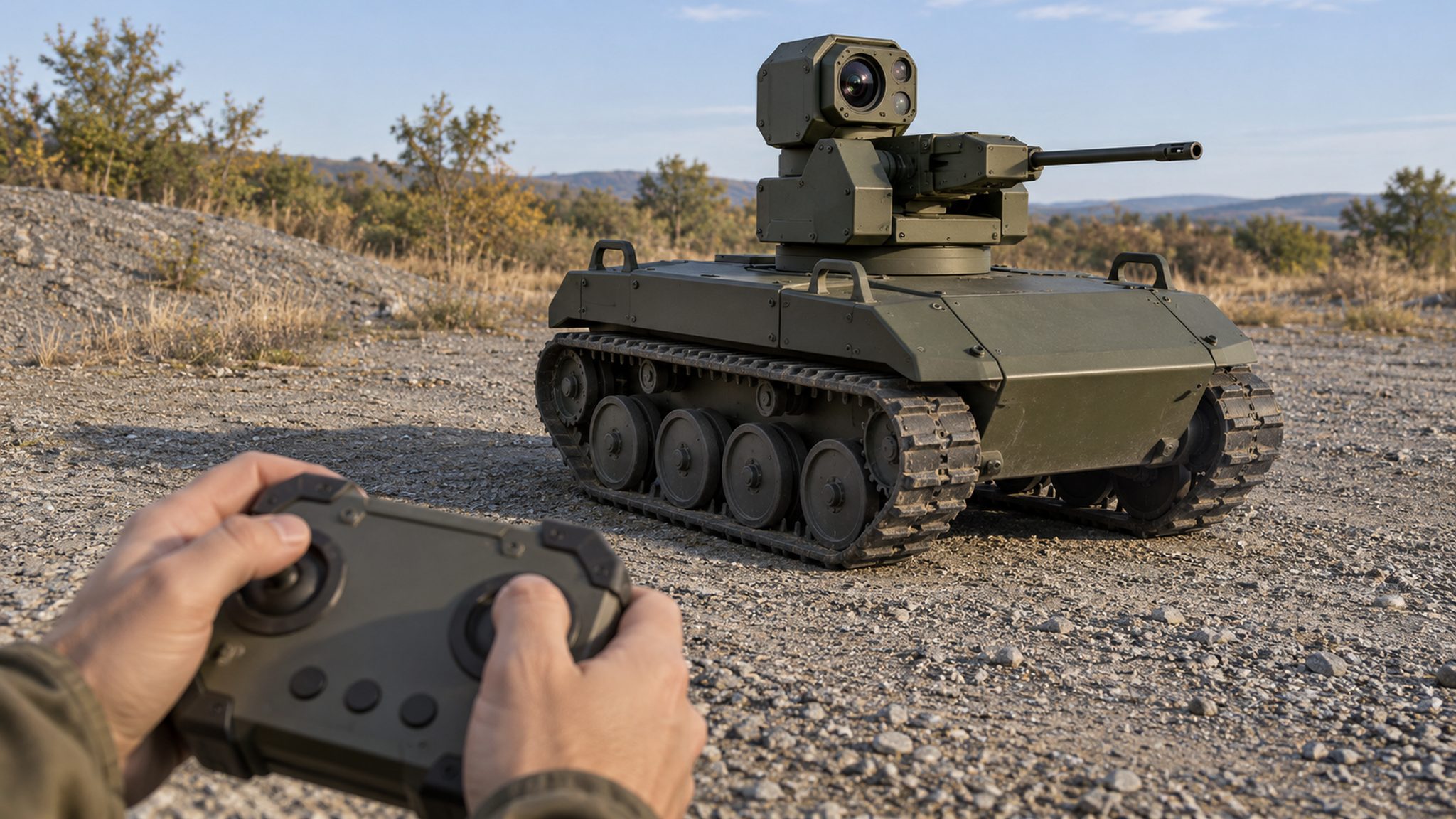
- The ICRC describes autonomous weapons as systems that select and apply force to targets without human intervention. A person may activate the weapon without choosing each subsequent target.
- Target selection can involve matching sensor observations against a programmed target profile. The resulting match can trigger force, making the profile and operating conditions central to civilian protection.
- A remotely piloted drone is not automatically autonomous: when a human identifies the target and decides to fire, the critical decision remains human, even if navigation is automated.
- Consider a hypothetical vehicle detector: recognizing a shape does not establish a lawful military objective. Civilian use and changing circumstances can make a technically correct classification legally insufficient.
Existing law still governs the attack
Autonomy changes how a weapon operates; it does not remove the legal requirements applicable to attacks during armed conflict.
- Distinction requires attacks to be directed at military objectives, not civilians or civilian objects. A sensor confidence score cannot, by itself, establish the legal status of a target.
- Proportionality prohibits attacks expected to cause incidental civilian harm excessive relative to the concrete and direct military advantage anticipated. This is a contextual judgment, not a simple accuracy threshold.
- Precautions require feasible steps to avoid or minimize civilian harm. Those planning an attack must consider the target, weapon and circumstances, rather than assume automation guarantees safer outcomes.
- The ICRC argues for new binding rules to address autonomy-specific risks. That advocacy must be distinguished from existing IHL obligations and from an agreement actually adopted by states.
Human control must work before and during use
A nominal human presence is insufficient if the person lacks information, time or an effective ability to influence the attack.
- Before activation, operators should understand the system’s capabilities and limits. Restricting target types, operating area and duration can reduce the range of situations in which unpredictable harm arises.
- During operation, supervision must be practicable. An override offers little protection if the system acts faster than the operator can understand events or if communications are unavailable.
- Testing should examine foreseeable conditions of use, including sensor failure and civilian movement. Successful performance in a controlled trial does not establish reliability across an unfamiliar battlefield.
- Human judgment includes deciding whether the system should be used at all. If commanders cannot reasonably anticipate its effects in a particular environment, adding a supervisor does not resolve that uncertainty.
Responsibility and the negotiating hurdle
The separate institutional question is how states translate legal responsibility into enforceable rules and traceable decisions.
- The CCW expert report affirms human responsibility for weapon-use decisions. Responsibility cannot be transferred to a machine merely because its software executed the attack.
- State responsibility concerns internationally wrongful conduct attributable to a state. It is distinct from an individual’s criminal responsibility; neither can be resolved simply by blaming an algorithm.
- Accountability requires identifying who authorized deployment, set constraints and supervised use. Preserving relevant records can support investigation without assuming every developer or operator is automatically criminally liable.
- The Hindu reported that CCW decisions require consensus. Disagreement can block a negotiating mandate; even an agreed mandate would begin negotiations, rather than instantly establish a binding prohibition.
Way Forward
Make human control demonstrable
- Define operational limits around target types, duration and environment, and test whether personnel can understand and enforce them.
- Preserve decision records linking authorization, settings and supervision so investigations can reconstruct responsibility after an incident.
- Seek clear prohibitions and restrictions through negotiations while implementing existing IHL obligations immediately; do not treat treaty discussions as permission to delay compliance.
Conclusion
- Autonomous weapons raise a control problem as well as a technology problem: the ability to detect a target does not supply the judgment needed to attack it lawfully.
- The CCW review should be assessed through legal status and practical safeguards: distinguish existing obligations, proposed rules and adopted agreements before judging whether civilian protection has improved.
UPSC Practice Questions
Prelims MCQ 1
With reference to autonomous weapons, consider the following statements:
- A remotely piloted drone is necessarily an autonomous weapon.
- International humanitarian law applies to autonomous weapons used in armed conflict.
- Human responsibility for weapon-use decisions cannot be transferred to machines.
How many of the above statements are correct?
(a) Only one (b) Only two (c) All three (d) None
Answer: (b) Only two
Explanation:
Statements 2 and 3 are correct. A human can retain target selection and firing decisions in a remotely piloted drone; autonomous navigation alone does not establish autonomy in critical functions.
Prelims MCQ 2
Which development would itself demonstrate the adoption of a new legal rule on autonomous weapons?
(a) Opening a review conference (b) Submitting a negotiating proposal (c) Agreeing only to begin negotiations (d) Adopting the negotiated legal instrument
Answer: (d) Adopting the negotiated legal instrument
Explanation:
Conference openings, proposals and negotiating mandates do not themselves adopt the substantive instrument. Adoption must also be distinguished from entry into force and the obligations of particular states.
UPSC Mains Questions
- Why is human control over autonomous weapons more demanding than providing an emergency override? Discuss with reference to international humanitarian law.
- Examine the relationship between state responsibility and the proposed international regulation of autonomous weapons. How does consensus affect the CCW process?
Sources: United Nations Office at Geneva and The Hindu (Associated Press).
Frequently Asked Questions
What is an autonomous weapon?
In the ICRC understanding, it is a weapon that selects and applies force to targets without human intervention. Human activation does not necessarily mean a person selects each subsequent target.
Did the November 2026 CCW opening ban autonomous weapons?
No new ban was established by the opening reported on 16 November. The live issue was whether states would begin negotiations toward rules, a stage distinct from adopting an agreement.
Does humanitarian law already apply?
Yes. During armed conflict, applicable international humanitarian law governs attacks involving autonomous weapons. Distinction, proportionality and precautions remain relevant even while states discuss additional rules specifically addressing autonomous functions.
Why is an override button insufficient?
An override is useful only when an operator understands the situation and can intervene effectively. Speed, communications failures and limited information can prevent meaningful control despite the presence of a nominal supervisor.
Tell Google you want more of this.
Add Anantam IAS as a preferred sourceOne tap, and this site shows up more often in your own Top Stories, AI Overviews and AI Mode. Remove it any time.