Why in News?
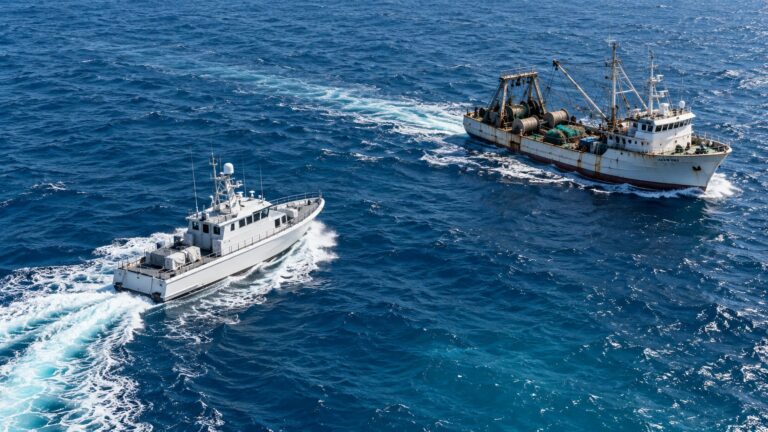
Yemeni authorities said Houthi forces attacked a commercial vessel in the Bab el-Mandeb Strait on 11 August 2026, killing six people in the first known deaths from attacks on shipping off Yemen during the latest round of fighting.
- The Associated Press reported, citing Yemen’s internationally recognised government, that the Houthis fired three ballistic missiles at the Yemeni commercial vessel.
- Yemen’s coast guard said the six dead comprised four crew members and two members of the government-allied National Resistance Forces.
- A subsequent official statement identified three of the dead crew as Pakistani nationals and one as Indonesian; Pakistan also reported that another Pakistani was wounded.
- The incident occurred amid broader fighting involving the Houthis, Yemen’s internationally recognised government and Saudi-linked interests. Claims about the vessel’s cargo or military purpose should not be treated as verified unless independently established.
- The active U.S. Maritime Administration advisory identifies missiles, one-way unmanned aerial vehicles, uncrewed surface and underwater vehicles, small boats, illegal boarding and seizure as possible threats in the Red Sea-Gulf of Aden operating area.
- Bab el-Mandeb is a narrow maritime chokepoint connecting the Red Sea with the Gulf of Aden and Arabian Sea; ships using the Suez route between Asia and Europe generally pass through it.
- An attack can impose costs far beyond the damaged vessel through higher war-risk premiums, rerouting, delayed cargo, additional fuel use and pressure on seafarers.
- For India, the risk concerns westbound trade, energy and fertiliser logistics, shipping services, Indian seafarers and the stability of the wider Indian Ocean neighbourhood.
UPSC Relevance
Prelims Relevance
- Bab el-Mandeb connects the Red Sea to the Gulf of Aden and Arabian Sea.
- It lies between Yemen on the Arabian Peninsula and Djibouti-Eritrea on the Horn of Africa side.
- The Suez Canal connects the Red Sea with the Mediterranean Sea, making Bab el-Mandeb part of the shorter Europe-Asia sea route.
- The alternative for many diverted vessels is the longer route around the Cape of Good Hope at Africa’s southern tip.
- The Automatic Identification System, or AIS, broadcasts vessel identity, position, course and related navigation information.
- SOLAS Chapter V permits a master to switch off AIS when its continuous operation could compromise ship safety or security, subject to the master’s responsibility for safe navigation and applicable requirements.
Mains Relevance
GS Paper 2
- West Asian instability, India’s economic interests and cooperation with littoral and maritime partners.
- Freedom of navigation, international maritime law and protection of civilian seafarers.
GS Paper 3
- Security of sea lanes of communication, maritime domain awareness and protection of merchant shipping.
- Economic effects of chokepoint disruption through freight, insurance, fuel, inventories and delivery time.
Essay
- A narrow strait can transmit a local conflict into a global economic shock.
Background and Context
What Happened in the Strait
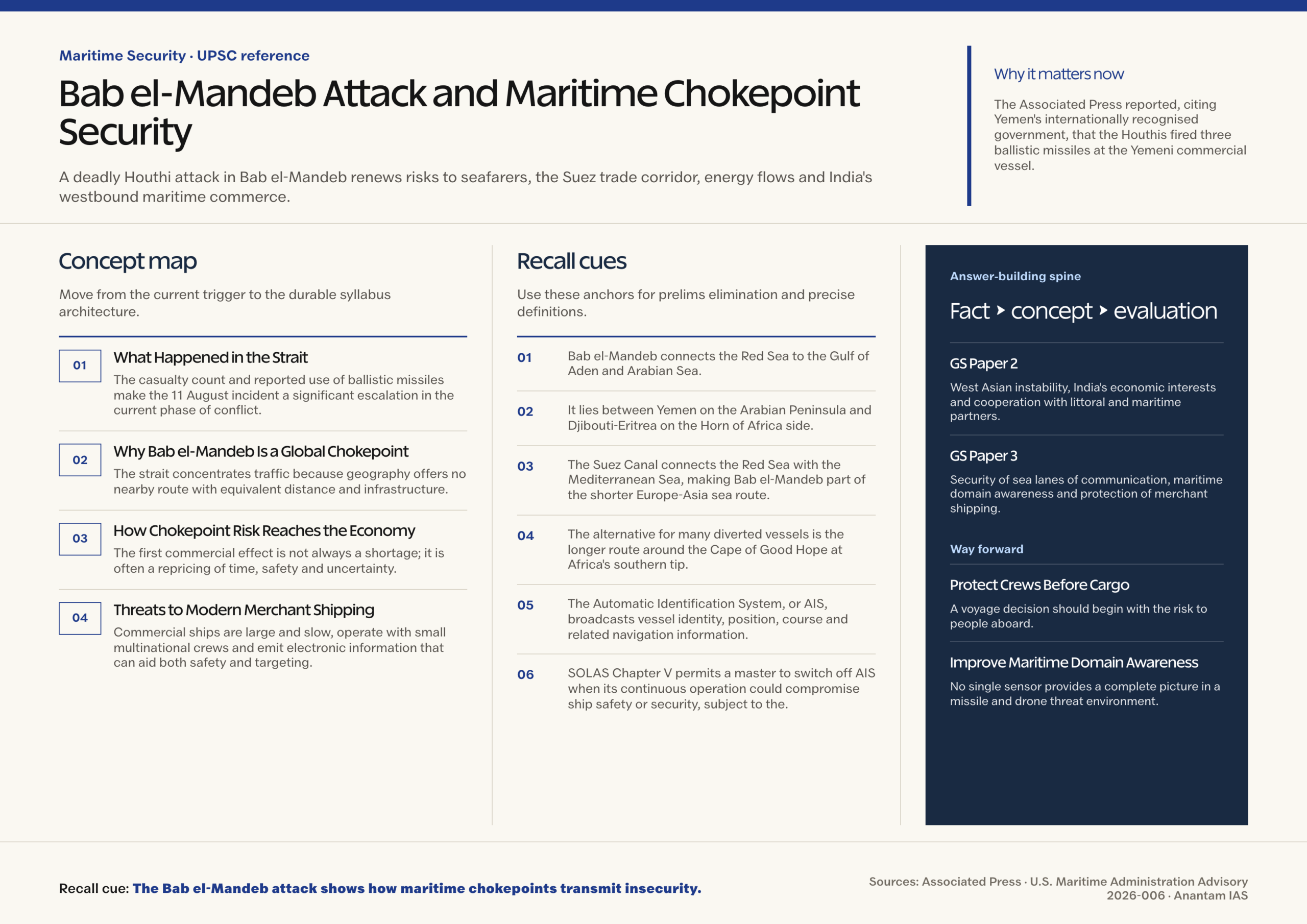
The casualty count and reported use of ballistic missiles make the 11 August incident a significant escalation in the current phase of conflict.
- According to the Associated Press, Yemen’s Transportation Ministry said Houthi forces fired three ballistic missiles at a Yemeni commercial vessel in Bab el-Mandeb.
- Yemen’s coast guard reported six deaths: four crew members and two personnel of the government-allied National Resistance Forces. Later reporting identified three Pakistani and one Indonesian crew member among those killed.
- The incident was described as the first known fatal attack on shipping off Yemen in the latest bout of fighting. This description is limited to the current phase, not the entire Red Sea campaign since 2023.
- The Houthis are an armed movement controlling much of north-western Yemen, including the capital Sana’a. They have used maritime attacks to pressure regional and external adversaries during interconnected conflicts.
Why Bab el-Mandeb Is a Global Chokepoint
The strait concentrates traffic because geography offers no nearby route with equivalent distance and infrastructure.
- Bab el-Mandeb sits between Yemen and the Horn of Africa, linking the Red Sea to the Gulf of Aden and the wider Arabian Sea.
- Northbound ships can continue through the Red Sea and Suez Canal into the Mediterranean. Southbound ships enter the Gulf of Aden before connecting with Indian Ocean routes.
- The U.S. Energy Information Administration estimated that about 4.2 million barrels per day of crude oil and petroleum products transited Bab el-Mandeb in the first half of 2025, roughly half the 2023 flow.
- A ship avoiding the Red Sea usually sails around the Cape of Good Hope. The EIA has estimated that an Arabian Sea-Europe journey by this route can take about 15 days longer than the Bab el-Mandeb-Suez.
How Chokepoint Risk Reaches the Economy
The first commercial effect is not always a shortage; it is often a repricing of time, safety and uncertainty.
- Insurers may raise war-risk premiums, impose tighter conditions or limit cover. Shipowners then decide whether the risk-adjusted cost of transit is lower than the cost of a longer voyage.
- Cape diversion increases distance, fuel consumption, charter time and pressure on available vessel capacity. The same fleet carries fewer annual voyages when each voyage takes longer.
- Longer lead times encourage firms to hold more inventory and working capital. Time-sensitive or low-margin cargo can face disproportionate disruption even when aggregate trade continues.
- Energy effects depend on which cargoes are rerouted, available pipelines and spare shipping capacity. A chokepoint incident can raise price volatility without physically stopping all oil flows.
Threats to Modern Merchant Shipping
Commercial ships are large and slow, operate with small multinational crews and emit electronic information that can aid both safety and targeting.
- MARAD Advisory 2026-006 lists ballistic and cruise missiles, one-way UAVs, uncrewed surface and underwater vehicles, small-arms fire, explosive boats, illegal boarding, detention and seizure among credible threats.
- AIS improves collision avoidance and maritime awareness by broadcasting vessel data. The same signal can reveal a target’s identity, position, course and speed to a hostile actor.
- SOLAS allows the master to turn AIS off when continued operation could compromise safety or security. This is a risk decision, not a general licence for invisible navigation; the master remains responsible for safe operation and.
- MARAD notes that hostile actors may also use small boats, UAVs and commercial electronic data to locate ships. Security requires control of unnecessary emissions, varied voyage planning, vigilant lookout and coordination with maritime information centres.
Way Forward
Protect Crews Before Cargo
- Require route-specific threat assessment, rehearsed citadel and fire response, medical preparation, redundant communication and clear authority for the master to delay or divert.
- Share verified warnings rapidly with multilingual crews and avoid commercial pressure that forces a transit beyond an accepted risk threshold.
- Fuse coastal radar, satellite data, naval reporting, vessel reports and validated open-source information through centres such as UKMTO and the Joint Maritime Information Center.
- Give masters current guidance on AIS, electronic emissions, route variation, speed, lookout and incident reporting without compromising collision safety.
Conclusion
- The Bab el-Mandeb attack shows how maritime chokepoints transmit insecurity .
- India’s best response combines crew-first risk management, maritime domain awareness, resilient trade planning and regional diplomacy.
UPSC Practice Questions
Prelims MCQ 1
With reference to the Bab el-Mandeb Strait, consider the following statements:
- It connects the Red Sea with the Gulf of Aden.
- It lies between Yemen and the Horn of Africa.
- Ships diverted from it can use the Cape of Good Hope route to travel between the Indian Ocean and Europe.
How many of the above statements are correct?
(a) Only one (b) Only two (c) All three (d) None
Answer: (c) All three
Explanation:
Bab el-Mandeb is the southern entrance to the Red Sea between Yemen and the Djibouti-Eritrea side of the Horn of Africa. Cape of Good Hope diversion avoids both Bab el-Mandeb and the Suez Canal.
Prelims MCQ 2
Under SOLAS guidance, when may a ship’s master switch off the Automatic Identification System?
(a) Whenever a ship enters any territorial sea (b) When continuous AIS operation could compromise the ship’s safety or security (c) Only after receiving permission from a coastal navy (d) Only when the vessel is carrying military cargo
Answer: (b) When continuous AIS operation could compromise the ship's safety or security
Explanation:
SOLAS Chapter V permits the master to switch AIS off when its continuous operation could compromise safety or security or when security incidents are imminent. The master remains responsible for safe navigation and applicable reporting requirements.
UPSC Mains Questions
- How does insecurity at Bab el-Mandeb convert a regional conflict into a global trade and energy-security challenge? Explain the transmission channels.
- Examine the role and limits of maritime domain awareness in protecting commercial shipping from missiles, drones and illegal boarding in the Red Sea-Gulf of Aden region.
Sources: Associated Press and U.S. Maritime Administration Advisory 2026-006.
Frequently Asked Questions
What happened in Bab el-Mandeb on 11 August 2026?
Yemeni authorities said Houthi forces fired three ballistic missiles at a Yemeni commercial vessel. Six people were reported killed: four crew members and two members of government-allied forces. The incident produced the first known shipping deaths off Yemen in the.
Why is Bab el-Mandeb strategically important?
The strait connects the Red Sea with the Gulf of Aden and Arabian Sea. Ships using the Suez route between Asia and Europe normally pass through it. Disruption can force longer Cape of Good Hope voyages, raising fuel use, shipping.
Where is Bab el-Mandeb located?
Bab el-Mandeb lies between Yemen on the Arabian Peninsula and Djibouti-Eritrea on the Horn of Africa side. It forms the southern gateway of the Red Sea. Northbound traffic can continue toward the Suez Canal, while southbound traffic enters the Gulf.
Why can AIS create both safety and security benefits?
AIS improves vessel identification, collision avoidance and maritime awareness by broadcasting position and movement data. In a hostile area, the same signal may help an attacker track a ship. SOLAS permits the master to switch it off when continuous operation.
Are Houthi attacks on ships automatically piracy?
No. Piracy has specific legal elements under UNCLOS, including location and private ends. An attack connected with an armed conflict or conducted by an organised armed group may fall under other international and domestic legal frameworks. The classification depends on.
Tell Google you want more of this.
Add Anantam IAS as a preferred sourceOne tap, and this site shows up more often in your own Top Stories, AI Overviews and AI Mode. Remove it any time.