Why in News?
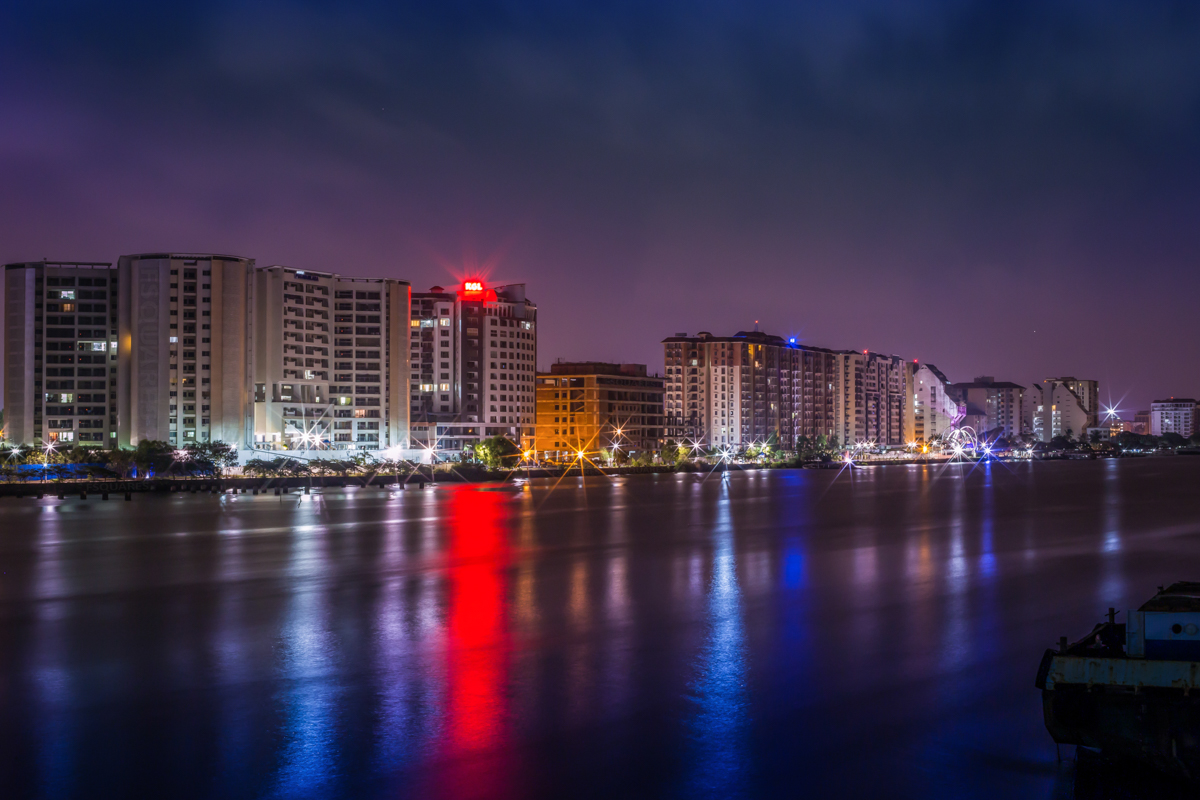
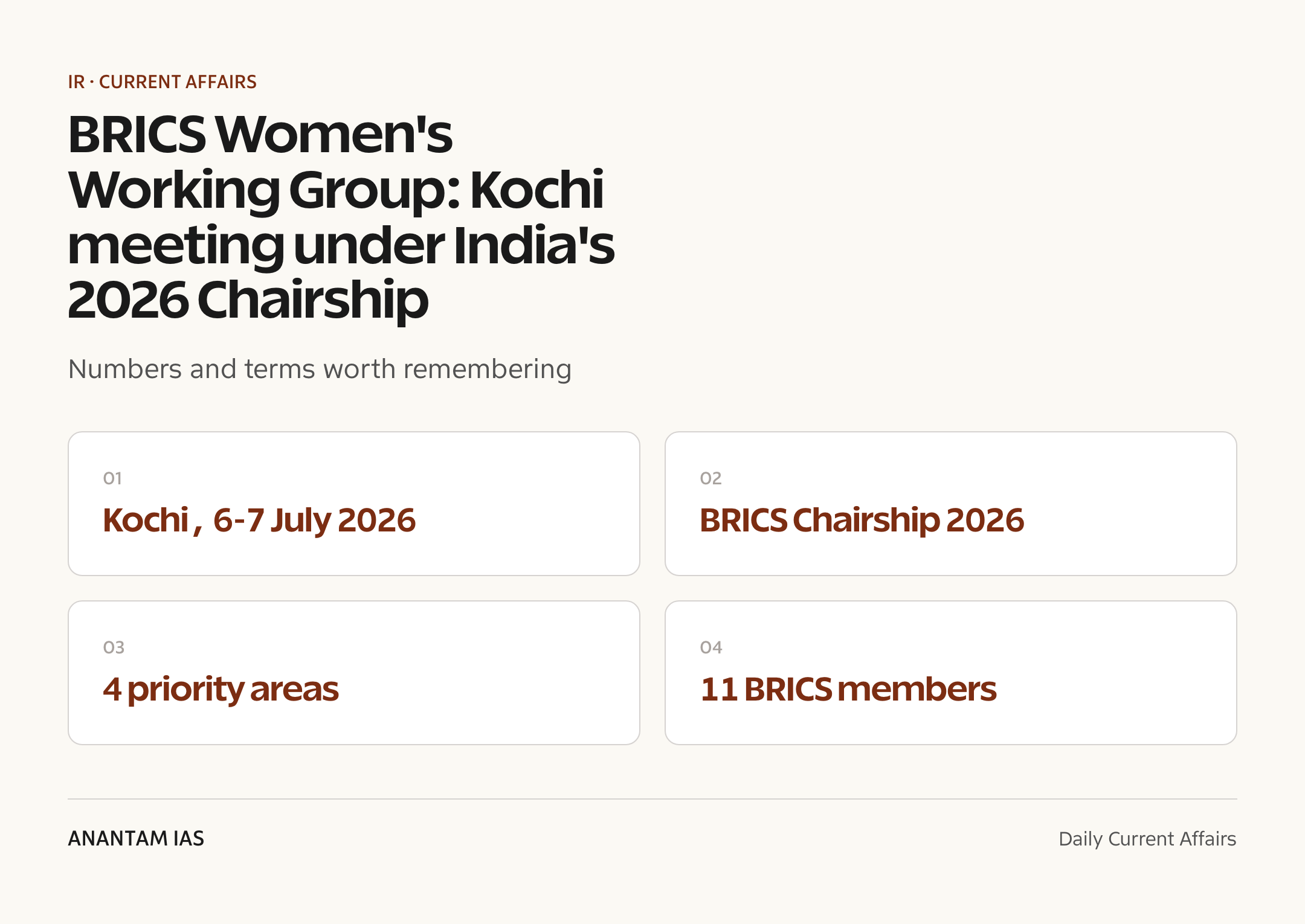
India commenced the BRICS Women’s Working Group (WWG) meeting in Kochi, Kerala on 6 July 2026, under its BRICS Chairship 2026. PIB confirmed that senior officials from all BRICS member countries are attending the two-day meeting to deliberate on women’s empowerment and women-led development.
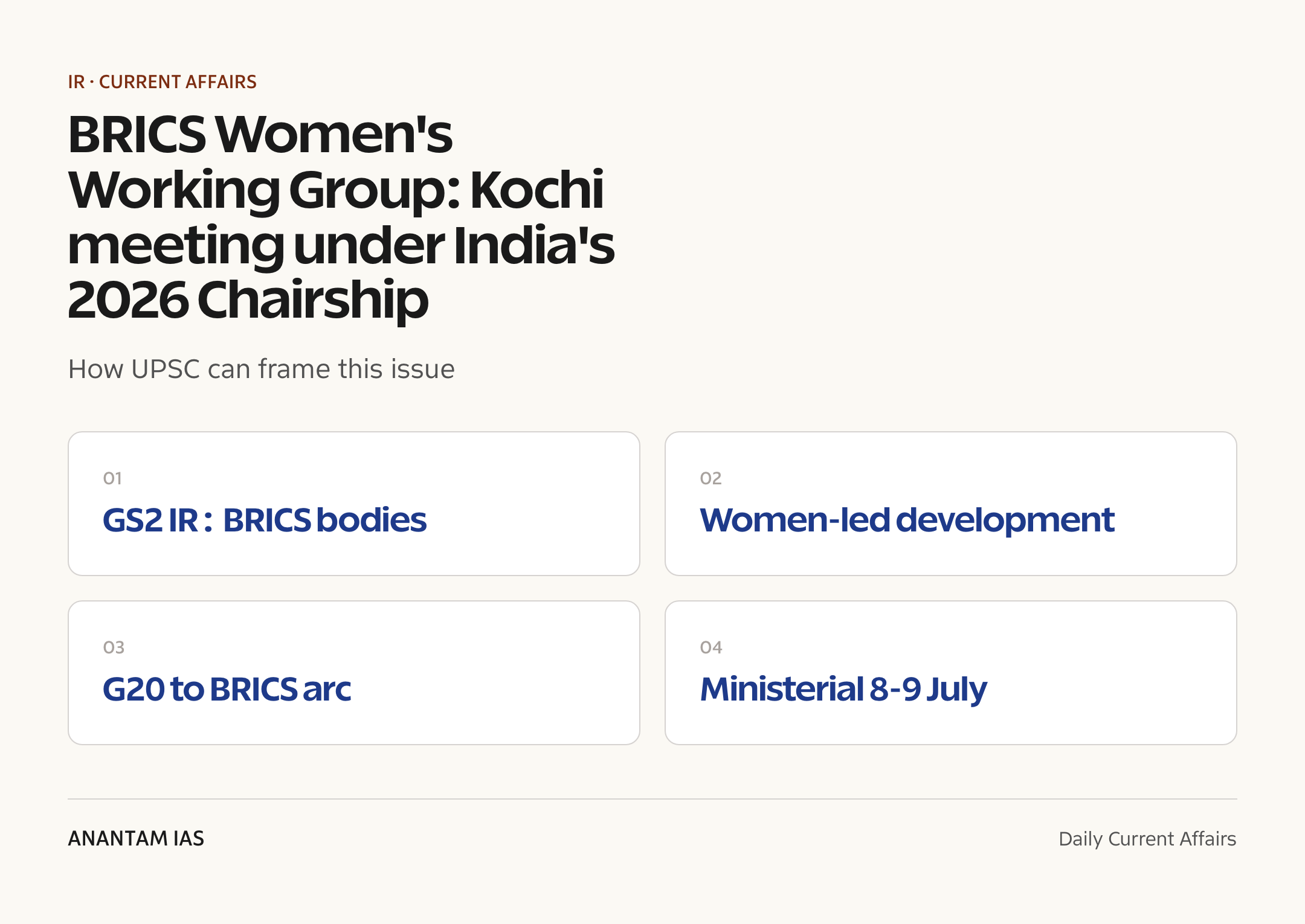
The Women Track under India’s Chairship is organised around four priority areas — governance and leadership, financial and digital inclusion, entrepreneurship and skill development, and women’s role in climate action, food security and nutrition. The Working Group meeting feeds directly into the BRICS Women’s Ministerial Meeting, also in Kochi, on 8–9 July 2026.
- Two-day Working Group meeting in Kochi on 6–7 July 2026; senior government officials from all BRICS members participating.
- Shri Anil Malik, Secretary, Ministry of Women and Child Development, opened the meeting, noting that the four priorities have guided the Women Track for several months of preparatory consultations.
- Held under India’s Chairship theme — “Building for Resilience, Innovation, Cooperation and Sustainability” — whose initials deliberately spell BRICS.
- The WWG prepares consensus outcomes for the Ministerial Meeting on 8–9 July; news agency IANS reported that a Digital Repository of Best Practices and BRICS Women’s Capacity Building Guidelines are among the outcome documents under discussion.
- India convened a third preparatory (virtual) meeting of the Women Track on 30 June 2026 before the in-person Kochi round.
The development matters in the context of:
- This is India’s first full run of the BRICS Women Track as Chair since the grouping expanded to eleven members — a test of whether India can convert its G20 women-led development template into a BRICS-wide agenda.
- Gender tracks are how plurilateral groupings institutionalise soft-policy cooperation: they produce repositories, guidelines and ministerial declarations rather than treaties, but they set normative benchmarks members cite domestically.
- For GS2, the meeting connects two syllabus threads at once — groupings and agreements involving India (IR) and mechanisms for the vulnerable sections (Social Justice).
UPSC Relevance
Prelims Relevance
- BRICS Women’s Working Group (WWG) — official-level body of the BRICS Women Track; 2026 meeting in Kochi, Kerala, 6–7 July, followed by the Ministerial on 8–9 July.
- India’s BRICS Chairship 2026 — assumed on 1 January 2026; theme: “Building for Resilience, Innovation, Cooperation and Sustainability”; the 18th BRICS Summit is to be hosted in New Delhi.
- Four Women Track priorities — (1) women’s governance and leadership; (2) financial and digital inclusion; (3) entrepreneurship and skill development; (4) climate action, food security and nutrition.
- BRICS membership (2026) — eleven: Brazil, Russia, India, China, South Africa, Egypt, Ethiopia, Iran, UAE, Saudi Arabia, Indonesia — roughly 49.5% of world population and about 40% of global GDP (PPP).
- Expansion timeline — BRIC founded 2006 (first summit Yekaterinburg, 2009); South Africa joined 2010; Egypt, Ethiopia, Iran and UAE from 1 January 2024; Indonesia became a full member in 2025.
- New Development Bank (NDB) — set up by the 2014 Fortaleza Summit, headquartered in Shanghai; the Contingent Reserve Arrangement (CRA) is the grouping’s USD 100 billion liquidity backstop.
- Women-led development — paradigm mainstreamed by India’s G20 Presidency 2023 (New Delhi Leaders’ Declaration), which also created a dedicated G20 Working Group on the Empowerment of Women.
- Nodal ministry — the Women Track under India’s Chairship is steered by the Ministry of Women and Child Development.
Mains Relevance
GS Paper 2
- IR: BRICS as an instrument of India’s multi-alignment — how a Chairship lets India set agendas (Women Track priorities, summit theme) in a grouping it neither dominates nor wants dominated by China.
- Social Justice: plurilateral gender mechanisms (G20 EmPower, BRICS Women Track, W20) as external accountability devices that reinforce domestic commitments on women’s empowerment.
- Governance: the shift from welfare (‘development of women’) to agency (‘women-led development’) as a design principle for schemes — from beneficiaries to entrepreneurs, lenders and leaders.
GS Paper 1
- Indian society: women’s organisations, low female labour-force participation and the care burden as the structural constraints any ‘women-led development’ agenda must answer.
- Use Kochi 2026 as a current example when discussing empowerment vs representation debates in society questions.
Essay
- “When women lead, development follows” — women-led development as India’s normative export from G20 to BRICS.
- Multipolarity with a human face: can plurilateral groupings deliver social outcomes, not just geopolitics?
Background and Context
BRICS: from four-letter acronym to eleven-member grouping
The grouping India chairs in 2026 is much larger — and harder to steer — than the one it co-founded.
- BRIC began as a foreign-ministers’ dialogue in 2006; the first summit was held at Yekaterinburg in 2009, and South Africa’s entry in 2010 completed the original BRICS.
- From 1 January 2024 the grouping admitted Egypt, Ethiopia, Iran and the UAE; Indonesia joined as a full member in 2025, taking membership to eleven (with Saudi Arabia also counted among members on the official BRICS India 2026 portal).
- The expanded BRICS accounts for roughly 49.5% of the world’s population and about 40% of global GDP — heft that makes even its soft-policy tracks, like the Women Track, globally consequential.
- Institutionally, BRICS runs on consensus, a rotating chair, and delivery arms such as the New Development Bank (Fortaleza, 2014; HQ Shanghai) and the Contingent Reserve Arrangement. Our notes on the BRICS Kazan Summit 2024 cover the expansion mechanics in detail.
- Sectoral ‘tracks’ — energy, health, science, women — are where BRICS does continuous work between summits, through working groups of officials that prepare ministerial meetings.
India's BRICS Chairship 2026
India took over the rotating chair on 1 January 2026 with a theme engineered to spell the grouping’s own name.
- Theme: “Building for Resilience, Innovation, Cooperation and Sustainability” — a backronym of BRICS, reflecting what PIB calls a people-centric, humanity-first approach first articulated by the Prime Minister at the 2025 Rio de Janeiro Summit.
- The Chairship year runs through dozens of working-group and ministerial meetings across Indian cities and culminates in the 18th BRICS Summit in New Delhi later in 2026.
- A Chairship is agenda-setting power: the chair decides which tracks get priority, drafts outcome documents, and frames the summit declaration — the same lever India used during its G20 Presidency 2023.
- For India, the Women Track is a deliberate showcase: it projects Global South leadership on a theme where India claims recent domestic credentials — from the Nari Shakti Vandan Adhiniyam to women-centred DBT and SHG architecture.
- Kochi’s selection also continues India’s G20-era practice of taking multilateral meetings beyond Delhi to showcase states — here, Kerala’s social-development record.
The Women Track: four priority areas
PIB confirmed that four priorities have guided the Women Track through months of preparatory consultations.
- 1. Governance and leadership: building a more resilient BRICS through women’s participation in public decision-making — legislatures, local government, public administration and corporate boards.
- 2. Financial and digital inclusion: treating bank access, credit and digital public infrastructure as catalysts — the JAM-trinity logic (Jan Dhan, Aadhaar, mobile) India routinely presents as a replicable model.
- 3. Entrepreneurship and skill development: moving women from wage-taking to enterprise ownership, through credit guarantees, market linkages and skilling.
- 4. Climate action, food security and nutrition: recognising women as first responders to climate stress and the pivotal actors in household nutrition and smallholder farming.
- The Working Group is negotiating outcome documents — IANS reported a Digital Repository of Best Practices and BRICS Women’s Capacity Building Guidelines — for adoption at the Ministerial Meeting on 8–9 July.
- Secretary Anil Malik framed the spirit of the meeting in one line: “While geography kept us physically apart, our shared commitment to advancing women’s empowerment has kept us closely connected.”
From G20 to BRICS: the women-led development continuity
Kochi 2026 is best read as the second act of a normative project India began at the G20.
- India’s G20 Presidency 2023 shifted the vocabulary from ‘development of women’ to ‘women-led development’ — women as drivers, not beneficiaries — and wrote it into the New Delhi Leaders’ Declaration.
- That presidency also created a new G20 Working Group on the Empowerment of Women, institutionalising the gender agenda beyond a single host year; our G20 explainer tracks this arc.
- Carrying the same framework into BRICS gives India cross-forum consistency: the identical four-pillar logic (leadership, inclusion, enterprise, climate-nutrition) now runs through both groupings it recently chaired.
- It also serves a strategic purpose — women-led development is a non-contentious, unifying agenda in a BRICS whose members disagree on much else, letting the chair bank early consensus before harder files (payments, expansion, West Asia).
- For the exam, this continuity is the analytical core: norm entrepreneurship — India exporting a domestically-branded development paradigm through successive chairships.
Where India stands: the gender scoreboard
India’s credibility as convenor rests on a domestic record that is improving but uneven.
- Female labour-force participation (usual status, 15+) rose to about 41.7% in PLFS 2023–24, up sharply from 23.3% in 2017–18 — though much of the rise is rural and self-employment-led.
- The WEF Global Gender Gap Report 2025 ranked India 131st of 148 countries — strong on political-empowerment history, weak on economic participation and health.
- Financial inclusion is the strongest suit: Jan Dhan accounts are majority women-held, and DAY-NRLM‘s self-help-group network (with the Lakhpati Didi push) is the world’s largest women’s collective platform.
- The 106th Constitutional Amendment (2023) reserves one-third of seats in the Lok Sabha and state assemblies for women, though its operation awaits the delimitation exercise.
- Instruments like gender budgeting, Beti Bachao Beti Padhao, and the NITI Aayog Women Entrepreneurship Platform supply the ‘best practices’ India will place in the proposed BRICS repository.
Significance and the gaps
A working-group meeting will not transform gender outcomes by itself — its value and limits both need stating.
- Significance: BRICS-wide guidelines and a best-practices repository create peer-learning channels among countries that together hold nearly half of the world’s women.
- Significance: hosting the track lets India shape definitions — whose ‘best practice’ counts — and quietly benchmarks members against SDG 5 (gender equality).
- Gap: BRICS outcomes are non-binding; without financing lines (an NDB gender window, for instance) the track risks producing documents, not outcomes.
- Gap: member diversity cuts both ways — legal regimes on women’s rights vary drastically across the eleven members, capping how specific any consensus text can be.
- Gap: India’s own unfinished business — low urban FLFPR, unpaid care burden, under-representation in legislatures pending delimitation — will be cited back at it; a chair is judged by its home record.
Way Forward
Institutionalise the track
- Anchor the Women Track in a standing BRICS mechanism with an annual reporting cycle, so the Kochi outcomes survive rotation of the chair.
- Link the proposed repository and capacity-building guidelines to measurable indicators (FLFPR, account ownership, women-led MSME credit) rather than narrative reporting.
- Explore a New Development Bank gender-lending window so the track acquires a financing arm, mirroring how G20 commitments ride on multilateral banks.
Convert consensus into domestic delivery
- Use BRICS peer exchange to fix India’s weakest indicator — urban female workforce participation — through care-infrastructure investment (creches, elder care) and safe mobility.
- Fast-track operational steps for the 106th Amendment so India’s leadership pillar rests on realised, not promised, representation.
- Scale digital-inclusion exports responsibly: pair DPI evangelism with data-protection and digital-literacy safeguards for first-generation women users.
Conclusion
The Kochi meeting is a small event with a large frame around it. As BRICS Chair, India is testing whether the women-led development paradigm it branded at the G20 can travel into a bigger, more heterogeneous grouping — and whether soft-policy tracks can give an expanded BRICS a cooperative core its geopolitics often lacks.
For aspirants, the takeaways are concrete: the four priority areas, the Chairship theme, the Kochi dates, and the analytical thread from the New Delhi G20 Declaration to the BRICS Women Track. The 8–9 July Ministerial Meeting and its outcome documents are the follow-up to watch.
UPSC Practice Questions
Prelims MCQ 1
With reference to the BRICS Women’s Working Group meeting of July 2026, consider the following statements:
- The meeting was held in Kochi under India’s BRICS Chairship 2026.
- The theme of India’s BRICS Chairship is “Building for Resilience, Innovation, Cooperation and Sustainability”.
- BRICS currently comprises nine member countries.
How many of the above statements are correct?
(a) Only one (b) Only two (c) All three (d) None
Answer: (b) Only two
Explanation:
Statements 1 and 2 are correct: the Working Group met in Kochi on 6–7 July 2026 under India’s Chairship, whose theme is a backronym of BRICS. Statement 3 is wrong — after the 2024 expansion and Indonesia’s 2025 entry, BRICS has eleven members, not nine.
Prelims MCQ 2
Which of the following is NOT one of the four priority areas of the Women Track under India’s BRICS Chairship 2026?
(a) Women’s governance and leadership (b) Financial and digital inclusion (c) Women’s entrepreneurship and skill development (d) Women’s participation in UN peacekeeping operations
Answer: (d) Women's participation in UN peacekeeping operations
Explanation:
The four priorities are governance and leadership; financial and digital inclusion; entrepreneurship and skill development; and women’s role in climate action, food security and nutrition. Peacekeeping is not among them.
UPSC Mains Questions
- India has carried the ‘women-led development’ agenda from its G20 Presidency into its BRICS Chairship 2026. Examine how plurilateral groupings can advance gender-equality outcomes, and the limits of such non-binding mechanisms. (250 words)
- “A country’s credibility as a norm entrepreneur abroad depends on its delivery record at home.” Discuss with reference to India’s leadership of the BRICS Women Track and its domestic indicators on women’s economic participation. (250 words)
Sources: PIB, Ministry of Women and Child Development and BRICS India 2026 official portal.
Frequently Asked Questions
What is the BRICS Women’s Working Group?
It’s the official-level body of the BRICS Women Track, where senior officials from all member countries negotiate cooperation on women’s empowerment. Its July 2026 meeting in Kochi, under India’s Chairship, prepares consensus outcomes for the BRICS Women’s Ministerial Meeting held immediately after, on 8–9 July.
What are the four priority areas of India’s BRICS Women Track?
Women’s governance and leadership; financial and digital inclusion; women’s entrepreneurship and skill development; and women’s role in climate action, food security and nutrition. PIB confirmed these four have guided the track through preparatory consultations since India assumed the chair.
What is the theme of India’s BRICS Chairship 2026?
“Building for Resilience, Innovation, Cooperation and Sustainability” — its initials deliberately spell BRICS. India assumed the rotating chair on 1 January 2026 and will host the 18th BRICS Summit in New Delhi later in the year.
How many members does BRICS have now?
Eleven. The original five (Brazil, Russia, India, China, South Africa) were joined by Egypt, Ethiopia, Iran and the UAE from January 2024, Indonesia in 2025, with Saudi Arabia also listed among members — together nearly half the world’s population.
What is women-led development?
A paradigm that treats women as drivers of growth — entrepreneurs, leaders and decision-makers — rather than passive beneficiaries of welfare. India mainstreamed the phrase through its G20 Presidency 2023 and the New Delhi Leaders’ Declaration, and has now made it the spine of the BRICS Women Track.
Why is this topic important for UPSC?
It sits at the junction of GS2 International Relations (BRICS mechanisms, India’s chairship diplomacy) and GS2 Social Justice/GS1 Society (women’s empowerment). The four priority areas, Kochi dates, chairship theme and G20-to-BRICS continuity are all directly testable.
Tell Google you want more of this.
Add Anantam IAS as a preferred sourceOne tap, and this site shows up more often in your own Top Stories, AI Overviews and AI Mode. Remove it any time.