Budget Session 2026 opened with the President’s Address to both Houses of Parliament on 28 January. The address is constitutionally significant because it frames the government’s policy agenda at the start of the first session of the year.
For UPSC, this is a classic polity topic with a current hook. Students should connect the event with Article 87, parliamentary procedure, Motion of Thanks, Budget process and executive accountability.
This article explains the constitutional and exam relevance of the President’s Address and Budget Session procedure.
Quick Facts
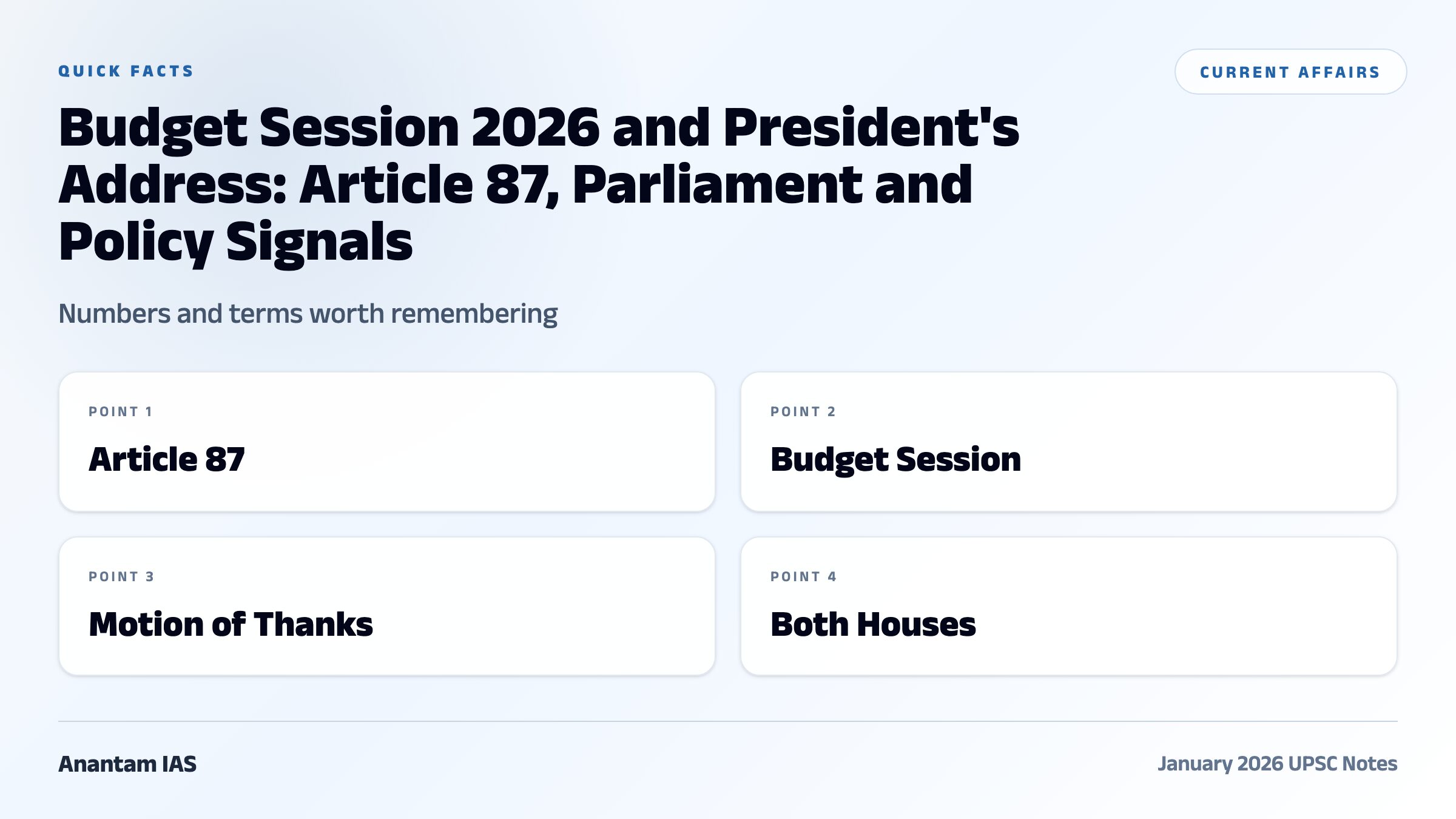
- The President addresses both Houses at the commencement of the first session each year.
- Article 87 of the Constitution provides for the special address.
- The address outlines the government’s policy agenda.
- Parliament discusses it through the Motion of Thanks.
- Budget Session also includes presentation and discussion of the Union Budget.
- Official source: President’s Address text dated 28 January 2026.
- Official source: President of India.
What Just Happened
The President addressed both Houses of Parliament at the opening of Budget Session 2026.
The address set out the government’s policy claims and priorities before the Budget and parliamentary debate.
For aspirants, the news should trigger revision of the President’s constitutional role in a parliamentary system.
Background and Historical Context
India’s President is the constitutional head of the Union, while real executive power is exercised by the Council of Ministers headed by the Prime Minister.
The President’s Address is prepared by the government and read by the President. It is therefore an executive policy statement delivered through a constitutional office.
The Motion of Thanks allows Parliament to debate the address. Amendments can become politically significant because they test the government’s majority and accountability.
Key Features of Parliament
The core policy architecture can be read through these features.
- Article 87: provides for the special address to both Houses.
- Policy statement: the address reflects the government’s agenda.
- Motion of Thanks: Parliament debates and votes on the address.
- Budget link: the session also handles financial business.
- Accountability: opposition uses the debate to scrutinise government claims.
- Constitutional symbolism: the President represents the Union while acting on ministerial advice.
Why It Matters
This is a high-yield UPSC topic because it joins current news with durable syllabus themes.
- It connects a January 2026 event with durable UPSC syllabus themes.
- It gives usable facts for Prelims and analytical hooks for Mains.
- It helps students move from news recall to policy reasoning.
- It can be linked with static concepts in polity, economy, governance, science, environment or society.
Detailed Analysis: Parliament Lens
The President’s Address is ceremonial but not empty. Its text becomes the government’s official policy narrative for parliamentary debate.
The Motion of Thanks is a control mechanism. It gives MPs a structured opportunity to challenge policy claims across sectors.
Budget Session tests parliamentary time management. Financial scrutiny often suffers when disruptions reduce debate on demands for grants.
Comparative Perspective
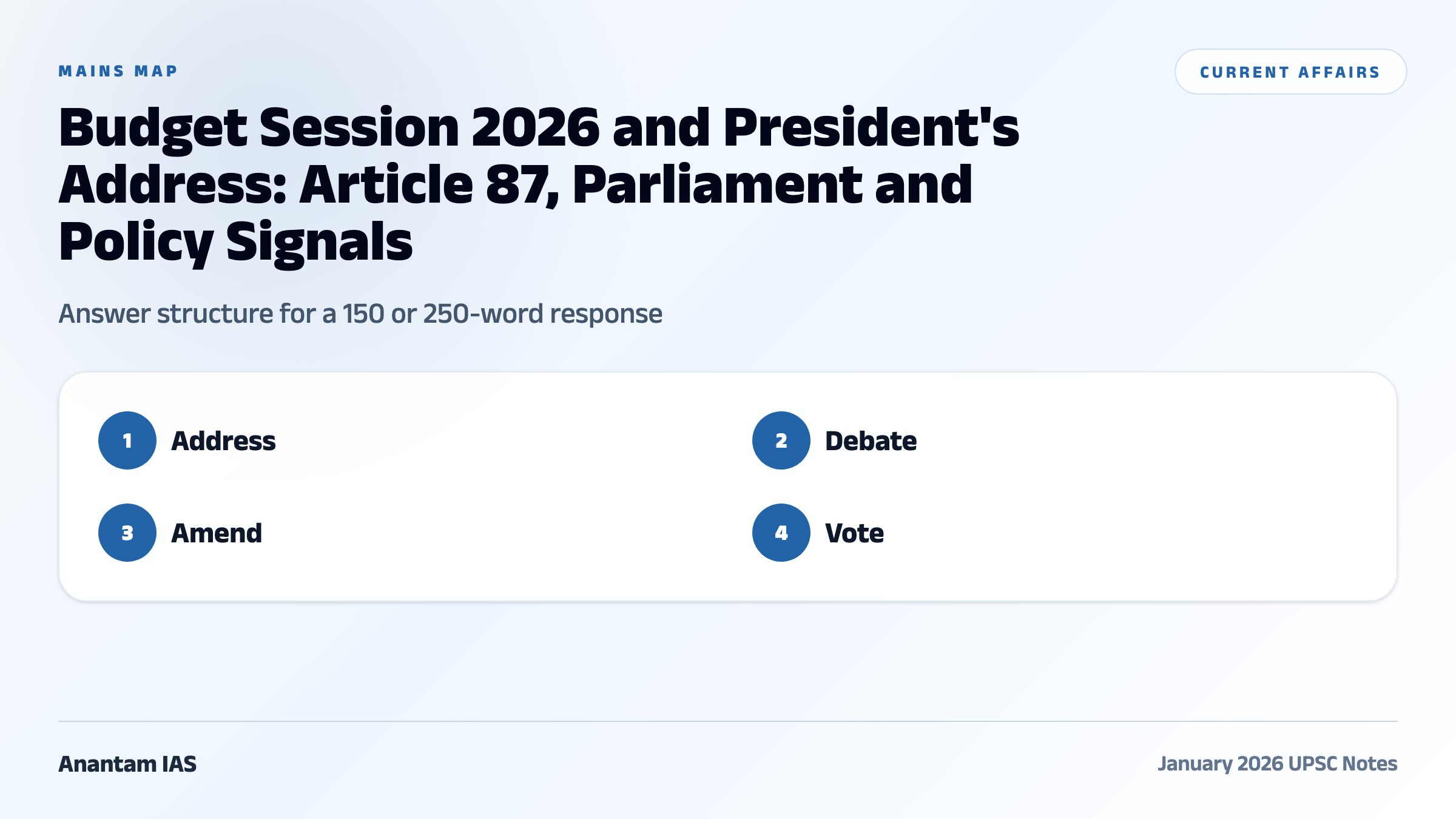
A comparison helps prevent the answer from becoming a one-dimensional news summary.
- Article 87 Address: policy statement at the first session of the year and after general elections.
- Budget Speech: Finance Minister’s fiscal and taxation statement.
- Economic Survey: Ministry of Finance’s analytical review of the economy.
- Motion of Thanks: parliamentary debate on the President’s Address.
Challenges
The policy or institutional promise runs into recurring constraints.
- Frequent disruptions can reduce scrutiny.
- Guillotine of demands for grants can limit detailed financial debate.
- The address may become politically celebratory rather than analytically accountable.
- Parliamentary committees need stronger follow-up on policy promises.
- Citizens often confuse the President’s personal views with the government’s policy text.
Prelims Pointers
- Article 87 deals with the President’s special address.
- The President addresses both Houses at the start of the first session each year.
- The Motion of Thanks is moved after the address.
- The Annual Financial Statement is under Article 112.
- Demands for grants are voted by the Lok Sabha.
- Rajya Sabha can discuss but not vote on demands for grants.
Mains Questions
- The President’s Address is a constitutional form through which executive policy enters parliamentary scrutiny. Discuss. (GS Paper II, 250 words)
- Explain the significance of the Motion of Thanks in parliamentary accountability. (GS Paper II, 150 words)
- Budget Session is central to legislative control over public finance. Analyse the challenges in India. (GS Paper II, 250 words)
- Distinguish between the Economic Survey, Budget Speech and President’s Address. (GS Paper II/III, 150 words)
Way Forward
Parliament should protect time for debate on the President’s Address, Budget and demands for grants.
Committee scrutiny and public dashboards can help track whether policy claims made in the address are implemented.
For Prelims, remember the Article numbers. For Mains, explain the accountability logic.
The examiner is unlikely to reward a bare fact dump here. The better answer connects the January 2026 event to institutional design, implementation capacity and India’s long-term development priorities.
Frequently Asked Questions
Which Article deals with the President’s Address?
Article 87 of the Constitution.
Who writes the President’s Address?
It is prepared by the government and delivered by the President.
What is the Motion of Thanks?
It is the parliamentary motion through which both Houses discuss the President’s Address.
How is it different from the Budget?
The address is a policy statement, while the Budget sets financial proposals.
Which Article covers the Annual Financial Statement?
Article 112.
Why is this important for UPSC?
It connects constitutional procedure with parliamentary accountability.
Tell Google you want more of this.
Add Anantam IAS as a preferred sourceOne tap, and this site shows up more often in your own Top Stories, AI Overviews and AI Mode. Remove it any time.