Why in News?
The Ministry of Petroleum and Natural Gas launched the integrated GOBARdhan Central Sector Scheme for compressed biogas on 1 October 2026, according to PIB.
- The framework combines offtake assurance, pricing, capital assistance, pipelines, credit guarantees and ecosystem support.
- The CBG procurement obligation for CGD entities is 3% in FY 2026–27, 4% in FY 2027–28 and 5% thereafter for CNG transport and domestic PNG.
- An administered price of ₹2,110 per MMBtu seeks to improve revenue visibility for producers.
- A plant needs both reliable feedstock and paying customers; machinery subsidies alone cannot establish a functioning waste-to-energy business.
- The policy connects rural waste management with domestic energy production, while leaving important operational and environmental risks to be managed.
UPSC Relevance
Prelims Relevance
- Compressed biogas (CBG)
- City Gas Distribution (CGD)
- CBG Obligation: procurement responsibility rests with CGD entities
- Central Sector Scheme; Ministry of Petroleum and Natural Gas
- Offtake assurance versus credit guarantee
Mains Relevance
GS Paper 3
- Market design for renewable gas and circular agriculture
- Infrastructure and finance constraints in waste-to-energy projects
GS Paper 2
- Coordination between a central scheme and state-level implementation
Essay
- Turning waste into a resource requires functioning institutions and markets.
Background and Context
The material and value chain
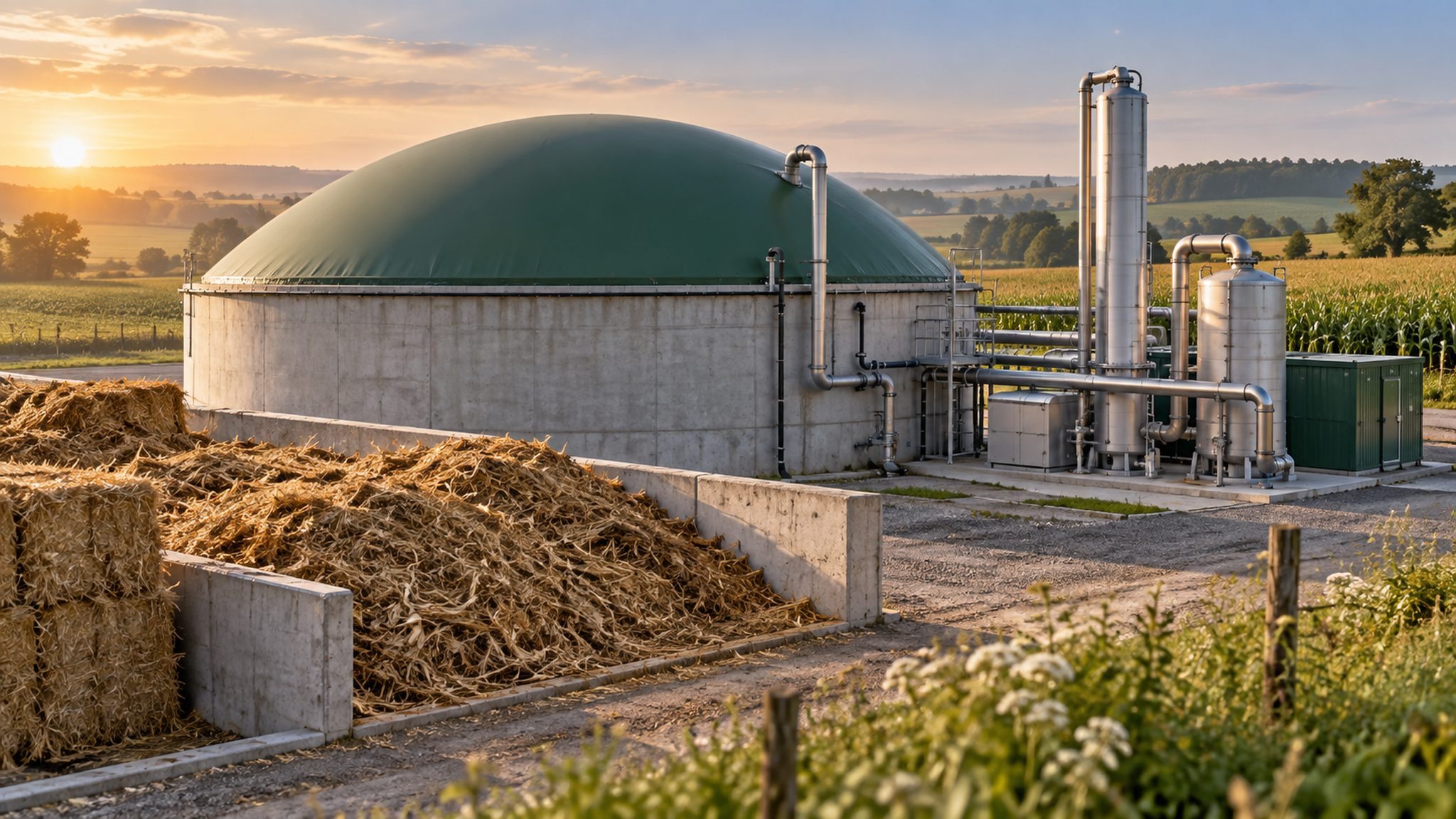
Compressed biogas connects organic resources to an energy market, but the useful product must reach a buyer.
- Crop residue, cattle dung and other organic resources are inputs identified in the release. Their economic value depends on collection and transport arrangements, rather than merely their presence in a district.
- Farmers, cooperatives, gaushalas and local enterprises can participate in aggregation, transportation and processing. These are potential business opportunities; the launch announcement does not establish that participants already receive additional income.
- Organic manure is another output identified alongside domestic gas. Its processing and sale matter because a plant needs a workable destination for this output as well as a gas customer.
- Feedstock assurance connects the agricultural and energy sides of the project. A proposed plant must assess accessible supplies, competing uses and collection costs before treating locally available waste as a dependable input.
How procurement and pricing reduce market uncertainty
The framework addresses two separate commercial questions: who buys the gas, and how predictable is the selling price?
- Offtake means purchase of a producer’s output. Mapping plants to identified CGD geographical areas or CBG clusters is intended to give production a dependable route into the gas market.
- The procurement obligation rests with CGD entities. It applies to the specified transport CNG and domestic PNG segments; it should not be described as a universal obligation covering every natural-gas use.
- Administered pricing improves revenue visibility by specifying the selling-price framework. It does not determine a plant’s profit, which also depends on operating costs, output, transport arrangements and timely payment.
- Demand assurance and physical connectivity solve different problems. Identifying a buyer cannot by itself move gas from a plant, while constructing a connection cannot by itself guarantee commercially viable production.
Why capital, pipelines and credit are separate interventions
The remaining support instruments address investment barriers that a procurement obligation alone cannot remove.
- Capital assistance for eligible greenfield projects covers plant machinery, feedstock aggregation and manure-processing or value-addition equipment. Eligibility matters: the announcement is not an unconditional subsidy promise to every existing or proposed operator.
- Pipeline infrastructure support distinguishes cluster connections to trunk networks from standalone plant connections to CGD networks. This recognises different gas-evacuation needs, rather than assuming every project can use an identical delivery arrangement.
- Credit guarantees cover eligible MSME-based projects, subject to limits. They share specified default exposure with lenders; they do not cancel the borrower’s repayment responsibility or make the underlying enterprise risk-free.
- The Ecosystem Challenge Fund supports technology, capacity building, feedstock assessment, aggregation and manure value addition. These supporting services can address constraints that remain even after equipment finance becomes available.
Implementation is the real test
The scheme announcement describes a policy framework; operating results must be assessed separately.
- State governments have roles in feedstock assessments, suitable land banks, approvals and infrastructure support. A single central nodal ministry still requires coordination with local institutions and project-level conditions.
- Projected jobs, emissions reductions and foreign-exchange savings are expected benefits in the release. They must not be reported as measured achievements resulting from the newly launched integrated scheme.
- Operating performance is a better implementation test than announcements alone. Track actual gas output and sales, reliable input supplies and manure offtake when assessing whether support translates into viable plants.
- Risk allocation remains central: producers need workable supply and delivery arrangements, buyers need reliable output, and lenders need credible cash flows. Public support reduces selected risks without eliminating all of them.
Way Forward
Test the complete project chain
- Require local feedstock and transport assessments before sizing projects; align plant capacity with supplies that can actually be collected.
- Coordinate buyer mapping and pipeline readiness with commissioning, so installed capacity has a practical route to market.
- Track gas sales and manure offtake alongside finance disbursed; distinguish operating outcomes from projected scheme benefits.
Conclusion
- GOBARdhan is a market-design intervention as well as an energy scheme: it connects procurement, pricing, infrastructure and finance around the same production chain.
- For a Mains answer, explain which bottleneck each instrument addresses, then assess the operational conditions required to turn policy assurance into sustained production.
UPSC Practice Questions
Prelims MCQ 1
With reference to the integrated GOBARdhan framework, consider the following statements:
- The CBG procurement obligation rests with City Gas Distribution entities.
- The prescribed obligation covers the CNG transport and domestic PNG segments.
- Credit guarantee support eliminates all commercial risks faced by a CBG producer.
How many of the above statements are correct?
(a) Only one (b) Only two (c) All three (d) None
Answer: (b) Only two
Explanation:
The first two statements describe the announced procurement framework. Credit guarantees cover specified eligible default exposure within limits; they do not eliminate operational or commercial risks.
Prelims MCQ 2
Which intervention most directly addresses the physical movement of gas from a CBG plant to a distribution network?
(a) Administered pricing (b) Credit guarantee support (c) Pipeline infrastructure development (d) Capacity-building assistance
Answer: (c) Pipeline infrastructure development
Explanation:
Pipeline support addresses gas evacuation and network connectivity. Pricing, guarantees and training address different commercial or institutional constraints.
UPSC Mains Questions
- Explain how combining procurement obligations, administered pricing and pipeline support can improve the viability of compressed biogas projects.
- Assess the role of feedstock assurance and organic-manure markets in translating waste-to-energy schemes into sustained rural economic benefits.
Source: PIB.
Frequently Asked Questions
What changed with the GOBARdhan launch?
The October launch brought offtake assurance, pricing, capital assistance, pipeline development, credit guarantees and ecosystem support into an integrated framework for the compressed biogas sector under the Ministry of Petroleum and Natural Gas.
Who must procure CBG under the obligation?
The procurement obligation rests with City Gas Distribution entities for the CNG transport and domestic PNG segments. It should not be interpreted as a purchase obligation applying to every category of natural-gas consumption.
Does an assured market make a biogas plant risk-free?
No. Offtake arrangements reduce market uncertainty, but feedstock availability, operating costs, reliable production, connectivity and payment performance still matter. Credit guarantees also operate within eligibility conditions and limits rather than eliminating all risk.
Why does manure matter in a gas scheme?
Organic manure is an associated output with its own processing and sales requirements. Developing its market strengthens the connection between agriculture and energy and helps address a constraint identified in the official release.
Are the announced economic benefits already achieved?
No. The release describes expected benefits and production ambitions. Evaluating the newly launched framework requires subsequent evidence of operating plants, actual gas sales and outcomes, rather than treating forecasts as completed achievements.
Tell Google you want more of this.
Add Anantam IAS as a preferred sourceOne tap, and this site shows up more often in your own Top Stories, AI Overviews and AI Mode. Remove it any time.