Why in News?
On 11 July 2026, Chief Justice of India Surya Kant drew a bright constitutional line on technology in justice delivery: Artificial Intelligence should be used only for procedural convenience, never for actual judging. Speaking at a summit organised by the Indian Institute of Arbitration and Mediation in New Delhi, he said the role of AI is that of an assistant, not a judge — The Hindu reported his remarks the same evening.
The CJI’s formulation was precise: AI may triage a dispute, organise evidence, or draft a first translation, but the moment it begins to weigh one party’s equities against another’s, “it has stopped assisting and started deciding” — and no algorithm has earned the authority to do that. The caution lands weeks after the Supreme Court found a tribunal had relied on AI-hallucinated precedents to decide a real case.
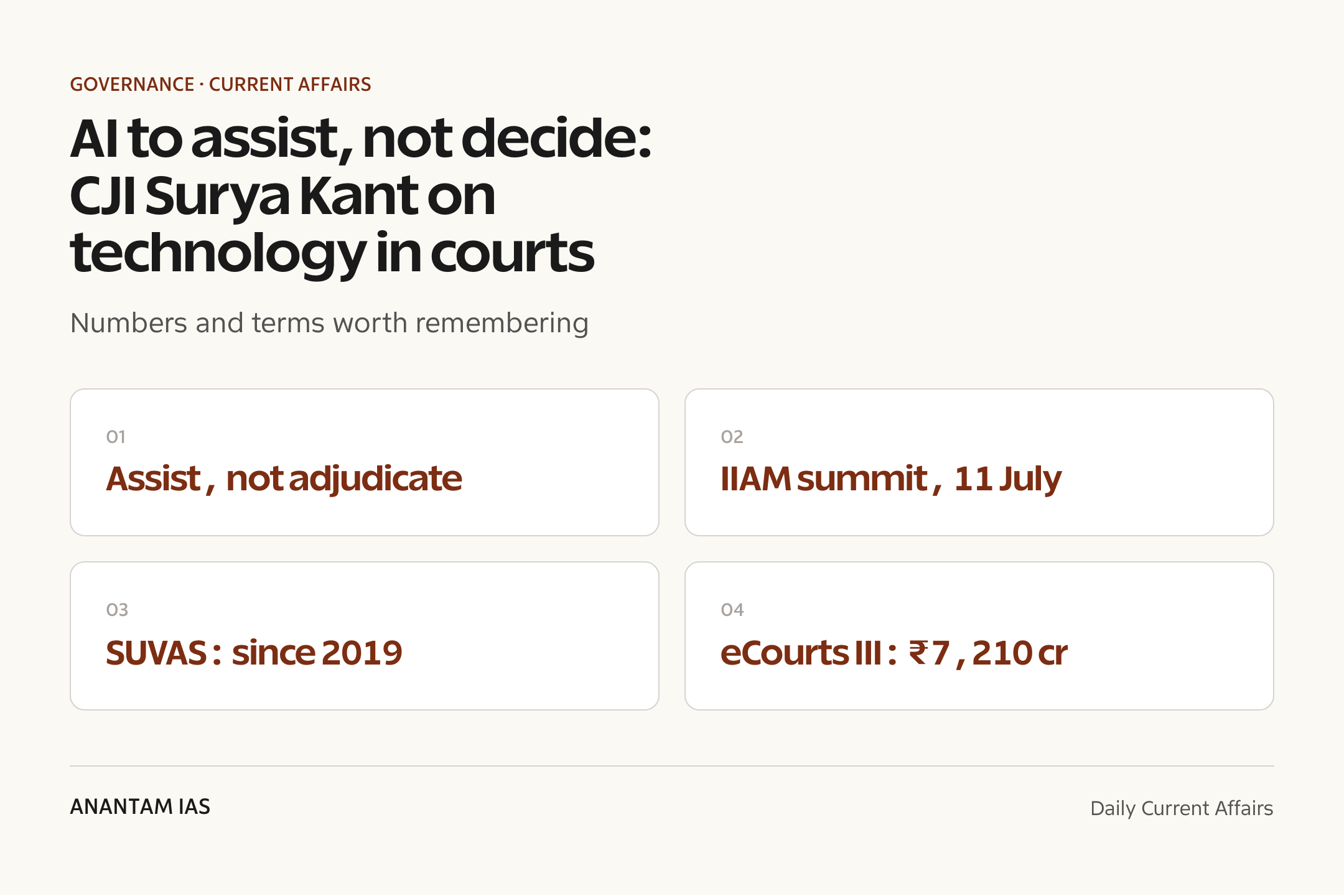
- The address was delivered on 11 July 2026 at a summit of the Indian Institute of Arbitration and Mediation (IIAM), with digital dispute resolution as the theme.
- The CJI said the real question isn’t whether India should embrace AI tools — that’s already under way — but whether we build legislative clarity and human oversight so these platforms widen access to justice rather than narrow it.
- He flagged the equity concern directly: safeguards must protect exactly the people least equipped to question an algorithm’s output.
- Earlier in July 2026, a Bench headed by Justice P.S. Narasimha set aside a tribunal ruling built on AI-hallucinated verdicts and declared zero tolerance for blind reliance on machine intelligence.
- Supreme Court judges including Justices B.V. Nagarathna and Dipankar Datta have reported encountering fabricated citations in petitions — including a fictitious case titled ‘Mercy versus Mankind’.
- Current Supreme Court AI deployments — legal research, case summarisation, translation of judgments into regional languages — remain “deliberately assistive rather than adjudicatory”, the CJI underscored.
The development matters in the context of:
- The speech supplies the judiciary’s own doctrinal answer to a question India’s AI governance debate keeps circling: which functions of the state can be delegated to algorithms, and which cannot.
- It converts scattered judicial anxiety about AI hallucinations into a positive design principle — assistive automation with a human adjudicator always in the loop.
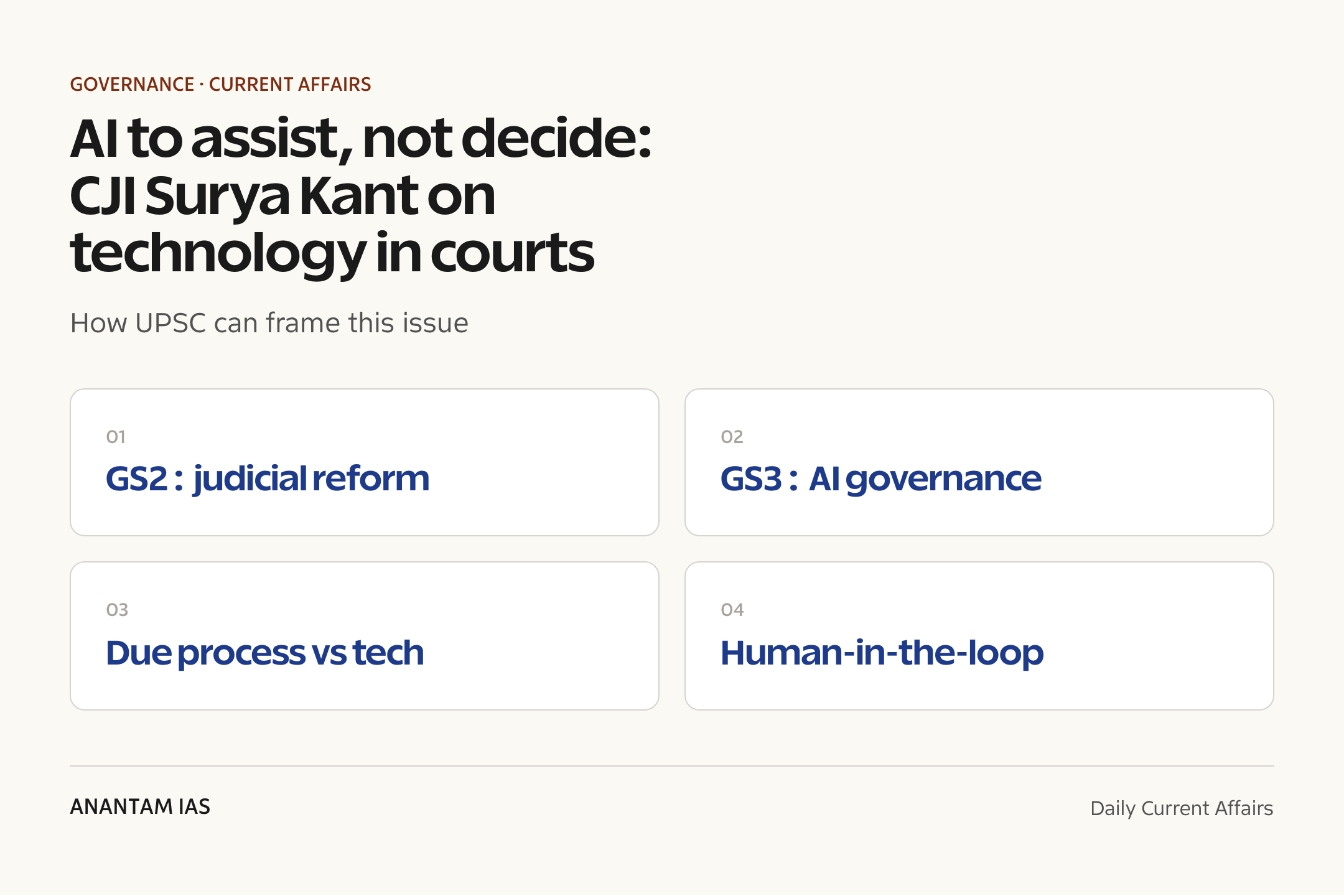
- For aspirants, it’s a ready quote-bank: the assist-vs-decide test works in answers on judicial reforms, due process, ethics of emerging technology, and regulation of AI.
UPSC Relevance
Prelims Relevance
- CJI Surya Kant — remarks on AI at the Indian Institute of Arbitration and Mediation summit, 11 July 2026: AI to assist, not decide equities.
- SUVAS (Supreme Court Vidhik Anuvaad Software) — AI-assisted neural machine translation tool launched on Constitution Day, 26 November 2019, to translate Supreme Court judgments into Indian languages.
- SUPACE (Supreme Court Portal for Assistance in Court’s Efficiency) — AI research-assistant portal launched in April 2021; processes case files and helps judges with research, but takes no part in decision-making.
- eCourts Project Phase III (2023–2027) — Cabinet-approved outlay of about ₹7,210 crore; includes a component (~₹53.57 crore) for AI and blockchain integration in courts.
- AI hallucination — a generative-AI system confidently producing false output, such as citations to non-existent case law.
- July 2026 Supreme Court ruling (Bench of Justice P.S. Narasimha) — set aside a tribunal verdict resting on hallucinated precedents; likened fake precedents to the release of methyl isocyanate in the province of law; directed the Bar Council of India to frame guidelines on AI-generated legal material.
- Digital dispute resolution / ODR — online dispute resolution platforms for negotiation, mediation and arbitration; NITI Aayog has backed ODR for small-value disputes.
- Articles 14 and 21 — equality before law and fair procedure; the constitutional basis for keeping adjudication reasoned, human and answerable.
Mains Relevance
GS Paper 2
- Judiciary and reforms: how assistive AI (translation, transcription, case management, triage) can attack the pendency backlog without touching the adjudicatory core.
- Access to justice: the CJI’s warning that poorly designed platforms hurt litigants least equipped to question an algorithm — a due-process and digital-divide argument in one line.
- Separation of functions within adjudication: why weighing equities is a non-delegable judicial function tied to reasoned decisions, natural justice and appealability.
GS Paper 3
- AI governance by domain: courts join finance and defence in defining sector-specific guardrails — compare the UK FCA’s review of AI risk in financial services and the debate on AI reshaping warfare.
- Trust and safety in generative AI: hallucination as a systemic risk when institutions consume AI output without verification.
- The case for legislative clarity: India has no statute governing AI use in adjudication; courts are filling the gap with rulings and administrative circulars.
GS Paper 4
- Accountability and moral responsibility: a judge can be reasoned with, recused, and held to account — an algorithm cannot; the ethics of delegating discretion to opaque systems.
Essay
- Technology is a good servant but a bad master — the courtroom as the test case.
- Justice must not only be done, it must be seen to be done: can an algorithm ever satisfy that maxim?
- Automation of process versus automation of judgment — where should a constitutional democracy draw the line?
Background and Context
The line the CJI drew: assist, never adjudicate
Chief Justice Surya Kant offered a functional test for AI in courts, not a blanket verdict for or against technology.
- Permissible zone: AI may triage disputes, organise evidence, transcribe proceedings, summarise case files and produce first-draft translations — all procedural convenience.
- Prohibited zone: the moment a system begins to weigh one party’s equities against another’s, it “has stopped assisting and started deciding” — and no algorithm has “earned the ability or authority to do that quietly”.
- On whether digital dispute resolution and AI enhance or disrupt access to justice, his honest answer was: they’ll do both, “depending on how deliberately we design their use”.
- The embracing exercise “is already under way and cannot sensibly be resisted” — so the operative agenda is legislative clarity plus human oversight, not prohibition.
- He framed the equity stake sharply: design must protect the people least equipped to question an algorithm’s output — the poor litigant, not the resourced law firm.
What triggered the caution: the hallucination crisis
The CJI’s remarks follow a run of incidents where fabricated AI output entered real judicial proceedings.
- In early July 2026, a Supreme Court Bench headed by Justice P.S. Narasimha found that a tribunal had relied on AI-hallucinated verdicts — citations to judgments that never existed — to decide a live insolvency-linked matter, and set the ruling aside.
- The Court declared zero tolerance for citing or relying on fake precedents, for the Bar and the Bench alike, warning that such sloppiness “would spell catastrophe” for the judicial process.
- The Bench’s metaphor was deliberately chilling: fake precedents are like methyl isocyanate released into the province of law — invisible, insidious, catastrophic by the time anyone notices.
- It directed the Bar Council of India to set up a committee to frame guidelines on AI-generated legal material and recommend disciplinary measures for advocates who file fabricated citations.
- Judges including Justices B.V. Nagarathna and Dipankar Datta have flagged fake case law in petitions from the open court — one filing cited a fictitious case titled ‘Mercy versus Mankind’.
- The pattern mirrors global experience: courts in the US, UK and Canada have sanctioned lawyers for filing briefs with hallucinated citations since 2023.
India's judicial AI stack: what already exists
The Supreme Court’s current deployments follow exactly the assistive template the CJI described.
- SUVAS (Supreme Court Vidhik Anuvaad Software), launched on Constitution Day, 26 November 2019, is a neural machine-translation system trained on judicial text; it has translated tens of thousands of judgments into Indian languages, widening access for non-English-speaking litigants.
- SUPACE (Supreme Court Portal for Assistance in Court’s Efficiency), launched in April 2021, reads case files and assists judges with research and fact-extraction — its design brief explicitly excludes decision-making.
- eCourts Phase III (2023–2027), approved with an outlay of about ₹7,210 crore, funds digital case records, e-filing, virtual hearings and courtroom infrastructure, with a dedicated slice (~₹53.57 crore) for AI and blockchain pilots in High Courts.
- AI-enabled live transcription of Constitution Bench hearings began in 2023, creating searchable records of oral arguments.
- In 2025, the Kerala High Court issued one of the first policies on AI use by the district judiciary — barring AI tools from being used to draft findings or orders while permitting administrative assistance.
- The CJI’s summary of the status quo: these interventions remain “deliberately assistive rather than adjudicatory” — the design choice, not an accident.
Why adjudication must stay human: the constitutional logic
The assist-vs-decide line isn’t technophobia; it flows from what a judicial decision is under the Constitution.
- Article 14 demands non-arbitrariness: a decision must rest on reasons that can be examined, and an opaque model’s output can’t be interrogated the way a judgment can.
- Article 21 guarantees a fair, just and reasonable procedure — which presupposes a hearing before a human mind capable of being persuaded (audi alteram partem).
- Judicial accountability runs through reasoned orders, appeals and review; an algorithm’s weights can’t be cross-examined, recused for bias, or impeached.
- Weighing equities involves discretion — mercy, proportionality, context — which training data can imitate but not own; responsibility for the outcome must sit with an identifiable judge.
- Algorithmic bias is a live risk: models trained on past outcomes can encode historic prejudice against marginalised litigants while wearing the costume of neutrality.
- Foreign experiments reinforce the caution — the US COMPAS recidivism-scoring controversy showed risk-assessment tools reproducing racial disparities in bail and sentencing.
The wider AI-governance moment
The judiciary is the latest Indian institution to write sector-specific rules of the road for AI, ahead of any general statute.
- India still has no dedicated AI law; governance runs through sectoral advisories, MeitY guidance and the IndiaAI Mission’s safe-and-trusted-AI pillar.
- The CJI’s call for legislative clarity effectively invites Parliament to define permissible judicial uses of AI, verification duties and liability for synthetic output.
- Regulators abroad are converging on the same human-oversight template — the UK’s Financial Conduct Authority is reviewing AI risk in financial services, and militaries are debating meaningful human control over autonomous systems.
- Digital dispute resolution (ODR) raises the same design question at scale: platforms resolving lakhs of small-value disputes must keep a human appeal route, or the algorithm quietly becomes the judge of first and last resort.
- The exam-ready synthesis: India’s emerging position is human-in-the-loop by design — automation of process, never automation of judgment.
Way Forward
Legislate the boundary
- Codify the assist-vs-decide line in statute or court-made rules: enumerate permissible AI uses (translation, transcription, triage, research) and prohibit adjudicatory delegation.
- Mandate disclosure when AI tools contribute to any filing or order, so parties and appellate courts can test the output.
Build verification into practice
- Fast-track the Bar Council of India guidelines the Supreme Court directed — a citation-verification duty for advocates, with graded discipline for filing hallucinated material.
- Deploy citation-checking tools in registries so fake precedents are caught at filing, not after judgment.
Design for the weakest litigant
- Audit judicial AI tools for bias and accuracy in Indian languages before scale-up; publish error rates.
- Pair ODR expansion with legal-aid navigators and a guaranteed human appeal, so digital-first never means algorithm-only for those least able to contest it.
- Invest eCourts Phase III funds in judicial training on AI capabilities and failure modes, from taluka courts up.
Conclusion
CJI Surya Kant’s speech is best read as a design document, not a lament. It accepts that AI in courts is irreversible, welcomes it for the drudgery — translation, transcription, triage — and fences off the one function that defines a court: weighing one person’s equities against another’s before the law.
The July 2026 hallucination ruling shows what happens when that fence fails quietly. The task now is institutional: a legislated boundary, a verification culture at the Bar, and tools audited for the litigant least able to question them. Done that way, the same technology that threatened the judicial process can become its most effective clerk.
UPSC Practice Questions
Prelims MCQ 1
With reference to the use of Artificial Intelligence in the Indian judiciary, consider the following statements:
- SUVAS is an AI-assisted software developed to translate Supreme Court judgments into Indian languages.
- SUPACE is an AI portal empowered to pronounce final verdicts in pending Supreme Court cases.
- Phase III of the eCourts Project (2023–2027) was approved with a financial outlay of over ₹7,000 crore.
How many of the above statements are correct?
(a) Only one (b) Only two (c) All three (d) None
Answer: (b) Only two
Explanation:
Statements 1 and 3 are correct: SUVAS (launched 2019) translates judgments into Indian languages, and eCourts Phase III carries an outlay of about ₹7,210 crore. Statement 2 is wrong — SUPACE only assists judges with research and case-file processing; it plays no role in decision-making.
Prelims MCQ 2
According to Chief Justice of India Surya Kant’s July 2026 remarks, which one of the following best describes the permissible role of Artificial Intelligence in courts?
(a) AI may decide small-value disputes to reduce pendency, subject to appeal before a judge (b) AI may perform assistive tasks such as triaging disputes, organising evidence and drafting translations, but must not weigh the equities between parties (c) AI must be excluded from all judicial work until Parliament enacts a comprehensive AI law (d) AI may draft final judgments provided a judge signs them
Answer: (b) AI may perform assistive tasks such as triaging disputes, organising evidence and drafting translations, but must not weigh the equities between parties
Explanation:
The CJI’s test is functional: procedural assistance (triage, evidence organisation, translation) is welcome, but the moment AI weighs one party’s equities against another’s it “has stopped assisting and started deciding”. He didn’t call for exclusion pending legislation — he said the embrace is already under way and needs legislative clarity plus human oversight.
UPSC Mains Questions
- “AI may triage a dispute, organise evidence, or draft a first translation — but it must not weigh one party’s equities against another’s.” In the light of this observation, examine the opportunities and constitutional limits of Artificial Intelligence in India’s justice delivery system. (250 words)
- AI-hallucinated precedents have been called the “methyl isocyanate” of the legal process. Discuss the risks generative AI poses to judicial integrity in India and suggest institutional safeguards for the Bench and the Bar. (250 words)
- Digital dispute resolution can both widen and narrow access to justice. Critically analyse this claim with reference to online dispute resolution platforms and litigants least equipped to question an algorithm’s output. (150 words)
Source: The Hindu.
Frequently Asked Questions
What did CJI Surya Kant say about AI in courts?
Speaking at an Indian Institute of Arbitration and Mediation summit on 11 July 2026, the CJI said AI should serve only procedural convenience — triaging disputes, organising evidence, drafting translations. The moment it weighs one party’s equities against another’s, it stops assisting and starts deciding, which no algorithm has the authority to do.
What prompted the CJI’s warning?
Weeks earlier, a Supreme Court Bench headed by Justice P.S. Narasimha found a tribunal had decided a real case on AI-hallucinated precedents — citations to judgments that never existed. The Court set the ruling aside, declared zero tolerance for fake precedents, and asked the Bar Council of India to frame guidelines.
What is an AI hallucination in the legal context?
It’s when a generative-AI tool confidently invents false output — most dangerously, citations to non-existent case law. Indian judges have reported fabricated precedents in petitions, including a fictitious case titled ‘Mercy versus Mankind’. Filing such material can amount to professional misconduct for an advocate.
What AI tools does the Supreme Court already use?
SUVAS (launched 2019) translates judgments into Indian languages using neural machine translation; SUPACE (2021) helps judges with research and case-file processing; live AI transcription covers Constitution Bench hearings. All are deliberately assistive — none takes part in deciding cases.
What is eCourts Phase III?
It’s the 2023–2027 phase of the judiciary’s digitisation mission, approved with an outlay of about ₹7,210 crore. It funds e-filing, digital case records, virtual hearings and courtroom infrastructure, and earmarks roughly ₹53.57 crore for AI and blockchain pilots in High Courts.
Why can’t AI decide cases if it reduces pendency?
Adjudication under Articles 14 and 21 requires reasoned, contestable decisions by an accountable human mind. An algorithm’s reasoning can’t be cross-examined, recused for bias, or held responsible; models trained on past data can also encode historic prejudice. Speed gains can’t substitute for due process.
Tell Google you want more of this.
Add Anantam IAS as a preferred sourceOne tap, and this site shows up more often in your own Top Stories, AI Overviews and AI Mode. Remove it any time.