
Why in News?
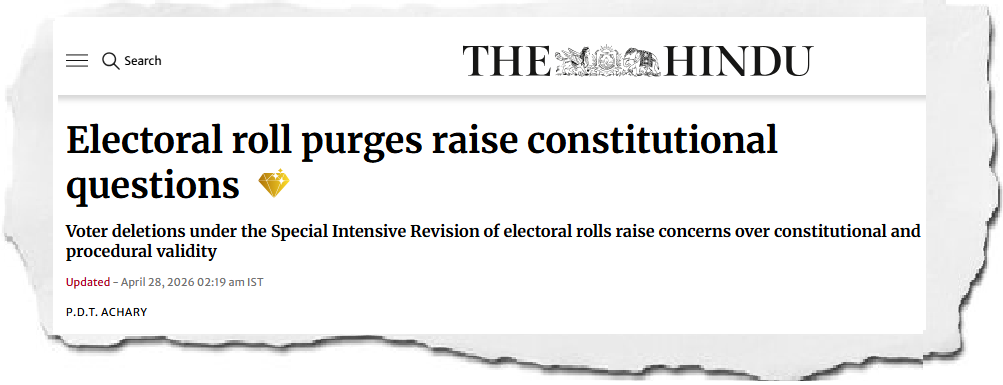
Recent electoral roll revisions through the Special Intensive Revision (SIR) in States such as West Bengal, Tamil Nadu, Kerala and Assam have triggered debate over large-scale deletions of voters. Concerns relate to the introduction of terms like “logical discrepancy”, documentation requirements, and the timing and manner of revision.
UPSC Relevance
GS-II: Polity, Election Commission, Constitutional Bodies, Electoral Reforms
Legal and Constitutional Framework
Right to Vote and Citizenship
- Article 326 of the Constitution provides for universal adult suffrage, subject to:
- Citizenship
- Age (18+)
- Disqualifications under law
This makes citizenship the foundational criterion for inclusion in electoral rolls.
Institutional Roles
Role of Election Commission of India
- Empowered under Article 324 to:
- Superintend, direct and control elections
- Prepare and revise electoral rolls
Role of Union Government
- Citizenship determination falls under:
- Citizenship Act, 1955
- Administered by the Ministry of Home Affairs
This creates an important distinction:
- ECI verifies eligibility
- Government defines citizenship framework
Key Issues Raised
1. Introduction of “Logical Discrepancy”
The categorisation of voters under “logical discrepancy” has raised concerns because:
- It is not explicitly defined in electoral law
- May lead to subjective or opaque deletions
This raises questions about:
- Transparency
- Legal validity
2. Documentation Requirements and Burden of Proof
During SIR:
- Certain commonly used documents (Aadhaar, ration card, voter ID) were reportedly not always accepted as sufficient proof
- Citizens were required to produce specific documents
This creates practical difficulties:
- Many rural and poor citizens lack archival documents
- Leads to exclusion despite genuine eligibility
3. Timing of Intensive Revision
Legal provisions under:
- Representation of the People Act, 1950 (Section 21)
- Registration of Electors Rules, 1960 (Rule 25)
suggest:
- Summary revision before elections
- Intensive revision ideally when elections are not imminent
Concerns arise when:
- Intensive revision is conducted close to elections, leaving limited time for corrections
4. Natural Justice and Due Process
Reports indicate:
- Deletions without adequate hearing
- Limited opportunity for appeal
This may violate:
- Principles of natural justice (right to be heard)
- Procedural safeguards under electoral law
5. Scale of Deletions
Large-scale deletions (in lakhs) raise broader concerns:
- Whether all deletions are justified
- Whether administrative processes are robust enough
Even if intended to remove ineligible names, scale amplifies risk of wrongful exclusion.
Broader Democratic Implications
1. Risk to Universal Adult Franchise
If eligible citizens are excluded:
- It weakens the core democratic principle of participation
2. Trust Deficit in Electoral Processes
Perception of arbitrary deletions can:
- Reduce public confidence in electoral institutions
- Lead to political and social contestation
3. Balance Between Accuracy and Inclusion
Electoral roll management involves a delicate balance:
- Removing ineligible voters (accuracy)
- Ensuring no eligible voter is excluded (inclusion)
Over-emphasis on one can undermine the other.
Way Forward
1. Clear Demarcation of Institutional Roles
- Citizenship criteria should be clearly defined by the Union government
- The ECI should focus on verification within that framework
This avoids jurisdictional ambiguity.
2. Transparent and Uniform Documentation Norms
- Publish a clear, exhaustive list of acceptable documents
- Include widely available documents (with safeguards)
This reduces confusion and exclusion.
3. Adherence to Legal Procedure and Timing
- Conduct intensive revisions well before election cycles
- Limit pre-election revisions to summary corrections
This ensures adequate time for grievance redressal.
4. Strengthening Natural Justice Mechanisms
- Ensure prior notice before deletion
- Provide accessible and time-bound appeal mechanisms
This protects voter rights.
5. Use of Technology with Safeguards
- Digital verification systems can reduce duplication
- However, they must be:
- Transparent
- Accountable
- Inclusive
6. Inclusion-Centric Approach
- Special outreach for:
- Migrants
- Rural populations
- Marginalised communities
Electoral integrity must go hand-in-hand with maximising inclusion.
Conclusion
Electoral roll purification is essential for credible elections, but it must be conducted within the constitutional framework, statutory limits, and principles of natural justice. The legitimacy of elections ultimately depends not only on removing ineligible voters but on ensuring that every eligible citizen retains their right to vote.
Practice Questions
Prelims
- With reference to electoral roll revision in India, consider the following statements:
- Article 324 empowers the Election Commission of India to determine citizenship criteria for voters.
- Article 326 provides for universal adult suffrage.
- The Representation of the People Act, 1950 deals with preparation of electoral rolls.
Which of the statements given above is/are correct?
(a) 2 and 3 only
(b) 1 and 2 only
(c) 1 only
(d) 1, 2 and 3
Answer: (a)
Mains
Discuss the challenges in balancing electoral roll accuracy with inclusiveness. Suggest measures to address these concerns.
Examine the constitutional and legal issues associated with large-scale electoral roll revisions in India.
Tell Google you want more of this.
Add Anantam IAS as a preferred sourceOne tap, and this site shows up more often in your own Top Stories, AI Overviews and AI Mode. Remove it any time.