Why in News?
On 1 July 2025 the Union Cabinet, chaired by the Prime Minister, approved the Employment Linked Incentive (ELI) Scheme, a demand-side instrument that ties cash incentives for first-time workers and hiring employers to enrolment with the Employees’ Provident Fund Organisation (EPFO).
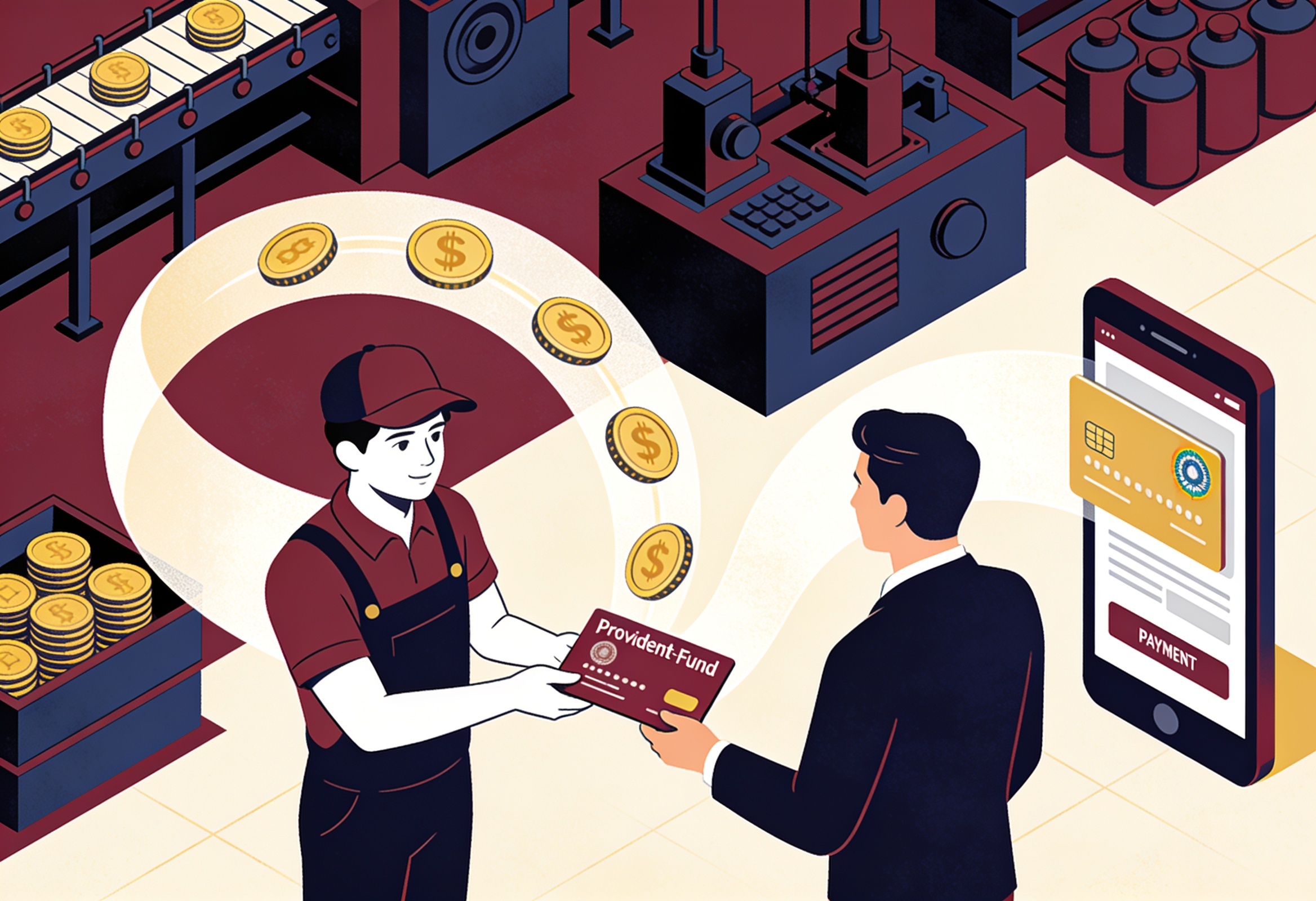
With an outlay of Rs 99,446 crore (about Rs 1 lakh crore), the scheme aims to support creation of more than 3.5 crore jobs over two years, of which around 1.92 crore are expected to be first-timers entering the formal workforce.
- Benefits apply to jobs created between 1 August 2025 and 31 July 2027.
- Part A pays EPFO-registered first-time employees one month’s EPF wage (up to Rs 15,000) in two instalments.
- Part B gives employers up to Rs 3,000 per month for two years per additional employee, extended to years 3 and 4 for manufacturing.
- ELI was announced in the Union Budget 2024-25 as part of the PM’s package of five schemes (Rs 2 lakh crore, targeting 4.1 crore youth).
- Part A is expected to reach about 1.92 crore first-timers; Part B to incentivise nearly 2.60 crore additional jobs.
The development matters in the context of:
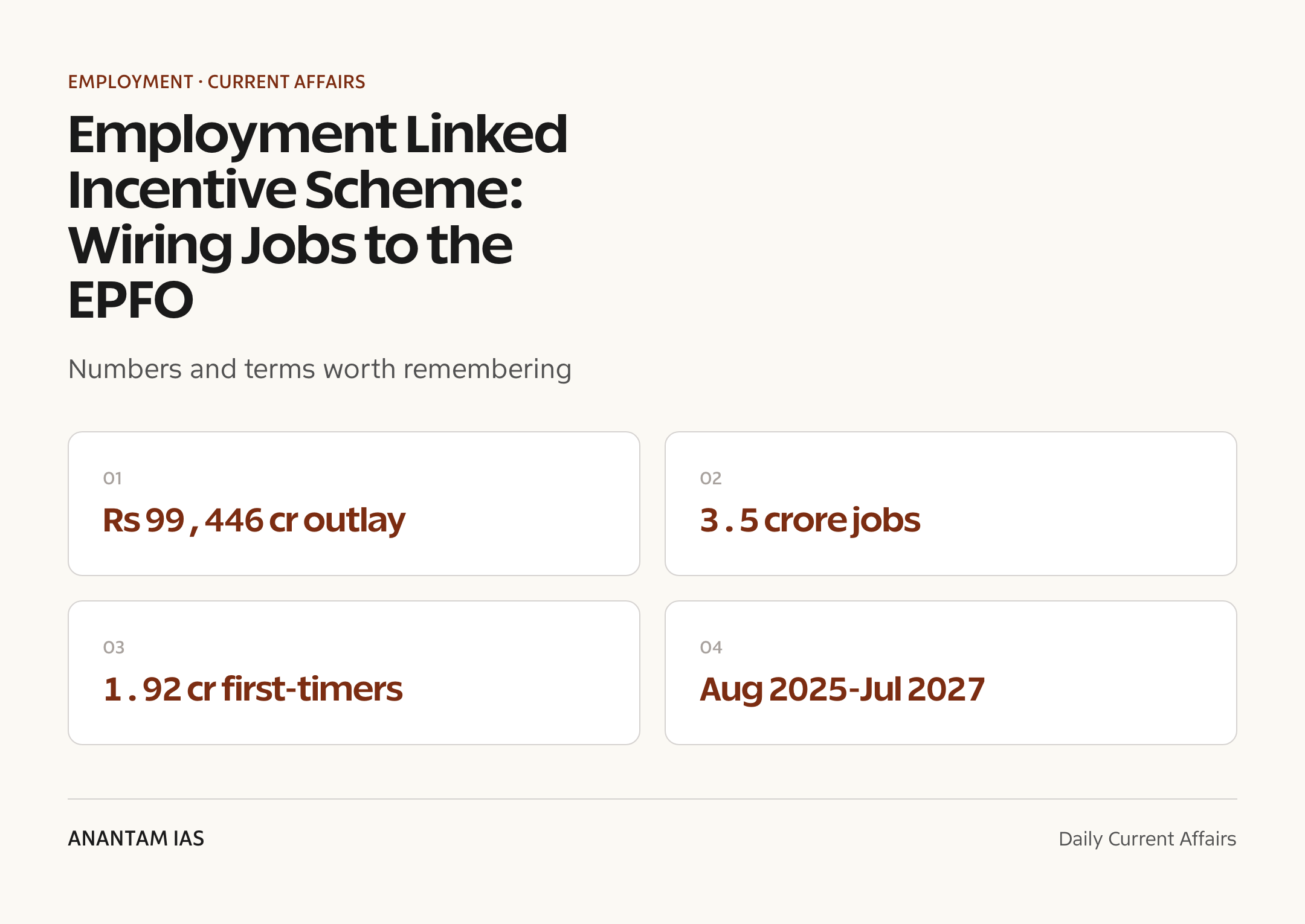
- Frames the policy answer to the ‘jobless growth’ debate by paying for jobs that show up in formal payroll data.
- Uses EPFO enrolment as both the eligibility gate and the proof-of-job, so the incentive doubles as a formalisation push.
UPSC Relevance
Prelims Relevance
- ELI Scheme outlay: Rs 99,446 crore; target of 3.5 crore+ jobs over two years.
- Job-creation window: 1 August 2025 to 31 July 2027.
- Part A: one month’s EPF wage up to Rs 15,000 for EPFO-registered first-timers, in two instalments.
- Part A instalments: 1st after 6 months of service; 2nd after 12 months plus a financial literacy programme.
- Salary eligibility ceiling for both parts: up to Rs 1 lakh per month.
- Part B employer incentive: up to Rs 3,000 per month for two years; years 3-4 for manufacturing.
- Hiring threshold: at least 2 additional employees (employers with <50) or 5 (employers with 50+), sustained for six months.
- Part A payments via DBT using the Aadhaar Bridge Payment System (ABPS); Part B into PAN-linked accounts.
- Part of the Budget 2024-25 package of five schemes worth Rs 2 lakh crore for 4.1 crore youth.
- Administering body for enrolment and verification: the EPFO.
Mains Relevance
GS Paper 3
- Employment generation, growth and development; demand-side versus supply-side job policy.
- Formalisation of the workforce and the role of social security in labour-market design.
GS Paper 2
- Welfare schemes and Direct Benefit Transfer as a governance mechanism; issues of targeting and leakage.
Essay
- Growth without enough good jobs: can incentives bridge the gap?
Background and Context
What the scheme actually does
ELI is a two-part incentive that rewards both the worker who joins the formal fold and the employer who expands payroll.
- Approved by the Union Cabinet on 1 July 2025 to enhance job creation, employability and social security across all sectors, with special focus on manufacturing.
- Total outlay of Rs 99,446 crore, targeting more than 3.5 crore jobs over two years.
- Of these, around 1.92 crore beneficiaries are projected to be first-time entrants to the workforce.
- Benefits attach only to jobs created between 1 August 2025 and 31 July 2027.
- Anchored to EPFO records, so eligibility and verification both run through provident-fund enrolment.
Part A — incentive to first-time employees
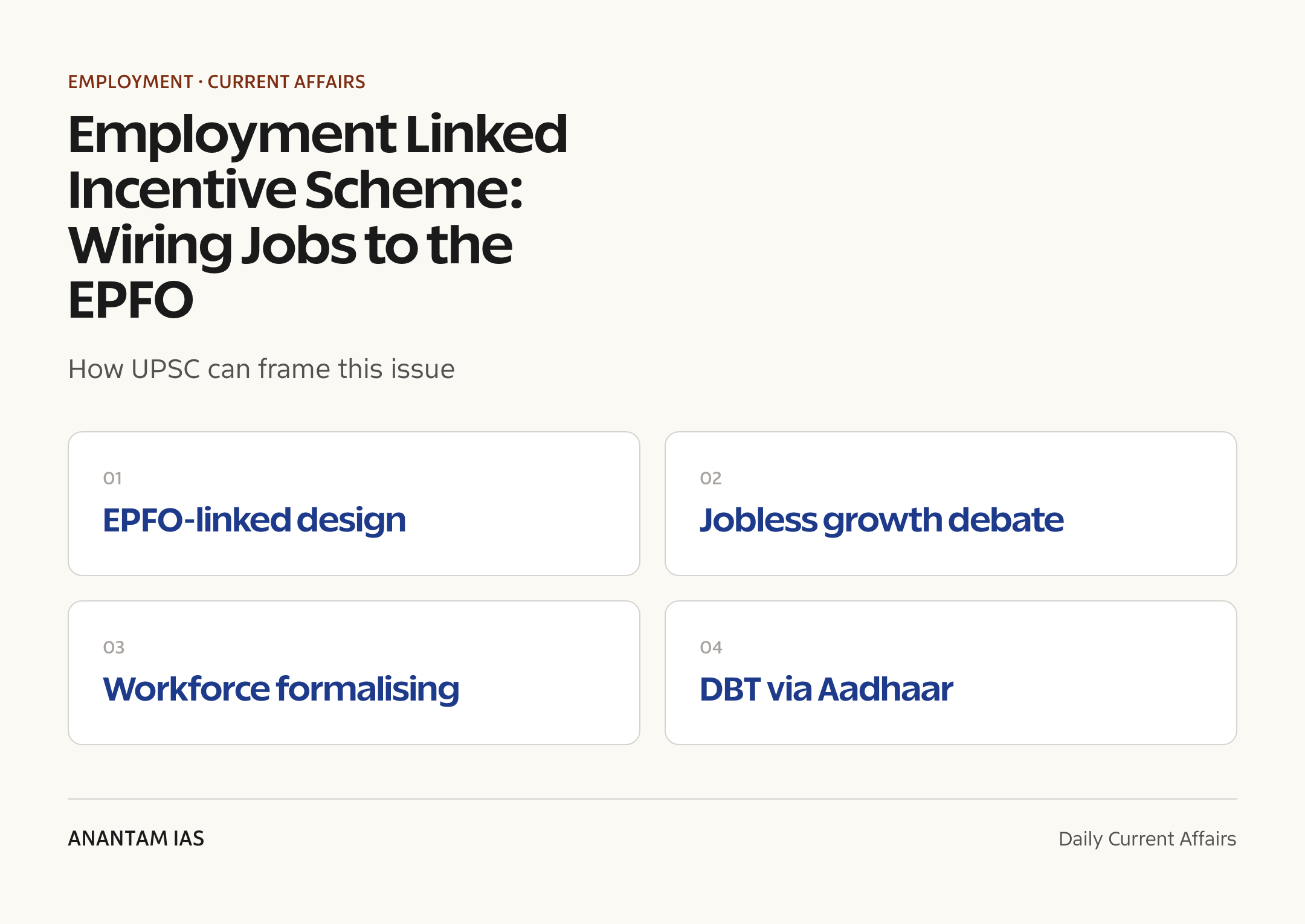
The worker-facing leg puts a month’s wage in the pocket of a new EPFO member, but staggered to reward staying.
- Targets first-time employees registered with the EPFO, offering one month’s EPF wage up to Rs 15,000.
- Open to employees with salaries up to Rs 1 lakh per month.
- Paid in two instalments: the first after 6 months of service, the second after 12 months and completion of a financial literacy programme.
- A portion is parked in a savings or deposit instrument for a fixed period, withdrawable later, to nudge a saving habit.
- Expected to benefit around 1.92 crore first-time employees.
Part B — support to employers
The firm-facing leg pays for net new jobs, not churn, and leans extra hard on manufacturing.
- Covers additional employment in all sectors, with a special focus on manufacturing.
- Government pays employers up to Rs 3,000 per month for two years for each additional employee in sustained employment for at least six months.
- For manufacturing, incentives extend into the 3rd and 4th years.
- Applies to employees with salaries up to Rs 1 lakh; those with EPF wages up to Rs 10,000 get a proportional incentive.
- Establishments must hire at least two additional employees (fewer than 50 on payroll) or five (50 or more), sustained for six months.
- Projected to incentivise nearly 2.60 crore additional jobs.
Plumbing — how the money moves
Payment rails are split so that workers and firms are paid through different, traceable channels.
- Part A payments to first-time employees flow through DBT using the Aadhaar Bridge Payment System (ABPS).
- Part B payments to employers go directly into their PAN-linked accounts.
- Routing through Aadhaar and PAN aims to cut duplication and leakage in incentive disbursal.
- Provident-fund records become the single source of truth for whether a job was genuinely created and sustained.
The bigger frame — formalisation and the budget package
ELI is less a standalone subsidy than one pillar of a larger employment and formalisation strategy.
- Announced in the Union Budget 2024-25 as part of the PM’s package of five schemes for employment, skilling and opportunity.
- That package carries a total outlay of Rs 2 lakh crore and targets 4.1 crore youth.
- A stated outcome is formalisation of the workforce by extending social security to crores of young workers.
- By rewarding EPFO enrolment, the scheme tries to convert informal jobs into recorded, benefit-bearing ones.
Why it sparks debate
An incentive tied to payroll is powerful but raises familiar design questions.
- Demand-side support can crowd in jobs that would have been created anyway (deadweight), inflating headline numbers.
- Tying eligibility to EPFO excludes the bulk of India’s workforce that is still informal and outside provident-fund coverage.
- The Rs 15,000 cap and the Rs 1 lakh salary ceiling mean the design leans toward lower-wage formal jobs.
- Sustaining quality jobs beyond the two-year window, once incentives lapse, is the harder test.
Way Forward
Guard against deadweight
- Track additionality rigorously so payments reward genuinely net-new jobs, not relabelled or seasonal hiring.
- Use EPFO and tax data together to flag firms that game the additional-employee thresholds.
Reach beyond the formal core
- Pair ELI with skilling and apprenticeship support so first-timers gain durable employability, not just a one-time transfer.
- Build bridges for informal and gig workers, who sit outside the EPFO gate, into social-security cover over time.
Make it durable
- Publish transparent, regular data on jobs created, sustained and lapsed to allow independent evaluation.
- Plan a glide path so manufacturing and other gains survive the end of the incentive period.
Conclusion
The ELI Scheme is a serious attempt to make job creation visible and rewardable by hard-wiring it to EPFO enrolment, turning a hiring subsidy into a formalisation lever. Its Rs 99,446 crore bet is that paying first-timers and growing firms together can move both employment and social-security coverage at once.
The payoff depends on execution: minimising deadweight, reaching workers still outside the formal net, and ensuring the jobs outlast the incentives. As one strand of a larger Rs 2 lakh crore package, ELI’s real test is whether it nudges India’s growth toward the quality employment the labour market needs.
UPSC Practice Questions
Prelims MCQ 1
With reference to the Employment Linked Incentive (ELI) Scheme, consider the following statements:
- It links incentives for first-time employees to their registration with the EPFO.
- Benefits are available for jobs created between August 2025 and July 2027.
- Employer incentives for the manufacturing sector are limited to the first two years only.
How many of the above statements are correct?
(a) Only one (b) Only two (c) All three (d) None
Answer: (b) Only two
Explanation:
Statements 1 and 2 are correct. Statement 3 is wrong: for manufacturing, employer incentives extend into the 3rd and 4th years, not just two.
Prelims MCQ 2
Under Part A of the ELI Scheme, the incentive to a first-time employee is:
(a) Paid as a lump sum on joining (b) One month’s EPF wage up to Rs 15,000, in two instalments (c) A fixed Rs 3,000 per month for two years (d) Routed through the employer’s PAN-linked account
Answer: (b) One month's EPF wage up to Rs 15,000, in two instalments
Explanation:
Part A gives EPFO-registered first-timers one month’s EPF wage up to Rs 15,000 in two instalments (after 6 and 12 months). The Rs 3,000/month employer incentive and PAN-linked routing belong to Part B.
UPSC Mains Questions
- The Employment Linked Incentive Scheme ties job-creation incentives to EPFO enrolment. Examine how such demand-side measures can address jobless growth, and identify the design risks they carry.
- Formalisation of the workforce is as much a social-security goal as an economic one. Discuss with reference to recent employment incentive schemes in India.
Sources: PIB, Cabinet and PMINDIA.
Frequently Asked Questions
What is the ELI Scheme?
The Employment Linked Incentive Scheme is a Rs 99,446 crore programme the Union Cabinet approved on 1 July 2025. It pays cash incentives to first-time employees and to employers who add jobs, with eligibility tied to enrolment with the EPFO. It targets more than 3.5 crore jobs over two years, including about 1.92 crore first-timers.
Who benefits under Part A?
Part A targets first-time employees registered with the EPFO who earn up to Rs 1 lakh a month. They receive one month’s EPF wage, up to Rs 15,000, in two instalments. The first comes after six months of service and the second after twelve months plus a financial literacy programme, with part parked in a savings instrument.
What do employers get under Part B?
Part B pays employers up to Rs 3,000 per month for two years for each additional employee kept in sustained service for at least six months. For the manufacturing sector, the support extends into the third and fourth years. Firms must add at least two new employees (under 50 on payroll) or five (50 or more).
For which period are jobs eligible?
The scheme’s benefits apply to jobs created between 1 August 2025 and 31 July 2027, a two-year window. Within this period, the staggered instalments and sustained-employment conditions determine when incentives are actually paid out.
How are the incentives paid?
Payments to first-time employees under Part A flow through Direct Benefit Transfer using the Aadhaar Bridge Payment System. Payments to employers under Part B go directly into their PAN-linked accounts. Routing through Aadhaar and PAN is meant to reduce duplication and leakage.
How does ELI help formalisation?
By tying every incentive to EPFO enrolment, the scheme pushes employers and workers to record jobs that might otherwise stay informal. This brings provident-fund and social-security coverage to crores of young workers, so a hiring subsidy doubles as a tool to formalise the workforce.
Tell Google you want more of this.
Add Anantam IAS as a preferred sourceOne tap, and this site shows up more often in your own Top Stories, AI Overviews and AI Mode. Remove it any time.