
Why in news?
FATF’s report, titled “Investigating Professional Money Laundering, Underground Banking, and the Use of Hawala and Other Similar Service Providers”, has identified the fusion of virtual assets with the traditional “hawala” system.
UPSC Relevance
Prelims
GS3, Basics of Cyber Security; Money-Laundering and its prevention.
What is hawala transaction ?
An informal, trust-based money transfer system operating outside traditional banking rails. It settles international cross-border transactions using balance offsets and local cash brokers without physically moving funds across borders.
- N.N. Vohra Committee (1993) :Highlighted how criminal networks and foreign intelligence agencies use money power derived from hawala and smuggling to run a “parallel government.”
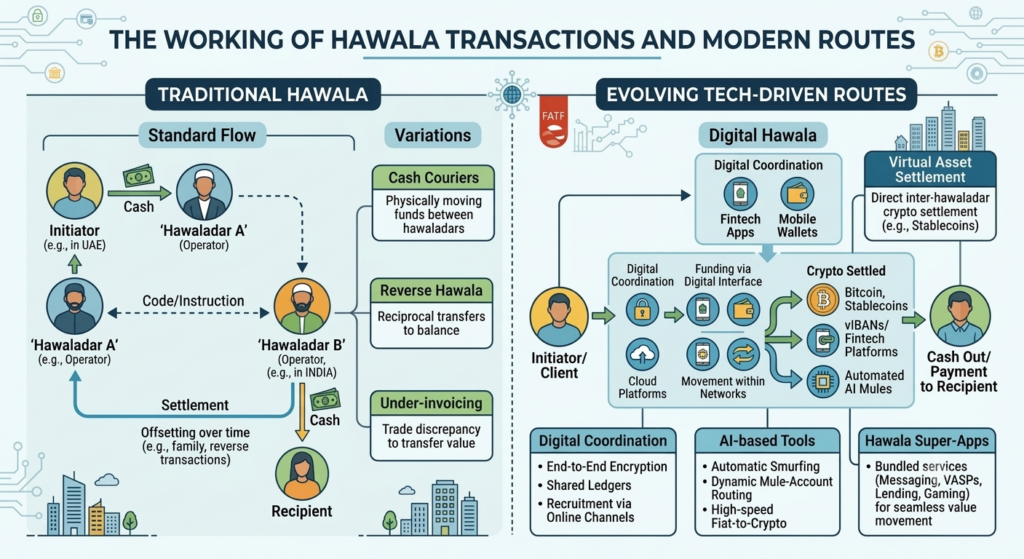
Evolving Threat Landscape: The Digital Hawala Nexus
- Technological Fusion: The centuries-old informal value transfer system (IVTS) is merging with cutting-ahead technologies—such as Virtual Assets (VAs), Virtual Asset Service Providers (VASPs), encrypted communication channels, and AI—creating a high-speed, decentralized parallel economy.
- Global Scale: According to the FATF report (Investigating Professional Money Laundering, Underground Banking, and the Use of Hawala and Other Similar Service Providers), nearly 70% of surveyed jurisdictions reported the integration of new technologies into traditional underground banking networks.
- Dual-Use Threat: Facilitates a wide spectrum of illicit financial flows (IFFs), ranging from routine money laundering and tax evasion to high-risk national security threats like Terror Financing (TF) and drug trafficking.
Types of Tech-Enabled Underground Banking
The report categorizes the spectrum of digital hawala into six operational forms:
- Digital Coordination, Traditional Settlement: Uses end-to-end encrypted messaging apps (e.g., Telegram, Signal) and shared ledgers for client recruitment and record-keeping, while ultimate settlement remains physical (cash/couriers).
- Digital Customer Interface: Front-end customer interaction occurs via fintech apps or mobile wallets, while back-end operator balances are settled offline via cash or trade-based money laundering (TBML).
- Virtual Asset-Based Settlement: Direct settlement of inter-hawaladar balances using stablecoins (e.g., USDT) and cryptocurrencies, bypassing traditional cross-border banking rails.
- Formal Digital Infrastructure Integration: Exploitation of legitimate Payment Service Providers (PSPs), fintech platforms, and Virtual International Bank Account Numbers (vIBANs) to obscure beneficial ownership.
- AI-Driven Automated Operations: Deployment of Artificial Intelligence for high-speed fiat-to-crypto conversion, automated transaction structuring (“smurfing”), and dynamic routing through networks of mule accounts.
- All-in-One “Hawala Super-Apps”: Bundled digital ecosystems that combine messaging, cloud storage, social gaming, lending platforms, and integrated VASP functions to conduct end-to-end illicit transfers inside a closed loop.
Institutional & Regulatory Mechanisms – India
- Prevention of Money Laundering Act (PMLA), 2002: Mandates strict Know Your Customer (KYC) norms and monitoring of Suspicious Transaction Reports (STRs).
- In 2023, the Finance Ministry brought VASPs/crypto-entities under the PMLA framework.
- Financial Intelligence Unit-India (FIU-IND): The central national agency responsible for receiving, processing, analyzing, and disseminating information relating to suspect financial transactions.
- Multilateral Enforcement: Enforcement Directorate (ED), Central Bureau of Investigation (CBI), and National Investigation Agency (NIA) coordinate cross-border asset recovery and terrorism funding probes under PMLA and UAPA.
Global Best Practices & FATF Standards
- FATF Recommendation 15 (New Technologies): Requires jurisdictions to identify and assess ML/TF risks arising from virtual asset activities and VASPs.
- The “Travel Rule”: Mandates VASPs to obtain, hold, and transmit originator and beneficiary information during virtual asset transfers to prevent anonymous cross-border hawala routing.
| Prelims Pointers : Financial Action Task Force (FATF) | |
| Basic Details | Intergovernmental body established in 1989 at the G7 Summit in Paris. |
| Secretariat | Located at OECD Headquarters in Paris (Note: FATF is independent of OECD). |
| Decision-Making | FATF Plenary (meets 3 times a year). |
| Evolution of Mandate | • 1989: Money Laundering (AML) • 2001: Terrorist Financing (CFT) • 2012: Financing of Proliferation of WMDs |
| Membership & India | • 39 members (37 countries + EC and GCC). • India: Joined as observer in 2006; became full member in 2010 (also part of APG and EAG). |
| Core Standards | 40+9 Recommendations (Global standard for AML/CFT). |
| Lists Maintained | • Grey List: Jurisdictions under increased monitoring. • Black List: High-risk jurisdictions (North Korea, Iran, Myanmar). |
| Prelims Traps | • NOT a UN agency. • NOT a law-enforcement agency (sets policies, does not investigate). • Uses Mutual Evaluation Reports (MER) for peer reviews. |
Key Challenges to Law Enforcement
- Anonymity & Obfuscation: The borderless, pseudonymous nature of blockchain transactions combined with privacy coins, mixers, and decentralized finance (DeFi) makes attribution difficult.
- Jurisdictional Friction: Lack of standardized global VASP regulation creates regulatory arbitrage, allowing syndicates to operate from low-compliance jurisdictions (“safe havens”).
- Super-App Silos: Encrypted, proprietary, all-in-one ecosystems complicate lawful interception and digital forensics.
Way Forward
- Public-Private Partnerships (PPP): Collaborative intelligence sharing between FIU-IND, law enforcement agencies, banks, and compliant VASPs to flag dynamic mule routing in real time.
- RegTech & SupTech Deployment: Adoption of AI-based predictive analytics, automated chain-analysis tools, and machine learning models within regulatory bodies to counter automated laundering schemes.
- Justice M.B. Shah Committee : Recommended real-time integration of databases across the Enforcement Directorate, Customs, Income Tax, and FIU-IND.
- Capacity Building: Specialized training for financial intelligence analysts and digital forensics teams to trace cross-border crypto-hawala transactions.
- Global Convergence: Harmonizing regulatory frameworks across FATF member nations to eliminate regulatory blind spots in virtual asset transfers.
Practice MCQ
With reference to ‘Digital Hawala’ and global Anti-Money Laundering frameworks, consider the following statements:
- Under PMLA, 2002, Virtual Asset Service Providers (VASPs) in India are registered as Reporting Entities to FIU-IND.
- FATF Recommendation 15 mandates the ‘Travel Rule’ for obtaining originator and beneficiary data during crypto transfers.
- Digital hawala exclusively uses virtual assets, eliminating cash and trade-based settlements.
Which statements are correct?
A.2 and 3 only
B.1 and 3 only
C.1 and 2 only
D.1, 2 and 3
Correct answer – C
Statements 1 and 2 are correct. In March 2023, India brought VASPs under the PMLA framework as Reporting Entities accountable to FIU-IND. FATF Recommendation 15 mandates the ‘Travel Rule’ to trace cross-border crypto transactions. Statement 3 is incorrect because digital hawala frequently relies on hybrid systems involving traditional cash couriers and trade-based money laundering (TBML) alongside digital assets.
Practice Question
“The integration of virtual assets and AI tools has transformed ‘Hawala’ into a sophisticated cyber-enabled security threat.” In light of recent Financial Action Task Force (FATF) observations, evaluate the adequacy of India’s existing regulatory and enforcement framework in mitigating these illicit financial flows. (15 Marks)
Tell Google you want more of this.
Add Anantam IAS as a preferred sourceOne tap, and this site shows up more often in your own Top Stories, AI Overviews and AI Mode. Remove it any time.