Context:
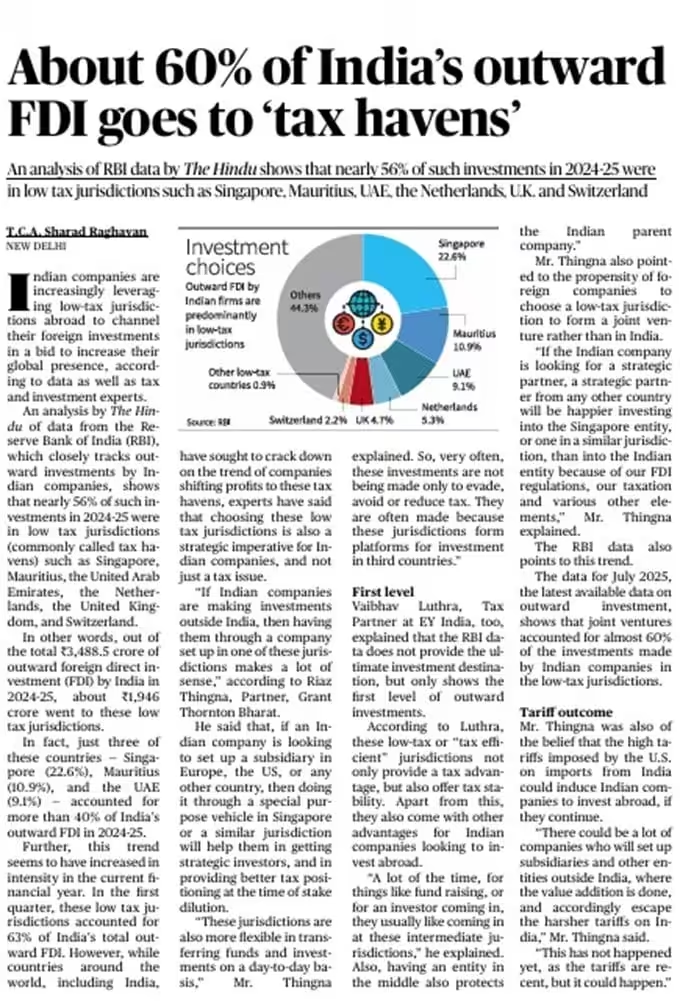
Indian companies are increasingly routing their outward FDI (Foreign Direct Investment) through low-tax jurisdictions (tax havens) such as Singapore, Mauritius, UAE, the Netherlands, the UK, and Switzerland. An RBI dataset for 2024–25 reveals that nearly 60% of India’s outward FDI went to these tax havens.
UPSC Relevance:
CSE in prelims as well as in mains examination has focused on FDI. A case in point is a following PYQ
Mains PYQ 2014
Q1: Foreign direct investment in the defence sector is now set to be liberalized. What influence this is expected to have on Indian defence and economy in the short and long run?
Mains PYQ 2013
Q2: Though India allowed foreign direct investment (FDI) in what is called multi brand retail through joint venture route in September 2012, the FDI ,even after a year, has not picket up. Discuss the reasons.(2013)
UPSC Prelims PYQ:
Consider the following:(2021)
Foreign currency convertible bonds
Foreign institutional investment with certain conditions
Global depository receipts
Non-resident external deposits
Which of the above can be included in Foreign Direct Investments?
A 1, 2 and 3 only
B 3 only
C 2 and 4 only
D 1 and 4 only
For Basics: https://anantamias.com/current-affairs/foreign-direct-investment/
Analysis of article:
- RBI’s July 2025 data showed that nearly 60% of India’s outward FDI continues to be routed through tax havens.
- The Total outward FDI (2024–25): ₹3,48,885 crore out of this, nearly ₹1,946 crore went to tax havens.
- Singapore (22.6%), Mauritius (10.9%), and UAE (9.1%)—attracted more than 40% of India’s outward FDI because they are tax haven country and India sign DTAA with these Nations.

Tax Haven Countries mean:
- Lower tax rates and flexible financial regimes.
- Favourable regulatory systems, easier cross-border transactions.
- Setting up in tax havens allows companies to route investments further into third countries.
- Attracts foreign partners who prefer dealing with entities incorporated in such jurisdictions.
Issues:
- Money outflow form India to save taxes. Here company take advantage of loop holes lies in (DTAA).
- Loss of Government Revenue.
- Difficult to track origin of funds.
Double Tax Avoidance Agreement:
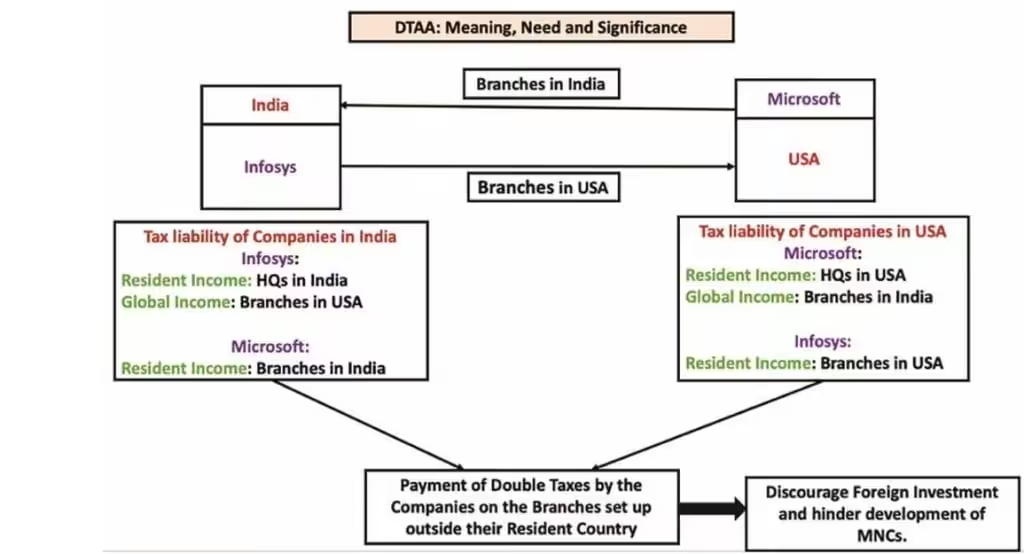
A Double Tax Avoidance Agreement (DTAA), also known as a tax treaty, is an agreement signed between two countries to prevent individuals or businesses from being subject to double taxation on their income.
Misuse of DTAA:
India has signed DTAA with the tax havens such as Mauritius, Singapore, Cayman Islands etc. These DTAAs have been misused by the MNCs in order to reduce their tax liability in India. For example, If a company (Shell Company) is registered in tax haven and carries out the operations through its subsidiary based in India. Under the provisions of DTAA, the company would be liable to pay tax only in the tax haven country, even for the profits which it makes in India. This causes significant revenue loss for India.
Round tripping: It is the practice where, capital belonging to India goes out to tax haven country where it is used to set up Shell Company. The money is then, reinvested back in India in the form of FDI.
Tell Google you want more of this.
Add Anantam IAS as a preferred sourceOne tap, and this site shows up more often in your own Top Stories, AI Overviews and AI Mode. Remove it any time.