Why in News?
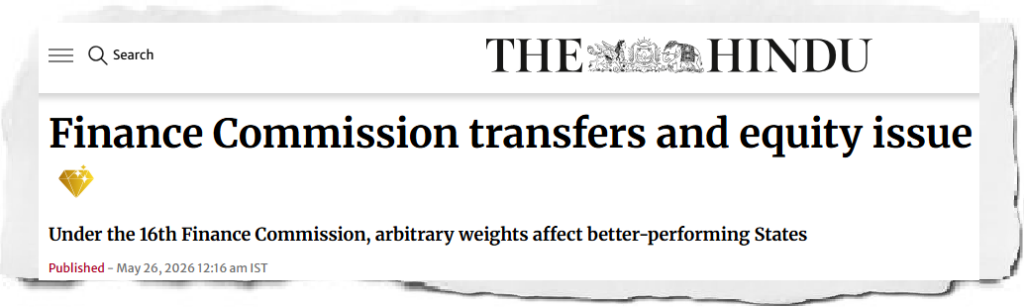
The debate around fiscal federalism and resource sharing has gained renewed attention after discussions surrounding the recommendations of the 16th Finance Commission (FC). While the Commission retained the 41% vertical devolution share for States, concerns continue regarding the balance between equity and efficiency in horizontal transfers among States. Several States, especially economically stronger southern States, have raised concerns about declining shares and fiscal autonomy.
UPSC Relevance
Prelims: Finance Commission, Articles related to fiscal federalism, tax devolution, cesses and surcharges, GST.
Mains:
GS-II: Centre-State relations, federalism, constitutional bodies;
GS-III: Public finance, fiscal policy, inclusive development.
Background and Context
India follows a federal fiscal structure in which expenditure responsibilities and revenue-raising capacities are distributed between the Union and States. However, a mismatch exists because States often bear larger expenditure obligations while the Centre controls major taxation powers.
To address these imbalances, the Constitution established the Finance Commission.
The Commission performs two important balancing functions:
- Addressing vertical imbalance, which concerns resource distribution between the Centre and States.
- Addressing horizontal imbalance, which concerns disparities among States themselves.
Over time, Finance Commissions have increasingly focused on equalisation, ensuring that relatively poorer States receive greater financial support.
Constitutional Framework of Finance Commission
The Finance Commission derives authority from Article 280 of the Constitution of India.
Its functions include:
- Recommending distribution of net tax proceeds between the Union and States.
- Determining principles governing grants-in-aid.
- Suggesting measures for strengthening State finances.
- Advising on matters referred by the President.
The Commission is appointed every five years.
Understanding Vertical and Horizontal Devolution
Vertical Devolution
Vertical devolution refers to the distribution of resources between the Union government and States.
The 15th Finance Commission had recommended 41% tax devolution to States (reduced from 42% due to the creation of Ladakh and Jammu & Kashmir as Union Territories).
The 16th Finance Commission retained this share.
Horizontal Devolution
Horizontal devolution distributes the States’ share among individual States using certain criteria.
The broad objective is to reduce disparities among States and ensure balanced development.
Criteria Used by the 16th Finance Commission
The 16th FC retained most criteria from the previous Commission with slight modifications:
| Criteria | Weight |
|---|---|
| Income distance | 42.5% |
| Population | 17.5% |
| Area | 10% |
| Forest and ecology | 10% |
| Demographic criterion | 10% |
| Contribution to national GDP | 10% |
The addition of contribution to GDP replaced tax effort.
However, instead of using actual GSDP values, the Commission used a square-root transformation, reducing advantages for larger economies.
Major Concerns Raised by States
Increasing Use of Cesses and Surcharges
States argued that cesses and surcharges have grown substantially.
These revenues:
- Are excluded from the divisible pool.
- Remain entirely with the Union government.
- Reduce actual transfers to States.
States suggested either:
- Including them within the divisible pool; or
- Capping them at around 8–10%.
Declining Fiscal Autonomy
States also highlighted concerns arising from:
- GST-related structural changes.
- Rising public debt burdens.
- Increasing dependence on Centrally Sponsored Schemes.
- Slower growth in central tax revenues.
For example, many schemes require States to bear a substantial share of expenditure.
This limits flexibility in spending according to local priorities.
Frequent Changes in Formula
States argued that repeated alterations in devolution criteria create uncertainty.
Unpredictability makes long-term fiscal planning difficult.
The Equity versus Efficiency Debate
The central issue is whether transfers should primarily reward:
- Equity, meaning support for poorer States to reduce disparities; or
- Efficiency, meaning rewarding States demonstrating better economic performance and governance outcomes.
The current system heavily favours equity.
Equity Arguments
Supporters argue that:
- Poorer States require greater assistance because of weaker fiscal capacities.
- Constitutional federalism seeks balanced regional development.
- Equal opportunities are necessary for national cohesion.
Examples include States such as Bihar and Uttar Pradesh, where developmental challenges remain significant.
Efficiency Arguments
Economically stronger States argue that:
- They contribute disproportionately to national GDP and taxes.
- Continued redistribution may weaken incentives for fiscal discipline.
- Better-performing States should not be excessively penalised.
Southern States particularly highlight this concern.
Their combined share reportedly declined substantially over successive Finance Commissions.
Why Fiscal Transfers Alone Have Not Eliminated Disparities
Higher transfers have not necessarily translated into convergence in public services.
Examples indicate persistent differences:
- Bihar’s health expenditure per person remains substantially lower than several other States.
- Spending on elementary education also shows wide variation.
This suggests that transfers alone cannot solve developmental inequalities.
Administrative capacity, governance quality and institutional efficiency also matter.
Alternative Devolution Approaches Suggested
The article discusses possible alternative models.
Greater Weight to Economic Contribution
Increasing GDP contribution weight to around 25% while reducing income-distance weight could substantially raise shares for economically stronger States.
Potential beneficiaries include:
- Maharashtra
- Karnataka
- Tamil Nadu
Use of Actual GSDP Instead of Square-root Transformation
Using actual economic contribution rather than transformed values may better reflect genuine fiscal capacity and economic output.
Data-driven Weight Assignment
The article proposes methods such as:
- Principal Component Analysis (PCA)
- Fiscal outcome indicators
- Revenue mobilisation indicators
Such approaches could reduce subjective weighting.
The Cost of Alternative Weighting Schemes
If the commission had utilized the actual, uncompressed GSDP shares or assigned higher weights to economic performance, the distribution of the vertical pool—estimated at ₹104 lakh crore over the award period—would look vastly different.
An alternative model using actual GSDP shares with a 25% weight (and reducing income distance to 27.5%) would have yielded major revenue gains for industrial states over the award period:
- Maharashtra: A share increase of 2.392%, translating to an additional ₹2.49 lakh crore (approx. ₹49,744 crore annually).
- Karnataka: A share increase of 1.806%, yielding an additional ₹1.88 lakh crore (approx. ₹37,565 crore annually).
- Tamil Nadu: A share increase of 1.556%, generating an additional ₹1.62 lakh crore (approx. ₹32,365 crore annually).
Challenges Before Fiscal Federalism
Rising political economy concerns
Future delimitation may alter parliamentary representation patterns, potentially influencing fiscal incentives and political bargaining.
Dependence on non-divisible revenues
Increasing reliance on cesses and surcharges may weaken cooperative federalism.
Reduced flexibility for States
Greater dependence on centrally designed schemes limits State autonomy.
Balancing national cohesion and economic incentives
Excessive equalisation may create dependency, while excessive efficiency orientation may deepen inequalities.
| Devolution Criterion | 15th FC Weight | 16th FC Weight | Key Structural Changes Under 16th FC |
| Income Distance | 45.0% | 42.5% | Retained as the dominant equity measure to support fiscally weaker states. |
| Population | 15.0% | 17.5% | Increased by 2.5%, keeping total demographic need central to the formula. |
| Area | 15.0% | 10.0% | Reduced to allocate more weight to performance metrics. |
| Forest Cover | 10.0% | 10.0% | Maintained to reward states preserving ecological assets. |
| Demographic Performance | 12.5% | 10.0% | Modified by replacing the inverse fertility rate with actual population growth. |
| Economic Performance | 2.5% (Tax Effort) | 10.0% (GDP Contribution) | Replaced “Tax Effort” with a state’s contribution to national GDP, using a square-root formula. |
Way Forward
Adopt a balanced equity-efficiency framework
Future Finance Commissions should maintain support for weaker States while adequately rewarding economic performance and governance outcomes.
Increase transparency in formula design
Predictable and stable criteria can help States undertake long-term fiscal planning.
Expand divisible resources
A review of cesses and surcharges can improve fairness in resource sharing.
Focus on fiscal outcomes
Indicators such as education outcomes, healthcare performance and tax mobilisation may improve incentive structures.
Strengthen cooperative federalism
Regular institutional dialogue between the Centre and States can reduce friction over fiscal issues.
Conclusion
India’s fiscal federal structure aims to balance national unity with regional equity. The challenge before future Finance Commissions is not simply deciding who gets more resources, but designing a system that simultaneously encourages efficiency, addresses disparities and preserves cooperative federalism. The debate is therefore not between rich and poor States, but between competing visions of fairness itself.
Practice Questions
Prelims Question 1 (Inference-based)
Consider the following statements regarding Finance Commission transfers in India:
I. Horizontal devolution primarily seeks to reduce developmental disparities among States.
II. Increasing the weight of GDP contribution in devolution criteria would likely increase transfers to economically stronger States.
III. Greater emphasis on income distance generally benefits fiscally stronger States.
Which of the following relationships among the statements is correct?
- Statement II extends the principle in Statement I by rewarding economic performance.
- Statement III contradicts Statement I.
- Statement II and Statement III represent competing approaches to fiscal transfer design.
(a) 1 only
(b) 2 only
(c) 1 and 3 only
(d) 3 only
Answer: (c)
Explanation: Statement II represents efficiency-based allocation, while Statement I represents equity objectives. Statement III is incorrect because income distance generally benefits weaker States.
Prelims Question 2
Match the following:
| Criteria | Purpose |
|---|---|
| A. Income distance | 1. Environmental conservation |
| B. Forest cover | 2. Reduce fiscal disparities |
| C. Population | 3. Reflect demographic needs |
Choose the correct answer:
(a) A–2, B–1, C–3
(b) A–1, B–3, C–2
(c) A–2, B–3, C–1
(d) A–3, B–2, C–1
Answer: (a)
Explanation: Income distance addresses disparities, forest cover rewards ecological contributions, and population captures demographic requirements.
Mains Questions
- “The debate on Finance Commission transfers is fundamentally a debate between equity and efficiency in Indian federalism.” Examine.
- Critically analyse whether the present fiscal transfer architecture adequately balances the developmental needs of poorer States with the aspirations of economically stronger States.
Tell Google you want more of this.
Add Anantam IAS as a preferred sourceOne tap, and this site shows up more often in your own Top Stories, AI Overviews and AI Mode. Remove it any time.