
Why in News?
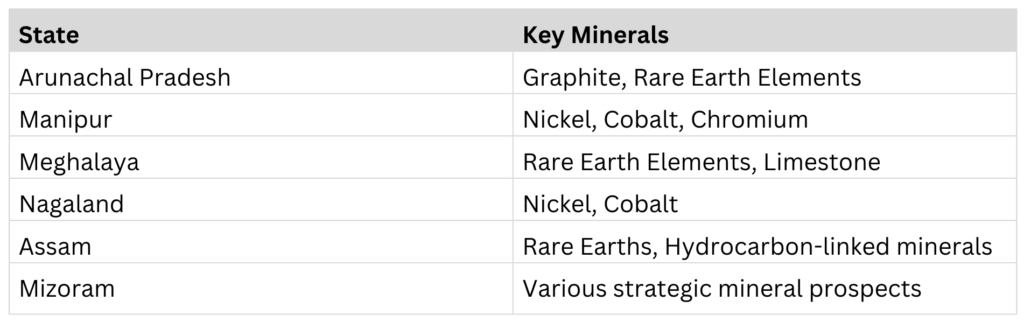
The Northeast India has traditionally been viewed through the lens of border security, insurgency, connectivity deficits and geopolitical vulnerability. Recent official references to several northeastern States as mineral-rich frontiers point to an emerging shift.
The region is increasingly being framed not only as a borderland to be secured or a corridor to be connected, but also as a strategic resource frontier.
| UPSC Relevance: GS-2 Polity and Governance: Federalism, Tribal Rights; GS-3 Economy: Critical minerals, Energy Mains: Critical minerals, Tribal Rights, Significance of North-East India |
Critical Minerals:
- Critical minerals are minerals that are:
- Essential for economic and national security.
- Important for emerging technologies and industrial production.
- Vulnerable to supply disruptions due to import dependence or geopolitical risks.
- Examples:
- Lithium: Essential for EV batteries and grid storage.
- Cobalt & Nickel: Key for high-energy-density batteries and superalloys.
- Graphite: Used in lithium-ion battery anodes.
- Rare Earth Elements: Critical for wind turbines, EV motors, and defence electronics.
- Vanadium: Used in grid-scale energy storage (vanadium redox batteries) and as a steel strengthening agent.
- Chromium: Used in stainless steel and defence alloys.
- In 2023, India amended the Mines and Minerals (Development and Regulation) Act, 1957, to designate 24 minerals as critical minerals, and a separate list of 30 critical minerals was released by the Ministry of Mines.
India’s dependence on imports for several critical minerals makes domestic exploration a matter of supply-chain security, not merely economic policy. China currently dominates global REE processing (over 85% of refining capacity), and disruptions in supply chains have underlined the strategic vulnerability of import dependence.
Northeast in India’s Critical Mineral Push:
- The Geological Survey of India (GSI) conducted 43 critical mineral exploration projects across the northeastern states during the field seasons of 2022-23, 2023-24, and 2024-25.
- Exploration covers Lithium, Rare Earth Elements, Graphite, Vanadium, Nickel and Cobalt.
Shift from Border Security to Resource Security:
- For decades, National Policy towards the Northeast was shaped by four dominant frames: security, connectivity, insurgency and integration. The region was seen as a sensitive borderland sharing international boundaries with China, Myanmar, Bangladesh, Bhutan and Nepal. Infrastructure development was often justified in terms of military mobility, border management and national integration.
- In the last decade, another frame has gained importance: the Northeast as a corridor under the Act East Policy. Roads, railways, waterways and border trade projects have been linked to India’s economic and strategic outreach towards Southeast Asia.
- The emerging critical-mineral discourse adds a third frame: the Northeast as a resource base for India’s green and technological transition. This marks a significant transformation. Territorial security, connectivity and resource security are now converging.
However, this convergence also creates new tensions. For the local communities, it can evoke fears of extraction, demographic pressure, ecological disruption and loss of control over land.
Key Challenges in Mineral Extraction from North-East India:
- Complex Land Governance: Much of the land in the Northeast is governed by customary ownership systems, not individual land titles. Formal mining laws may not always align with local customary practices. Disputes may arise over who has the authority to give consent for exploration or mining.
- Constitutional and Legal Sensitivities: Several areas are protected under the Sixth Schedule and special provisions, such as Article 371. Autonomous District Councils and traditional institutions have powers over land, forests and local governance. Mining projects may face legal and political resistance if these institutions are bypassed.
- Trust Deficit and Political Sensitivity: The region has a history of insurgency, militarisation, ethnic conflicts and alienation from mainland policy-making. Communities may see mining projects as another form of external control over their land.
- Environmental Fragility: The Northeast lies in one of the world’s most biodiverse and ecologically sensitive zones. Mining can lead to deforestation, habitat loss, soil erosion and biodiversity decline.
- Water and River-System Risks: Mining can contaminate rivers, streams and groundwater through waste discharge, heavy metals and sedimentation. Acid mine drainage and unregulated dumping can cause long-term ecological damage.
- Livelihood Disruption: Local communities depend on forests, shifting cultivation, horticulture, livestock and minor forest produce. Mining may reduce access to common lands, forests and water sources.
- Risk of Displacement: Even limited mining can cause indirect displacement by restricting access to forests, grazing lands and sacred sites. In tribal areas, displacement is not only economic but also cultural and social.
- Infrastructure Deficit: Many mineral-bearing areas lack reliable roads, rail links, power supply and logistics infrastructure. Building infrastructure in mountainous terrain is costly, and poor connectivity can make extraction commercially unviable.
Way Forward:
- Strengthen mandatory Free, Prior and Informed Consent (FPIC) mechanisms, in line with ILO Convention 169 and the UN Declaration on the Rights of Indigenous Peoples (UNDRIP), before initiating mineral exploration in Scheduled and tribal areas.
- Ensure District Mineral Foundation (DMF) funds mandated under the MMDR Act (2015) are transparently governed, locally administered, and directed toward health, education, and livelihood infrastructure in affected communities.
- Develop a Northeast-specific Critical Mineral Policy that integrates geological surveys with prior social impact assessments, environmental impact assessments, and conflict-sensitivity analyses, particularly in areas affected by ongoing ethnic conflict.
- Build local processing and value-addition capacity (rather than extracting raw ore) to prevent the northeast from becoming a supplier of primary commodities while manufacturing benefits accrue elsewhere in the national or global economy.
- Revitalise Autonomous District Councils under the Sixth Schedule, ensuring they have the technical capacity and legal authority to meaningfully participate in (and veto if necessary) mineral development decisions within their jurisdictions.
- Adopt cumulative environmental impact assessments at the river-basin and ecosystem level, rather than project-by-project approvals, to protect the northeast’s biodiversity corridors and the Brahmaputra basin’s hydrology.
The real test of India’s critical mineral strategy will not be whether it can locate minerals beneath the hills, but whether it can build a model of development that respects the people who live above them. Resource security must be built on ecological prudence, constitutional sensitivity and democratic inclusion.
Tell Google you want more of this.
Add Anantam IAS as a preferred sourceOne tap, and this site shows up more often in your own Top Stories, AI Overviews and AI Mode. Remove it any time.