Why in News?
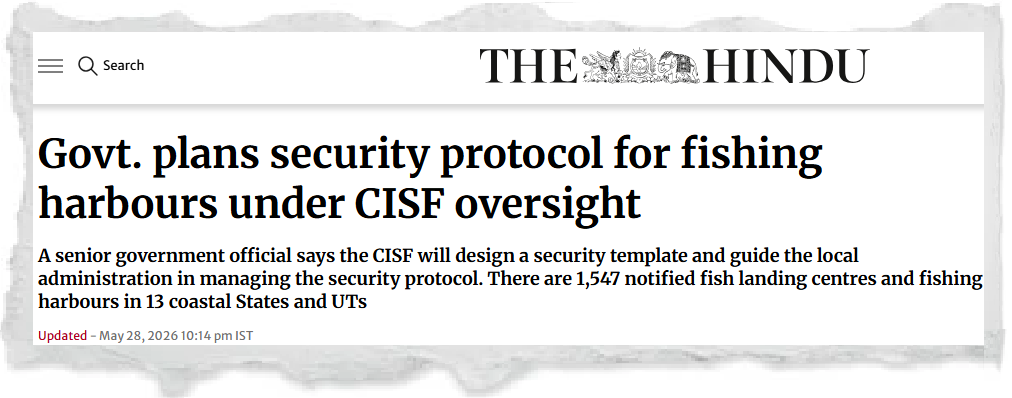
The Union Home Ministry is planning to bring around 1,200 fishing harbours and fish landing centres under a security oversight framework guided by the Central Industrial Security Force (CISF).
The move is aimed at strengthening India’s coastal security architecture, plugging surveillance gaps, and creating a more uniform security mechanism across fishing hubs and maritime infrastructure, particularly in the aftermath of vulnerabilities exposed during the 26/11 Mumbai terror attacks.
UPSC Relevance
Prelims: CISF, coastal security, Bureau of Port Security (BoPS), Indian Coast Guard, maritime security, 26/11 attacks.
Mains:
GS II – Governance, Centre-State coordination, internal security;
GS III – Coastal security, border management, maritime infrastructure, terrorism.
Background: Why Coastal Security is Important
India has a coastline of approximately 7,516 km spread across 13 coastal States and Union Territories. Along this coastline are major ports, fishing harbours, fish landing centres, naval facilities, coastal settlements, and busy shipping routes that are crucial for India’s economy and security.
The significance of coastal security became especially evident after the 26/11 Mumbai terror attacks in 2008, when terrorists entered India through the sea route after hijacking an Indian fishing vessel near the coast. The incident exposed serious weaknesses in maritime surveillance, harbour security, identity verification systems, and coordination among multiple agencies.
Since then, India has gradually strengthened its maritime security architecture through institutional reforms, coastal radar systems, and greater coordination between the Navy, Coast Guard and marine police.
What is the Government’s New Proposal?
The Ministry of Home Affairs proposes to bring fishing harbours and landing sites under an overall security framework supervised by the CISF. However, CISF personnel are unlikely to be physically deployed at every harbour because of the large number of sites spread across the coastline.
Instead, the CISF is expected to function as a central security regulator and advisory institution that will help local administrations design standardised security mechanisms. The force will assist in developing uniform operational procedures, surveillance systems, and risk-management protocols across fishing harbours.
The objective is to remove the present fragmentation in coastal security arrangements and establish a more coordinated national framework.
Proposed Security Measures
Technology-driven monitoring systems
The government plans to regulate the movement of fisherfolk through biometric attendance systems and smart identification cards. This would help authorities identify genuine fishermen, prevent unauthorised access to sensitive coastal zones, and improve real-time monitoring of harbour activities.
The use of digital systems is also expected to strengthen database integration and assist security agencies in identifying suspicious movements more efficiently.
Standardised harbour security framework
At present, different coastal regions follow varying security practices depending on local administrative arrangements. The CISF is expected to create a common security template covering areas such as entry and exit regulation, CCTV surveillance, vessel monitoring, digital registration systems, security audits, and emergency response mechanisms.
Such standardisation would improve coordination among agencies and reduce gaps in surveillance and enforcement.
Community participation in security
Fishing communities are often the first observers of unusual maritime activity. The proposed framework also seeks to sensitise local populations regarding coastal security threats and encourage cooperation between fisherfolk and security agencies.
This reflects the broader understanding that coastal security cannot rely only on armed forces and surveillance technology, but also requires active community participation.
Existing Coastal Security Architecture in India
India’s coastal security system currently involves several agencies operating at different levels.
State police and marine police are responsible for near-shore patrolling and local intelligence gathering. The Indian Coast Guard conducts maritime surveillance, anti-smuggling operations, and search-and-rescue missions, while the Indian Navy handles deeper maritime defence and strategic security responsibilities.
The CISF currently provides security to all 13 major ports in the country and has increasingly emerged as the central agency responsible for port-security regulation. The government has also designated the CISF as the security regulator for over 250 seaports, including private cargo ports.
However, because multiple agencies operate simultaneously, concerns have often been raised regarding coordination gaps and the absence of a uniform security framework.
Bureau of Port Security (BoPS)
In December 2025, the Union Home Minister proposed the establishment of the Bureau of Port Security (BoPS). The proposed body is expected to function on the lines of the Bureau of Civil Aviation Security (BCAS), which regulates airport security in India.
The BoPS is intended to create national standards for port and maritime security, coordinate among different agencies, conduct inspections and audits, and ensure compliance with security protocols across ports and coastal infrastructure.
The proposed institution reflects the government’s attempt to move towards a more integrated and centralised maritime security architecture.
Why Fishing Harbours are Strategically Sensitive
Fishing harbours and landing centres involve constant movement of people and vessels, informal economic activities, and large stretches of relatively less-monitored coastal areas. Small fishing boats can sometimes escape surveillance due to weak registration and tracking systems.
This creates vulnerabilities related to smuggling, illegal fishing, infiltration, and even possible terrorist movement through maritime routes. Strengthening security in these areas is therefore important not only for counter-terrorism but also for improving maritime domain awareness and protecting coastal economic infrastructure.
Challenges in Implementing the Framework
Large-scale implementation difficulties
India has more than 1,500 notified fishing harbours and landing centres distributed across mainland and island territories. Ensuring uniform implementation of security systems across such a vast and geographically dispersed network will be administratively challenging.
Centre-State coordination issues
Fishing harbours are managed by both State governments and Central agencies. Effective coordination among multiple authorities, each with different administrative structures and priorities, remains a major challenge.
Financial and technological limitations
Installing surveillance infrastructure, biometric systems, vessel-tracking mechanisms, and digital databases across remote coastal areas will require significant financial investment and technological capacity.
Balancing security with livelihoods
Fishing communities depend on flexible and continuous access to coastal areas for their livelihoods. Excessive regulation or cumbersome verification procedures may create inconvenience and resistance among local populations if not implemented sensitively.
Importance of Maritime Security for India
India’s strategic location in the Indian Ocean Region makes maritime security a critical component of national security. Nearly 95% of India’s trade by volume and a major share of its energy imports move through sea routes.
As a result, secure ports, fishing zones and coastal infrastructure are vital for economic stability, uninterrupted energy supplies, national defence preparedness, and counter-terrorism efforts. With increasing geopolitical competition in the Indo-Pacific region, maritime security has also become central to India’s broader strategic ambitions.
Way Forward
Integrated coastal surveillance
India should further strengthen integrated coastal radar networks, satellite monitoring systems, and vessel-tracking mechanisms to improve maritime domain awareness.
Community-based coastal security
Fishing communities should be treated as important stakeholders in coastal security through awareness programmes, community intelligence networks, and regular engagement with security agencies.
Better inter-agency coordination
Greater institutional coordination among the Navy, Coast Guard, CISF, marine police, intelligence agencies and local administrations is essential for seamless coastal management.
Technological modernisation
The use of artificial intelligence, drones, digital harbour management systems, and data integration platforms can significantly improve surveillance and response efficiency.
Institutional strengthening
The proposed Bureau of Port Security should be operationalised quickly with clearly defined powers, accountability mechanisms, and coordination responsibilities.
Conclusion
The proposal to bring fishing harbours under a CISF-guided security framework represents another important step in strengthening India’s maritime security architecture. The move reflects lessons learned from past security failures, particularly the 26/11 Mumbai terror attacks, and recognises the growing strategic importance of coastal infrastructure in an increasingly interconnected world.
As India expands its maritime ambitions and economic engagement in the Indo-Pacific region, securing fishing harbours, ports and coastal communities will become essential not only for national security but also for economic resilience and regional stability.
Practice Questions
Prelims Question 1 (Inference-based)
Consider the following statements with reference to India’s proposed CISF-led security framework for fishing harbours:
I. The proposed framework seeks to create a more standardised coastal security mechanism across fishing harbours and landing centres.
II. The initiative reflects concerns that fragmented institutional responsibilities can weaken maritime security management.
III. The increasing emphasis on biometric monitoring and digital identification indicates a shift towards technology-driven coastal governance.
Which of the following relationships among the above statements is/are correct?
- Statement II explains the administrative rationale behind the objective mentioned in Statement I.
- Statement III represents one of the methods through which the goals mentioned in Statement I may be implemented.
- Statement I contradicts Statement III because technology-driven systems reduce the role of institutional coordination.
(a) 1 and 2 only
(b) 2 and 3 only
(c) 1 only
(d) 1, 2 and 3
Answer: (a)
Explanation: Statement II explains why a standardised framework is necessary, while Statement III shows how technological tools may help achieve those objectives. Statement 3 is incorrect because technological systems complement rather than contradict institutional coordination.
Prelims Question 2
Assertion (A): The Government of India proposes to involve the CISF in designing security protocols for fishing harbours and landing centres.
Reason (R): Fishing harbours and coastal landing centres are strategically sensitive locations that can potentially be exploited for infiltration, smuggling and maritime security threats.
(a) Both A and R are correct, and R is the correct explanation of A
(b) Both A and R are correct, but R is not the correct explanation of A
(c) A is correct, but R is incorrect
(d) A is incorrect, but R is correct
Answer: (a)
Explanation: Fishing harbours are strategically sensitive because of continuous vessel movement and limited monitoring infrastructure in some regions. The government’s decision to involve the CISF is intended to strengthen security and surveillance in these vulnerable areas.
Mains Questions
- Discuss the importance of coastal security in India’s internal security architecture. Examine the challenges associated with securing fishing harbours and landing centres.
- Analyse the role of institutional coordination and technological surveillance in strengthening India’s maritime security framework.
Tell Google you want more of this.
Add Anantam IAS as a preferred sourceOne tap, and this site shows up more often in your own Top Stories, AI Overviews and AI Mode. Remove it any time.