Context: Union Parliamentary Affairs Minister Kiren Rijiju on July 20, 2025 said over 100 MPs have already signed a notice to bring a motion in Parliament for the removal of Justice Yashwant Varma, which is the minimum support required for tabling the impeachment exercise in the Lok Sabha.
The constitution states that a judge can be removed only by a president’s order, on the basis of a motion moved and approved by both houses of the parliament.
UPSC PYQ (2019)
Consider the following statements:
- If the motion for the impeachment of a Judge is taken up for voting, the law requires the motion to be backed by each House of the Parliament and supported by a majority of total membership of that House and by not less than two-thirds of total members of that House present and voting.
- The motion to impeach a Judge of the Supreme Court of India cannot be rejected by the Speaker of the Lok Sabha as per the Judges (Inquiry) Act, 1968.
- The Constitution of India defines and gives details of what constitutes incapacity and proved misbehaviour’ of the Judges of the Supreme Court of India.
Which of the statements given above is/are correct?
D 1, 3 and 4 only
A 1 and 2 only
B 3 only
C 3 and 4 only
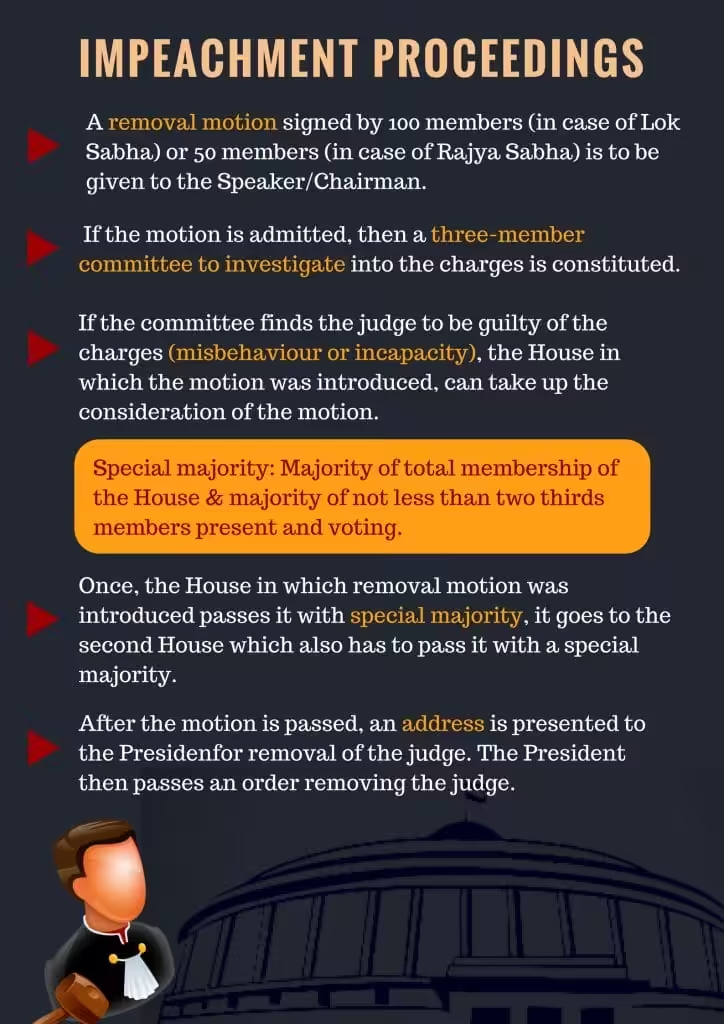
The details of the process of impeachment of the Judges of the Supreme Court of India are given in the Judges (Inquiry) Act, 1968. The process for removing judges is further detailed in the Judges Inquiry Act, 1968. The Act prescribes the following steps for removal from office:
- According to the Act, an impeachment motion can be initiated in either house of parliament.
- To bring proceedings into being: (i) not less than 100 members of Lok Sabha can present a signed notice to the speaker, or (ii) not less than 50 members of Rajya Sabha can present a signed notice to the chairman.
- The speaker or chairman can consult persons and scrutinize concerned material connected with the notice. Depending on this, he or she can choose to either grant the motion or deny the motion.
- If the motion is accepted, the speaker or chairman (who accepts it) will form a three-member committee to inquire into the complaint.
- It will include:
- (i) a Supreme Court judge;
- (ii) chief justice of a high court; and
- (iii) a renowned jurist.
- The committee will draft charges upon which the inquiry shall be conducted.
A copy of the charges will be sent to the judge who may file a written defence. Once it makes its findings, the committee shall report to the speaker or chairman, who shall lay the report before the parliament house concerned. Upon entering a finding of misbehaviour or incapacity, the motion for removal will be moved and shall be considered and debated.
The removal motion must be passed by each parliament house by: (i) the majority of the entire membership of such house; and (ii) a majority of not less than two-thirds of members present and voting in such house. When the motion is so passed, the motion will be referred to the other house for adoption.
After it is passed in the two chambers, the motion is brought before the president for an order of removal of the judge.
Tell Google you want more of this.
Add Anantam IAS as a preferred sourceOne tap, and this site shows up more often in your own Top Stories, AI Overviews and AI Mode. Remove it any time.