Why in News?
On 30 August 2026, the Department of Fertilizers described how the Integrated Fertilizer Management System (iFMS) is being expanded from transaction recording into data-linked monitoring and decision support.
- The architecture connects production, imports, movement, stocks, retail sales and subsidy processing, allowing officials to examine one supply chain through linked records.
- Haryana’s Meri Fasal Mera Byora integration and subsequent AgriStack work tested links among fertilizer purchases, farmer identity, land records and crop information.
- The Framework for Fertilizer Sale adds mobile booking and a verification step before the existing iFMS Point of Sale transaction.
- The framework is being implemented in phases; the official release does not establish that every state database, booking flow or financial integration is nationally complete.
- Linked data can reveal stock delays, unusual purchases and mismatches between booked requirement and final sale, but a flagged pattern is an audit lead, not proof of diversion.
- Land-linked controls can improve targeting while excluding cultivators whose tenancy, inheritance, crop or plot details are missing, disputed or stale in the underlying record.
UPSC Relevance
Prelims Relevance
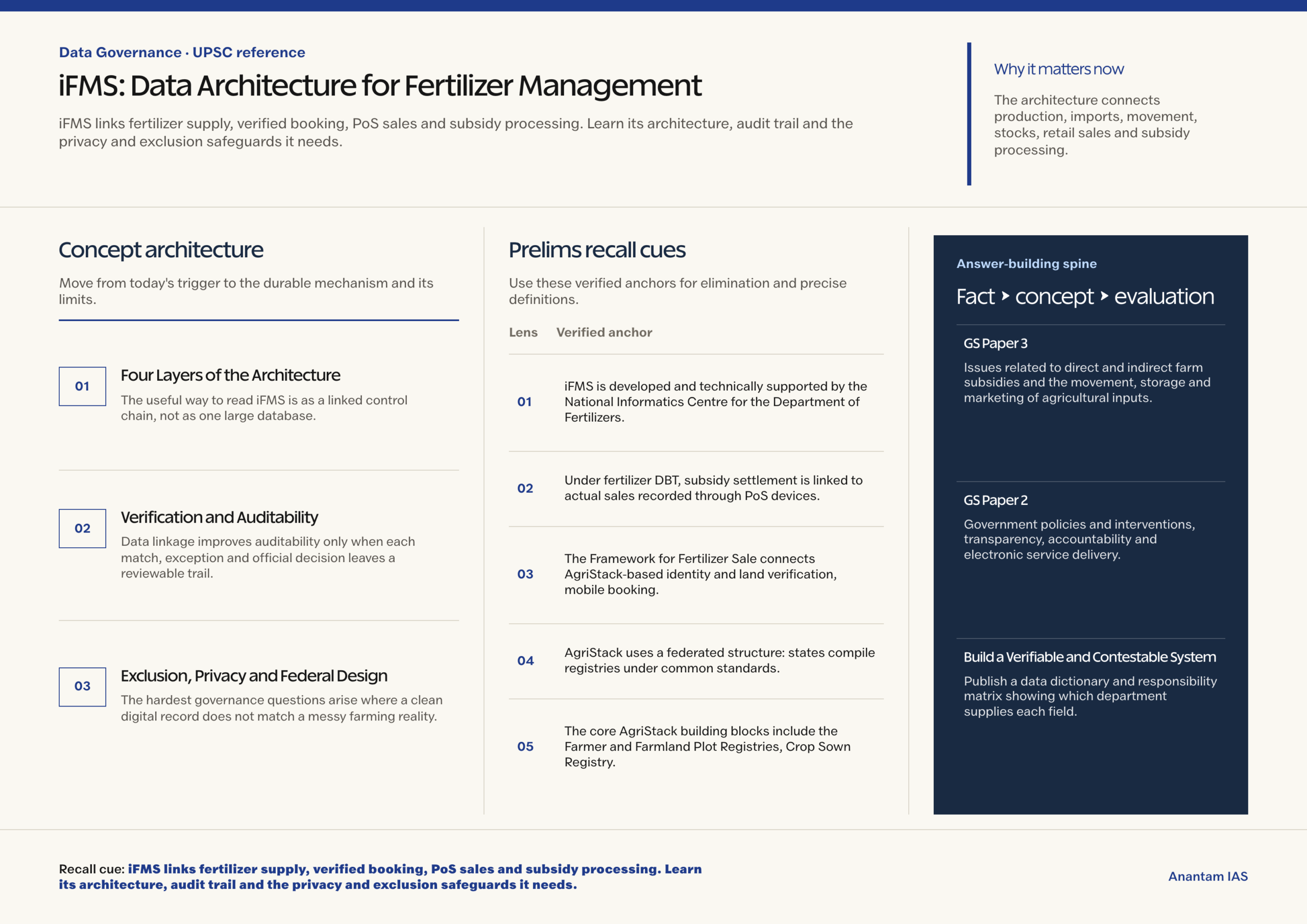
- iFMS is developed and technically supported by the National Informatics Centre for the Department of Fertilizers.
- Under fertilizer DBT, subsidy settlement is linked to actual sales recorded through PoS devices; the subsidized amount is not a cash transfer to the farmer.
- The Framework for Fertilizer Sale connects AgriStack-based identity and land verification, mobile booking, a generated QR reference and the retailer’s PoS transaction.
- AgriStack uses a federated structure: states compile registries under common standards, while standardized interfaces support authorized exchange.
- The core AgriStack building blocks include the Farmer and Farmland Plot Registries, Crop Sown Registry, Unified Farmer Service Interface and Consent Manager.
Mains Relevance
GS Paper 3
- Issues related to direct and indirect farm subsidies and the movement, storage and marketing of agricultural inputs.
- Technology missions, farm-sector digital infrastructure and supply-chain monitoring.
GS Paper 2
- Government policies and interventions, transparency, accountability and electronic service delivery.
- Data protection, grievance redress and the exclusion risks created by automated eligibility checks.
Essay
- Digital governance becomes trustworthy when efficiency is matched by explainability, correction rights and a working human appeal channel.
Background and Context
Four Layers of the Architecture
The useful way to read iFMS is as a linked control chain, not as one large database. Each layer answers a different control question.
- The supply layer records production, imports, dispatch, goods in transit, stock position and retail availability, making gaps visible across successive stages.
- The identity and farm layer matches a fertilizer buyer with state-held farmer, land and crop records through integrations such as MFMB and AgriStack.
- The booking layer records assessed requirement before purchase, then carries the booking reference to the retailer’s PoS device for comparison with the quantity sold.
- The transaction layer records the final retail sale. This is the event to which fertilizer subsidy processing is linked under the present DBT design.
- The settlement layer links electronic subsidy bills with financial processes such as PFMS and e-Bill, creating traceable stages from claim to payment.
Verification and Auditability
Data linkage improves auditability only when each match, exception and official decision leaves a reviewable trail. A dashboard alone cannot supply this.
- Dashboards can compare dispatch, stock and sale records across administrative levels, helping officials locate delays or unusual movement before a local shortage deepens.
- Booking-versus-purchase comparison tests whether the final sale corresponds with an assessed requirement, but weather, crop change or revised sowing can produce legitimate variation.
- Analytical flags should trigger risk-based verification, not automatic guilt. The rule, threshold, data version and officer action must remain available for later review.
- Electronic bills reduce paper movement, while timestamps, maker-checker controls and payment-stage logs allow an auditor to reconstruct how a subsidy claim was examined.
- A strong audit design preserves both positive and negative decisions: who approved a claim, who stopped it, what evidence was used and how an error was corrected.
Exclusion, Privacy and Federal Design
The hardest governance questions arise where a clean digital record does not match a messy farming reality. That mismatch is where exclusion begins.
- A land title may name an owner while a tenant, joint holder or cultivator buys the input. The official dispute system recognizes these competing farmer roles.
- Inheritance, mutation and crop updates can lag. A failed match should open an exception route, not silently convert a record-quality problem into denial.
- Because AgriStack is federated, state ownership of registries can limit central duplication, but common standards are still needed for access control, correction and interoperability.
- Farmer identity, land, crop and purchase history can reveal livelihood patterns. Collection should be purpose-bound, minimal, encrypted and retained only for a defined period.
- Consent-based sharing is one AgriStack safeguard, but consent cannot replace clear notices, role-based access, breach response, grievance handling and independent security and bias audits.
Way Forward
Build a Verifiable and Contestable System
The next phase should measure successful correction and fair access, not only the number of linked transactions.
- Publish a data dictionary and responsibility matrix showing which department supplies each field, how often it updates and who corrects an error.
- Provide assisted and offline fallbacks for connectivity or authentication failure, with a time-bound human appeal that pauses adverse action during a genuine dispute.
- Log every data access and automated flag, restrict fields by official role and subject the system to periodic privacy, security and exclusion-impact audits.
- Scale each integration only after pilots disclose match errors, unresolved cases, turnaround time and outcomes for tenants, joint holders and other non-standard records.
Conclusion
- iFMS can connect physical fertilizer movement, farm-linked demand, verified sale and subsidy settlement into one auditable chain, but integration quality matters more than database size.
- A balanced Mains answer should pair targeting and traceability with federal data ownership, purpose limitation, correction rights and a human route for resolving exclusion.
UPSC Practice Questions
Prelims MCQ 1
With reference to the Integrated Fertilizer Management System (iFMS), consider the following statements:
- It is technically supported by the National Informatics Centre for the Department of Fertilizers.
- Fertilizer subsidy processing is linked to actual retail sales recorded through the Point of Sale network.
- The Framework for Fertilizer Sale links AgriStack-based verification and booking with the existing iFMS PoS ecosystem.
How many of the above statements are correct?
(a) Only one (b) Only two (c) All three (d) None
Answer: (c) All three
Explanation:
All three describe the official architecture. The booking framework adds a verification layer before the final PoS sale recorded in iFMS.
Prelims MCQ 2
Which one of the following best describes the federated design of AgriStack?
(a) All state land records are replaced by a single centrally owned register (b) States maintain registries under common standards and authorized interfaces enable data exchange (c) Private input dealers determine farmer eligibility without government-held records (d) Crop data can be exchanged without authentication, authorization or consent controls
Answer: (b) States maintain registries under common standards and authorized interfaces enable data exchange
Explanation:
AgriStack places states at the center of registry ownership while common schemas and interfaces support authorized, consent-brokered exchange.
UPSC Mains Questions
- Data integration can make fertilizer subsidy administration more targeted, but it can also turn record errors into exclusion. Critically examine with reference to iFMS and AgriStack.
- Digitization creates traceability, not accountability by itself. Discuss the institutional safeguards needed to make data-driven fertilizer management auditable and contestable.
Sources: PIB, Department of Fertilizers and AgriStack, Department of Agriculture and Farmers Welfare.
Frequently Asked Questions
What is iFMS?
The Integrated Fertilizer Management System is the Department of Fertilizers’ digital platform for monitoring production, imports, movement, stocks, retail sales and subsidy-related transactions.
Does fertilizer DBT transfer subsidy money to a farmer’s bank account?
No. Under the present design, subsidy is released to fertilizer companies based on actual retail sales captured through the PoS network.
How does the Framework for Fertilizer Sale fit into iFMS?
It adds farmer, land and crop verification plus mobile booking before the retailer records the final purchase through the existing iFMS PoS system.
Why can land-linked verification exclude a genuine cultivator?
Land records may be outdated or may name an owner rather than the tenant or joint cultivator. A correction and dispute route is needed before denying access.
Is iFMS-AgriStack integration complete across India?
The official release describes pilots, state integrations and phased implementation. It should not be read as proof that every database and booking process is nationally complete.
Tell Google you want more of this.
Add Anantam IAS as a preferred sourceOne tap, and this site shows up more often in your own Top Stories, AI Overviews and AI Mode. Remove it any time.