Why in News?
India’s external-intelligence chief Parag Jain met Bangladesh Prime Minister Tarique Rahman’s defence adviser, retired Brigadier General A.K.M.
- The Dhaka meeting reversed the direction of the March 2026 outreach, when Bangladesh’s military-intelligence chief visited New Delhi and met senior Indian security officials. Reciprocal visits suggest that the channel is becoming more regular rather than.
- Security engagement is important because the two countries share a long and densely inhabited border, riverine stretches, transport links and common exposure to terrorism, organised crime, trafficking and irregular movement.
- The substance of intelligence discussions was not publicly detailed. Any claim about operational commitments beyond the reported meeting would be speculative.
- The talks came days after Dhaka renewed criticism of India’s handling of Sheikh Hasina’s presence and sought action under the bilateral extradition framework. That dispute remains a legal and political issue distinct from routine security cooperation.
- The immediate test is whether both governments can practise issue-based compartmentalisation: manage a serious disagreement without suspending border coordination, intelligence liaison and diplomatic communication.
- Stable India-Bangladesh ties affect the security and connectivity of India’s eastern and northeastern states as well as Bangladesh’s trade, energy access and regional options.
- The engagement illustrates how neighbourly relations are managed through several parallel institutions: political leadership, diplomatic missions, national-security officials, home ministries and border forces.
- Extradition is not an automatic political handover. A treaty request is examined through the applicable treaty, domestic law, supporting documents and available grounds for refusal.
UPSC Relevance
Prelims Relevance
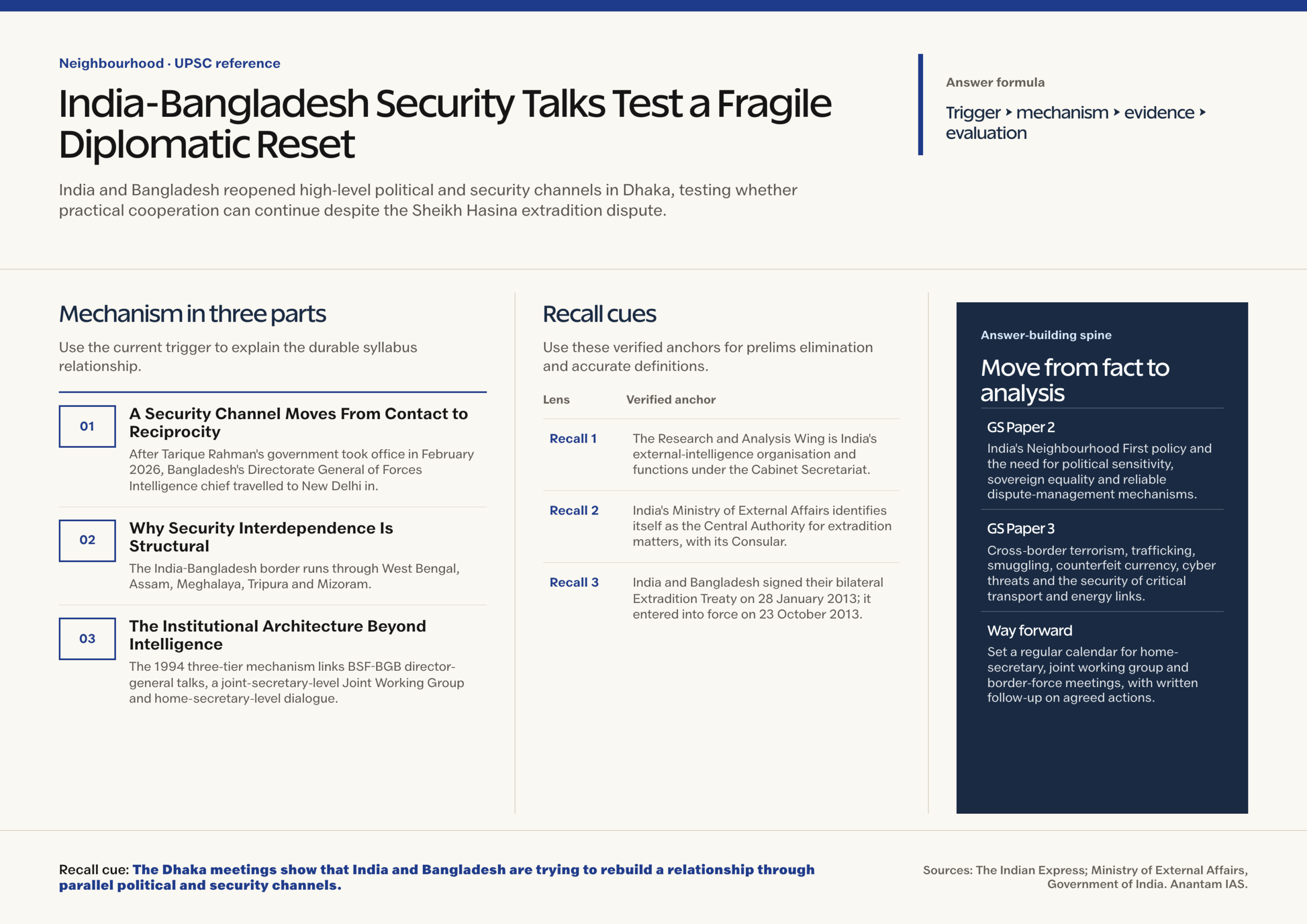
- The Research and Analysis Wing is India’s external-intelligence organisation and functions under the Cabinet Secretariat; it is different from the Intelligence Bureau, which has a domestic intelligence mandate.
- India’s Ministry of External Affairs identifies itself as the Central Authority for extradition matters, with its Consular, Passport and Visa Division serving as the nodal point.
- India and Bangladesh signed their bilateral Extradition Treaty on 28 January 2013; it entered into force on 23 October 2013.
- Under the treaty, extraditable conduct must generally be punishable under the laws of both states by imprisonment for at least one year. The legal categories or names of the offences need not be identical.
- The treaty allows a request to be refused for an offence of a political character, but expressly excludes several violent and terrorism-related offences from that exception.
- Article 10 requires extradition requests to travel through the diplomatic channel and specifies supporting material, including an arrest warrant for an accused person.
Mains Relevance
GS Paper 2
- India’s Neighbourhood First policy and the need for political sensitivity, sovereign equality and reliable dispute-management mechanisms.
- The role of embassies, security advisers, home ministries and leader-level diplomacy in rebuilding trust after a political transition.
GS Paper 3
- Cross-border terrorism, trafficking, smuggling, counterfeit currency, cyber threats and the security of critical transport and energy links.
- The value and risks of intelligence liaison, including timely threat exchange, verification, confidentiality and political oversight.
Essay
- Geography makes cooperation a permanent necessity even when politics makes trust temporary.
Background and Context
A Security Channel Moves From Contact to Reciprocity
The latest visit matters because it follows a sequence of contacts rather than appearing in isolation.
- After Tarique Rahman’s government took office in February 2026, Bangladesh’s Directorate General of Forces Intelligence chief travelled to New Delhi in March and met R&AW chief Parag Jain and other senior Indian security officials.
- In July, Shamsul Islam represented Bangladesh at the BIMSTEC national-security chiefs’ meeting in New Delhi and met India’s National Security Adviser Ajit Doval on the sidelines.
- Jain’s Dhaka visit adds reciprocity and continuity. It gives both sides a channel for communicating sensitive concerns without forcing every issue into public diplomacy.
- Intelligence liaison can support early warning and de-escalation, but its value depends on verified information, agreed red lines and confidence that shared material will be protected.
- A useful liaison channel separates strategic warning from unverified allegation. Each side should be able to ask for corroboration, identify the legal authority for action and record which agency is responsible for follow-up.
Why Security Interdependence Is Structural
The bilateral security agenda flows from geography and cannot be switched off without costs to both countries.
- The India-Bangladesh border runs through West Bengal, Assam, Meghalaya, Tripura and Mizoram. Settlements, rivers, farms and family links make it a human landscape rather than a simple line of control.
- Transnational threats include trafficking in persons, narcotics and arms; smuggling; forged documents; irregular movement; organised criminal networks; extremist recruitment and misuse of digital platforms.
- For India, a cooperative Bangladesh helps prevent hostile actors from exploiting territory near the Northeast. For Bangladesh, cooperation supports border order, trade flows, energy connectivity and access to a large neighbouring market.
- Effective policy must distinguish lawful mobility from criminal movement. Over-securitisation can harm legitimate travellers and border livelihoods, while weak enforcement benefits organised networks.
- Riverine and densely settled stretches complicate surveillance and incident attribution. Local commander hotlines, shared verification of an incident’s location and prompt return of inadvertently crossing civilians can prevent a tactical episode from becoming a diplomatic crisis.
The Institutional Architecture Beyond Intelligence Talks
Security cooperation rests on several formal layers, not on one discreet meeting.
- The 1994 three-tier mechanism links BSF-BGB director-general talks, a joint-secretary-level Joint Working Group and home-secretary-level dialogue. These levels can escalate unresolved operational questions without immediately politicising them.
- The Coordinated Border Management Plan encourages coordinated patrolling, information exchange and action against cross-border crime. Border-force conferences provide a recurring venue to address fencing, vulnerable stretches and incidents involving civilians or personnel.
- The bilateral toolkit also includes arrangements concerning terrorism and organised crime, illicit narcotics, human trafficking, fake currency, maritime cooperation and transfer of sentenced persons.
- BIMSTEC adds a regional layer. Its national-security dialogue can connect bilateral concerns to wider Bay of Bengal challenges such as terrorism, violent extremism, cyber risk and maritime insecurity.
- The levels perform different jobs. Border commanders handle immediate incidents; the Joint Working Group can reconcile procedures across departments; home secretaries can settle policy questions; and political leaders can provide authority when a dispute exceeds the.
Extradition Is a Legal Process, Not a Diplomatic Shortcut
The Hasina dispute is politically charged, but the applicable framework contains defined legal tests and procedures.
- The 2013 treaty creates a reciprocal obligation to extradite persons accused, convicted or wanted to enforce a judicially pronounced penalty for an extraditable offence, subject to the treaty’s conditions.
- The treaty applies dual criminality: the conduct must be punishable in both states, although each legal system may classify or name it differently.
- A request must be made through diplomatic channels and supported by prescribed documents. In India, the Ministry of External Affairs examines the request under the treaty and the Extradition Act, 1962.
- The requested state can examine grounds for refusal, evidentiary sufficiency and procedural protections. The existence of a treaty does not make surrender immediate or remove the role of domestic authorities.
- Keeping treaty analysis separate from intelligence cooperation reduces the danger that either side treats security coordination as leverage for a particular legal outcome.
Way Forward
Institutionalise the Renewed Contact
- Set a regular calendar for home-secretary, joint working group and border-force meetings, with written follow-up on agreed actions.
- Create secure points of contact for urgent threat information and require confirmation before operational action is taken on shared intelligence.
- Use diplomatic missions to connect security discussions with political guidance and prevent competing official messages.
Conclusion
- The Dhaka meetings show that India and Bangladesh are trying to rebuild a relationship through parallel political and security channels .
- The strongest path is institutional: keep border and intelligence cooperation regular, handle extradition through law, and measure progress through safer borders and reliable official conduct.
UPSC Practice Questions
Prelims MCQ 1
With reference to the India-Bangladesh Extradition Treaty, consider the following statements:
- An extraditable offence generally involves conduct punishable in both states by imprisonment for at least one year.
- The laws of both states must classify and name the relevant offence in exactly the same manner.
- The Ministry of External Affairs is India’s Central Authority under the treaty.
How many of the above statements are correct?
(a) Only one (b) Only two (c) All three (d) None
Answer: (b) Only two
Explanation:
Statements 1 and 3 are correct. Article 2 applies dual criminality but says the two legal systems need not place the conduct in the same category or use the same terminology. Article 4 designates India’s Ministry of External Affairs as the Central Authority.
Prelims MCQ 2
Which one of the following correctly describes the three-tier India-Bangladesh mechanism for security and border-management issues?
(a) Coast guard commanders, foreign ministers and prime ministers (b) District magistrates, commerce secretaries and finance ministers (c) BSF-BGB directors general, a joint-secretary-level Joint Working Group and home secretaries (d) Army chiefs, BIMSTEC secretariat and national parliaments
Answer: (c) BSF-BGB directors general, a joint-secretary-level Joint Working Group and home secretaries
Explanation:
The Ministry of Home Affairs records a three-tier mechanism established in 1994: border-force director-general talks, a Joint Working Group at joint-secretary level and home-secretary-level talks.
UPSC Mains Questions
- India-Bangladesh relations demonstrate that security interdependence can outlast political trust. Discuss with reference to the recent revival of high-level security engagement.
- Extradition treaties create a legal framework but not an automatic right to surrender. Explain the distinction and assess its diplomatic significance in South Asia.
Sources: The Indian Express and Ministry of External Affairs, Government of India.
Frequently Asked Questions
What was the immediate trigger for the latest India-Bangladesh security discussion?
R&AW chief Parag Jain met Bangladesh Prime Minister Tarique Rahman’s defence adviser A.K.M. Shamsul Islam in Dhaka on 10 August 2026. Indian High Commissioner Dinesh Trivedi also met the prime minister, showing that political and security contacts were moving in.
Why is intelligence cooperation important between India and Bangladesh?
The neighbours face connected risks involving terrorism, trafficking, narcotics, arms smuggling, forged documents and cyber-enabled crime. Timely, verified intelligence can help disrupt networks and prevent escalation, especially along a long, populated border, but it needs confidentiality, oversight and clear limits.
Does the 2013 extradition treaty make extradition automatic?
No. The treaty creates obligations subject to defined offences, prescribed documents, domestic legal procedure and grounds for refusal. The requested state examines the request under the treaty and its own law. A political demand by itself does not complete the.
What is dual criminality in extradition law?
Dual criminality means that the underlying conduct must be punishable in both the requesting and requested states. Under the India-Bangladesh treaty, the two legal systems do not have to give the offence the same name or place it in the.
What is the Coordinated Border Management Plan?
It is an India-Bangladesh operational framework for more coordinated border management by the BSF and BGB. It supports communication, coordinated action and efforts against illegal cross-border activities while sitting alongside formal director-general, joint working group and home-secretary talks.
Tell Google you want more of this.
Add Anantam IAS as a preferred sourceOne tap, and this site shows up more often in your own Top Stories, AI Overviews and AI Mode. Remove it any time.