Why in News?
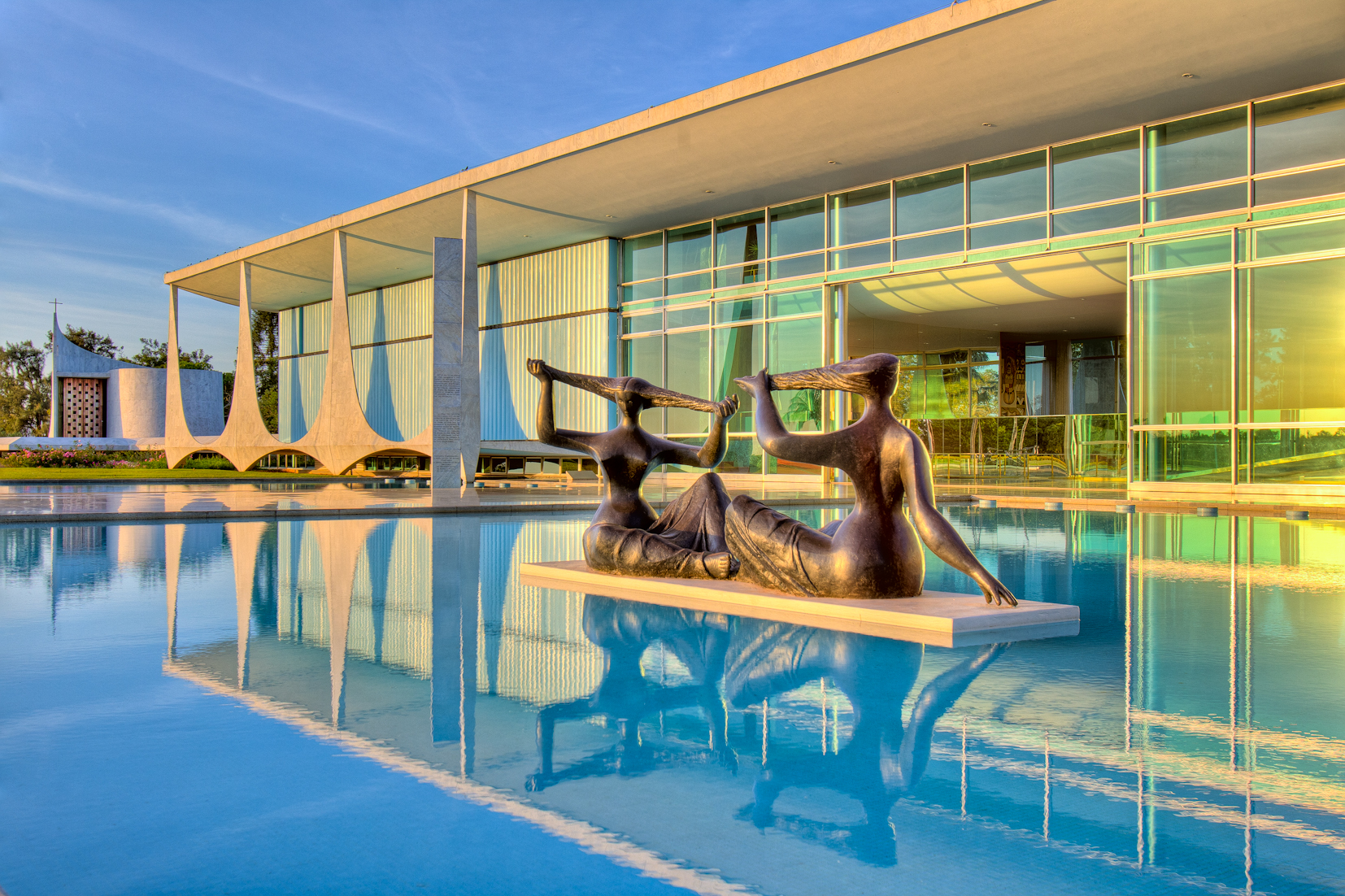
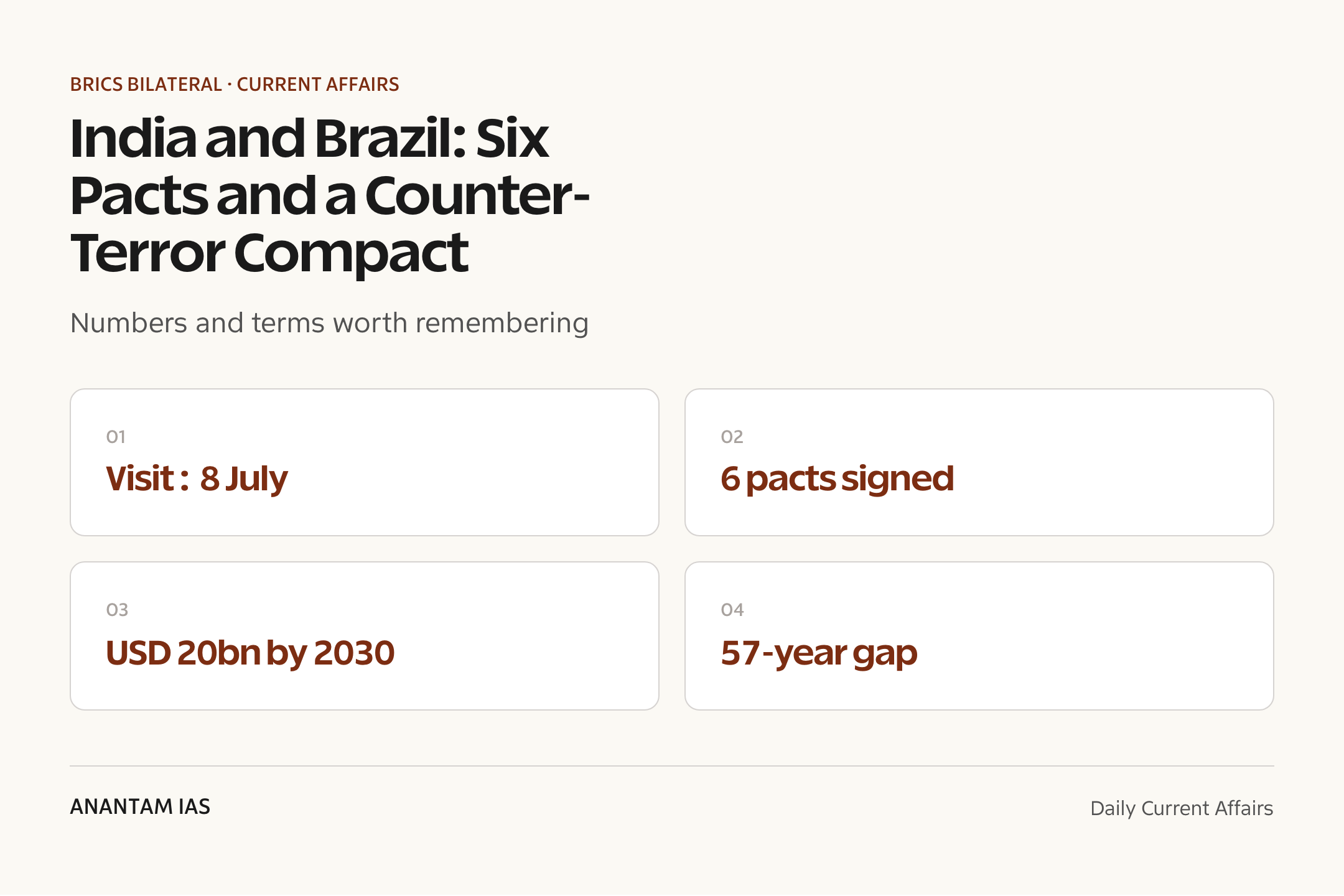
Straight after the 17th BRICS Summit in Rio de Janeiro (6-7 July 2025), Prime Minister Narendra Modi travelled to Brasília for a State Visit to Brazil on 8 July 2025, hosted by President Luiz Inácio Lula da Silva at the Alvorada Palace. It was the first bilateral State Visit by an Indian PM to Brazil in 57 years and only the second ever, a reset of ties first elevated to a Strategic Partnership in 2006.
The two governments issued a Joint Statement, ‘India and Brazil – Two Great Nations with Higher Purposes’, and signed six instruments spanning counter-terrorism, classified-information protection, renewable energy, agricultural research, digital public infrastructure and intellectual property. PM Modi set a target to roughly double two-way trade from about USD 12.2 billion to USD 20 billion in five years.
- State Visit on 8 July 2025; agreements signed across 8-9 July at the Alvorada Palace, Brasília.
- Six instruments signed; a separate basket of five (defence-industry, sports, archives, MLA in civil matters, cultural exchange) flagged for early conclusion.
- Trade target: from ~USD 12.2 billion to USD 20 billion by 2030; a Review Mechanism at Trade-Minister level set up.
- PM Modi conferred Brazil’s highest civilian honour, the Grand Collar of the National Order of the Southern Cross.
- Five-pillar decade roadmap agreed: defence/security, food security, energy transition, digital transformation, industrial partnerships.
- Per PIB, India welcomed Brazil’s support for India’s non-permanent UNSC seat for the 2028-29 term.
The development matters in the context of:
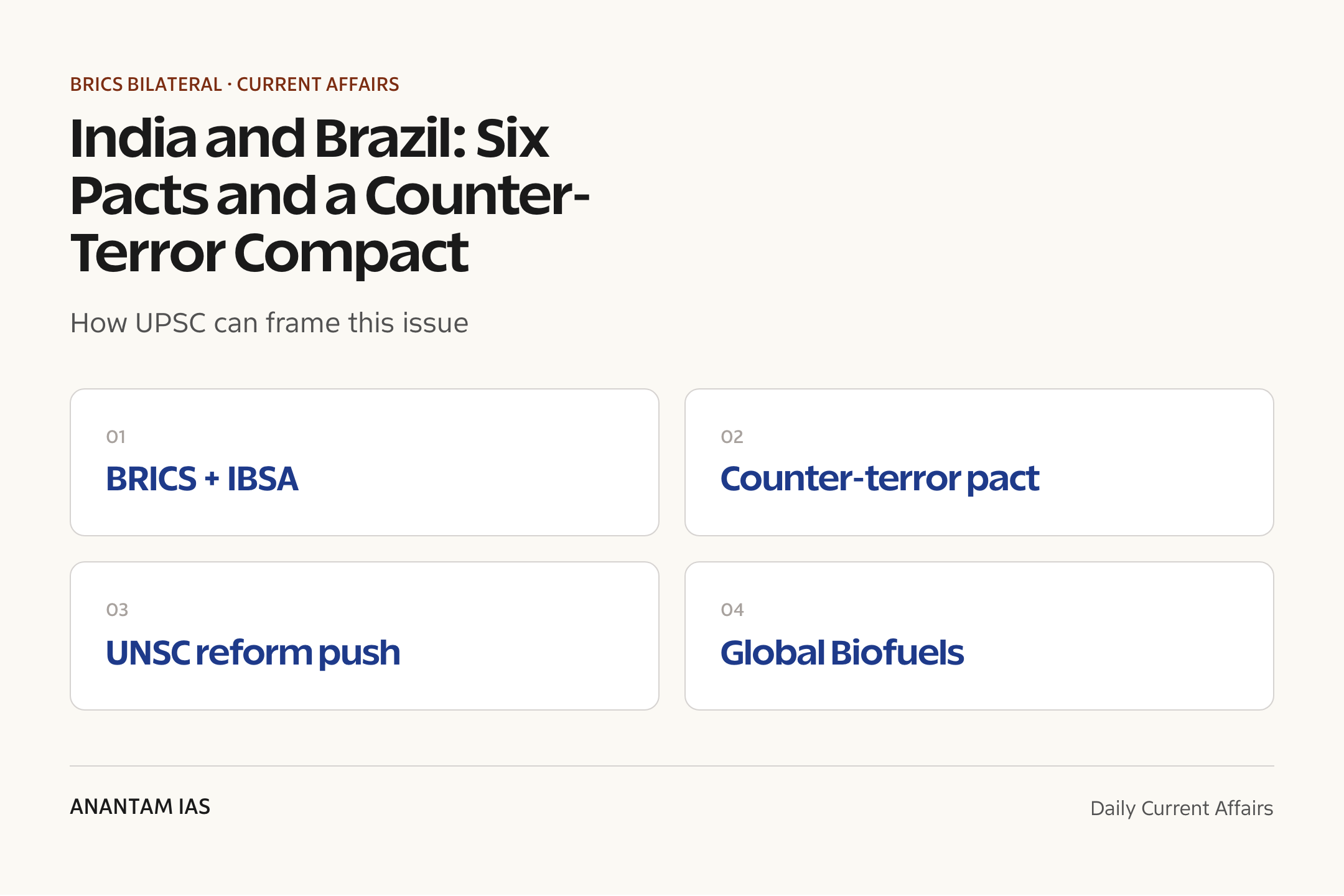
- India and Brazil are fellow members of BRICS, IBSA (India-Brazil-South Africa) and the G20, and co-founders of the Global Biofuels Alliance.
- Both are large Global South democracies and long-standing claimants to permanent UN Security Council seats under a reformed Council.
- The visit anchors counter-terror diplomacy after the Pahalgam terror attack of April 2025, which Brazil condemned.
UPSC Relevance
Prelims Relevance
- IBSA = India, Brazil, South Africa trilateral dialogue forum (2003).
- India-Brazil Strategic Partnership elevated in 2006.
- Global Biofuels Alliance founding members: India and Brazil among them.
- EMBRAPA is Brazil’s agricultural research corporation; signed an MoU with ICAR.
- DPIIT (India) signed the IP MoU with Brazil’s MDIC.
- 1267 UNSC Sanctions Committee designations cited: LeT and JeM.
- FATF referenced for disrupting terror-financing channels.
- COP30 hosted by Brazil at Belém, November 2025; TFFF (Tropical Forests Forever Fund) launched.
- New Development Bank (NDB) is the BRICS bank, headquartered in Shanghai.
- Mercosur is the South American customs union; India-Mercosur has a Preferential Trade Agreement.
Mains Relevance
GS Paper 2
- India-Brazil bilateral ties as a template for Global South and South-South cooperation within BRICS and IBSA.
- Counter-terrorism diplomacy: ‘zero tolerance, zero double standards’, UNSC 1267 listings and FATF cooperation.
- India’s quest for permanent UNSC membership and reciprocal Brazilian backing for the 2028-29 non-permanent seat.
GS Paper 3
- Internal-security dimension: real-time intelligence-sharing and the fight against transnational organised crime.
- Energy transition, biofuels and Sustainable Aviation Fuel cooperation; food and nutritional security through agricultural R&D.
Essay
- Diplomacy as the most effective means of ensuring international peace and security.
- The Global South and the unfinished agenda of fairer global governance.
Background and Context
The visit and its significance
A long-overdue bilateral reset, layered on top of the Rio BRICS Summit.
- First bilateral State Visit by an Indian PM to Brazil in 57 years and only the second ever, signalling renewed political investment in the relationship.
- Came directly after the 17th BRICS Summit at Rio de Janeiro (6-7 July 2025), where India was handed the BRICS Chairship for 2026.
- Ties span almost eight decades; the partnership was raised to a Strategic Partnership in 2006.
- PM Modi was conferred the Grand Collar of the National Order of the Southern Cross, Brazil’s highest civilian honour.
Six instruments signed
Per the PIB Joint Statement, six agreements were signed during the State Visit.
- Agreement on Cooperation in Combating International Terrorism and Transnational Organized Crime.
- Agreement on the Exchange and Mutual Protection of Classified Information.
- MoU on Cooperation in Renewable Energy.
- MoU on Agricultural Research between EMBRAPA and the Indian Council of Agricultural Research (ICAR).
- MoU on Sharing of Successful Large-Scale Digital Solutions for digital transformation (the digital public infrastructure track).
- MoU on Intellectual Property between DPIIT of India and MDIC of Brazil.
The counter-terror compact
The headline security pact targets real-time intelligence cooperation.
- The terrorism agreement covers information exchange, transfer of persons/criminals, and real-time or near-real-time intelligence cooperation, complementing existing extradition and mutual legal assistance frameworks (MEA briefing).
- PM Modi framed it as ‘zero tolerance and zero double standards’ against terrorism, thanking Brazil for condemning the Pahalgam terror attack (April 2025).
- Both leaders called for action against all UN-designated terrorists, citing LeT and JeM under the 1267 Committee, and pledged to choke terror financing at the UN and FATF.
- They welcomed adoption of the UN Convention on Cybercrime and a new Bilateral Cybersecurity Dialogue.
Five-pillar decade roadmap
The leaders chartered a strategic roadmap around five priority pillars for the next ten years.
- Defence and security — joint exercises, classified-information protection, an MoU on defence-industry cooperation flagged for early conclusion.
- Food and nutritional security — agricultural R&D, animal genetics and the Global Alliance Against Hunger and Poverty.
- Energy transition and climate change — biofuels, flex-fuel vehicles, Sustainable Aviation Fuel (SAF), and the Global Biofuels Alliance.
- Digital transformation and emerging technologies — DPI, AI, quantum technologies.
- Industrial partnerships in strategic areas, channelled through the Brazil-India Business Council.
Trade, economy and the USD 20 billion target
Economic ambition was the visit’s commercial centrepiece.
- PM Modi set a target to lift two-way trade from about USD 12.2 billion to USD 20 billion by 2030 (roughly five years).
- A Review Mechanism at the Trade-Minister level was established to track progress and clear bottlenecks.
- Leaders agreed to identify and remove non-tariff barriers and to deepen the India-Mercosur Preferential Trade Agreement.
- Cooperation flagged on local-currency financing, climate finance and capital markets, and within the NDB and AIIB.
Multilateral and Global South convergence
The two democracies aligned on reform of global governance.
- Reaffirmed support for a comprehensive UNSC reform, including permanent seats for both; India welcomed Brazil’s backing of its 2028-29 non-permanent UNSC bid.
- Coordination across BRICS, IBSA, the G20, the World Bank, IMF, AIIB and NDB.
- India backed Brazil’s COP30 presidency (Belém, November 2025) and the Tropical Forests Forever Fund (TFFF).
- Shared positions on Palestine (two-state solution), support for UNRWA, and diplomacy over the Ukraine and West Asia conflicts.
Way Forward
Operationalise the pacts
- Convene the Brazil-India Joint Commission and the Joint Commission on Scientific and Technological Cooperation to turn the five pillars into projects.
- Stand up the Trade-Minister Review Mechanism early so the USD 20 billion goal is measured, not merely announced.
Deepen security cooperation
- Move the counter-terror agreement from text to real-time intelligence-sharing with clear standard operating procedures.
- Conclude the pending defence-industry MoU and the Mutual Legal Assistance agreement in civil matters.
Close the trade-imbalance gap by tackling non-tariff barriers, expanding the India-Mercosur PTA, and scaling cooperation on biofuels and Sustainable Aviation Fuel ahead of COP30.
Conclusion
The Brasília visit converts a long-dormant bilateral track into a working agenda: six signed instruments, a decade roadmap built on five pillars, and a concrete USD 20 billion trade target give the India-Brazil Strategic Partnership measurable substance.
For UPSC, the value lies in how two large Global South democracies fuse counter-terror cooperation, food and energy security, and a shared push for UNSC and global-governance reform — a textbook case of South-South partnership within BRICS and IBSA.
UPSC Practice Questions
Prelims MCQ 1
With reference to the India-Brazil agreements signed during the July 2025 State Visit, consider the following statements:
- An agreement on combating international terrorism and transnational organised crime was signed.
- The MoU on agricultural research was concluded between EMBRAPA and the Indian Council of Agricultural Research.
- An MoU on intellectual property was signed between DPIIT of India and a Brazilian ministry.
How many of the above statements are correct?
(a) Only one (b) Only two (c) All three (d) None
Answer: (c) All three
Explanation:
Per the PIB Joint Statement, all three were among the six instruments signed: the counter-terror agreement, the EMBRAPA-ICAR agricultural research MoU, and the DPIIT-MDIC intellectual property MoU.
Prelims MCQ 2
India and Brazil are members of which of the following groupings together?
(a) BRICS, IBSA and the Global Biofuels Alliance (b) BRICS, ASEAN and the Quad (c) IBSA, SCO and the G7 (d) BRICS, OPEC and IBSA
Answer: (a) BRICS, IBSA and the Global Biofuels Alliance
Explanation:
India and Brazil are fellow members of BRICS and IBSA, and co-founders of the Global Biofuels Alliance. They are not in ASEAN, the Quad, the SCO, the G7 or OPEC.
UPSC Mains Questions
- The July 2025 India-Brazil State Visit has been described as a reset of a long-dormant partnership. Evaluate the strategic significance of the six agreements signed, and assess how they advance India’s interests across BRICS, IBSA and the wider Global South. (250 words)
- Counter-terrorism cooperation is increasingly central to India’s bilateral diplomacy. In light of the India-Brazil agreement on combating international terrorism and transnational organised crime, discuss the opportunities and limits of such real-time intelligence-sharing pacts. (250 words)
Sources: PIB, Prime Minister's Office (Joint Statement) and The Tribune.
Frequently Asked Questions
When did PM Modi visit Brazil in 2025?
Prime Minister Narendra Modi made a State Visit to Brazil on 8 July 2025, hosted by President Lula da Silva at the Alvorada Palace in Brasília, immediately after attending the 17th BRICS Summit in Rio de Janeiro on 6-7 July 2025. Agreements were signed across 8-9 July.
Why was the visit called historic?
It was the first bilateral State Visit by an Indian Prime Minister to Brazil in 57 years, and only the second ever. The relationship had been elevated to a Strategic Partnership in 2006, but this visit gave it a fresh, structured agenda built on five priority pillars over the next decade.
What were the six agreements signed?
The six instruments covered combating international terrorism and transnational organised crime; exchange and protection of classified information; renewable energy; agricultural research (EMBRAPA-ICAR); large-scale digital solutions for digital transformation; and intellectual property (DPIIT-MDIC). These were detailed in the PIB Joint Statement.
What is the India-Brazil trade target?
PM Modi set a target to roughly double two-way trade from about USD 12.2 billion to USD 20 billion by 2030, over five years. The leaders also set up a Review Mechanism at the Trade-Minister level and agreed to remove non-tariff barriers to unlock the full trade potential.
How does the counter-terror agreement work?
Per the MEA briefing, the agreement on combating terrorism and transnational organised crime enables information exchange, transfer of persons and real-time or near-real-time intelligence cooperation. It complements existing extradition and mutual legal assistance treaties, framed by PM Modi as ‘zero tolerance, zero double standards’.
Which groupings do India and Brazil share?
India and Brazil are fellow members of BRICS, IBSA (India-Brazil-South Africa), the G20 and the BASIC climate bloc, and co-founders of the Global Biofuels Alliance. Both are long-standing claimants to permanent seats in a reformed UN Security Council and key Global South voices.
Tell Google you want more of this.
Add Anantam IAS as a preferred sourceOne tap, and this site shows up more often in your own Top Stories, AI Overviews and AI Mode. Remove it any time.