Why in News?
On 9 July 2025, during the first visit by an Indian Prime Minister to Namibia in 27 years, India and Namibia held delegation-level talks at State House, Windhoek, with President Netumbo Nandi-Ndaitwah. News On Air (Prasar Bharati) reported the two sides agreed to expand cooperation across digital technology, defence, agriculture, healthcare and critical minerals.
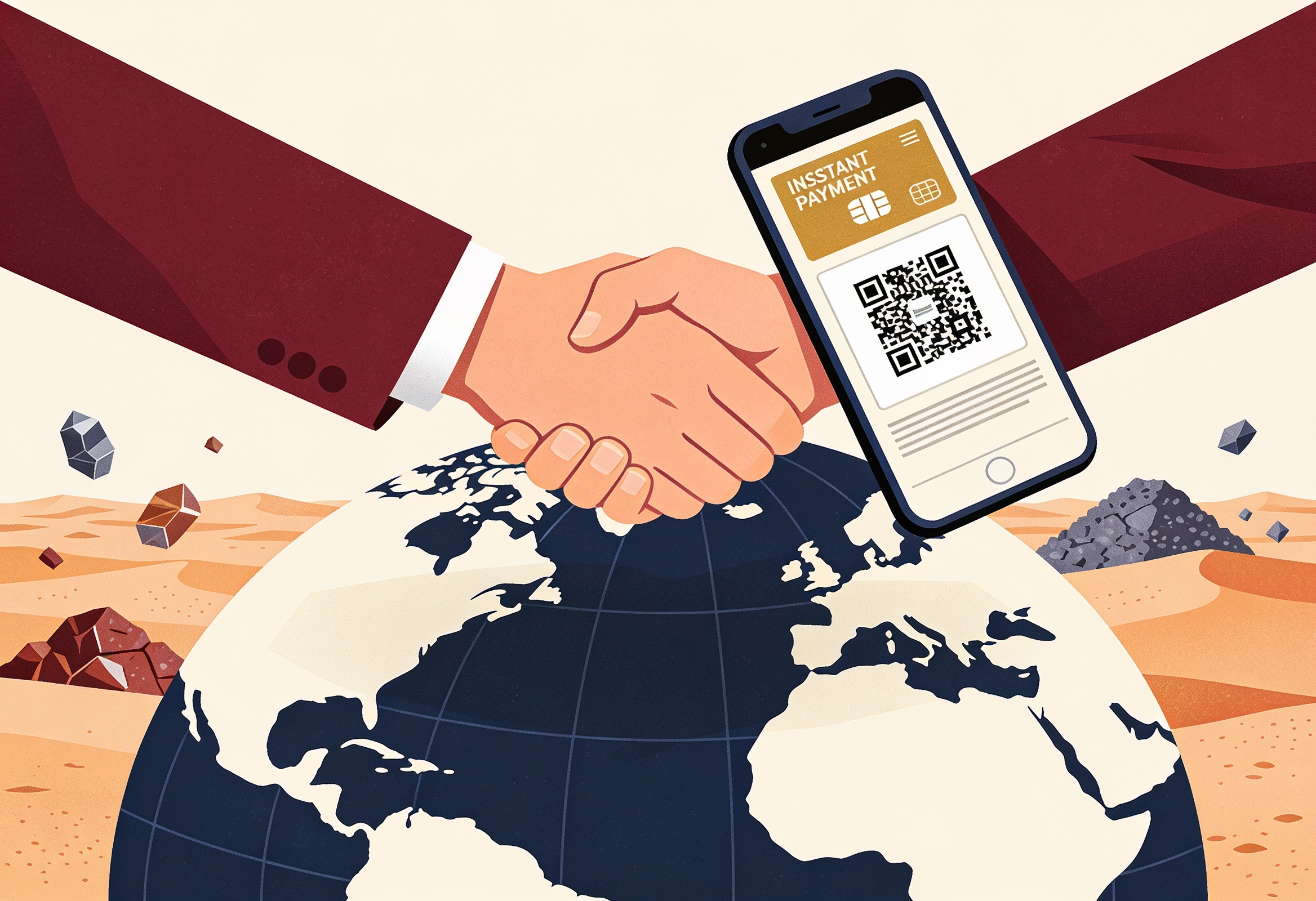
The headline outcome: NPCI International signed a technology agreement with Namibia’s central bank, making Namibia the first country in the world to adopt a UPI-like system through direct licensing. Secretary (Economic Relations) Dammu Ravi confirmed it is “the first country in the world where NPCI has done a technology agreement with a central bank” for a UPI-like payments system.
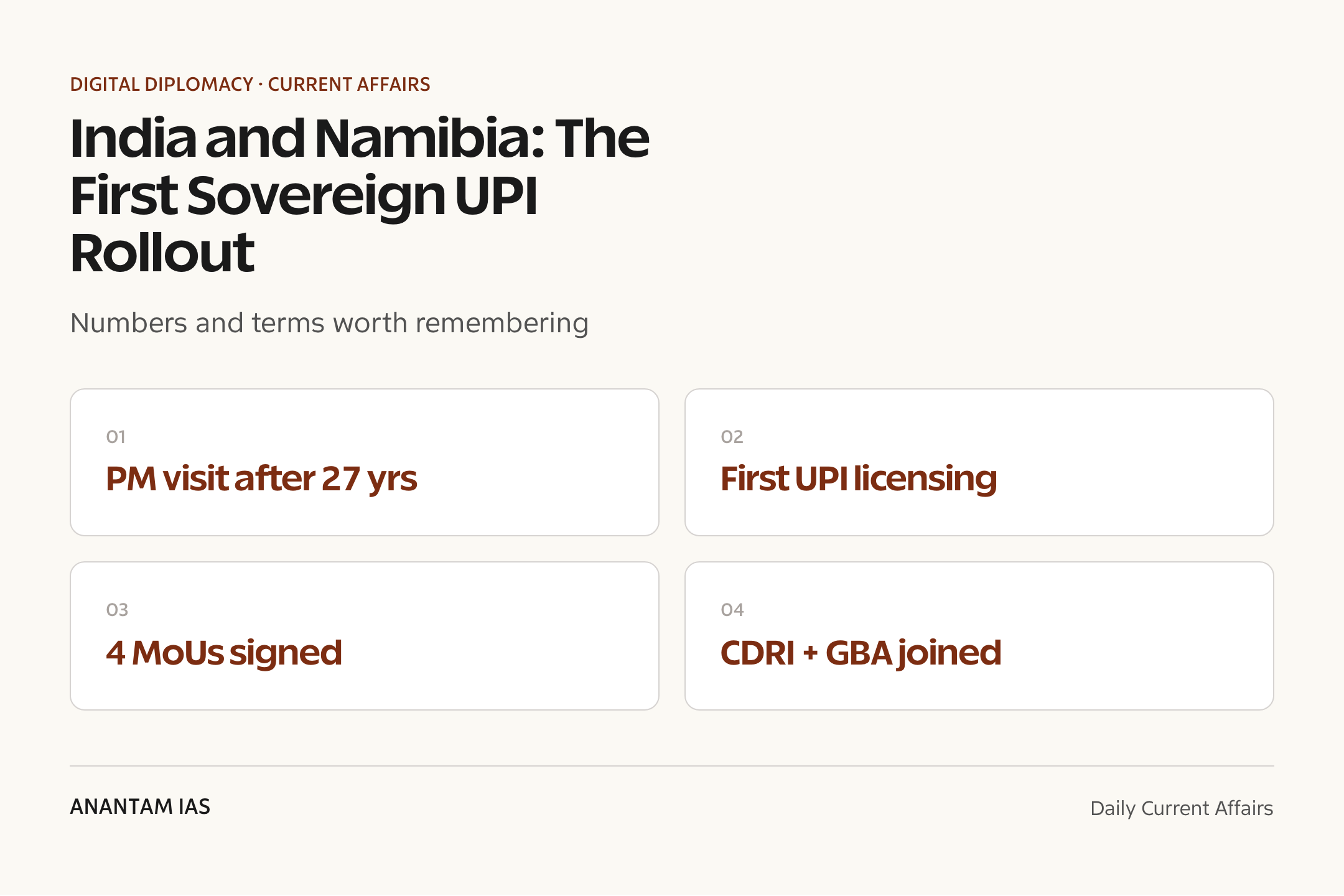
- First Indian PM visit to Namibia in 27 years; talks held at State House, Windhoek.
- NPCI International signed a UPI technology pact with the Bank of Namibia — the world’s first sovereign UPI licensing.
- Four MoUs exchanged, including on health and medicine and an Entrepreneurship Development Centre.
- Namibia accepted membership of the Coalition for Disaster Resilient Infrastructure (CDRI).
- Namibia accepted membership of the Global Biofuels Alliance (GBA).
- Cooperation deepened on critical minerals and digital public infrastructure; the PM paid tribute to founding father Sam Nujoma at Heroes’ Acre.
The development matters in the context of:
- Namibia is rich in uranium, rare earths and other critical minerals India needs for its energy transition and supply-chain diversification.
- UPI’s export turns India’s Digital Public Infrastructure into a foreign-policy tool, scaling the Global South outreach beyond credit lines and training.
UPSC Relevance
Prelims Relevance
- NPCI International Payments Ltd (NIPL) — the NPCI arm that exports UPI and RuPay abroad.
- UPI — Unified Payments Interface, India’s real-time mobile payment system run by NPCI.
- Bank of Namibia — Namibia’s central bank, the counterparty to the technology agreement.
- State House, Windhoek — venue of the talks; Windhoek is Namibia’s capital.
- President Netumbo Nandi-Ndaitwah — Namibia’s first woman President.
- CDRI — Coalition for Disaster Resilient Infrastructure, India-launched at UN in 2019.
- Global Biofuels Alliance — launched at India’s 2023 G20 presidency.
- Sam Nujoma — Namibia’s founding President; Heroes’ Acre is the national memorial.
- Namibia’s location — south-western Africa, on the Atlantic; key uranium exporter.
- Digital Public Infrastructure (DPI) — open digital systems (identity, payments, data) India promotes globally.
Mains Relevance
GS Paper 2
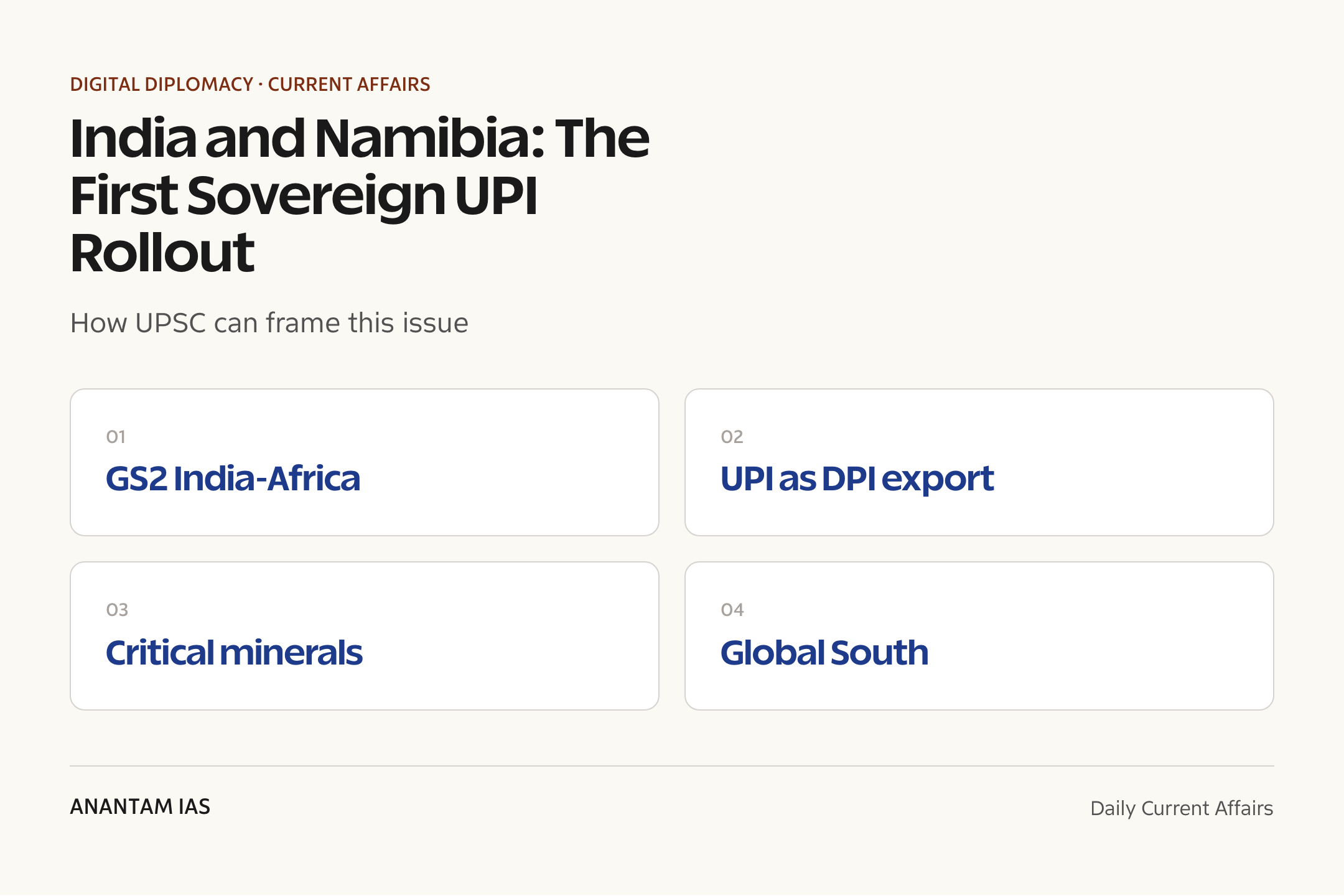
- India-Africa relations: bilateral agreements and the use of digital public goods in India’s foreign policy.
- India’s bid for Global South leadership through technology partnerships and India-led plurilateral coalitions.
GS Paper 3
- Digital public infrastructure and fintech: UPI as an exportable model and the issues in cross-border payments.
- Critical minerals and resource security as drivers of India’s economic diplomacy in Africa.
Essay
- Technology as the new currency of diplomacy.
- India and the Global South: digital public goods over patronage.
Background and Context
The visit and the four MoUs
The Windhoek stop, the final leg of a five-nation tour, anchored several instruments.
- President Netumbo Nandi-Ndaitwah received the PM at State House, Windhoek, for delegation-level talks on 9 July 2025.
- Four MoUs were exchanged, covering health and medicine, the setting up of an Entrepreneurship Development Centre, broad cooperation, and digital payments.
- Cooperation areas flagged: digital technology, defence, security, agriculture, healthcare, education and critical minerals.
- The PM paid tribute to Sam Nujoma, Namibia’s founding father, at the National Memorial Heroes’ Acre.
The first sovereign UPI licensing
The standout deliverable made Namibia a global first for UPI adoption.
- NPCI International signed a technology agreement with Namibia’s central bank to build a UPI-like instant payments system, targeted for a later-2025 rollout.
- Secretary (Economic Relations) Dammu Ravi said Namibia is “the first country in the world where NPCI has done a technology agreement with a central bank” for such a system.
- Unlike earlier interlinking deals (Singapore’s PayNow, France, the UAE), this is direct licensing of the technology so Namibia runs its own sovereign rail.
- It marks a shift from exporting UPI as a service to transferring it as infrastructure a partner state owns and operates.
UPI as a foreign-policy export
Digital Public Infrastructure has become a distinct lever of Indian statecraft.
- UPI processes the bulk of India’s retail digital transactions; its open, low-cost design is attractive to developing economies.
- NPCI International Payments Ltd (NIPL) is the dedicated arm for taking UPI and RuPay overseas.
- India frames its DPI stack — identity, payments and data exchange — as a digital public good for the Global South.
- For Namibia, a homegrown system promises lower transaction costs, deeper financial inclusion and reduced dependence on foreign card networks.
Joining India-led coalitions
The visit drew Namibia into two plurilateral groupings India helped create.
- Namibia accepted membership of the Coalition for Disaster Resilient Infrastructure (CDRI), launched by India at the UN Climate Action Summit in 2019.
- Namibia accepted membership of the Global Biofuels Alliance (GBA), launched during India’s 2023 G20 presidency.
- Both expand India’s convening power and embed partners in India-built multilateral architecture.
- The pattern mirrors India’s wider Africa outreach — coalitions plus capacity-building rather than aid alone.
Critical minerals and why Namibia matters
Beyond payments, resource security underpins the engagement.
- Namibia is among the world’s largest uranium producers and holds rare earths and other critical minerals.
- These feed India’s energy transition, nuclear programme and clean-tech supply chains amid efforts to cut import concentration.
- Critical-minerals cooperation aligns with India’s push to secure inputs for batteries, semiconductors and renewables.
- Namibia’s Atlantic location and stable polity make it a useful entry point for India’s Africa economic strategy and a counterweight to other external powers.
Way Forward
Operationalise the UPI rail
- Move from the technology agreement to a live, audited system with clear data-localisation, security and grievance-redress rules.
- Build interoperability so the Namibian system can later link to UPI for remittances and cross-border payments.
Convert minerals talk into projects
- Negotiate transparent, value-adding deals on uranium and rare earths that include local processing and skills, not raw extraction.
- Tie critical-minerals supply to India’s clean-energy and strategic-reserve goals.
Use the four MoUs and new coalition memberships to create a structured review mechanism, so a historic first visit translates into delivered projects rather than one-off announcements.
Conclusion
The Namibia visit shows India deploying Digital Public Infrastructure as a foreign-policy export: by licensing UPI to a sovereign central bank for the first time, India offered not a service but ownership of the technology itself.
Paired with critical-minerals cooperation and Namibia’s entry into CDRI and the Global Biofuels Alliance, the visit advances India’s bid to lead the Global South through digital public goods. Delivery on the live payments system and mineral projects will decide whether the first-of-its-kind label endures.
UPSC Practice Questions
Prelims MCQ 1
With reference to the India-Namibia engagement of July 2025, consider the following statements:
- Namibia became the first country to adopt a UPI-like system through direct technology licensing from NPCI.
- Namibia accepted membership of the Coalition for Disaster Resilient Infrastructure.
- Namibia accepted membership of the Global Biofuels Alliance.
How many of the above statements are correct?
(a) Only one (b) Only two (c) All three (d) None
Answer: (c) All three
Explanation:
All three are correct: NPCI signed the world’s first central-bank UPI technology agreement with Namibia, and Namibia accepted membership of both CDRI and the Global Biofuels Alliance during the visit.
Prelims MCQ 2
Which entity is responsible for taking India’s UPI and RuPay systems to other countries?
(a) Reserve Bank of India (b) NPCI International Payments Ltd (c) Ministry of External Affairs (d) National Informatics Centre
Answer: (b) NPCI International Payments Ltd
Explanation:
NPCI International Payments Ltd (NIPL) is the dedicated overseas arm of the National Payments Corporation of India for exporting UPI and RuPay; it signed the technology agreement with Namibia’s central bank.
UPSC Mains Questions
- India is increasingly using its Digital Public Infrastructure as an instrument of foreign policy. Examine this shift in the light of the 2025 UPI technology agreement with Namibia’s central bank.
- “India’s outreach to Africa now combines digital public goods, critical-minerals security and India-led coalitions.” Discuss with reference to the July 2025 India-Namibia engagement.
Sources: News On Air (Prasar Bharati) and India's World.
Frequently Asked Questions
What was historic about the July 2025 India-Namibia talks?
It was the first visit by an Indian Prime Minister to Namibia in 27 years. The headline outcome was a technology agreement under which NPCI helps Namibia’s central bank build a UPI-like instant payments system — the first time any country has adopted UPI through direct sovereign licensing rather than a service link-up.
What is the difference between UPI licensing and UPI linkage?
In earlier deals such as Singapore’s PayNow, India interlinked two existing systems for cross-border payments. With Namibia, NPCI is licensing the underlying technology so the country builds and runs its own sovereign payments rail. It owns the infrastructure rather than simply connecting to India’s.
What is NPCI International Payments Ltd?
NPCI International Payments Ltd (NIPL) is the overseas arm of the National Payments Corporation of India. It is tasked with deploying UPI and RuPay abroad through partnerships with central banks, payment operators and merchants, and it signed the technology agreement with Namibia’s central bank.
Which coalitions did Namibia join during the visit?
Namibia accepted membership of two India-led groupings: the Coalition for Disaster Resilient Infrastructure (CDRI), launched by India at the UN in 2019, and the Global Biofuels Alliance, launched during India’s 2023 G20 presidency. Both embed Namibia in India-built multilateral platforms.
Why are critical minerals central to India-Namibia ties?
Namibia is among the world’s largest uranium producers and holds rare earths and other critical minerals. India needs these for its energy transition, nuclear programme and clean-technology supply chains, and is seeking transparent partnerships that include local value addition rather than raw extraction alone.
What does the UPI deal mean for India’s foreign policy?
It shows India exporting Digital Public Infrastructure as a foreign-policy tool. By transferring UPI as owned infrastructure, India deepens its Global South leadership, builds goodwill and long-term technological ties, and offers an alternative to dependence on foreign card networks for developing economies.
Tell Google you want more of this.
Add Anantam IAS as a preferred sourceOne tap, and this site shows up more often in your own Top Stories, AI Overviews and AI Mode. Remove it any time.