Why in News?
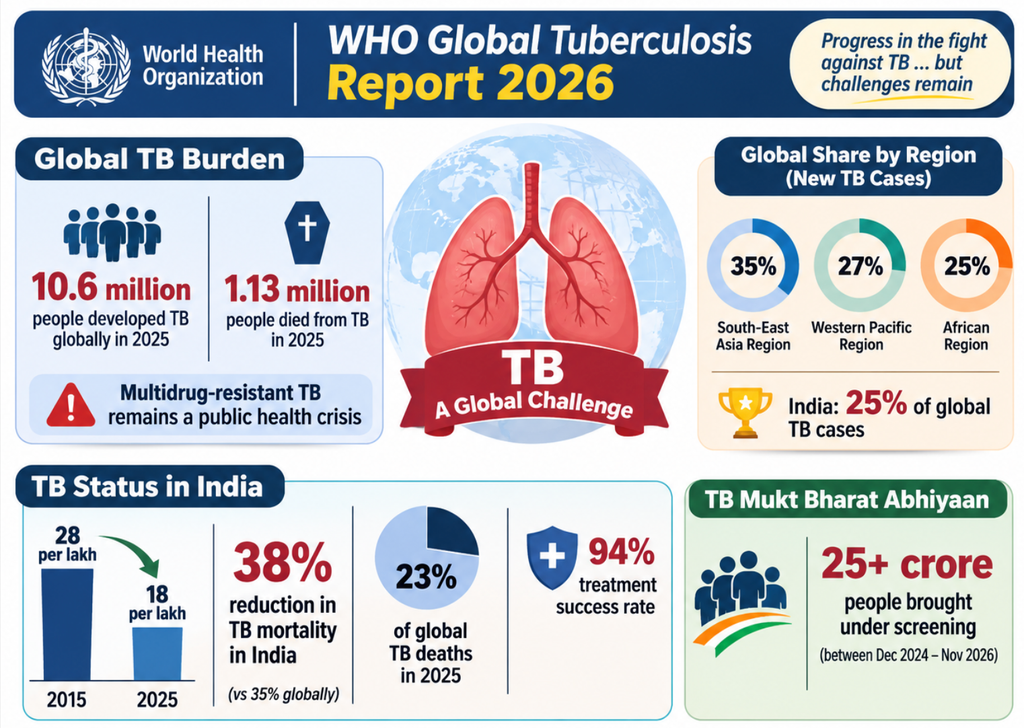
As per the World Health Organisation (WHO)’s Global Tuberculosis Report 2026, India has seen a 38% reduction in tuberculosis (TB) mortality since 2015, compared to a global average of 35%, and a 94% treatment success rate among patients with drug-susceptible TB.
| UPSC Relevance: GS-2 Social Justice: Health; GS-3 Science and Technology: Diseases Prelims: Tuberculosis; National TB Elimination Programme; PM TB Mukt Bharat Abhiyan Mains: TB control- challenges associated & policies launched. |
Key Highlights of the WHO Global Tuberculosis Report 2026:
1. Global TB Burden:
- An estimated 10.6 million people developed TB globally in 2025. Approximately 1.13 million people died from TB in 2025. Multidrug-resistant TB remains a public health crisis and a health security threat.
- The South-East Asia Region accounted for the largest share of new TB cases (35%), followed by the Western Pacific Region (27%) and the African Region (25%).
- India has the highest share of global TB cases (25%).
2. TB Status in India:
- India recorded a 38% reduction in TB mortality between 2015 and 2025, compared with the global decline of 35%.
- India’s estimated TB mortality rate declined from 28 deaths per lakh population in 2015 to 18 per lakh in 2025.
- India accounted for approximately 23% of global TB deaths in 2025, indicating that the disease continues to pose a major public health challenge.
- India achieved a 94% treatment success rate among patients with drug-susceptible TB.
Between December 7, 2024 and November 8, 2026, the TB Mukt Bharat Abhiyaan achieved significant progress, identifying and bringing over 25 crore individuals within the scope of screening.
What is Tuberculosis?
- An airborne, communicable disease caused by the bacterium Mycobacterium tuberculosis.
- Can cause:
- Pulmonary TB (Infection in the lungs): Typically, the bacteria grow in the body where oxygen and blood are in high amounts. As a result, 80% of TB cases are pulmonary.
- Extra-pulmonary TB: 20% of cases are extra-pulmonary, which can infect the brain, uterus, stomach, mouth, kidneys and bones.
- High-risk groups: People with weak immunity, like those infected with HIV, undernutrition, diabetes, smoking and alcohol consumption.
- Prevention: BCG vaccine for children. Currently, there is no effective vaccine for adults.
- Treatment: DOTS strategy (Directly Observed Treatment Short Course) is a WHO-recommended cost-effective strategy.
- Latent TB Infection: A condition in which a person is infected with TB bacteria but does not have active disease and cannot transmit TB.
- Drug-Resistant TB: Develops when TB bacteria become resistant to medicines used to treat the disease.
- MDR-TB: Multidrug-resistant TB, resistant to at least isoniazid and rifampicin, the two most powerful first-line anti-TB drugs.
- XDR-TB: Extensively drug-resistant TB, a form of MDR/RR-TB with additional resistance to important medicines, including fluoroquinolones and other Group A drugs.
Challenges in Eliminating TB in India:
- High Disease Burden: India continues to account for approximately one-fourth of global TB cases, making elimination particularly challenging.
- Drug-Resistant TB: Incomplete treatment, delayed diagnosis and inappropriate use of antibiotics can contribute to drug resistance, making treatment longer, more complex and expensive.
- Undernutrition and Poverty: Poor nutritional status increases susceptibility to TB and can worsen treatment outcomes. Poverty also limits access to timely diagnosis and healthcare.
- Missing Cases: Undiagnosed and unreported cases continue to facilitate transmission within communities. Asymptomatic cases further complicate detection.
- Stigma and Social Discrimination: Fear of social exclusion discourages people from seeking diagnosis and completing treatment.
- Private Healthcare Fragmentation: A significant proportion of patients seek treatment in the private sector, making standardised reporting, treatment protocols and follow-up essential.
- Financial Burden: Indirect costs, including lost wages, transportation and nutritional expenses, can push TB-affected households into poverty.
- Comorbidities: HIV, diabetes, tobacco consumption and undernutrition increase vulnerability to TB and complicate treatment.
Efforts towards TB Eradication:
(i) Global Efforts:
- End TB Strategy: WHO declared TB a global epidemic in 1993. End TB Strategy is a global strategy by WHO to reduce TB deaths by 90% and cut new cases by 80% by 2030. It includes five pillars: integrated patient-centred care and prevention, bold policies and supportive systems, intensified research and innovation, universal health coverage, and social and economic interventions.
(ii) Initiatives by the Indian Government:
- National TB Elimination Programme (NTEP) was adopted in 1997 (earlier known as the Revised National Tuberculosis Control Programme).
- DOTS strategy: Focus on Early Diagnosis and Treatment in accordance with the DOTS strategy and supported with high-quality, free diagnostics, treatment and medicines.
- Nikshay Portal (Ni-Kshay: End TB) is a web-enabled patient management system for tracking of notified TB cases and TB control under the NTEP.
- Nikshay Poshan Yojana provides ₹1000 per month to support patients’ nutrition during their treatment.
- Nikshay Mitra initiative: Mobilises voluntary community support for TB-affected persons.
- Intensified IEC campaigns to reduce stigma, raise community awareness and improve health-seeking behaviour.
- National Strategic Plan for TB Elimination 2017-2025: Adopted in 2018 in line with WHO’s TB Elimination Strategy. It set the ambitious target to reduce TB incidence, prevalence and mortality rates in India by 2025.
- Includes 4 strategic pillars: Detect – Treat – Prevent – Build
- Specific targets include: 80% reduction in TB incidence; 90% reduction in TB mortality ; 0% of patients with catastrophic expenditure due to TB.
- Pradhan Mantri TB Mukt Bharat Abhiyan campaign: Launched in 2022, the campaign encourages communities to adopt TB patients and support them through nutritional support and vocational support for a minimum of 6 months or up to 3 years.
India’s reduction in TB mortality and improvement in treatment success reflect progress in public health interventions.
The continuing disease burden and drug-resistant TB highlight the need to move beyond treatment-centric interventions towards comprehensive prevention, nutritional security, accessible healthcare and community-led action.
Mains Practice Question:
Q. Despite improvements in diagnosis and treatment, tuberculosis remains a major public health challenge in India. Examine the socio-economic and healthcare-related factors responsible for its persistence and suggest measures to achieve TB elimination.
Tell Google you want more of this.
Add Anantam IAS as a preferred sourceOne tap, and this site shows up more often in your own Top Stories, AI Overviews and AI Mode. Remove it any time.