Why in News?
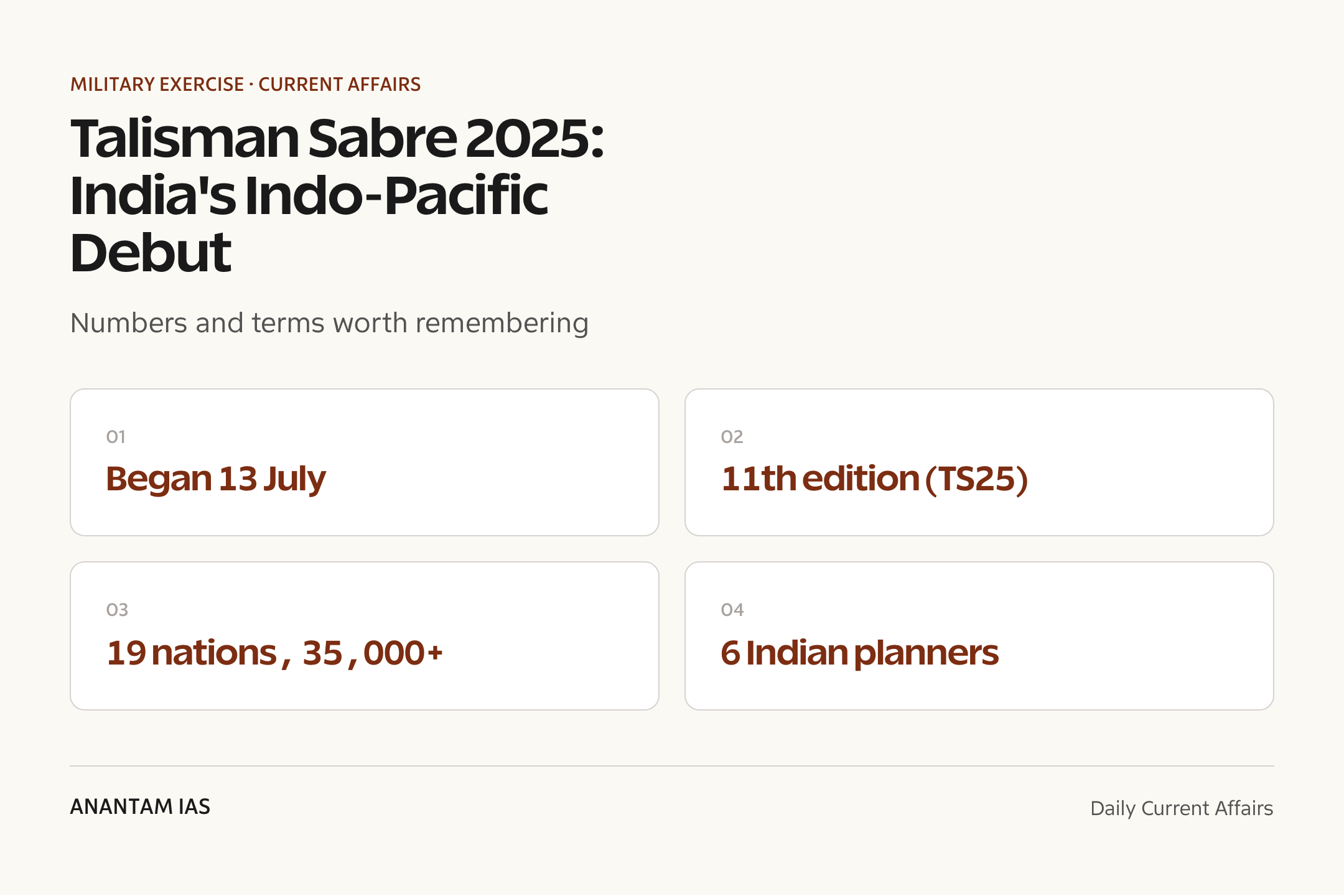
From 13 July 2025, India took part for the first time as an active participant in Exercise Talisman Sabre 2025 (TS25) — the largest multilateral warfighting exercise led by the Australian Defence Force (ADF) and the United States Armed Forces. Held across Australia and, for the first time, Papua New Guinea, the three-week exercise drew over 35,000 personnel from 19 nations.
PIB confirmed that six officers of the Indian Armed Forces served as Staff Planners across Joint Operations Planning, Control, Safety and Logistics. India had earlier attended the 2021 and 2023 editions only as Observers, so TS25 marks its shift from watching to working inside the exercise’s planning machinery.
- TS25 is the 11th edition of the biennial exercise; it began on 13 July 2025 and ran for about three weeks.
- Scale: over 35,000 military personnel from 19 nations, with Malaysia and Vietnam attending as observers.
- India’s contribution: six officers as Staff Planners in Joint Operations Planning, Control, Safety and Logistics.
- Indian officers participated in the 2021 and 2023 editions as Observers — TS25 is their first active, embedded role.
- Chief of Integrated Defence Staff (CISC), Air Marshal Ashutosh Dixit, visited Australia on 26–28 July 2025 to witness the exercise.
- Australian venues spanned Queensland, the Northern Territory, Western Australia, New South Wales and Christmas Island, plus the first-ever expansion into Papua New Guinea.
The development matters in the context of:
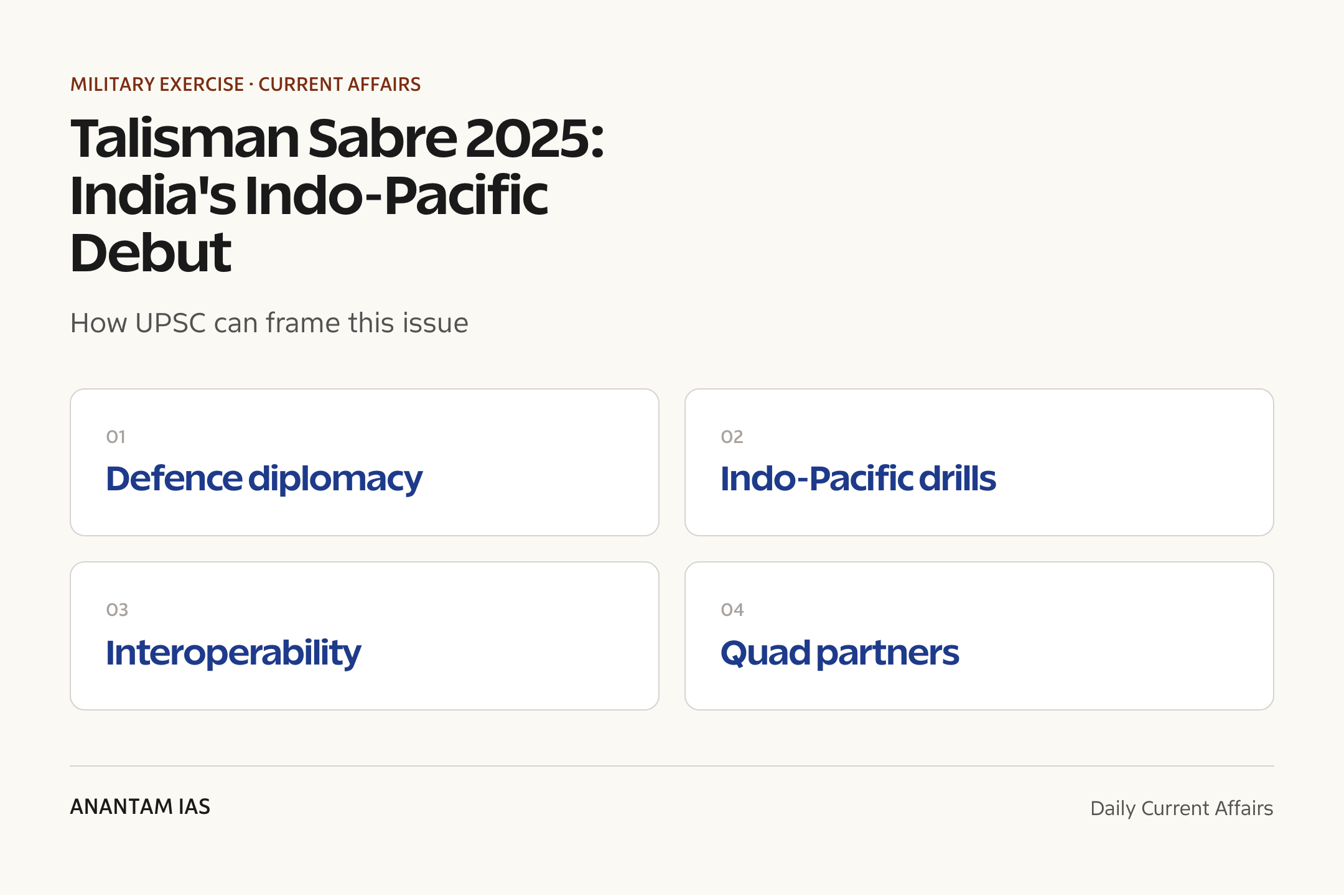
- India’s debut as a participant signals deepening alignment with the Quad and like-minded Indo-Pacific partners on military interoperability.
- It fits a wider pattern of India joining and hosting multilateral drills — from Malabar and Tarang Shakti to bilateral exercises with key partners.
- Staff-planner roles, rather than mere observation, build the institutional muscle needed to operate inside complex multinational task forces.
UPSC Relevance
Prelims Relevance
- Exercise Talisman Sabre — biennial multilateral exercise led by Australia and the United States; 11th edition (TS25) in 2025.
- TS25 scale: over 35,000 personnel from 19 nations; first-ever activity extending into Papua New Guinea.
- India’s role in TS25: six officers as Staff Planners; earlier present only as Observers (2021, 2023).
- Chief of Integrated Defence Staff (CISC) — a tri-services post under the Department of Military Affairs; held by Air Marshal Ashutosh Dixit in 2025.
- Domains exercised: land, air, maritime, space and cyber — i.e. multi-domain operations.
- Quad — India, US, Australia, Japan; an informal Indo-Pacific grouping (not a treaty alliance).
- Malabar — India-led naval exercise now involving all four Quad navies.
- Tarang Shakti — India’s first multinational air exercise, hosted in 2024.
- Other Indo-Pacific exercises: RIMPAC (US-led, world’s largest naval exercise) and Pitch Black (Australia-led air exercise).
Mains Relevance
GS Paper 3
- Joint and multilateral military exercises as instruments of building interoperability, doctrine and force readiness.
- Role of the integrated tri-services structure (CDS, CISC, theatre commands) in coordinating India’s external defence engagements.
GS Paper 2
- Defence diplomacy and the Quad as vectors of India’s Indo-Pacific strategy.
- Balancing closer security cooperation with the US and Australia against India’s tradition of strategic autonomy.
Essay
- Security through cooperation: the changing grammar of military partnerships in the Indo-Pacific.
- Strategic autonomy in an era of minilateral alignments.
Background and Context
What Exercise Talisman Sabre is
Talisman Sabre is the flagship Australia-US warfighting exercise, run every two years.
- Co-led by the Australian Defence Force (ADF) and the United States Armed Forces; the 2025 edition (TS25) is the 11th in the series.
- TS25 ran for about three weeks from 13 July 2025, drawing over 35,000 personnel from 19 nations.
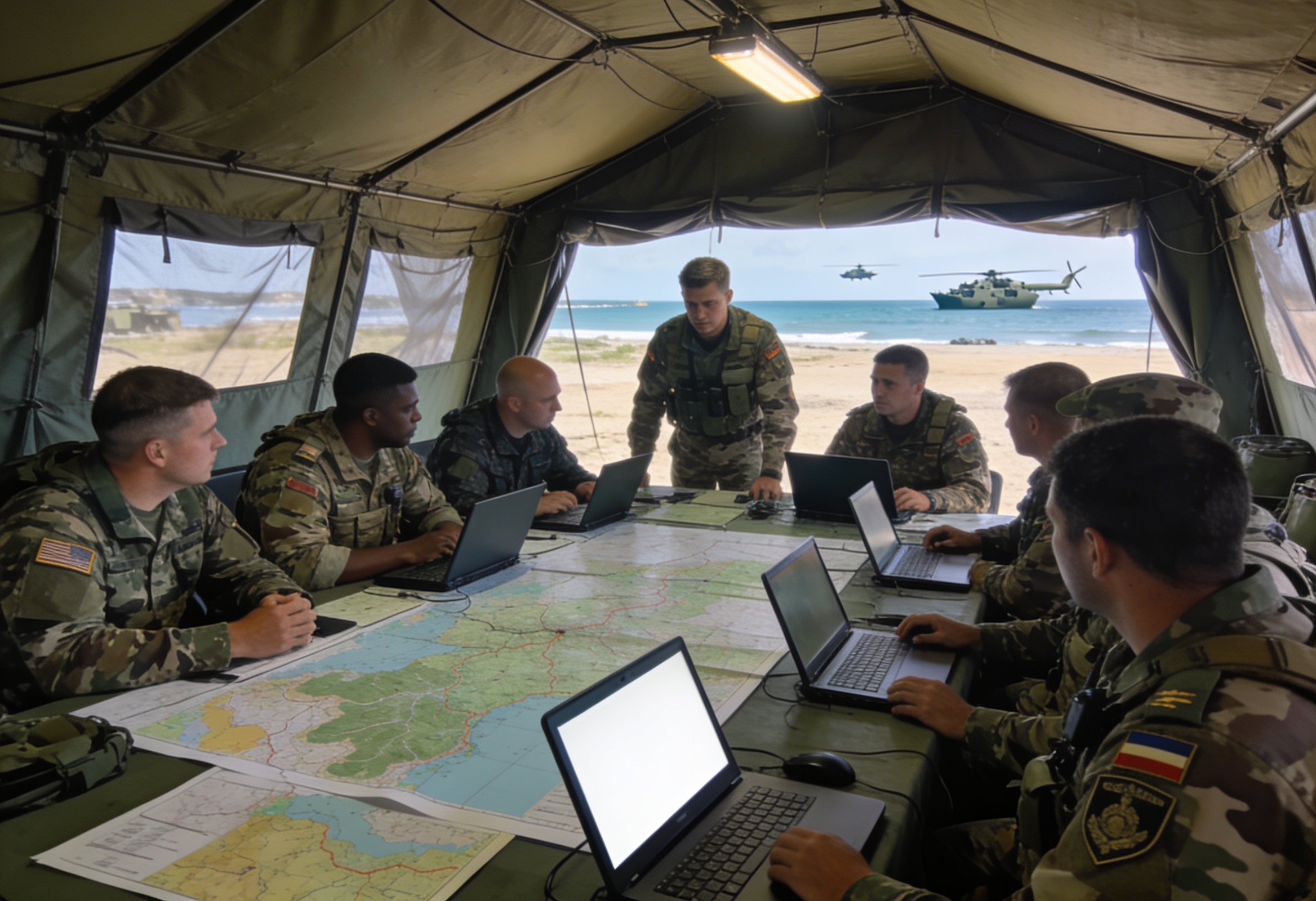
- Activities include live-fire drills, amphibious landings, integrated field training and combined air and maritime operations across land, air, maritime, space and cyber domains.
- It is designed as a realistic testbed for multi-domain operations in support of a free, open and inclusive Indo-Pacific.
Who took part
TS25 brought together a broad spread of regional and global partners.
- Participating nations alongside Australia and the US included India, Japan, the Republic of Korea, the Philippines, Singapore, Thailand, Indonesia, New Zealand, Fiji, Tonga and Papua New Guinea, plus European partners the United Kingdom, France, Germany, the Netherlands and Norway and Canada.
- Malaysia and Vietnam attended as observers.
- Australian venues ran across Queensland, the Northern Territory, Western Australia, New South Wales and Christmas Island.
- For the first time the exercise expanded into Papua New Guinea, extending its geographic footprint into the South Pacific.
What India actually did
India’s participation was modest in size but significant in kind.
- Six officers of the Indian Armed Forces were embedded as Staff Planners at various levels of Joint Operations Planning, Control, Safety and Logistics.
- This is a step up from the 2021 and 2023 editions, where Indian officers attended only as Observers — TS25 is the first time India worked inside the exercise’s command-and-control structure.
- CISC Air Marshal Ashutosh Dixit visited Australia on 26–28 July 2025 to witness training activities and meet senior military leaders of participating nations.
- PIB framed the participation as a testimony to India’s growing role in multilateral defence diplomacy and a stable Indo-Pacific.
Why interoperability matters
Staff-planner roles build the unglamorous but decisive skill of operating with others.
- Interoperability is the ability of different forces to plan, communicate and fight together using shared procedures, terminology and systems.
- Embedding officers in planning, control, safety and logistics teaches India how a large multinational force is run from the inside, not just observed from the sidelines.
- These skills transfer to HADR (humanitarian assistance and disaster relief), evacuation and coalition operations where India increasingly contributes.
- It also signals reliability to partners, supporting India’s positioning as a net security provider in the Indo-Pacific.
India's wider exercise calendar
TS25 sits within a fast-growing web of Indian military diplomacy.
- Malabar — the naval exercise India hosts that now brings together all four Quad navies.
- Tarang Shakti — India’s first multinational air exercise, hosted in 2024.
- Bilateral and trilateral drills span the army, navy and air force with the US, France, Australia, Japan and others.
- Joining a flagship like Talisman Sabre complements these and widens India’s partner network in the Pacific theatre.
The Indo-Pacific strategic backdrop
India’s debut reflects a region recalibrating around shared security concerns.
- The exercise is explicitly framed around a free, open and inclusive Indo-Pacific — language widely read as a response to assertive Chinese behaviour in the region.
- Closer drills with Quad and like-minded partners deepen practical cooperation without forming a formal alliance.
- For India this is calibrated engagement: deepening interoperability while protecting strategic autonomy and avoiding open bloc politics.
- The expansion into Papua New Guinea underlines the Pacific Island states’ rising weight in the regional security map.
Way Forward
Move from planning to forces
- Build on the staff-planner role by committing ships, aircraft or troops to future editions so India trains as a contributing force, not only a planner.
- Use lessons in logistics and multi-domain coordination to sharpen India’s own integrated-theatre-command reforms.
Institutionalise interoperability
- Standardise procedures, communications and data-sharing with key partners to make joint operations faster and safer.
- Expand officer exchanges and embedded postings so the skills gained at TS25 spread across the services.
Keep the engagement calibrated
- Deepen Indo-Pacific cooperation while preserving strategic autonomy and avoiding the optics of a formal military bloc.
- Tie exercise diplomacy to concrete goals — HADR readiness, maritime domain awareness and capacity-building with Pacific partners.
Conclusion
India’s move from Observer to Staff Planner at Talisman Sabre 2025 is a small contribution with a large signal. By embedding officers in the planning, control, safety and logistics of the Indo-Pacific’s biggest multilateral exercise, India is building the institutional habit of operating inside complex multinational forces.
The next test is depth: turning planning roles into committed forces, and exercise diplomacy into durable interoperability. Done well, participation in drills like TS25 strengthens India’s standing as a trusted, capable partner while keeping its strategic autonomy intact.
UPSC Practice Questions
Prelims MCQ 1
With reference to Exercise Talisman Sabre 2025 (TS25), consider the following statements:
- It is led by the Australian Defence Force and the United States Armed Forces.
- India participated in the 2025 edition with officers serving as Staff Planners.
- The 2025 edition for the first time extended its activities into Papua New Guinea.
How many of the above statements are correct?
(a) Only one (b) Only two (c) All three (d) None
Answer: (c) All three
Explanation:
All three are correct. PIB confirmed TS25 is co-led by the ADF and US Armed Forces, that six Indian officers took part as Staff Planners, and that the 2025 edition expanded into Papua New Guinea for the first time.
Prelims MCQ 2
The post of Chief of Integrated Defence Staff (CISC) in India is best described as:
(a) A purely naval appointment heading the Western Naval Command (b) A tri-services appointment within the integrated defence structure (c) The civilian Defence Secretary in the Ministry of Defence (d) The diplomatic head of India’s defence attaches abroad
Answer: (b) A tri-services appointment within the integrated defence structure
Explanation:
The CISC is a senior tri-services officer in India’s integrated defence apparatus; in 2025 the post was held by Air Marshal Ashutosh Dixit, who visited Australia to witness TS25.
UPSC Mains Questions
- Multilateral military exercises have become a central instrument of India’s defence diplomacy in the Indo-Pacific. In this context, examine the significance of India’s participation in Exercise Talisman Sabre and the role of interoperability in modern joint operations. (250 words)
- India seeks to deepen security cooperation with like-minded partners while preserving strategic autonomy. Discuss how participation in exercises such as Talisman Sabre advances this balance and the challenges it poses. (250 words)
Sources: PIB, Ministry of Defence and India Business (Invest India / indbiz.gov.in).
Frequently Asked Questions
What is Exercise Talisman Sabre?
Talisman Sabre is a biennial multilateral warfighting exercise co-led by the Australian Defence Force and the United States Armed Forces. The 2025 edition, its 11th, ran for about three weeks from 13 July 2025 across Australia and, for the first time, Papua New Guinea, involving over 35,000 personnel from 19 nations.
What was India’s role in Talisman Sabre 2025?
Six officers of the Indian Armed Forces took part as Staff Planners across Joint Operations Planning, Control, Safety and Logistics. India had earlier attended the 2021 and 2023 editions only as Observers, so the 2025 edition marked its first active, embedded role inside the exercise’s planning structure.
How many nations took part in TS25?
Nineteen nations participated, alongside more than 35,000 military personnel. Malaysia and Vietnam attended as observers. Participants included Australia, the US, India, Japan, South Korea, the Philippines, Singapore, Thailand, Indonesia, New Zealand, Fiji, Tonga, Papua New Guinea, the UK, France, Germany, the Netherlands, Norway and Canada.
Why is India’s participation significant?
It marks India’s shift from observing to working inside the largest Australia-led multilateral exercise, deepening interoperability with Quad and like-minded Indo-Pacific partners. PIB framed it as evidence of India’s growing role in multilateral defence diplomacy and its contribution to a stable, free and open Indo-Pacific.
What is interoperability and why does it matter?
Interoperability is the ability of different armed forces to plan, communicate and operate together using shared procedures and systems. Serving as Staff Planners teaches Indian officers how a large multinational force is run, building skills useful for coalition operations, disaster relief and India’s role as a net security provider.
Who is the CISC and what was the link to TS25?
The Chief of Integrated Defence Staff is a senior tri-services officer in India’s integrated defence structure. In 2025 the post was held by Air Marshal Ashutosh Dixit, who visited Australia on 26-28 July 2025 to witness Talisman Sabre training activities and meet senior military leaders of participating nations.
Tell Google you want more of this.
Add Anantam IAS as a preferred sourceOne tap, and this site shows up more often in your own Top Stories, AI Overviews and AI Mode. Remove it any time.