Why in News?
India and Uzbekistan concluded a package of instruments and announcements on 30 August 2026 after the Indian Prime Minister’s State Visit to Uzbekistan.
- The official outcomes list records 11 instruments: a cultural programme, a heritage letter of intent, seven MoUs, a tourism partnership programme and two cooperation agreements.
- A geology and mineral-resources MoU was paired with a political commitment to pursue projects across exploration, mining, processing and integrated critical-mineral value chains.
- The package announced a Comprehensive Strategic Partnership, a USD 1 million Aral Sea greening grant, 100 Hindi scholarships and an ICCR Sanskrit Chair.
- A separate commercial agreement between NIPL and Uzbekistan’s NIPC is intended to let Indian UPI apps scan UZQR for merchant payments in Uzbekistan.
- The outcome package converts parts of the pre-visit agenda into named institutional channels covering minerals, finance, heritage, education, health, tourism and environmental cooperation.
- Its legal and operational weight varies: a signed MoU, a letter of intent, a commercial agreement and a leaders’ commitment should not be treated as interchangeable.
- The central test is implementation through projects, regulator-level work and follow-up, not the breadth of sectors mentioned in the joint statement.
UPSC Relevance
Prelims Relevance
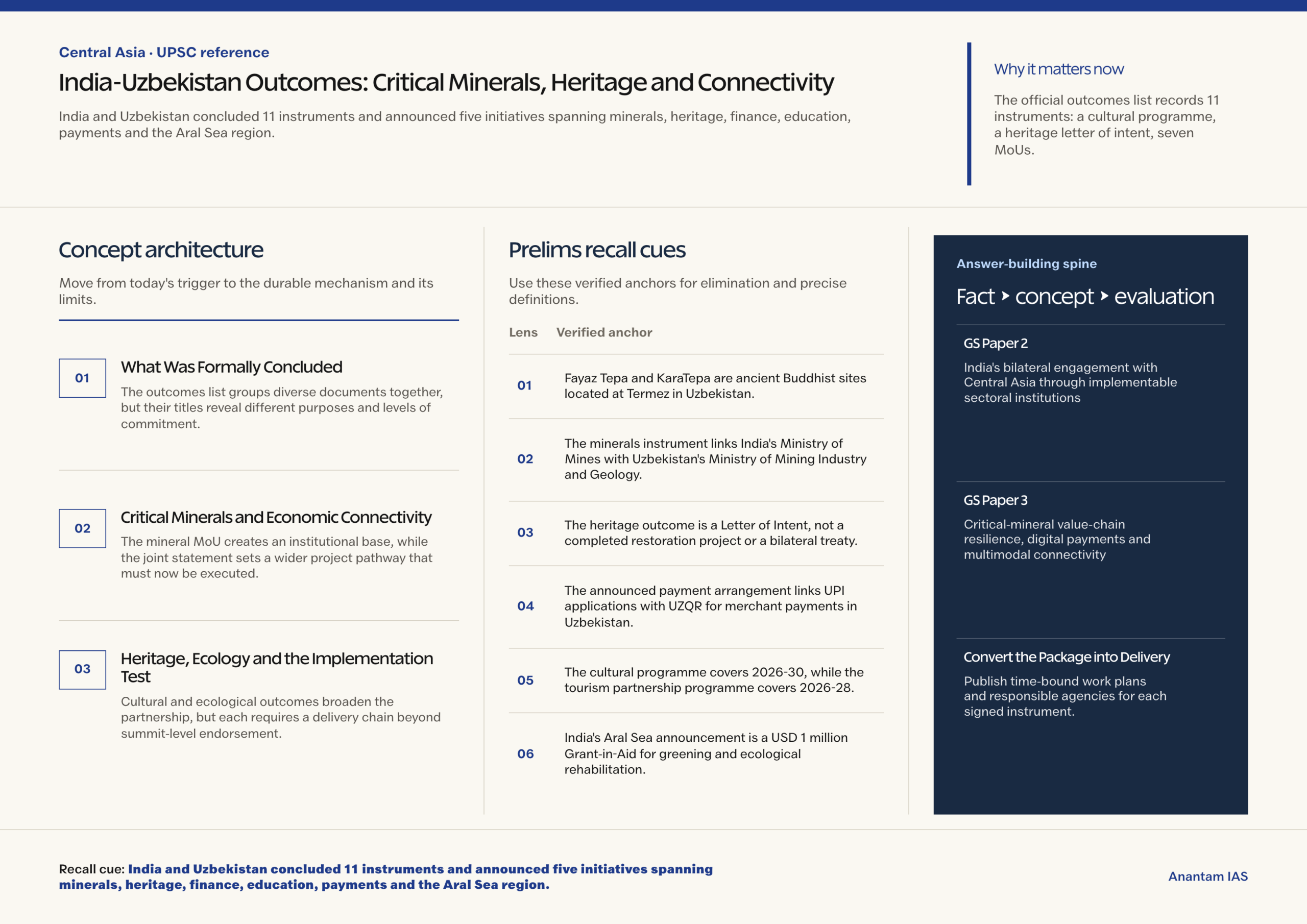
- Fayaz Tepa and KaraTepa are ancient Buddhist sites located at Termez in Uzbekistan.
- The minerals instrument links India’s Ministry of Mines with Uzbekistan’s Ministry of Mining Industry and Geology.
- The heritage outcome is a Letter of Intent, not a completed restoration project or a bilateral treaty.
- The announced payment arrangement links UPI applications with UZQR for merchant payments in Uzbekistan.
- The cultural programme covers 2026-30, while the tourism partnership programme covers 2026-28.
- India’s Aral Sea announcement is a USD 1 million Grant-in-Aid for greening and ecological rehabilitation.
Mains Relevance
GS Paper 2
- India’s bilateral engagement with Central Asia through implementable sectoral institutions
- The difference between diplomatic declarations, signed instruments and delivery mechanisms
GS Paper 3
- Critical-mineral value-chain resilience, digital payments and multimodal connectivity
- Heritage conservation and ecological rehabilitation as instruments of development partnership
Essay
- Diplomacy gains durability when civilisational links are matched by institutions, investment and measurable delivery.
Background and Context
What Was Formally Concluded
The outcomes list groups diverse documents together, but their titles reveal different purposes and levels of commitment.
- The Cultural Exchange Programme provides a defined 2026-30 framework, while the tourism partnership programme establishes a separate 2026-28 cooperation window with scheduled institutional continuity.
- Seven listed MoUs cover archives, traditional medicine, geology and minerals, diplomatic training, economic and financial dialogue, higher education and scientific research through dedicated government channels.
- An environmental cooperation agreement and a Gujarat-Samarkand partnership agreement add national and subnational channels rather than relying only on central diplomatic exchanges.
- The Buddhist-site document is explicitly a Letter of Intent; it signals intent to conserve Fayaz Tepa and KaraTepa but does not itself prove restoration has begun.
- The UPI-UZQR arrangement is a commercial agreement between payment-system entities, distinct from an intergovernmental MoU and still dependent on technical integration, regulatory readiness and operational rollout.
Critical Minerals and Economic Connectivity
The mineral MoU creates an institutional base, while the joint statement sets a wider project pathway that must now be executed.
- The leaders identified geological exploration, mining, mineral processing and integrated value chains as fields for possible joint critical-mineral projects involving companies and specialist institutions.
- Processing and value addition matter because access to ore alone does not secure the refining, intermediate materials and recycling capabilities required by batteries, electronics and strategic manufacturing.
- A proposed Joint Working Group on non-tariff issues and investment barriers is a political commitment requiring follow-up, not one of the 11 listed signed instruments.
- The two sides also directed ministries to explore time-bound next steps after completing a feasibility study on a preferential trade agreement; no trade agreement was concluded during this visit.
- Transport language remained exploratory: the leaders backed multimodal routes, freight restoration and logistics cooperation without announcing a new corridor treaty, completed route or immediate reduction in trade costs.
Heritage, Ecology and the Implementation Test
Cultural and ecological outcomes broaden the partnership, but each requires a delivery chain beyond summit-level endorsement.
- The Termez heritage initiative can combine conservation expertise, archaeological research and digital documentation through museums and restoration centres, but its scope, schedule and implementing arrangements remain unsettled.
- The Aral Sea Grant-in-Aid is a concrete funding announcement for greening and ecological rehabilitation, accompanied by technical support under India’s development partnership framework.
- A Foreign Ministers-led mechanism was politically agreed to coordinate implementation of agreements and priority projects, with timely realisation as its stated purpose and principal test.
- The elevation to a Comprehensive Strategic Partnership raises political ambition, but the designation is not evidence that every sectoral proposal is funded, operational or supported by delivery milestones.
- For answers, classify outcomes as signed instruments, commercial arrangements, funded announcements or future commitments before judging their strategic value.
Way Forward
Convert the Package into Delivery
- Publish time-bound work plans and responsible agencies for each signed instrument, with periodic review through the Foreign Ministers-led mechanism.
- Move the minerals MoU toward bankable projects that cover exploration data, environmental safeguards, processing capacity, recycling and predictable offtake arrangements.
- Complete technical and regulatory integration before presenting UPI-UZQR merchant acceptance as an available service.
- Define conservation standards, site responsibilities and monitoring for Termez, while linking Aral Sea support to locally suitable restoration and transparent outcome reporting.
Conclusion
- The visit’s significance lies in its layered outcome package: institutional instruments, a commercial payments link, funded announcements and political commitments serving different functions.
- A strong UPSC answer should distinguish those categories, then assess whether follow-up produces mineral projects, usable connectivity, conserved heritage and accountable ecological outcomes.
UPSC Practice Questions
Prelims MCQ 1
With reference to the outcomes of the 2026 India-Uzbekistan State Visit, consider the following statements:
- A Letter of Intent concerned conservation and restoration of Buddhist sites at Termez.
- The geology and mineral-resources instrument was signed by India’s Ministry of Mines and its Uzbek counterpart.
- The visit concluded a bilateral preferential trade agreement.
How many of the above statements are correct?
(a) Only one (b) Only two (c) All three (d) None
Answer: (b) Only two
Explanation:
Statements 1 and 2 are correct. The leaders directed their ministries to explore next steps after a feasibility study; they did not conclude a preferential trade agreement.
Prelims MCQ 2
The announced NIPL-NIPC commercial agreement primarily seeks to:
(a) settle bilateral trade exclusively in national currencies (b) connect securities depositories of the two countries (c) enable Indian UPI apps to scan UZQR for merchant payments in Uzbekistan (d) create a common central-bank digital currency
Answer: (c) enable Indian UPI apps to scan UZQR for merchant payments in Uzbekistan
Explanation:
The official outcomes list describes merchant-payment interoperability between Indian UPI applications and Uzbekistan’s national QR system through a commercial agreement between NIPL and NIPC.
UPSC Mains Questions
- Distinguishing signed instruments from political commitments is essential for assessing summit diplomacy. Examine with reference to the 2026 India-Uzbekistan State Visit outcomes.
- How can cooperation with Uzbekistan strengthen India’s critical-mineral resilience and Central Asian connectivity? Discuss the implementation challenges.
Sources: PIB, Prime Minister's Office: List of Outcomes and PIB, Prime Minister's Office: Joint Statement.
Frequently Asked Questions
What were the main India-Uzbekistan outcomes in August 2026?
The package covered minerals, archives, traditional medicine, education, finance, environment, tourism and heritage, alongside partnership elevation, scholarships, Aral Sea support and a payments arrangement.
Did India and Uzbekistan sign a critical-minerals agreement?
They signed an MoU on geology and mineral resources. The joint statement separately expressed intent to develop projects in exploration, mining, processing, recycling and integrated value chains.
What is the status of the Termez Buddhist-site initiative?
It is a Letter of Intent concerning conservation and restoration of Fayaz Tepa and KaraTepa. It signals cooperation but does not establish that restoration work is complete or underway.
What does the UPI-UZQR announcement mean?
NIPL and Uzbekistan’s NIPC signed a commercial agreement intended to let Indian UPI apps scan UZQR for merchant payments in Uzbekistan, subject to operational implementation.
How should UPSC answers evaluate the visit?
Classify each outcome by status, identify its delivery mechanism and judge progress through implemented projects, functioning payment links, reduced trade barriers and verifiable conservation or ecological results.
Tell Google you want more of this.
Add Anantam IAS as a preferred sourceOne tap, and this site shows up more often in your own Top Stories, AI Overviews and AI Mode. Remove it any time.