Why in News?
The newly elected state government in Kerala has announced the formation of a department for elderly people, the first such initiative in India. At present, the welfare of the aged comes under the state’s Social Welfare department.
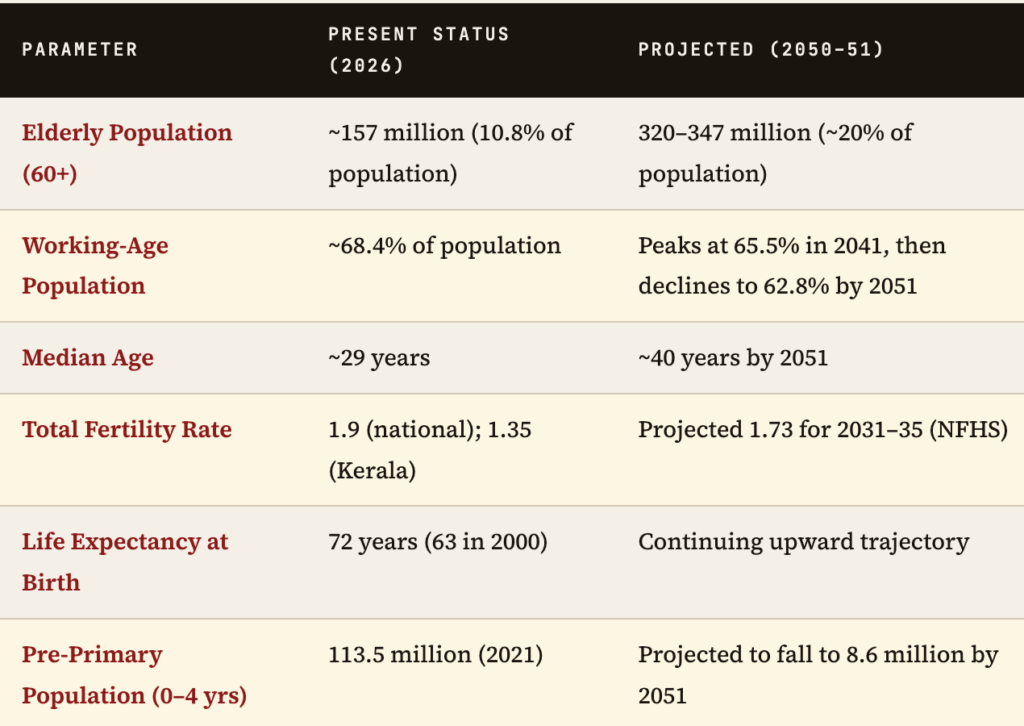
India is facing a rapid demographic transition, with the elderly population (aged 60+) projected to reach 347 million by 2050, making up roughly 20% of the total population.
| UPSC Relevance: GS-1 Indian Society: Population Issues; GS-2 Social Justice: Human Resources Mains: India’s Ageing Challenge & Structural Demographic Shift |
Structural Demographic Shift in India:
- India’s latest Sample Registration System (SRS) Statistical Report, 2024, offers evidence of a structural demographic shift. The country’s Total Fertility Rate (TFR) has fallen to 1.9, dipping below the replacement level of 2.1 for the first time in recorded history.
- The crude birth rate has dropped from 21 per thousand in 2014 to 18.3 in 2024, while the death rate has fallen marginally from 6.7 to 6.4.
Together, these figures confirm that India is transitioning from a phase of population explosion to one of decelerating growth and eventual demographic ageing.
Features of Demographic Shift in India:
- Accelerated ageing: India’s elderly population is growing at a decadal rate exceeding 41%, far faster than the historical pace seen in now-developed nations, which had decades of economic growth to build social security systems before facing similar transitions.
- Feminisation of ageing: women constitute the majority of the elderly demographic, and widowhood leaves over 50% of elderly women exposed to financial vulnerability, social exclusion, and property rights disputes.
- State-level disparities: Southern states such as Kerala, Tamil Nadu, and Goa, along with Himachal Pradesh and Punjab in the north, have already achieved fertility rates comparable to developed nations and are ageing rapidly, while northern states like Uttar Pradesh and Bihar continue to have TFRs well above replacement level.
India has roughly 33 years to leverage its demographic dividend before transitioning into an ageing economy, similar to developed nations, by the 2050s.
Rising Elderly Population and Associated Challenges:
- Financial Vulnerability: Only an estimated 10% of the elderly in urban areas and 5% in rural areas have access to formal social security or pension coverage.
- Healthcare Infrastructure Gap: Approximately 75% of the elderly suffer from chronic conditions such as diabetes, hypertension, arthritis, and cardiovascular disease. The NPHCE now covers all 713 health districts, but India faces an acute shortage of geriatricians, trained nurses, physiotherapists, and occupational therapists relative to projected needs.
- Caregiving Deficit: Urban migration and the shift to nuclear families have left nearly 20% of urban elderly and 10% of rural elderly living alone. India’s care economy remains structurally undervalued, with women bearing a disproportionate burden estimated at around four hours of unpaid care daily.
- Mental Health and Dementia: Nearly 1 in 4 older adults in India exhibits symptoms of psychological distress, according to the India Ageing Report 2023. Mental health conditions, particularly dementia, remain heavily stigmatised, limiting early diagnosis and appropriate care.
- Delayed Census Impact: The Census, postponed since 2020 due to the COVID-19 pandemic, has disrupted planning for delimitation, financial devolution to states (which uses population and demographic performance as criteria), and sample surveys that rely on census data as a sampling frame.
- Workforce and Fiscal Pressure: As the dependency ratio rises (more elderly per working-age adult), fiscal pressure on pension systems, healthcare budgets, and state welfare programmes will intensify. E.g., the old-age dependency ratio in Kerala has already risen from ~19% (2011) to ~26% (2021), and is projected to reach >34% by 2031.
Case Study- Kerala: India’s Greying Frontier
- Kerala is India’s most rapidly ageing state, with a demographic profile comparable to East Asian and European nations. As per the Elderly in India Report 2021, around 16.5% of Kerala’s population is already aged 60 and above, a share expected to reach ~21% by 2031, compared with the all-India figure of 13.1%.
- Three reinforcing factors explain Kerala’s rapid ageing:
- TFR has fallen to just 1.35.
- Significantly better healthcare outcomes (female life expectancy at 78.4 years, against 71.9 years for men)
- Large-scale outmigration of working-age adults, particularly men, to West Asia. Return migration of older former emigrants further swells the elderly population.
Over 70% of Kerala’s elderly suffer from at least one chronic ailment. Old-age home residents have nearly doubled in less than a decade.
Kerala has responded with several institutional innovations:
- State Elderly Commission (2025)
- Department for Senior Citizens (2026)
- Vayomithram (mobile geriatric care)
- Smruthipadham (dementia initiative)
- Kerala Care Palliative Grid (1,387 govt + 1,227 NGO units)
- Samayaprabha (day-care for the elderly)
Key Central Government Policies and Schemes:
- The National Policy on Older Persons, 1999, laid the foundational framework for state responsibility toward senior citizens.
- The Maintenance and Welfare of Parents and Senior Citizens Act, 2007, provides legal provisions mandating family maintenance and penalises neglect or abandonment of elderly parents.
- National Programme for Health Care of the Elderly, 2010-11 (NPHCE), a Centrally Sponsored Programme launched by the Ministry of Health, now covers all 713 health districts and operates through dedicated geriatric OPDs, 10-bedded geriatric wards, and two National Centres of Ageing.
- Atal Vayo Abhyuday Yojana (2021) envisions a society where all senior citizens live healthy, empowered, and dignified lives with strong intergenerational bonds, consolidating multiple elderly welfare schemes.
- Ayushman Bharat PMJAY now extends health insurance coverage to all citizens aged 70 and above, significantly widening the social protection net for the elderly.
- India announced a National Demographic Mission (2025), an initiative to monitor and manage demographic transitions, including migration, ageing, and human capital development. The first time demographic management has been elevated to a dedicated national programme.
Despite this, the functionality of schemes remains deeply uneven across regions. Rural areas lag behind urban centres in access to geriatric services. Northern states require targeted interventions to achieve national convergence. Inter-state migration is expected to intensify as demographic gaps between states widen.
Way Forward:
- Universal Social Security Architecture. India must scale pension coverage far beyond its current reach, which stands at only 10% in urban and 5% in rural elderly populations. Contributory pension schemes, portability of social security for migrant workers, and universal old-age pensions for the unorganised sector are minimum requirements for preventing mass old-age poverty.
- Invest in Geriatric Health Infrastructure. The NPHCE must be rapidly scaled with substantially more geriatricians, trained nurses, physiotherapists, and occupational therapists to meet the WHO multidisciplinary care benchmarks. National Centres of Ageing should serve as research and training hubs, and dementia care requires dedicated attention through awareness campaigns and community programmes.
- Formalise and Value the Care Economy: India’s care economy, disproportionately borne by women, must be recognised, regulated, and remunerated. This includes creating a skilled, certified workforce of professional caregivers, expanding community-based home care, and providing social recognition and financial support to informal caregivers.
- Harness the Silver Economy: Rather than viewing seniors as dependents, India should create enabling conditions for productive, active ageing. Senior skill registries, digital literacy drives, encore career platforms, and senior entrepreneurship support programmes can convert the elderly into economic contributors.
- Facilitate Managed Inter-State Migration: As high-TFR northern states continue to generate a labour surplus while low-TFR southern states face workforce shortages, managed inter-state migration becomes essential. This requires investment in transport infrastructure, implementation of the three-language formula, removal of local employment quotas, and portability of welfare entitlements across states.
- Adopt Technology and AI for Elder Care. Digital Public Infrastructure should be leveraged to integrate elderly health records, streamline pension delivery, enable teleconsultation with geriatricians in remote areas, and detect elder abuse.
Following the WHO’s model of healthy ageing, India’s policies should shift from a disease-management model to a capability-enhancement model.
Tell Google you want more of this.
Add Anantam IAS as a preferred sourceOne tap, and this site shows up more often in your own Top Stories, AI Overviews and AI Mode. Remove it any time.