Why in news ?
In a major breakthrough, the U.K. has recognised India’s Carbon Credit Trading Scheme (CCTS) as a qualifying criterion for pricing relief under its carbon border adjustment mechanism (CBAM), a move that would reduce the tax burden on domestic exporters.
UPSC Relevance
Prelims
GS3, Conservation, Environmental Pollution and Degradation, Environmental Impact Assessment.
India–U.K. Carbon Pricing Bilateral Breakthrough
- Relief for Indian Exporters: HM Treasury (U.K.) has recognized India’s domestic Carbon Credit Trading Scheme (CCTS) as a qualifying carbon pricing mechanism.
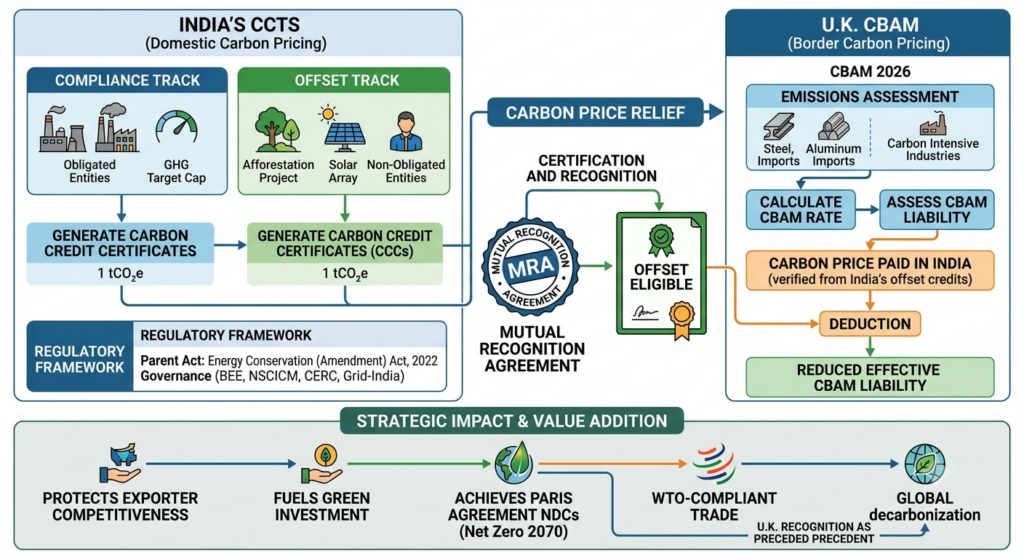
- Impact on CBAM Tax: Indian exporters will be eligible for “Carbon Price Relief” under the U.K. Carbon Border Adjustment Mechanism (CBAM) Calculation Regulations 2026. This allows domestic entities to offset carbon prices paid in India against U.K. import carbon levies.
Carbon pricing
Carbon pricing is an environmental policy approach that charges emitters a fee for every unit of greenhouse gas ( 1 tonne of CO2 equivalent) they discharge into the atmosphere.
By applying the “Polluter Pays Principle,” it factors the hidden societal costs of climate change—such as healthcare expenses, agricultural loss, and disaster cleanup—into economic decision-making, incentivizing industries to innovate and reduce emissions.
Primary Mechanisms
- Carbon Tax: A direct, fixed fee set by the government on the carbon content of fossil fuels or emissions. Emitters pay a set price per tonne of carbon, providing price certainty.
- Emissions Trading System (ETS) / Cap-and-Trade: A market-based approach where the government sets a total cap on allowed emissions. Entities trade emission allowances or carbon credits based on their needs, providing quantity certainty.
- Carbon Offsets: Credit-based mechanisms where entities earn certificates by funding verifiable carbon-reduction projects (e.g., reforestation, clean power) to balance out their own emissions.
Carbon Border Adjustment Mechanism (CBAM) Architecture
- Definition: A trade measure imposing a tariff on imports of carbon-intensive products to level the playing field for domestic producers subject to strict climate regulations (preventing “carbon leakage”).
- Key Targets: Targets energy-heavy export sectors like steel, aluminium, cement, fertilizers, hydrogen, glass, and ceramics.
- Mechanism: If an exporting country taxes carbon domestically, CBAM allows deduction of those taxes to avoid double taxation.
- How did India-EU FTA affect the CBAM?
- The India–EU FTA did not grant an explicit CBAM exemption. However, it offers bilateral mechanisms for green technology transfer, financial assistance, and potential carbon-offset recognitions to reduce compliance burdens on Indian exporters.
India’s Carbon Credit Trading Scheme (CCTS)
- Legal Foundation: Introduced under the Energy Conservation (Amendment) Act, 2022.
- Institutional Governance
- National Steering Committee for Indian Carbon Market (NSCICM): Apex body chaired by the Secretary, Ministry of Power, and co-chaired by the Secretary, MoEFCC.
- Administrator: Bureau of Energy Efficiency (BEE).
- Market Regulator: Central Electricity Regulatory Commission (CERC).
- Registry Operator: Grid Controller of India Limited (Grid-India).
- Structural Transition: Replaces the legacy Perform, Achieve, and Trade (PAT) scheme, transitioning from basic energy-saving targets to greenhouse gas (GHG) emission-intensity reductions.
- Denominator: 1{ CCC} = 1 tonne of CO2 equivalent (tCO2e) reduced or avoided. (1 metric tonne =1000kgs)
- Dual Mechanisms:
- Compliance Mechanism: Mandatory GHG emission-intensity caps for obligated energy-intensive industrial sectors (e.g., aluminium, cement, steel, refineries).
- Offset Mechanism: Allows non-obligated entities (forestry, renewables, agriculture) to generate voluntary Carbon Credit Certificates (CCCs) for trading.
Strategic & Geopolitical Implications
- International Trade & WTO Alignment: Neutralizes non-tariff environmental trade barriers and sets a precedent for India’s negotiations with the European Union (EU) on its own CBAM framework.
- Paris Agreement Commitments: Aligns domestic market mechanisms with Article 6 of the Paris Agreement (internationally transferred mitigation outcomes).
- Economic Defense: Protects export competitiveness in critical manufacturing sectors, supporting India’s vision of becoming a global manufacturing hub (Make in India).
- Support for India’s NDCs: Direct economic incentives drive industrial decarbonization, aiding India’s Panchamrit target to reduce economy-wide carbon intensity by 45% by 2030 and achieve Net Zero by 2070.
Practice MCQ:
With reference to India’s Carbon Credit Trading Scheme (CCTS) and international climate trade mechanisms, consider the following statements:
- Under CCTS, 1 Carbon Credit Certificate (CCC) equals 1 metric tonne of CO2 equivalent reduced or avoided.
- The U.K. CBAM recognition allows Indian exporters to completely bypass border carbon tariffs.
- The Central Electricity Regulatory Commission (CERC) acts as the market regulator for CCTS.
Which of the statements given above are correct?
(a) 1 and 2 only
(b) 2 and 3 only
(c) 1 and 3 only
(d) 1, 2 and 3
Answer: (c) 1 and 3 only
Rationale: Statement 2 is incorrect because U.K. recognition provides price relief (deducting carbon price paid in India from U.K. liability), not a complete exemption from CBAM. Statements 1 and 3 are correct.
Practice Question
In light of the recent recognition of India’s Carbon Credit Trading Scheme (CCTS) by the U.K., critically analyze the challenges posed by unilateral border carbon tariffs on developing economies. How far can domestic carbon markets like CCTS safeguard India’s trade competitiveness while fulfilling its Nationally Determined Contributions (NDCs)? (15 Marks, 250 Words)
Tell Google you want more of this.
Add Anantam IAS as a preferred sourceOne tap, and this site shows up more often in your own Top Stories, AI Overviews and AI Mode. Remove it any time.