
Why in News?
A The Hindu editorial (around 15 June 2026) revisited the case for reforming India’s Insolvency and Bankruptcy Code (IBC), 2016, the country’s flagship law for resolving the debts of stressed companies. The editorial argued that despite a decade of operation, the regime is slowed by NCLT congestion, long resolution timelines and steep value erosion for lenders, even as a fresh set of statutory fixes awaits rollout.
The trigger is the Insolvency and Bankruptcy Code (Amendment) Act, 2026 — assented by the President in April 2026 — whose provisions are being notified in stages. The editorial weighed whether creditor-led resolution, group and cross-border insolvency and tighter admission deadlines can fix the delay-and-haircut problem that IBBI data keeps flagging.
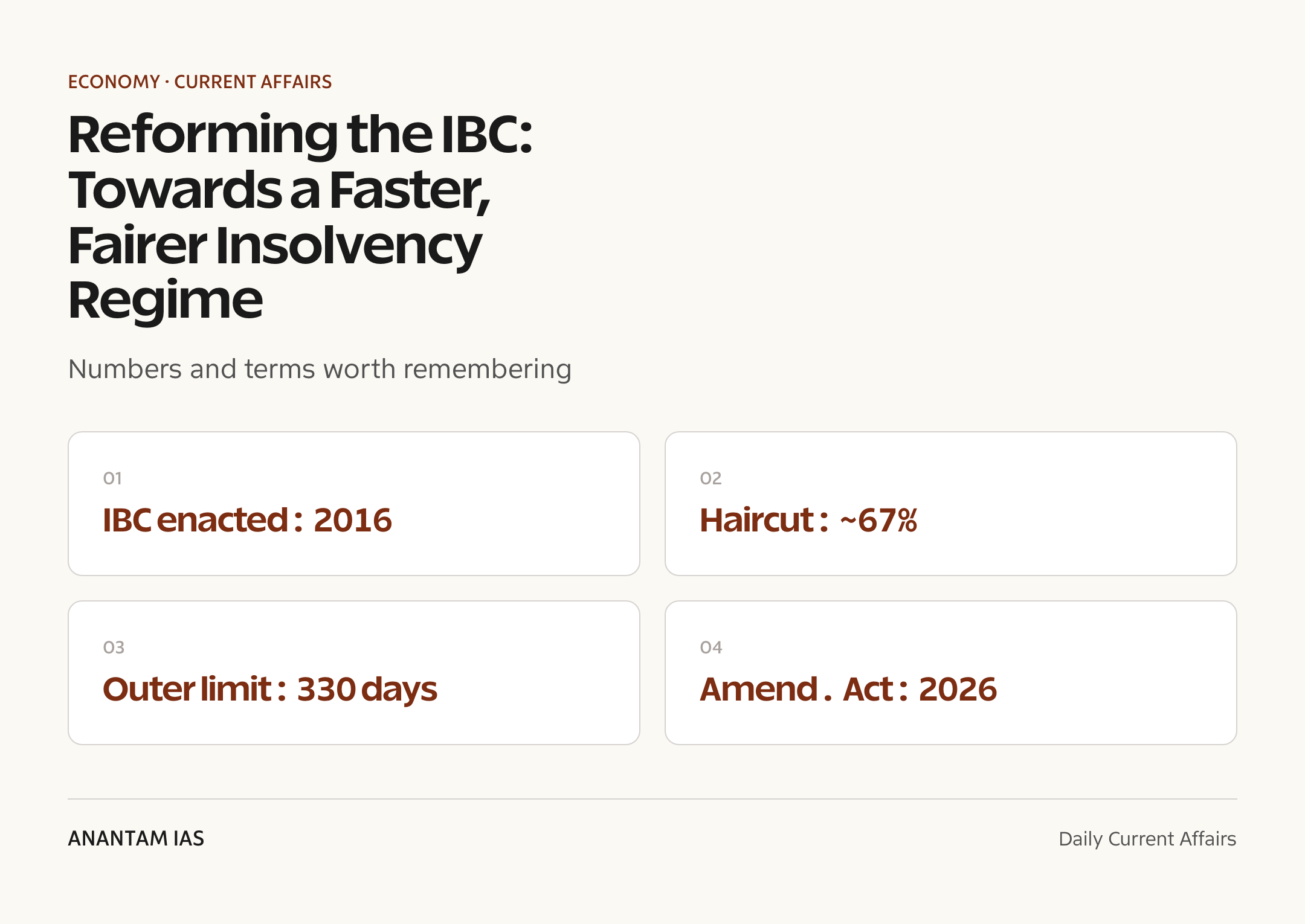
- Per published IBBI/CIRP data (realisations till around September 2025), lenders took an aggregate haircut of roughly 67% on admitted claims under resolved cases.
- Financial creditors realised about ₹3.99 lakh crore under approved resolution plans against admitted claims of about ₹12.31 lakh crore (IBBI, published figures).
- A large share of ongoing CIRP cases had crossed the 270-day mark, with average resolution running far beyond the 330-day statutory ceiling (IBBI, ~early 2026).
- The Amendment Act, 2026, introduces a creditor-initiated process, an enabling framework for cross-border and group insolvency, and fixed admission deadlines for the NCLT.
The development matters in the context of:
- Matters because the IBC underpins credit discipline in the Indian economy: faster, higher recoveries, lower banks’ cost of capital and reduces non-performing assets (NPAs).
- Matters because delayed resolution destroys going-concern value — pushing more firms into liquidation, where recoveries are a fraction of those under resolution.
- Matters because investor confidence in India’s ease of doing business hinges on a predictable, time-bound exit mechanism for failed firms.
UPSC Relevance
Prelims Relevance
- IBC, 2016 — single, consolidated law for corporate and individual insolvency; replaced a patchwork including SICA and the BIFR.
- IBBI — the regulator for insolvency professionals, agencies, valuers and information utilities; a statutory body under the IBC.
- NCLT (adjudicating authority for corporate insolvency) and NCLAT (appellate tribunal); appeals lie further to the Supreme Court.
- CIRP — Corporate Insolvency Resolution Process; the time-bound process to revive or resolve a defaulting company.
- Committee of Creditors (CoC) — body of financial creditors that approves a resolution plan; key voting thresholds of 66% and 51%.
- 330-day outer limit for completing CIRP (including litigation), versus the original 180+90-day design.
- Resolution vs liquidation — a resolution plan revives the firm as a going concern; liquidation breaks it up and sells assets.
- Haircut — the share of admitted claims that creditors forgo; the inverse of the recovery rate.
- UNCITRAL Model Law on Cross-Border Insolvency — the global template the 2026 framework draws on (Section 240C).
- Amendment Act, 2026 — adds creditor-initiated, group and cross-border insolvency; assented April 2026.
Mains Relevance
GS Paper 3
- Insolvency reform as an instrument of credit discipline, NPA resolution and capital-market deepening.
- Balancing speed of recovery with fairness to operational creditors, workers and minority stakeholders.
GS Paper 2
- Institutional capacity of quasi-judicial tribunals (NCLT/NCLAT) and the governance challenge of judicial delay.
Essay
- Markets need clean exits as much as clean entries: the role of orderly failure in a dynamic economy.
- Speed and fairness in justice — can a time-bound law deliver both?
Background and Context
What the IBC set out to do
The Code rewired how India handles business failure.
- Enacted in 2016, the IBC consolidated fragmented laws into a single, time-bound framework for resolving the insolvency of firms and individuals.
- It shifted control from defaulting promoters to a Committee of Creditors, supervised by a licensed resolution professional, during a moratorium.
- The original design targeted resolution within 180 days (extendable by 90), later capped at an outer limit of 330 days, including litigation.
- Twin goals: maximise value for creditors and preserve the firm as a going concern wherever viable, rather than default to liquidation.
The institutional architecture
Four pillars carry the process.
- IBBI regulates insolvency professionals, professional agencies, valuers and information utilities — the market plumbing of the regime.
- The NCLT admits applications, supervises the CIRP and approves resolution plans; the NCLAT hears appeals.
- The Committee of Creditors — drawn from financial creditors — exercises the ‘commercial wisdom’ that approves or rejects plans by a 66% vote.
- Resolution professionals run the company as a going concern through the process and file applications against avoidance and fraudulent transactions.
Why recoveries disappoint: delays and haircuts
The numbers explain the editorial’s worry.
- Per IBBI‘s published data, the aggregate haircut on admitted claims under resolved cases ran near 67% — creditors recovering roughly a third of what they were owed.
- Recoveries under resolution plans (around a third of claims) far exceed those in liquidation (a low single-digit share) — so delay-driven liquidation is costly.
- A large majority of pending CIRP cases had crossed the 270-day mark, with average resolution stretching well past the 330-day statutory ceiling.
- Root causes: NCLT vacancies and case overload, drawn-out litigation, and slow admission of fresh applications that let asset value erode before resolution begins.
What the 2026 amendments change
The Amendment Act, 2026, attacks the delay problem on several fronts.
- Creditor-initiated resolution — a new chapter lets specified financial creditors run an out-of-court process with lower approval thresholds, easing the load on the NCLT.
- Cross-border insolvency — Section 240C empowers the Centre to frame rules drawing on the UNCITRAL Model Law, covering recognition of and cooperation with foreign proceedings.
- Group insolvency — a new framework lets two or more linked corporate debtors be resolved together, reducing today’s case-by-case judicial improvisation.
- Tighter timelines — fixed admission deadlines with recorded reasons for delay, a supervised liquidation timeline, and curbs on withdrawal of admitted applications.
- The Act was assented to in April 2026; provisions are being notified in stages rather than all at once.
Where the editorial sees unfinished work
Statutory fixes are necessary but not sufficient.
- Tighter deadlines mean little without NCLT bench strength — more members, registrars and benches to clear the backlog.
- Cross-border rules and group insolvency need careful subordinate legislation; an enabling clause is only the first step.
- The personal and partnership insolvency framework remains largely unimplemented, leaving guarantors and small businesses in limbo.
- Deep haircuts raise a fairness question for operational creditors, workers and small suppliers, who rank below financial creditors in the waterfall.
Why this matters for the wider economy
Insolvency reform is macroprudential, not just procedural.
- Faster, higher recoveries lower banks’ provisioning burden and free capital for fresh lending across the Indian economy — easing the NPA overhang.
- A credible exit option sharpens credit discipline: borrowers price in the cost of default, and lenders price risk better.
- A predictable insolvency regime is a key input to ease of doing business and to attracting long-term and foreign capital.
- Resolution that preserves the going concern protects jobs and supply chains that liquidation would otherwise destroy.
Way Forward
Build tribunal capacity
- Fill NCLT/NCLAT vacancies and add benches so the new admission deadlines are met in practice, not just on paper.
- Invest in digital case management and an electronic portal to cut procedural lag.
Operationalise the new tools carefully
- Notify clear rules for cross-border and group insolvency, aligned with the UNCITRAL Model Law, to reduce uncertainty.
- Sequence the creditor-initiated process with safeguards against misuse by dominant creditors.
Widen and balance the regime
- Implement the long-pending personal and partnership insolvency chapters in calibrated phases.
- Improve outcomes for operational creditors and workers, and curb avoidable liquidation by admitting cases before value erodes.
Conclusion
The IBC remains India’s most important market-discipline reform of the past decade, but its promise is throttled by delay. The 2026 amendments rightly target the bottlenecks — creditor-led resolution, group and cross-border frameworks and firmer timelines — yet a law is only as fast as the tribunals that apply it.
The editorial’s message is that fairness and speed must advance together: clearing benches, protecting weaker creditors and notifying the new rules with care. Done well, a faster, fairer insolvency regime would lower the cost of credit and make orderly business failure a feature, not a fault, of a dynamic economy.
UPSC Practice Questions
Prelims MCQ 1
With reference to the Insolvency and Bankruptcy Code, 2016, consider the following statements:
- The Committee of Creditors is composed of the operational creditors of the corporate debtor.
- The National Company Law Tribunal is the adjudicating authority for the corporate insolvency resolution process.
- The Corporate Insolvency Resolution Process is to be completed within an outer limit of 330 days, including the time taken in litigation.
How many of the above statements are correct?
(a) Only one (b) Only two (c) All three (d) None
Answer: (b) Only two
Explanation:
Statement 1 is incorrect — the Committee of Creditors comprises financial creditors, not operational creditors. Statements 2 and 3 are correct: the NCLT adjudicates corporate insolvency, and the CIRP carries a 330-day outer limit, including litigation.
Prelims MCQ 2
The Insolvency and Bankruptcy Code (Amendment) Act, 2026, is most closely associated with which of the following changes?
(a) Abolishing the Committee of Creditors and replacing it with a government-appointed board
(b) Introducing a creditor-initiated process and enabling frameworks for cross-border and group insolvency
(c) Transferring all insolvency cases from the NCLT to the regular civil courts
(d) Ending resolution plans and making liquidation the default outcome
Answer: (b) Introducing a creditor-initiated process and enabling frameworks for cross-border and group insolvency
Explanation:
The 2026 amendments add a creditor-initiated resolution route, an enabling clause for cross-border insolvency (Section 240C, drawing on the UNCITRAL Model Law) and a group-insolvency framework, while tightening NCLT timelines.
UPSC Mains Questions
- The Insolvency and Bankruptcy Code has reshaped India’s approach to business failure, yet delays and deep haircuts persist. Examine the structural reasons for low recoveries and assess how far the 2026 amendments address them. (250 words)
- “A time-bound insolvency law is only as effective as the tribunals that enforce it.” In light of NCLT delays, discuss the institutional and procedural reforms needed to make India’s insolvency regime faster and fairer. (250 words)
- Discuss the significance of cross-border and group insolvency frameworks for India’s integration with global capital, and the challenges in operationalising them under the UNCITRAL Model Law. (150 words)
Sources: The Hindu (Editorial) and Insolvency and Bankruptcy Board of India (IBBI).
Frequently Asked Questions
What is the Insolvency and Bankruptcy Code, 2016?
It is India’s single, time-bound law for resolving the insolvency of companies and individuals. Enacted in 2016, it consolidated earlier fragmented laws and shifted control from defaulting promoters to creditors during a structured resolution process, aiming to maximise value and revive viable firms.
What is a haircut in insolvency?
A haircut is the portion of their admitted claims that creditors give up when a company is resolved or liquidated. If lenders recover only a third of what they are owed, the haircut is about two-thirds. It is the inverse of the recovery rate and a key measure of how well the regime works.
What is the difference between resolution and liquidation?
Resolution revives a defaulting company as a going concern under a court-approved plan, usually with a new owner, preserving jobs and value. Liquidation breaks up the firm and sells its assets piecemeal. Recoveries under resolution are typically far higher than under liquidation, so resolution is the preferred outcome.
What does the 330-day timeline mean?
The Code requires the Corporate Insolvency Resolution Process to be completed within an outer limit of 330 days, including time spent in litigation. In practice, many cases run well beyond this because of tribunal backlogs and appeals, eroding the value available for recovery.
What do the 2026 amendments to the IBC change?
The Insolvency and Bankruptcy Code (Amendment) Act, 2026 introduces a creditor-initiated resolution process, enabling frameworks for cross-border and group insolvency, and fixed admission deadlines for the NCLT. It received Presidential assent in April 2026, with its provisions being notified in stages.
What is cross-border insolvency?
Cross-border insolvency deals with companies that have assets, creditors or operations in more than one country. India’s 2026 framework, drawing on the UNCITRAL Model Law, lets Indian and foreign proceedings recognise and cooperate with each other, making it easier to resolve globally connected firms.
Tell Google you want more of this.
Add Anantam IAS as a preferred sourceOne tap, and this site shows up more often in your own Top Stories, AI Overviews and AI Mode. Remove it any time.