Why in News?
Japan’s Ministry of Defense released the English digest of Defense of Japan 2026 , its annual white paper on the security environment and national defence policy.
- The white paper says Japan should respond through comprehensive national power and cooperation with its ally, like-minded countries and other partners.
- It records China’s broad military modernisation, including nuclear, missile, naval and air capabilities, and says defence-budget growth has continued at a high level for more than 30 years without adequate transparency.
- Japan highlights intensified Chinese activity around the Senkaku Islands, which Japan administers and China claims as the Diaoyu Islands, as well as activity in the Sea of Japan and western Pacific.
- The document also points to repeated exercises around Taiwan, while carefully presenting possible blockade scenarios as an assessment rather than a confirmed future course of action.
- The Hindu reported the sharper language amid renewed China-Japan tensions. The wording remains Japan’s official threat perception, which must be distinguished from a neutral finding or legal adjudication.
- The white paper matters because Japan sits close to the Taiwan Strait and the East China Sea, while its economy depends heavily on secure maritime routes through the wider Indo-Pacific.
- Japan’s assessment can shape the revision of its Three Strategic Documents: the National Security Strategy, National Defense Strategy and Defense Buildup Program.
- For India, the development affects the strategic setting of the Quad, maritime-domain awareness, defence technology cooperation and the wider balance between deterrence and escalation management.
UPSC Relevance
Prelims Relevance
- Defense of Japan is an annual white paper issued by Japan’s Ministry of Defense; it explains Japan’s security environment and defence initiatives.
- Japan’s Three Strategic Documents are the National Security Strategy, National Defense Strategy and Defense Buildup Program.
- Japan’s official policy retains an Exclusively Defense-Oriented Policy, civilian control and the Three Non-Nuclear Principles as policy guidelines.
- The Senkaku Islands are administered by Japan in the East China Sea and claimed by China as the Diaoyu Islands; this is a sovereignty dispute, not a settled description accepted by both sides.
- The Taiwan Strait connects the East China Sea and South China Sea and is strategically relevant to regional sea and air routes.
- The Quad comprises India, Japan, Australia and the United States; it is a diplomatic partnership, not a collective-defence treaty organisation.
Mains Relevance
GS Paper 2
- Assess how changing threat perceptions in Japan influence India-Japan strategic cooperation, the Quad and the idea of a free and open Indo-Pacific.
- Examine the role and limits of minilateral institutions in maritime security when they lack mutual-defence obligations.
GS Paper 3
- Connect East Asian tensions with sea-lane security, critical supply chains, maritime-domain awareness and India’s economic security.
- Analyse the security implications of unmanned systems, cyber operations, space assets, information warfare and rapid military-technological change.
Essay
- Security dilemmas can make defensive measures appear offensive to a rival, creating an action-reaction cycle even when neither side publicly seeks war.
Background and Context
What Japan's white paper actually says
The document is an official Japanese assessment, so its claims should be read precisely and attributed clearly.
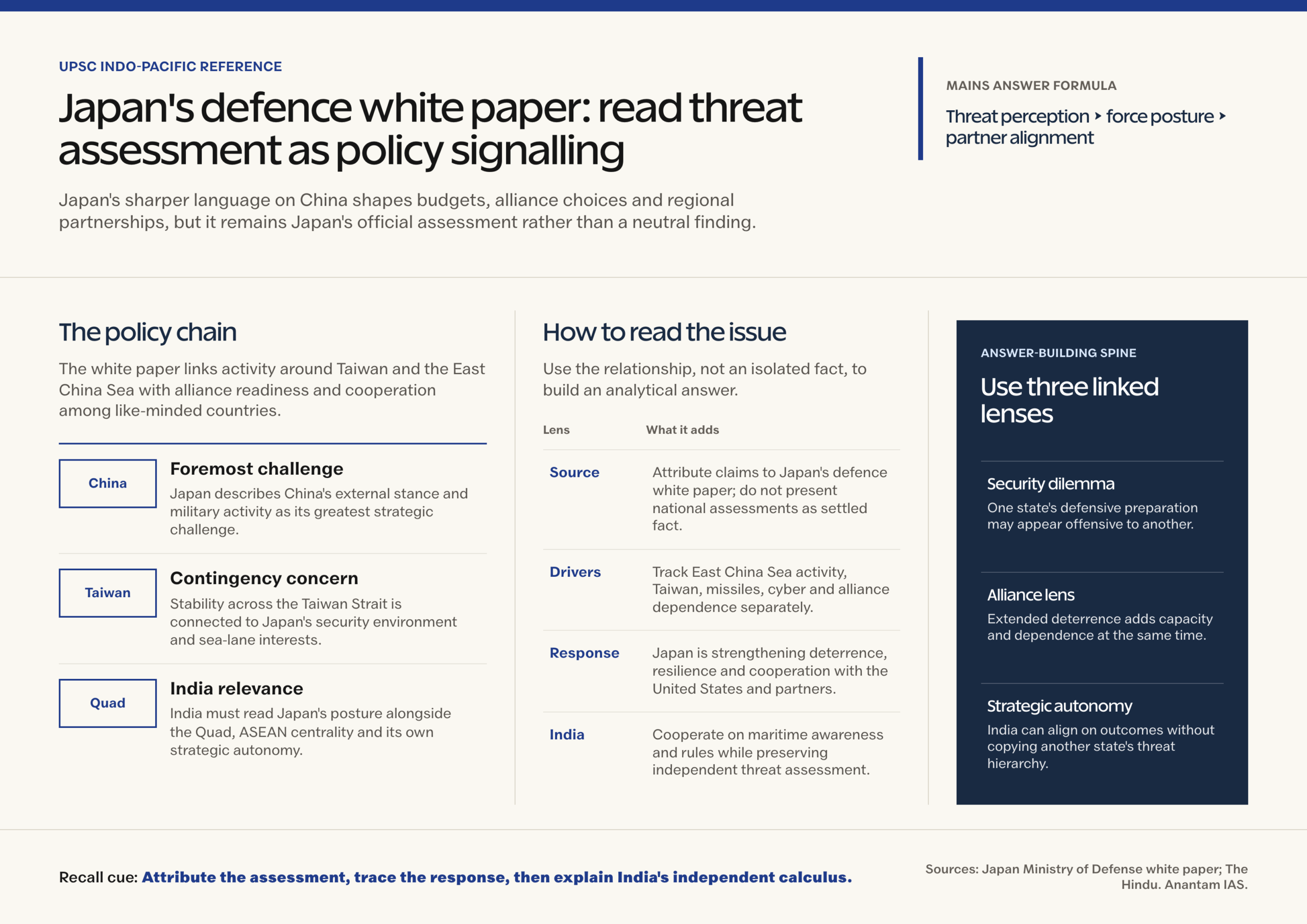
- It describes China’s external posture and military activities as a matter of serious concern for Japan and the international community, and as Japan’s unprecedented and greatest strategic challenge.
- The assessment combines several strands: sustained military modernisation, maritime and air activity around Japan, operations farther into the western Pacific, pressure around Taiwan and growing China-Russia military cooperation.
- The white paper does not say that armed conflict is inevitable. It says a serious situation in East Asia cannot be ruled out, which is risk language rather than a forecast.
- UPSC answers should separate three layers: verified activity, Japan’s interpretation of that activity, and broader analytical judgments about regional consequences.
East China Sea, Taiwan and the maritime geography
Geography makes developments around Taiwan and the East China Sea directly relevant to Japan’s security planning.
- Japan’s southwestern islands extend toward Taiwan, while the disputed Senkaku/Diaoyu Islands lie in the East China Sea. Regular coast-guard and military activity raises the risk of miscalculation even without an intended attack.
- The white paper says Chinese activity has extended beyond the so-called first island chain toward the second island chain. These are strategic-geography concepts, not treaty boundaries or legal maritime zones.
- It notes intensified Chinese military exercises around Taiwan and argues that repeated operations can normalise a larger operational presence. This is Japan’s assessment of the pattern and purpose.
- A Taiwan crisis could affect commercial shipping, aviation, semiconductor supply chains and alliance calculations. Such consequences explain the global interest, but they do not determine the legal status of Taiwan or prejudge a specific scenario.
Japan's post-war defence framework is changing in scale
Japan is strengthening military capability while presenting the shift within its constitutional and policy constraints.
- The 2026 digest restates the Exclusively Defense-Oriented Policy, civilian control and the Three Non-Nuclear Principles as policy guidelines.
- It also supports stronger defence capabilities, including counterstrike capabilities, backed by diplomacy and the Japan-US Alliance. This creates continuing domestic debate about the scope of Japan’s post-war security posture.
- Japan formulated its current National Security Strategy, National Defense Strategy and Defense Buildup Program in 2022. The government plans to revise these documents within 2026 because it judges the environment to have changed faster than.
- The digest says the government achieved the defence-budget level of 2% of GDP, counting initial and supplementary budgets, ahead of its original schedule. It also says FY2026 defence-related expenditure, including specified US-force realignment costs, exceeded.
- Budget growth improves capacity only when matched by personnel, maintenance, stockpiles, resilient bases, command systems and democratic oversight. Expenditure alone is not a measure of readiness or regional stability.
Alliances, minilateralism and regional deterrence
Japan’s answer is not military self-reliance alone; it is a layered network centred on the United States and connected to regional partners.
- The white paper calls the Japan-US Alliance a key pillar and advocates closer training, operations, equipment cooperation and industrial links with like-minded countries.
- Japan also works through small-group formats and partnerships. Minilateralism can be faster and more task-specific than a large multilateral organisation, but it may create exclusion concerns or unclear crisis expectations.
- The Quad focuses on practical public-good cooperation such as maritime-domain awareness, resilient supply chains, critical technologies and humanitarian assistance. It does not impose a NATO-style collective-defence obligation.
- Deterrence aims to persuade an opponent that coercion will fail or become too costly. Yet additional deployments and exercises can intensify a security dilemma if each side interprets the other’s defensive steps as preparation for attack.
- Risk-reduction measures such as hotlines, prior notification, professional air and maritime encounters and crisis communication are complements to deterrence, not signs of strategic weakness.
Way Forward
Pair deterrence with crisis-management guardrails
- Japan and China should keep defence hotlines operational and adopt clear procedures for unexpected air and maritime encounters.
- All sides should avoid unsafe approaches, radar illumination and other conduct that can be misread during close operations.
- Exercise notification, professional communication and incident-investigation channels can create escalation control without resolving sovereignty disputes.
Conclusion
- Japan’s 2026 defence white paper marks a sharper official assessment of China, but its lasting importance lies in the policy chain it may produce: revised strategy, larger capabilities, stronger alliances and deeper defence-industrial cooperation.
- For India, the useful response is neither indifference nor automatic alignment.
UPSC Practice Questions
Prelims MCQ 1
With reference to Japan’s security architecture, consider the following statements:
- Japan’s Three Strategic Documents include the National Security Strategy, National Defense Strategy and Defense Buildup Program.
- The Quad creates a legally binding collective-defence obligation among India, Japan, Australia and the United States.
- Japan’s Official Security Assistance is distinct from its Official Development Assistance.
How many of the above statements are correct?
(a) Only one (b) Only two (c) All three (d) None
Answer: (b) Only two
Explanation:
Statements 1 and 3 are correct. Japan’s Three Strategic Documents are the NSS, NDS and DBP. Official Security Assistance supports security capabilities and is distinct from development-focused ODA. The Quad is a diplomatic partnership and has no collective-defence treaty clause.
Prelims MCQ 2
Which one of the following best describes the first and second island chains in Indo-Pacific strategic discussions?
(a) Maritime boundaries fixed by the UN Convention on the Law of the Sea (b) Treaty-defined collective-defence zones of the Quad (c) Strategic-geography concepts describing arcs of islands in the western Pacific (d) Exclusive economic zones jointly administered by Japan and the United States
Answer: (c) Strategic-geography concepts describing arcs of islands in the western Pacific
Explanation:
The island chains are strategic-geography concepts used to discuss the western Pacific. They are not legal maritime boundaries, Quad treaty zones or jointly administered exclusive economic zones.
UPSC Mains Questions
- Japan’s 2026 defence white paper reflects both a changing East Asian security environment and a classic security dilemma. Discuss. (250 words)
- How should India deepen security cooperation with Japan while preserving strategic autonomy and regional stability? Examine with reference to maritime and technology cooperation. (250 words)
Sources: Japan Ministry of Defense and The Hindu.
Frequently Asked Questions
What is Japan’s Defense of Japan white paper?
Defense of Japan is the Ministry of Defense’s annual public assessment of the security environment and Japan’s defence policies and activities. It is a primary source for understanding official Japanese perceptions and priorities, but its analytical judgments remain the position.
Why does the 2026 white paper call China Japan’s greatest strategic challenge?
The paper cites China’s long-term military modernisation, intensified maritime and air activity around Japan, operations in the western Pacific, exercises around Taiwan, South China Sea activity and closer military cooperation with Russia. The phrase expresses Japan’s official assessment; it.
What are Japan’s Three Strategic Documents?
They are the National Security Strategy, which gives broad national-security direction; the National Defense Strategy, which states defence objectives and approaches; and the Defense Buildup Program, which specifies the capability-building programme. The current set dates from 2022, and Japan.
How is the Japan-China security debate relevant to India?
It affects the Indo-Pacific environment in which India protects maritime trade, critical supply chains and strategic partnerships. India works with Japan bilaterally and through the Quad on maritime awareness, technology and resilience, but it has no treaty obligation to adopt.
Is the Quad an Asian NATO?
No. The Quad is a partnership of India, Japan, Australia and the United States focused on practical cooperation in areas such as maritime security, critical technologies, supply chains and disaster response. It has no collective-defence clause, permanent military command.
Tell Google you want more of this.
Add Anantam IAS as a preferred sourceOne tap, and this site shows up more often in your own Top Stories, AI Overviews and AI Mode. Remove it any time.