Why in News?
The Indian Express reported that Jammu and Kashmir Police planned stronger surveillance, night patrolling, area domination and secure night clusters for migrant brick-kiln workers after two workers from Chhattisgarh were killed in a terrorist attack at Kilam village in Kulgam.
- The two workers were attacked at a brick kiln on July 31, 2026. The newspaper identified them as Deepak Ratre and Bhupendra Bhaina; both later died from their injuries.
- Lieutenant Governor Manoj Sinha chaired a high-level review and directed a comprehensive review of security SOPs for labourers from outside Jammu and Kashmir.
- The administration also directed employers to provide insurance and register workers’ details with the local police and district authorities.
- Police field officers were reportedly asked to bring workers and their families from scattered kiln-side accommodation to a secure location in the same village at night, while increasing checkpoints, vehicle checks and patrols.
- Police had not publicly established the perpetrators when the reports were published. Investigators were examining an anonymous claim attributed to The Resistance Front; the claim must not be treated as a proven finding.
- Brick kilns are often located in secluded village pockets, and workers may live with their families in basic on-site shelters. This dispersal makes static protection for every site difficult.
- The Indian Express reported 199 registered kilns in Budgam alone and hundreds more across the Valley. These are reported figures, not a complete official count of establishments or workers.
- Targeted attacks seek effects beyond immediate casualties: fear, worker flight and economic disruption.
UPSC Relevance
Prelims Relevance
- Under Article 14, every person is entitled to equality before law and equal protection of the laws; the guarantee is not confined to citizens.
- Article 19(1)(d), 19(1)(e) and 19(1)(g) protect citizens’ freedoms to move throughout India, reside and settle in any part of India, and practise a profession or carry on an occupation, trade or business.
- The freedoms under Article 19 are not absolute. The Constitution permits reasonable restrictions by law on specified grounds, including the interests of the general public for movement and residence.
- Article 21 protects life and personal liberty except according to procedure established by law. Protective policing should reduce threats to life without using arbitrary restraints.
- The Resistance Front is included with Lashkar-e-Taiba in the Ministry of Home Affairs’ list of terrorist organisations under Section 35 of the UAPA.
- An anonymous claim of responsibility is intelligence or investigative material; it is not by itself a judicially proved attribution of an offence.
Mains Relevance
GS Paper 3
- Use the case to discuss targeted civilian killings, soft-target protection, intelligence-led policing, community information networks and the limits of permanent static deployment.
- Analyse how small attacks can generate disproportionate psychological, economic and political effects. Link this to the UPSC theme of the role of state and non-state actors in internal security.
GS Paper 2
- Evaluate proportionality: a measure should pursue a legitimate security aim, be suitable for that aim, use the least restrictive workable option, and maintain a fair balance between safety and rights.
- Examine coordination among the Lieutenant Governor’s administration, district magistracy, police, employers and labour authorities, with clear responsibility for transport, accommodation, insurance and grievance redress.
Essay
- Security is durable when the protected person remains an agent with choices, not merely an object to be moved.
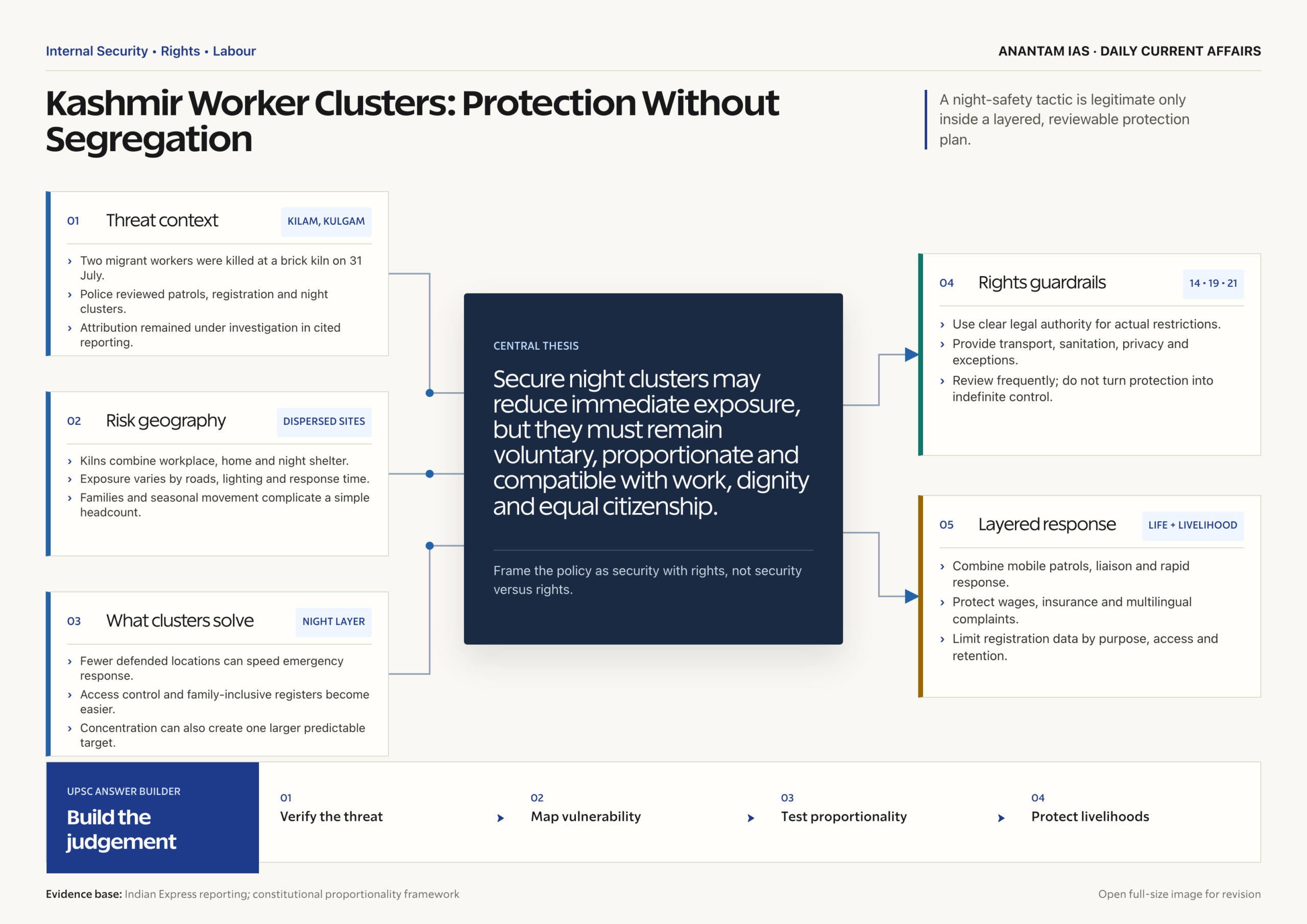
Background and Context
What the Attack and Review Established
The event record should remain separate from claims still under investigation.
- The attack occurred at a brick kiln in Kilam, Kulgam, on July 31. A joint police, Army and paramilitary search followed, according to the newspaper’s reporting.
- The review included the Chief Secretary and Director General of Police. It covered revised SOPs, anti-terror operations, worker registration and employer-provided insurance.
- Police were investigating an online claim associated with TRF, but no final attribution had been announced in the cited reports. In an answer, write ‘police were investigating’, not ‘TRF carried out the attack’.
- The official UAPA listing establishes TRF’s legal designation; it does not prove responsibility for this specific incident. This distinction protects factual accuracy and the integrity of the investigation.
- The evidentiary sequence matters: preserve the crime scene, examine witness accounts and digital claims, test intelligence against recoverable evidence, identify individual perpetrators, and present attribution only when the investigation supports it.
Why Dispersed Brick Kilns Are Difficult to Secure
The protection problem is geographic, seasonal and occupational.
- Kilns are dispersed across villages and may be set away from dense habitation. Workers commonly live beside the worksite, making the same isolated location their workplace, home and night shelter.
- The labour force changes seasonally. Families may accompany workers, so a headcount of only adult employees would exclude dependants from emergency plans.
- Permanent guards at every kiln can consume large manpower while remaining predictable. Mobile patrols, risk-tiered deployment, emergency communications and local intelligence may cover a wider area when coordinated well.
- The risk is not uniform. Location, approach roads, lighting, mobile connectivity, prior threats and distance from the nearest response unit should shape deployment rather than a single Valley-wide template.
- A site audit should identify blind approaches, response delays and communication gaps. Fixing lighting or an alarm link may reduce exposure at one kiln, while another may genuinely require temporary night relocation.
What Secure Night Clusters Can and Cannot Do
Clustering is a protective tactic, not a complete counter-terror strategy.
- A defended night shelter can reduce watched locations, improve access control, speed emergency response and support a family-inclusive register.
- Concentration can also create a larger single target. Locations, routes and schedules should not become publicly predictable, and evacuation plus medical-response plans must accompany perimeter security.
- Night relocation can mean travel after long shifts, overcrowding and sanitation burdens. Workers should not pay for a security measure they did not cause.
- The arrangement should be voluntary wherever feasible, time-bound, periodically reviewed and supported by safe transport. Any restriction must have clear authority, recorded reasons and a channel for urgent exceptions.
- Clustering should be only the night-safety layer. Daytime protection still requires route checks, contact points at worksites, quick reporting of suspicious activity and response plans that do not expose workers who seek help.
Rights, Proportionality and Equal Citizenship
Protection loses legitimacy when a temporary safety measure becomes indefinite control over a class of people.
- Articles 19 and 21 require administrators to ask whether a night movement restriction is lawful, necessary and no wider than the threat demands. Informal police advice is not a substitute for a clear legal basis when.
- Article 14 requires non-arbitrary classification. Risk may justify attention to a vulnerable group, but state of origin alone cannot justify inferior treatment, blanket suspicion or exclusion from ordinary public spaces.
- Workers need multilingual information, healthcare access, confidential complaints and threat reporting without fear of wage loss or punitive policing.
- Registration data should serve safety, insurance and emergency contact purposes. Purpose limitation, access controls, retention limits and an audit trail reduce the chance that a protection database becomes a tool for unrelated surveillance.
- Proportionality must be reassessed as conditions change. A measure suitable immediately after an attack may become excessive if continued automatically after threat levels, patrol coverage or safer accommodation options have materially changed.
Way Forward
Build a Risk-Tiered Protection Plan
- Map kilns and worker accommodation by exposure, road access, lighting, communication and response time; keep sensitive operational details restricted.
- Combine unpredictable mobile patrols, secure communications, rapid-response teams, checkpoint intelligence and site-level emergency drills instead of relying only on static guards.
- Give every cluster an evacuation route, first-aid capacity, a named police liaison and a tested way to contact families and hospitals.
- Use daily field feedback to vary patrol timing and routes. Predictable deployment can be observed and bypassed, while excessive random checking can disrupt lawful movement and weaken cooperation.
Conclusion
- The Kulgam attack demands a firm intelligence and policing response, but the quality of that response will be judged by more than force deployment.
- For a UPSC answer, frame the balance as security with equal citizenship : risk-tiered policing, lawful and reviewable safeguards, employer accountability, worker welfare, privacy protection and evidence-led investigation.
UPSC Practice Questions
Prelims MCQ 1
With reference to constitutional protections relevant to inter-state migrant workers, consider the following statements:
- Article 14 guarantees equality before law and equal protection of the laws to every person.
- Article 19 guarantees to citizens the freedoms to move freely throughout India and to reside and settle in any part of India.
- The freedoms of movement and residence under Article 19 can never be subjected to reasonable restrictions in the interests of the general public.
How many of the above statements are correct?
(a) Only one (b) Only two (c) All three (d) None
Answer: (b) Only two
Explanation:
Statements 1 and 2 are correct. Article 14 applies to every person, while the cited Article 19 freedoms apply to citizens. Statement 3 is incorrect because Article 19(5) permits reasonable restrictions on movement and residence, including in the interests of the general public.
Prelims MCQ 2
The Resistance Front is officially listed by the Ministry of Home Affairs as a terrorist organisation under which law?
(a) National Security Act, 1980 (b) Unlawful Activities (Prevention) Act, 1967 (c) Armed Forces (Special Powers) Act, 1958 (d) Official Secrets Act, 1923
Answer: (b) Unlawful Activities (Prevention) Act, 1967
Explanation:
The Ministry of Home Affairs lists Lashkar-e-Taiba, The Resistance Front and their manifestations or front organisations in the First Schedule associated with terrorist organisations under Section 35 of the UAPA. This legal listing does not establish responsibility for any particular incident without investigation and evidence.
UPSC Mains Questions
- Targeted attacks on migrant workers seek to convert local violence into wider economic and psychological disruption. Examine the security logic of this tactic and propose a layered response that protects soft targets without exhausting police capacity.
- A protective measure can become exclusionary when consent, proportionality and livelihood effects are ignored. Critically evaluate the proposal to place migrant workers in secure night clusters in Kashmir.
Sources: The Indian Express and Ministry of Home Affairs.
Frequently Asked Questions
What triggered the migrant-worker security review in Kashmir?
Two brick-kiln workers from Chhattisgarh died after being shot at Kilam village in Kulgam on July 31, 2026. The attack led the Lieutenant Governor to order a review of security SOPs for non-local labourers and prompted police to increase surveillance.
What is a secure night cluster?
In the reported plan, workers living in scattered kiln-side shelters would gather with their families at a more easily protected location in the same village at night. It can reduce the number of sites requiring protection, but it needs safe.
Why can worker clustering create a rights concern?
If clustering is compulsory, indefinite or based only on state of origin, it can restrict movement, stigmatise workers and disrupt livelihoods. Articles 14, 19 and 21 require non-arbitrary, lawful and proportionate action. Protection should use the least restrictive workable method.
Did TRF carry out the Kulgam attack?
The cited reports said police were investigating an anonymous online claim associated with TRF and had not publicly established responsibility. TRF’s official designation under UAPA is a separate legal fact. A claim of responsibility should not be presented as proven.
What should employers do under the new security directions?
The administration directed employers to ensure insurance for workers from other states and Union Territories and register their details with local police and district authorities. Good implementation should also record dependants, protect wages, provide safe accommodation and limit use of.
Tell Google you want more of this.
Add Anantam IAS as a preferred sourceOne tap, and this site shows up more often in your own Top Stories, AI Overviews and AI Mode. Remove it any time.