Why in News?
The Department of Consumer Affairs notified the Indian Standard Time Rules on 27 August 2026, but they will come into force only after the stated 180-day window.
- The Rules were made under Section 52 of the Legal Metrology Act, 2009 and establish a framework for generating, disseminating and tracing IST.
- The 180-day commencement window runs from Gazette publication; it is a preparation period, so the notification should not be presented as immediately operative.
- IST becomes the common reference for legal, administrative, commercial and official purposes, including time-dependent records and systems.
- The framework connects timekeeping with critical infrastructure, cybersecurity, continuity planning and auditable proof that system time traces to the national standard.
- A timestamp is evidence only when its source, accuracy and chain of synchronisation can be demonstrated, not merely because a screen displays the correct hour.
- Common time supports transaction ordering, incident reconstruction and coordination across banking, telecom, transport, power, data centres and government records.
- The compliance challenge is operational: organisations must align clocks, logs, fallback sources and audit evidence during the transition window.
UPSC Relevance
Prelims Relevance
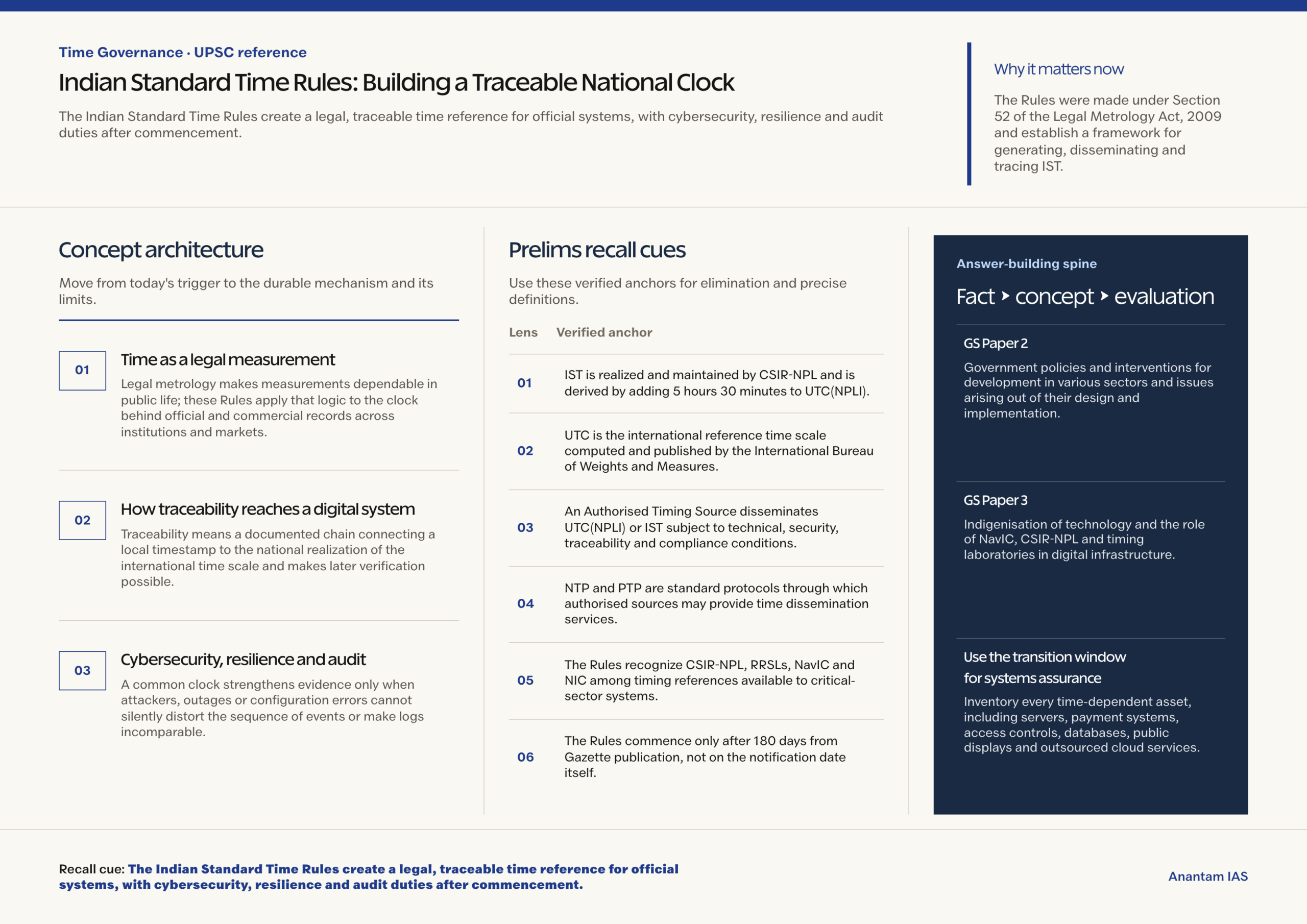
- IST is realized and maintained by CSIR-NPL and is derived by adding 5 hours 30 minutes to UTC(NPLI).
- UTC is the international reference time scale computed and published by the International Bureau of Weights and Measures.
- An Authorised Timing Source disseminates UTC(NPLI) or IST subject to technical, security, traceability and compliance conditions.
- NTP and PTP are standard protocols through which authorised sources may provide time dissemination services.
- The Rules recognize CSIR-NPL, RRSLs, NavIC and NIC among timing references available to critical-sector systems.
- The Rules commence only after 180 days from Gazette publication, not on the notification date itself.
Mains Relevance
GS Paper 2
- Government policies and interventions for development in various sectors and issues arising out of their design and implementation.
- Transparency and accountability through common timestamps, traceable records and auditable administrative systems.
GS Paper 3
- Indigenisation of technology and the role of NavIC, CSIR-NPL and timing laboratories in digital infrastructure.
- Cybersecurity and protection of critical infrastructure through resilient, redundant and verifiable time synchronisation.
Essay
- Digital trust depends on invisible public standards that make records comparable, systems accountable and infrastructure resilient.
Background and Context
Time as a legal measurement
Legal metrology makes measurements dependable in public life; these Rules apply that logic to the clock behind official and commercial records across institutions and markets.
- Indian Standard Time is the official scale for civil, commercial and legal purposes, realized by CSIR-NPL from UTC(NPLI) with a 5-hour-30-minute offset.
- After commencement, references in legal, administrative and official documents default to IST unless another basis is stated explicitly, reducing ambiguity over when an act occurred.
- The standard reaches commerce, transport, public administration, contracts and financial operations; it concerns recorded events and machine clocks, not simply wall-clock uniformity.
- Other time references are generally prohibited, but clearly labelled foreign zones may accompany IST where law or directions permit; approved alternatives remain possible for research, navigation or astronomy.
- This is metrology because a usable time value needs a defined unit, an authoritative realization and an unbroken comparison chain, just like other regulated measurements.
How traceability reaches a digital system
Traceability means a documented chain connecting a local timestamp to the national realization of the international time scale and makes later verification possible.
- The BIPM computes and publishes UTC from participating national laboratories; CSIR-NPL maintains UTC(NPLI) and realizes IST while preserving its traceability to UTC.
- CSIR-NPL, RRSLs, ISRO and other authorised sources disseminate official signals, while the Legal Metrology Division maintains secondary time scales at Regional Reference Standards Laboratories.
- Critical systems may synchronise through authorised NTP, PTP or NavIC services; the Director of Legal Metrology is to publish the designated addresses or access protocols.
- The authorised source protects signal accuracy, but the end entity remains responsible for accuracy, stability and traceability inside its own servers, devices, databases and applications.
- End users must monitor clock deviation, record it under applicable standards and retain auditable data proving that local time traces back to the national standard.
Cybersecurity, resilience and audit
A common clock strengthens evidence only when attackers, outages or configuration errors cannot silently distort the sequence of events or make logs incomparable.
- False time can reorder payments, confuse network logs or weaken incident reconstruction; the Rules require safeguards against jamming, spoofing and cyber-attacks on synchronisation systems.
- Entities must use redundant synchronisation and contingency plans so loss of one reference does not interrupt traceable time for networks and mission-critical services.
- Critical sectors, including power, telecom, finance, transport, broadcasting and data centres, must include NavIC or another authorised source alongside an additional authorised reference.
- Secure housing, hardware, software and procedures must preserve integrity, availability, accountability and traceability; accurate time is treated as a protected infrastructure service.
- Periodic audits will test compliance, including the traceability and availability of authorised sources, while the Legal Metrology Division oversees monitoring and enforcement.
Way Forward
Use the transition window for systems assurance
The 180-day interval should become a controlled migration, not a last-minute clock-setting exercise.
- Inventory every time-dependent asset, including servers, payment systems, access controls, databases, public displays and outsourced cloud services; identify its present source and tolerance.
- Design primary and fallback synchronisation paths using authorised timing sources, then test failover under spoofing, jamming, network loss and clock-drift scenarios.
- Preserve configuration histories, deviation records and incident logs so auditors can reconstruct the traceability chain from each important timestamp to UTC(NPLI) or IST.
- Issue sector-specific technical guidance before commencement so smaller institutions can meet security and evidence requirements without interpreting protocol-level duties alone.
Conclusion
- The durable lesson is that IST is becoming a governed measurement chain, joining national time realization, authorised dissemination, secure system synchronisation and auditable local use.
- In a Mains answer, separate notification from commencement, then connect standardisation with digital trust, cybersecurity, critical-infrastructure resilience and accountable record-keeping.
UPSC Practice Questions
Prelims MCQ 1
With reference to the Legal Metrology (Indian Standard Time) Rules, 2026, consider the following statements:
- IST is realized and maintained by CSIR-NPL and derived from UTC(NPLI).
- End entities remain responsible for accuracy, stability and traceability within their systems.
- The Rules came into force immediately upon notification on 27 August 2026.
How many of the above statements are correct?
(a) Only one (b) Only two (c) All three (d) None
Answer: (b) Only two
Explanation:
Statements 1 and 2 are correct. The Rules come into force only after 180 days from publication in the Official Gazette, not immediately on notification.
Prelims MCQ 2
In the context of the Indian Standard Time Rules, what does time traceability most accurately mean?
(a) A clock displays the same hour as a nearby mobile phone (b) Every device receives time directly from a foreign satellite (c) A documented comparison chain connects a system’s time to UTC(NPLI) or IST (d) All records are stored in one central database
Answer: (c) A documented comparison chain connects a system's time to UTC(NPLI) or IST
Explanation:
Traceability requires evidence linking the local time value through authorised references to the national standard; visual agreement alone does not establish that chain.
UPSC Mains Questions
- A common legal time reference is both a metrology reform and a digital-governance reform. Discuss with reference to traceability, accountability and public infrastructure.
- Examine how secure and resilient time synchronisation can strengthen India’s critical infrastructure. What implementation challenges must be addressed during the transition period?
Sources: PIB, Department of Consumer Affairs and Department of Consumer Affairs, Gazette Notification G.S.R. 761(E).
Frequently Asked Questions
Are the Indian Standard Time Rules already in force?
No. They were notified in August 2026 but commence only after 180 days from publication in the Official Gazette. The interval is meant for technical and organisational preparation.
Who maintains India’s official time?
CSIR-NPL maintains UTC(NPLI), India’s realization of Coordinated Universal Time, and realizes IST by adding 5 hours 30 minutes while preserving traceability to UTC.
What is time traceability?
It is a documented, auditable chain connecting a local clock or timestamp through authorised timing sources to UTC(NPLI) or IST, including records of deviations and synchronisation.
Why is common time important for cybersecurity?
Security logs, payment records and incident timelines depend on event order. Spoofed or drifting clocks can obscure that order, so systems need protected sources, redundancy and contingency plans.
Can foreign time zones still be displayed?
The Rules allow clearly labelled foreign-zone time alongside IST where another law, order, direction or guideline permits it; approved alternative scales may serve specified scientific uses.
Tell Google you want more of this.
Add Anantam IAS as a preferred sourceOne tap, and this site shows up more often in your own Top Stories, AI Overviews and AI Mode. Remove it any time.