Why in news:
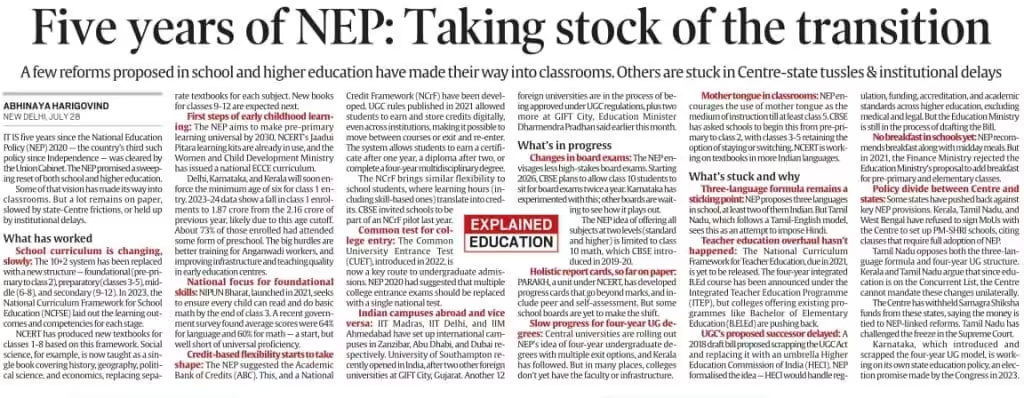
It is five years since the National Education Policy (NEP) 2020 – the country’s third such policy since Independence – was cleared by the Union Cabinet. It promised a sweeping reset of both school and higher education. Some aspects have already been implemented while some others have remained on paper amidst Center State friction and institutional delays.
UPSC CSE Relevance:
UPSC CSE in mains and prelims examination has focused on Government policies and interventions for development in various sectors and Issues relating to development and management of Social Sector/Services relating to Health, Education, Human Resources. As we can see PYQ related to this.
UPSC 2022 mains PYQ:
The Right of Children to Free and Compulsory Education Act, 2009 remains inadequate in promoting incentive-based system for children’s education without generating awareness about the importance of schooling. Analyse
About New Education Policy, 2020:
- It is the first education policy of the 21st century and replaces the 34-year-old National Policy on Education (NPE), 1986.
- The new Curricular Structure of (5+3+3+4) replaces the traditional 10+2 school structure.
- Aims to increase public investment in education to 6% of GDP (from around 4.43% currently).
- Holistic and multidisciplinary education with no rigid separation of streams, integration of vocational education and emphasis on 21st-century skills.
- Promotes multilingualism and mother Tongue by recommending teaching in the home language/mother tongue/local language/regional language until at least Grade 5. Continues with the three-language formula, emphasizing Indian languages.
- A new National Assessment Centre, PARAKH (Performance Assessment, Review, and Analysis of Knowledge for Holistic Development), to be set up as a standard-setting body.
- Shift from summative to formative assessment focusing on regular, competency-based assessments that promote learning and development, testing higher-order skills.
- Focus on teacher education and development by developing National Professional Standards for Teachers (NPST) and 4 year integrated B. ED.
- Higher education reforms with common entrance exam, multiple Entry/Exit Options, Academic Bank of Credits (ABC) and a Higher Education Commission of India (HECI) as a single overarching umbrella body for higher education, replacing multiple regulatory bodies like UGC and AICTE.
- Integration of technology by establishing National Educational Technology Forum (NETF) and via digital learning platforms like DIKSHA, SWAYAM, and National Digital Library.
- Promoting inclusive education by focusing on Socially and Economically Disadvantaged Groups (SEDGs), including gender identities, socio-cultural identities, and geographical identities.
What has worked?
- School curriculum is changing : The 10+2 system has been replaced with a new structure – foundational (pre-pri-mary to class 2), preparatory (classes 3-5), middle (6-8), and secondary (9-12).
- In 2023, the National Curriculum Framework for School Education (NCFSE) laid out the learning outcomes and competencies for each stage.
- NCERT has produced new textbooks for classes 1-8 based on this framework
- Primary Education : The NEP aims to make pre-primary learning universal by 2030.
- NCERT’s Jaadui Pitara learning kits are already in use.
- the Women and Child Development Ministry has issued a national ECCE curriculum.
- National focus for foundational skills: NIPUN Bharat, launched in 2021, seeks to ensure every child can read and do basic math by the end of class 3.
- A recent govern-ment survey found average scores were 64% for language and 60% for math – a start, but well short of universal proficiency
- Flexibility in Education : Academic Bank of Credits (ABC) for higher education and a National Credit Framework for School education have been developed to exit and enter courses flexibly.
- Common test for college entry: The Common University Entrance Test (CUET), introduced in 2022, is now a key route to undergraduate admissions and CUET PG fir postgraduate admissions.
- Indian campuses abroad and vice versa: IIT Madras, IIT Delhi, and IIM Ahmedabad have set up international cam-puses in Zanzibar, Abu Dhabi, and Dubai respectively. University of Southampton recently opened in India, after two other foreign universities at GIFT City, Gujarat.
- Changes in board exams: The NEP envisages less high-stakes board exams. Starting 2026, CBSE plans to allow class 10 students to sit for board exams twice a year. Karnataka has experimented with this; other boards are waiting to see how it plays out.
What is stuck ?
- Holistic report cards, so far on paper : PARAKH, a unit under NCERT, has developed progress cards that go beyond marks, and include peer and self-assessment. But some school boards are yet to make the shift.
- Slow progress for four-year UG degrees: Central universities are rolling out NEP’s idea of four-year undergraduate degrees with multiple exit options, and Kerala has followed. But in many places, colleges don’t yet have the faculty or infrastructure.
- The three-language formula was not received well : NEP proposes three languages in school, at least two of them Indian. But Tamil Nadu, which follows a Tamil-English model, sees this as an attempt to impose Hindi. A similar controversy erupted in Maharashtra also recently.
- Teacher education overhaul hasn’t happened: The National Curriculum Framework for Teacher Education, due in 2021, is yet to be released. The four-year integrated B.Ed course has been announced, but colleges offering existing programmes like Bachelor of Elementary Education (B.El.Ed) are pushing back.
- Delay in establishing HECI: A 2018 draft bill proposed scrapping the UGC Act and replacing it with an umbrella Higher Education Commission of India (HECI) but the Education Ministry is still in the process of drafting the Bill.
- No breakfast in schools yet: NEP recommends breakfast along with midday meals. But in 2021, the Finance Ministry rejected the Education Ministry’s proposal to add breakfast for pre-primary and elementary classes.
- Policy divide between Centre and states: Some states have pushed back against key NEP provisions. Kerala, Tamil Nadu, and West Bengal have refused to sign MoUs with the Centre to set up PM-SHRI schools, citing clauses that require full adoption of NEP.
Way Ahead:
- Structured Inter-State Forums: Revitalize and utilize bodies like the Inter-State Council and NITI Aayog‘s Governing Council for regular, high-level discussions and consensus-building on NEP implementation. These should not be mere consultation platforms but genuine decision-making forums.
- “One Size Does Not Fit All”: The Centre should provide broad guidelines and a national vision, but allow states the flexibility to adapt implementation strategies to their local contexts, linguistic diversity, and resource availability. This is crucial for successful adoption.
- Increased and Predictable Funding: The Centre must honor the commitment to increase public investment in education to 6% of GDP, and this funding should be predictable and sufficient for states to plan long-term reforms.
- Performance-Linked Incentives: Link a portion of central funds to clear, outcome-based performance indicators related to NEP goals, rather than just input-based compliance. This incentivizes states to achieve results.
- Phased Infrastructure Development: Prioritize essential infrastructure development (e.g., basic amenities, digital labs, libraries) in a phased manner, focusing on areas with the greatest need.
- Public-Private Partnerships (PPPs): Explore ethical and transparent PPP models for funding infrastructure development and specialized vocational training, ensuring equity and quality.
- Robust Data Systems: Develop and implement robust, integrated data collection and management systems at national, state, and institutional levels to track progress, identify gaps, and inform policy adjustments.
- Outcome-Based Monitoring: Shift from mere input-based monitoring to outcome-based evaluation, focusing on actual learning outcomes and skill development.
Tell Google you want more of this.
Add Anantam IAS as a preferred sourceOne tap, and this site shows up more often in your own Top Stories, AI Overviews and AI Mode. Remove it any time.