Why in News?
On 30 August 2026, The Hindu reported that Parliament had not been prorogued 17 days after both Houses adjourned sine die on 13 August.
- The Monsoon Session remained formally open because adjournment sine die ended the sittings, while no presidential prorogation order had ended the session.
- An unprorogued House may be reconvened within the same session without a fresh presidential summons, although members must still be informed of the resumed sitting.
- The reported gap was unusual but not unprecedented: the 2015 Monsoon Session was prorogued 28 days after adjournment sine die.
- The report recorded political concern and speculation, but no official announcement established that Parliament would be reconvened or that particular legislation would be introduced.
- The exam trap is to treat the end of a sitting, the end of a session and the end of the Lok Sabha as the same event.
- The distinction decides whether fresh summons are needed, whether notices survive and whether the constitutional condition for an ordinance exists.
- A delay between adjournment sine die and prorogation is not by itself unconstitutional because Article 85 sets no deadline linking those two acts.
UPSC Relevance
Prelims Relevance
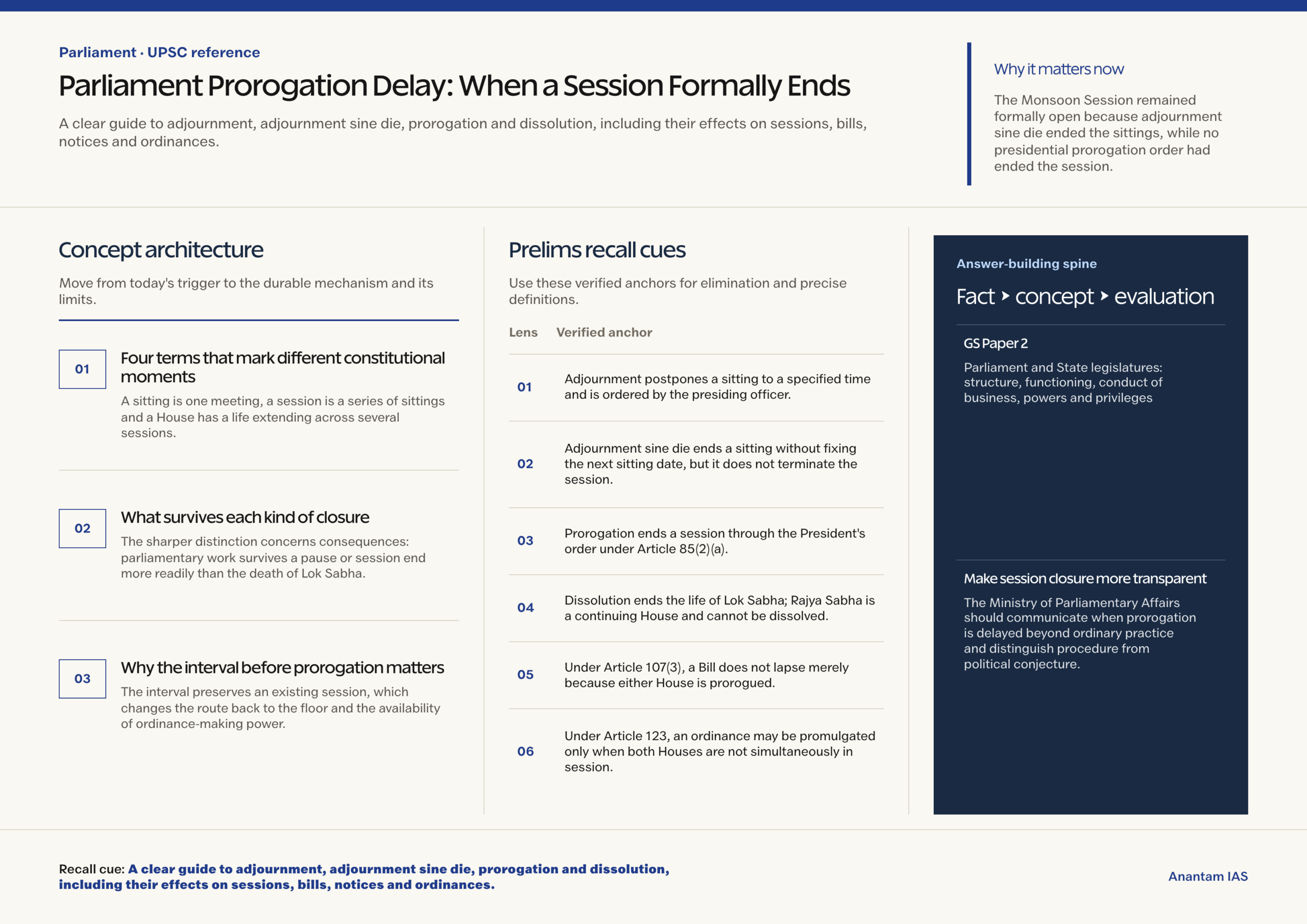
- Adjournment postpones a sitting to a specified time and is ordered by the presiding officer.
- Adjournment sine die ends a sitting without fixing the next sitting date, but it does not terminate the session.
- Prorogation ends a session through the President’s order under Article 85(2)(a).
- Dissolution ends the life of Lok Sabha; Rajya Sabha is a continuing House and cannot be dissolved.
- Under Article 107(3), a Bill does not lapse merely because either House is prorogued.
- Under Article 123, an ordinance may be promulgated only when both Houses are not simultaneously in session.
Mains Relevance
GS Paper 2
- Parliament and State legislatures: structure, functioning, conduct of business, powers and privileges
- Executive-legislature relations, constitutional conventions and the accountability value of transparent session management
Essay
- Constitutional government depends on both legal power and transparent procedure.
Background and Context
Four terms that mark different constitutional moments
A sitting is one meeting, a session is a series of sittings and a House has a life extending across several sessions.
- An adjournment pauses a sitting until a stated hour or date; the Speaker or Chairman controls it and pending business remains alive.
- An adjournment sine die closes a sitting without naming a return date. The Latin phrase means without a day, not that the session has constitutionally ended.
- A prorogation terminates the session. Under Article 85(2)(a), the President may prorogue both Houses together or either House separately.
- A dissolution terminates Lok Sabha itself, either on completion of its constitutional term or earlier under Article 85(2)(b). Members then lose their representative capacity in that House.
- Rajya Sabha is not subject to dissolution under Article 83(1); roughly one-third of its members retire every second year.
What survives each kind of closure
The sharper distinction concerns consequences: parliamentary work survives a pause or session end more readily than the death of Lok Sabha.
- Adjournment, including adjournment sine die, does not make pending business lapse because the same session and the same House continue.
- Prorogation ends the session, but Article 107(3) protects pending Bills, including Bills before Select or Joint Committees, from lapsing merely for that reason.
- In Lok Sabha, already moved motions, resolutions and amendments may continue, while most pending notices lapse and must be given afresh for the next session.
- Parliamentary committee business continues through prorogation. This continuity allows scrutiny to proceed between sessions rather than restarting every time a session closes.
- Dissolution is stronger: a Bill pending in Lok Sabha, or passed there and pending in Rajya Sabha, lapses; a Bill pending only in Rajya Sabha does not.
Why the interval before prorogation matters
The interval preserves an existing session, which changes the route back to the floor and the availability of ordinance-making power.
- Before prorogation, a House adjourned sine die can be reconvened as another part of the same session; a fresh presidential summons is unnecessary.
- After prorogation, another sitting requires a new summons under Article 85(1). The gap between the last sitting of one session and first sitting of the next cannot exceed six months.
- While both Houses remain technically in session, Article 123 does not permit an ordinance because its threshold is that both Houses must not be simultaneously in session.
- This makes prorogation constitutionally consequential, but it does not prove a hidden legislative plan. Reconvening and the business taken up require separate official decisions.
- For a related ordinance-power revision, see The Ordinance Question before the Supreme Court.
Way Forward
Make session closure more transparent
- The Ministry of Parliamentary Affairs should communicate when prorogation is delayed beyond ordinary practice and distinguish procedure from political conjecture.
- Prorogation orders and related bulletins should be published promptly in searchable form so members and citizens can identify the House’s exact constitutional status.
- Any reconvening should provide members adequate notice and a clear agenda, preserving effective participation even when a fresh presidential summons is legally unnecessary.
- Parliamentary reform should protect predictable calendars while retaining limited flexibility for genuine urgency and respecting the six-month ceiling under Article 85(1).
Conclusion
- Adjournment pauses a sitting, prorogation ends a session and dissolution ends Lok Sabha. Keep those three levels separate in every answer.
- The 17-day delay kept the session formally alive and preserved a route to reconvene, but it did not establish that a special sitting or specified Bill was planned.
- Use Articles 83, 85, 107 and 123 together to explain the institutional consequences rather than inferring political purpose from procedural timing.
UPSC Practice Questions
Prelims MCQ 1
With reference to parliamentary procedure in India, consider the following statements:
- Adjournment sine die ends a sitting without fixing a date for the next sitting.
- Prorogation causes every Bill pending in Parliament to lapse.
- Rajya Sabha is not subject to dissolution.
How many of the above statements are correct?
(a) Only one (b) Only two (c) All three (d) None
Answer: (b) Only two
Explanation:
Statements 1 and 3 are correct. Article 107(3) expressly provides that a Bill pending in Parliament does not lapse merely because the Houses are prorogued.
Prelims MCQ 2
Which statement best describes the effect of dissolving Lok Sabha on pending Bills?
(a) Every Bill pending anywhere in Parliament lapses (b) No pending Bill lapses until Rajya Sabha is also dissolved (c) A Bill pending only in Rajya Sabha and not passed by Lok Sabha does not lapse (d) Only Money Bills lapse
Answer: (c) A Bill pending only in Rajya Sabha and not passed by Lok Sabha does not lapse
Explanation:
Article 107(4) protects such a Bill. A Bill pending in Lok Sabha, or passed by Lok Sabha and pending in Rajya Sabha, lapses under Article 107(5).
UPSC Mains Questions
- Distinguish adjournment, adjournment sine die, prorogation and dissolution. Explain their consequences for parliamentary business and executive ordinance-making.
- Procedural transparency is a substantive part of legislative accountability. Discuss with reference to the summoning, prorogation and reconvening of Parliament.
Sources: The Hindu and Digital Sansad, Lok Sabha FAQ.
Frequently Asked Questions
Does adjournment sine die end a parliamentary session?
No. It ends a sitting without fixing the next sitting date. The session formally ends only when the President prorogues the House under Article 85(2)(a).
Can Parliament meet again before prorogation?
Yes. A House adjourned sine die may be reconvened as part of the same session without a fresh presidential summons, after members receive notice of the sitting.
Do Bills lapse when Parliament is prorogued?
No. Article 107(3) protects Bills pending in Parliament from lapsing merely because of prorogation, including Bills being examined by Select or Joint Committees.
Can the President issue an ordinance before both Houses are prorogued?
Not while both Houses remain technically in session. Article 123 permits an ordinance only when both Houses are not simultaneously in session and immediate action is considered necessary.
Is a long gap before prorogation unconstitutional?
Not by itself. Article 85 prescribes no deadline between adjournment sine die and prorogation, though an unexplained delay may raise legitimate questions about transparency and parliamentary planning.
Tell Google you want more of this.
Add Anantam IAS as a preferred sourceOne tap, and this site shows up more often in your own Top Stories, AI Overviews and AI Mode. Remove it any time.