Why in News?
The Union Cabinet approved the restructuring and continuation of the flagship National Social Assistance Programme (NSAP) as the Pradhan Mantri Samajik Sahayata Yojana, backed by a financial outlay of ₹53,428 crore for the period 2026-27 to 2030-31.
The reform extends pension coverage to an estimated 3.20 crore beneficiaries across all 36 States and Union Territories, with a major emphasis on lowering the threshold for disability assistance.
| UPSC Relevance: GS-2 Social Justice: Vulnerable Sections; Welfare Schemes Prelims: Pradhan Mantri Samajik Sahayata Yojana |
National Social Assistance Programme (NSAP):
- Origin & Nodal Ministry: Launched on 15 August 1995 under the Ministry of Rural Development as a step towards a National Policy for Social Assistance.
- Constitutional Anchor: Grounded in Article 41 (a Directive Principle of State Policy), which directs the State, within the limits of its economic capacity and development, to make effective provision for securing the right to work, to education, and to public assistance in cases of unemployment, old age, sickness, and disablement.
- Fiscal Architecture: Central assistance for prescribed components is 100% funded by the Union Government. However, because States/UTs are expected to top up these amounts, actual payouts vary significantly across India.
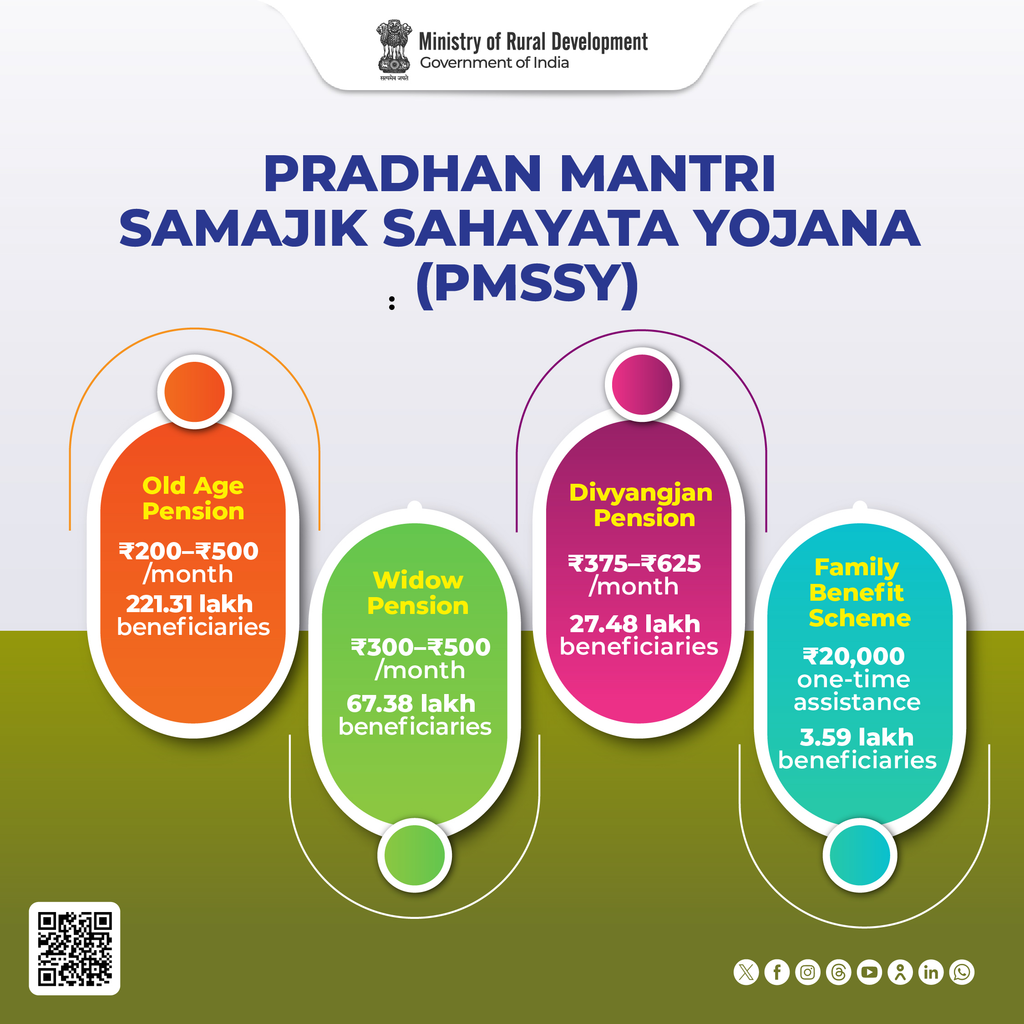
Key Structural & Nomenclature Changes:
1. Renaming of Sub-Schemes:
To unify branding under national welfare nomenclature, the sub-schemes have been renamed:
| Earlier Scheme Name (NSAP) | Approved New Scheme Name (PMSSY) |
| Indira Gandhi National Old Age Pension Scheme | Pradhan Mantri Vridhavastha Pension Yojana |
| Indira Gandhi National Widow Pension Scheme | Pradhan Mantri Vidhawa Pension Yojana |
| Indira Gandhi National Disability Pension Scheme | Pradhan Mantri Divyangjan Pension Yojana |
| National Family Benefit Scheme | Pradhan Mantri Parivar Labh Yojana |
2. Overhaul of the Disability Pension:
- Disability Threshold Lowered: Reduced drastically from 80% to 40% severe/multiple disability, bringing central norms in sync with the RPWD Act, 2016.
- Age Floor Removed: Eligibility now commences from birth, eliminating the previous discriminatory age restriction for children with disabilities.
- Revised Assistance Tiers:
- Ages 0-79: ₹375 per month
- Ages 80 and above: ₹625 per month
- Rollout Window: Detailed operational guidelines are mandated for rollout within three months; nationwide implementation is phased rather than immediate.
3. Status Quo for Other Components:
- Old-Age Pension: Retained at ₹200/month (BPL, ages 60-79) and ₹500/month (ages 80+).
- Widow Pension: Retained at ₹300/month (BPL, ages 40-79) and ₹500/month (ages 80+).
- National Family Benefit: Retained at a one-time grant of ₹20,000 to a BPL household on the death of the primary breadwinner (ages 18-59).
Significance for Governance & Rights:
- Legislative Harmonisation: Aligning the disability cutoff to 40% bridges a long-standing gap with Section 24 of the Rights of Persons with Disabilities (RPWD) Act, 2016, which mandates social security measures and a 25% higher assistance rate compared to general schemes.
- Life-Cycle Approach to Disability: Removing the age floor acknowledges that families incur heavy caregiving, therapeutic, and assistive-device costs for infants and children with developmental or congenital disabilities.
Persistent Gaps & Bottlenecks:
- Stagnant Core Pension Amounts:
- Central old-age (₹200) and widow (₹300) rates have remained virtually frozen for decades. In real terms, they fail to buy basic nutritional security or cover out-of-pocket healthcare expenses.
- Even the revised disability pension (₹375-₹625) falls short of actual rehabilitation and care costs.
- Inflation Trap: Fixed nominal transfers without automatic indexation or cost-of-living adjustment (COLA) mean high inflation continuously erodes purchasing power over the 5-year plan cycle.
- Federal Disparities and Operational Bottlenecks:
- Because fiscal capacity varies, richer States provide generous top-ups while poorer States (where poverty density is highest) lag.
- CAG audits and research highlights frequently flag delayed fund transfers, biometric authentication failures, and irregular disbursement schedules that break the “predictable income” promise of social assistance.
Way Forward:
- Inflation Indexation & Baseline Revision: Link pension disbursements to the Consumer Price Index (CPI-Rural) and benchmark a realistic minimum floor aligned with ILO social protection floors.
- Dynamic Ceiling Elimination: Replace artificial State-wise beneficiary quotas with a demand-driven, SECC/NSSO-updated dynamic registry (akin to MGNREGA principles).
- De-bottlenecking the Disability Certification Ecosystem: Expand medical boards at the Block/PHC level to prevent corruption and long travel distances for rural Divyangjan seeking 40% certification.
- Digitised, Timely DBT & Social Audits: Mandate real-time Aadhaar/e-KYC tracking with social audits under the Gram Sabha to eliminate ghost beneficiaries and payment backlogs.
Prelims Practice MCQ:
Q. Consider the following statements:
- Article 41 provides a Directive Principle concerning public assistance in cases including old age and disablement.
- The approved disability pension revision lowers the disability threshold to 40% and allows eligibility from birth.
- States/UTs cannot supplement the central pension assistance.
Which of the statements given above are correct?
(a) 1 and 2 only
(b) 2 and 3 only
(c) 1 and 3 only
(d) 1, 2 and 3
Answer: (a)
Tell Google you want more of this.
Add Anantam IAS as a preferred sourceOne tap, and this site shows up more often in your own Top Stories, AI Overviews and AI Mode. Remove it any time.