Digital Gold or E-gold

- The Securities and Exchange Board of India (SEBI) has publicly cautioned the general public against investing in digital gold or e-gold products.
- The popularity of digital gold has surged due to a steep rise in gold prices and the convenience/ease of owning gold digitally through online platforms.
- Digital Gold – It is the process of buying gold without physically possessing the precious metal.
- The price of digital gold is linked to that of physical gold.
- Often created using blockchain technology to allow investors to buy, sell, and store gold electronically.
- Can be converted into physical gold (coins, bars, or jewellery) whenever required.
- Risks and Lack of Protection :
- Regulatory Status: SEBI states that digital gold is different from gold-related products it regulates. They are neither notified as securities nor regulated as commodity derivatives.
- No Investor Protection: None of the investor protection mechanisms under the securities market purview are available for such investments.
- Ease of Entry (Double-Edged): Unlike regulated products like Gold ETFs and commodity derivatives, investing in digital gold does not require a demat account or margin deposits, which drives investor interest but bypasses regulatory checks.
- Promoters: Both organised and unorganised sector jewellers are providing opportunities for investment in digital gold.
How is it different from other gold investment options?
| Feature | Physical Gold (Jewellery/Coins) | Digital Gold (Unregulated) | Gold ETF (Exchange Traded Fund) (Regulated) | Sovereign Gold Bond (SGB) (Regulated) |
| Form | Tangible metal (Coins, Bars, Jewellery) | Digital ownership of physical gold in a vault | Units of a mutual fund scheme traded on exchange | Government security denominated in grams of gold |
| Regulator | None (Purity is self-regulated/Hallmarking) | None (Not regulated by SEBI/RBI) – High Risk | SEBI (Securities and Exchange Board of India) | RBI (Reserve Bank of India) on behalf of the Govt. of India |
| Purity | Varies (22K, 24K). Risk of impurity and making charges. | Typically 99.9% (24K) pure is promised. | 99.5% pure gold backing the units. | Price is linked to 999 purity gold. |
| Minimum Investment | High (Cost of smallest coin/jewellery item) | Very Low (As low as ₹1 or ₹10) | Low (Cost of one unit, usually approx 1 gram price) | Low (Minimum 1 gram) |
| Storage & Security | High risk of theft/loss. Requires bank locker (costly). | Stored in insured, secure vaults by the provider. | Managed by the Fund House (in their secure vault). | Paper/Demat Form (No storage risk). |
| Extra Return | None | Not necessarily, Potential for gold leasing income on some platforms. | None | Fixed Interest of 2.50% p.a. (Paid semi-annually) |
| Liquidity | Low (Requires visiting a jeweller, can involve purity check deduction). | High (Can sell instantly online on the platform). | High (Can be sold instantly on the stock exchange during market hours). | Low (Lock-in period of 5 years, tradable on exchange thereafter; maturity is 8 years). |
| Capital Gains Tax at Maturity | Taxed (LTCG with indexation after 3 years). | Taxed (LTCG with indexation after 3 years). | Taxed (LTCG with indexation after 3 years). | 100% Tax Exempted on maturity (after 8 years). |
| Charges/Cost | Making Charges (5%-25%), GST (3%) | GST (3%), Buy/Sell spread (2-5%) | Demat A/C AMC, Brokerage, Fund Expense Ratio (approx 0.5%-1.0%) | None (Often a ₹50/gram discount for online purchase). |
| Physical Delivery | Yes, you possess it. | Yes, can be converted to coins/bars (min. limits apply). | No, units must be sold for cash. | No, matures in cash. |
Great Indian Bustard

- The Great Indian Bustard (GIB), locally known as Godawan in Rajasthan, is one of the most critically endangered birds globally and is a flagship species for the health of India’s grassland ecosystems.
- IUCN Red List: Critically Endangered (CR).
- Wildlife (Protection) Act, 1972 (India): Schedule I.
- CITES (Convention on International Trade in Endangered Species): Appendix I.
- Prefers arid and semi-arid grasslands and scrublands with minimal visual obstruction and disturbance.
- It is endemic to Indian subcontinent.
- Historically found across 11 states in India and parts of Pakistan. Today, its population is confined mostly to Rajasthan (Desert National Park is a stronghold) and Gujarat. Small, scattered populations also exist in Maharashtra, Karnataka, and Andhra Pradesh.
- It is a very large bird, among the heaviest flying birds in the world, standing about one meter (3.3 feet) tall. It is easily distinguished by its black crown on a pale head and neck.
- Reproduction Rate: A significant factor in its decline is its slow reproductive rate.
- The female typically lays a single egg per breeding season (usually during the monsoon, March-September).
- She incubates the egg in a shallow, unlined scrape on the open ground.
- Only the female is involved in incubation and parental care, which lasts until the next breeding season (almost a year).
- Diet : Omnivorous and Opportunistic (feeds on whatever is available). Feeds on grass seeds, berries, insects (like grasshoppers and beetles), small rodents, and small reptiles. It is considered a “Friend of the Farmer” as it controls insect and rodent populations.
- Mating Behavior (Lekking): The GIB is polygamous, and males engage in an elaborate courtship display called lekking to attract females.
- The male performs a striking visual display, including fluffing its white neck feathers and inflating a gular pouch (neck pouch).
- The inflated pouch helps produce a deep, resonant, booming call that can be heard up to 500 meters away.
- Social Structure: Males are generally solitary, but the birds may congregate in small flocks during the winter months after the monsoon breeding season.
- Flagship Species: It is considered the “umbrella species” of the Indian grassland ecosystem, meaning conservation efforts aimed at the GIB benefit all other species in the grassland habitat.
- Collision/Electrocution with Power Lines: Due to their poor frontal vision and heavy weight, they are unable to spot or maneuver away from high-tension electric wires, leading to a high rate of mortality.
- Hunting/Poaching: Although protected, it remains a threat, especially in border areas and Pakistan.
Lesser Florican
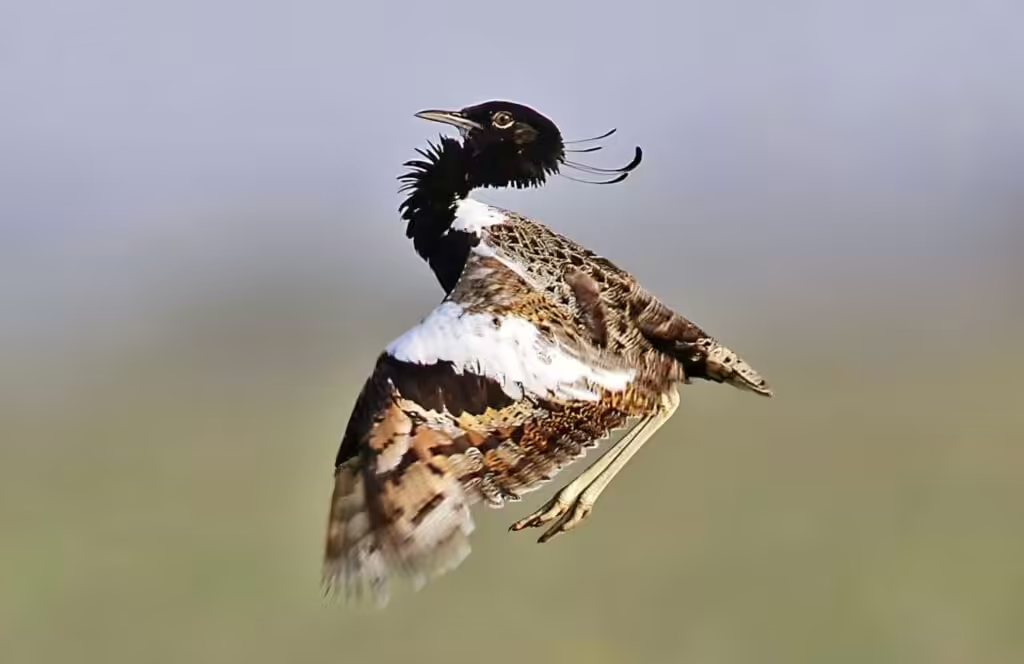
- The Lesser Florican , also known as the Likh or Kharmore, is an incredibly important and highly threatened bird species endemic to the Indian Subcontinent.
- IUCN Red List Status : Critically Endangered (CR)
- Wildlife (Protection) Act, 1972 (India) : Schedule I
| Feature | Details |
| Scientific Name | Sypheotides indicus |
| Family | Otididae (Bustard family) |
| Key Identity | It is the smallest member of the bustard family and the only species in the genus Sypheotides. |
| Endemic Range | Indian Subcontinent. Primarily observed in Gujarat, Rajasthan, and Madhya Pradesh during the breeding season. |
| Habitat | Prefers tall grasslands and semi-arid plains. Increasingly forced to use agricultural fields (like cotton, millet, sorghum) due to grassland loss. |
| Breeding Display | Males are famous for their unique, energetic “sky-dancing” or leaping display during the monsoon season. They jump several meters into the air, fluttering their wings and emitting a distinctive croaking sound to attract females (part of a dispersed lek mating system). |
| Appearance | Breeding Male: Striking black head, neck, and underparts with contrasting white throat, wing coverts, and a distinctive set of three ribbon-like plumes extending from behind the ear-coverts. |
| Diet | Omnivorous, feeding on a variety of invertebrates (grasshoppers, caterpillars, beetles, worms), small vertebrates (lizards, frogs), and plant parts (shoots and seeds). |
| Nature | Local Migrant; its movement is often linked to the pattern of the southwest monsoon, migrating from non-breeding sites to breeding grounds. |
Plastic Recycling

Factors Affecting Plastic Recycling
- Thermoplastics (Recyclable):
- They soften when heated and harden when cooled (e.g., PET in water bottles, HDPE in milk jugs).
- This property allows them to be successfully melted, filtered, and reshaped with limited damage.
- Thermosets (Not Recyclable by Normal Methods):
- They form permanent chemical bonds when first made (e.g., epoxy resins, some rubber parts).
- They crack instead of melting when heated, making standard heat-based recycling impossible.
- Contaminants Weaken Product: Even within thermoplastics, recycling depends on the material’s purity.
- Weakening Agents: Labels, food residues, dyes, fillers, flame retardants, and plasticisers change how the melted plastic flows and weaken the final recycled product.
- Multilayer Packaging: Combining different polymers (e.g., PET, polyethylene, and aluminum) creates layers that are hard to separate, often rendering the item non-recyclable.
- Recycling Must Be Profitable: Recycling only occurs when there is a steady demand for the recycled pellets to offset the costs of collecting, sorting, washing, and remelting.
- Established Waste Streams: Waste streams for bottles and jugs are typically large and clean, with established buyers.
- Challenging Materials: Many films, foams, and mixed plastics lack established buyers and viable, cost-effective waste streams.
- Chemical Recycling: Newer methods can theoretically break polymers into simpler molecules.
- Current Limitations: These methods are energy-intensive and are not yet broadly deployed in practice.
Plastic Resin Identification Codes and Recyclability
- The numbers you often see inside the triangular “chasing arrows” symbol on plastic products are called Resin Identification Codes (RIC). These codes identify the type of plastic polymer used, but they do not automatically mean the item is recyclable in your local program.
| RIC | Abbreviation | Polymer Name | Common Uses | General Recyclability |
| 1 | PET(E) | Polyethylene Terephthalate | Water/soda bottles, cooking oil bottles, peanut butter jars, food trays, polyester fibers (e.g., fleece) | Most Commonly Recycled. Accepted by nearly all curbside programs. Recycled into new bottles, carpet, and clothing fibers. |
| 2 | HDPE | High-Density Polyethylene | Milk jugs, detergent/bleach bottles, shampoo bottles, yogurt tubs, pipes, plastic lumber, and toys. | Very Commonly Recycled. Accepted by nearly all curbside programs. Recycled into non-food containers, plastic lumber, and bins. |
| 3 | PVC (V) | Polyvinyl Chloride | Plumbing pipes, window frames, siding, shower curtains, medical tubing, clear food packaging, and some bottles. | Rarely Recycled. Contains chlorine and can release toxins if incinerated. Often requires specialized, non-curbside recycling. |
| 4 | LDPE | Low-Density Polyethylene | Plastic bags (grocery, bread, dry cleaning), squeeze bottles, plastic film (cling wrap), and food container lids. | Varies. Soft/film plastic is NOT typically accepted in curbside bins (it jams machinery). Often collected at special drop-off locations (e.g., grocery stores). Rigid LDPE (like some lids) may be accepted. |
| 5 | PP | Polypropylene | Bottle caps, yogurt containers, margarine tubs, medicine bottles, straws, auto parts, and microwavable food containers. | Becoming More Common. Often accepted in curbside programs, but acceptance can vary. Recycled into bins, brushes, and auto parts. |
| 6 | PS | Polystyrene | Disposable cups and plates, takeout containers, egg cartons, packing peanuts, and insulation (Styrofoam™). | Rarely Recycled. Lightweight and bulky, making it uneconomical to transport. Foam forms are generally not accepted in curbside bins and should be checked for specialized recycling. |
| 7 | OTHER (O) | All other plastics (e.g., PC, PLA, Nylon) | Multi-layer packaging, baby bottles, eyeglasses, DVDs/CDs, certain bio-plastics (PLA), and polycarbonate (PC) items. | Generally Not Recycled. This is a catch-all category. Recyclability is highly product and location-specific. Bio-plastics may require industrial composting facilities. |
Pradhan Mantri Viksit Bharat Rozgar Yojana (PMVBRY)

| Feature | Details |
| Objective | To incentivize the creation of new formal jobs, enhance employability, and expand social security coverage across all sectors, especially Manufacturing. |
| Total Outlay | ₹99,446 Crore (approx. ₹1 Lakh Crore). |
| Target | Creation of over 3.5 Crore new jobs in the country. |
| Launch Date | Approved by Union Cabinet on July 1, 2025. Effective from August 1, 2025. |
| Job Creation Period | Benefits are applicable to jobs created between August 1, 2025, and July 31, 2027. |
| Implementing Body | Ministry of Labour and Employment, through the Employees’ Provident Fund Organisation (EPFO). |
| Scheme Structure | Part A: Support to First-Time Employees. Part B: Incentives for Employers creating additional jobs. |
| Employee Eligibility (Part A) | – Must be a first-time employee (never an EPFO member before Aug 1, 2025). – Monthly salary (EPF wage) of up to ₹1,00,000. |
| Employer Eligibility (Part B) | – Must be an EPFO-registered establishment (including exempted trusts). – Must meet a minimum hiring threshold for additional employees: 2 new hires for small establishments (under 50 staff) or 5 new hires for larger establishments (50+ staff). |
| Incentive for Employee (Part A) | A one-time incentive of up to ₹15,000 (equivalent to one month’s EPF wage). Payment: Disbursed in two installments of 7,500 each : 1st after 6 months of continuous service, and 2nd after 12 months (plus completion of a mandatory financial literacy course). |
| Incentive for Employer (Part B) | Monthly incentive of up to ₹3,000 per additional new employee (first-timer or re-joinee). Incentive Duration: 2 years for all sectors; 4 years for the Manufacturing sector. |
| Payment Method | Employee: Direct Benefit Transfer (DBT) to the Aadhaar-linked bank account. Employer: Direct to the company’s PAN-linked bank account. |
| Key Benefits | For Employees: Formalization of the job with social security (EPF), financial literacy training, and a one-time financial boost. For Employers: Reduced cost of additional job creation, enhanced social security coverage for the workforce, and increased workforce stability. |
Tell Google you want more of this.
Add Anantam IAS as a preferred sourceOne tap, and this site shows up more often in your own Top Stories, AI Overviews and AI Mode. Remove it any time.