


Why in News?
The Supreme Court and High Courts have repeatedly quashed preventive-detention orders in recent years, faulting States for treating an extraordinary power as a routine policing tool. A fresh editorial in The Hindu has again warned against the casual invocation of preventive detention, reviving a long-standing debate over how far the state may curb personal liberty in the name of public order and security.
At the core is Article 22 of the Constitution, which permits detention without trial under specially enacted laws but hedges it with safeguards. Judicial concern centres on the gap between those constitutional safeguards on paper and the mechanical, often poorly-reasoned, detention orders passed on the ground.
- Preventive detention means detention without trial to prevent a person from acting in a way prejudicial to the state, public order, or security — distinct from punitive detention that follows a conviction.
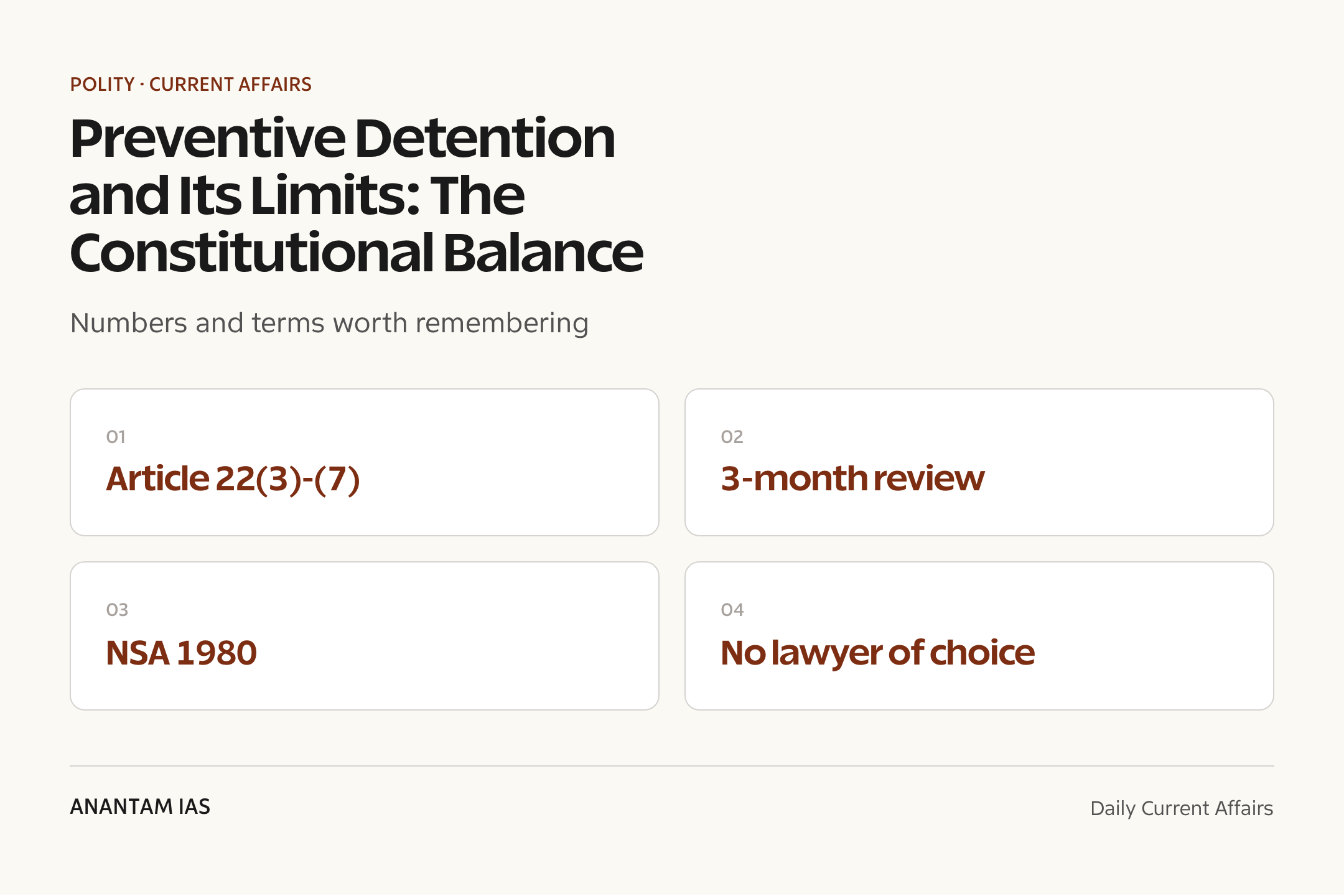
- Article 22 (clauses 3 to 7) is the constitutional source of preventive detention law and its safeguards.
- Central laws include the National Security Act, 1980 (NSA) and the PIT-NDPS Act, 1988; States run their own goonda or PASA-style laws.
- Courts have flagged non-application of mind, vague grounds, and the conflation of law-and-order with public order as recurring defects.
- An Advisory Board must review the detention within three months unless a parliamentary law allows longer detention.
The development matters in the context of:
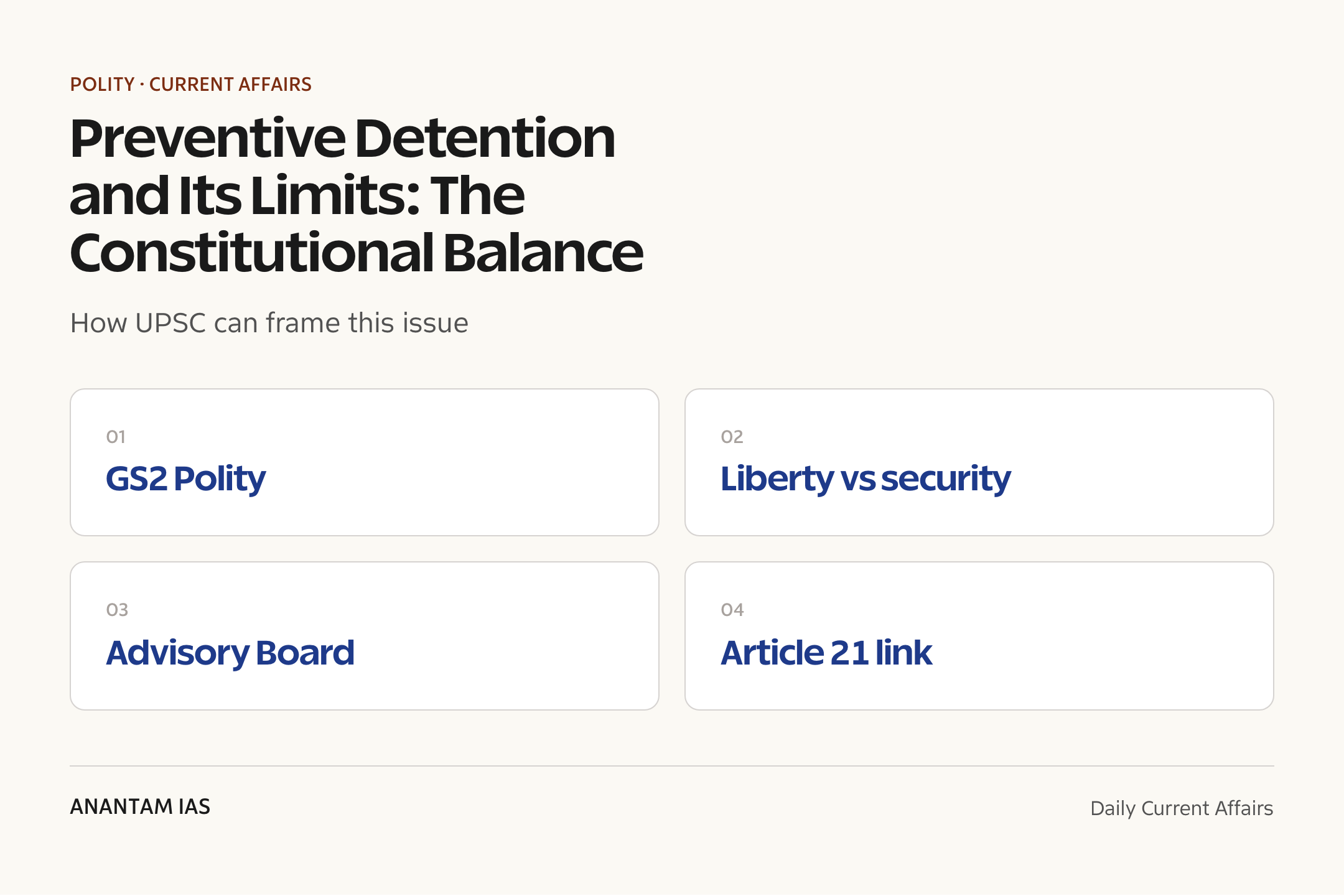
- Tests the friction between personal liberty (Article 21) and the state’s preventive powers — a perennial GS2 theme.
- Preventive detention is one of the few constitutional powers that authorise detention without trial, making its limits critical.
- Frequent judicial quashing signals a systemic accountability gap in how States exercise this exceptional power.
UPSC Relevance
Prelims Relevance
- Article 22: protections against arrest and detention; clauses (1)-(2) for ordinary arrest, clauses (3)-(7) for preventive detention.
- Preventive detention vs punitive detention — without trial vs after conviction.
- Safeguards under Article 22(4)-(7): Advisory Board, three-month limit, communication of grounds, right to representation.
- Article 22(3): preventive detainees do NOT get the Article 22(1)-(2) protections (lawyer of choice, production before a magistrate within 24 hours).
- National Security Act, 1980 (NSA); PIT-NDPS Act, 1988; COFEPOSA, 1974.
- State PASA / goonda Acts (e.g. Gujarat PASA, Telangana/Tamil Nadu goonda laws).
- Entry 9 of the Union List and Entry 3 of the Concurrent List on preventive detention.
- Article 22(7): Parliament may prescribe detention beyond three months without an Advisory Board.
- 44th Amendment (1978) sought to cut the maximum pre-Advisory-Board period to two months — that change was never notified.
- Distinction between ‘law and order’ and ‘public order’ (Ram Manohar Lohia case).
Mains Relevance
GS Paper 2
- Preventive detention as a constitutional exception: how Article 22 balances individual liberty against collective security.
- Why courts repeatedly quash detention orders — the gap between safeguards on paper and executive practice.
GS Paper 2
- Role of Advisory Boards and judicial review in checking the abuse of detention without trial.
Essay
- Liberty versus security: where should a constitutional democracy draw the line?
- The cost of extraordinary powers becoming ordinary tools of governance.
Background and Context
What Preventive Detention Means
Preventive detention is custody aimed at the future, not the past.
- It detains a person to PREVENT an anticipated act prejudicial to the security of the state, public order, maintenance of essential supplies, or foreign relations — no offence need yet have been committed.
- Punitive detention, by contrast, punishes a person AFTER trial and conviction for an offence already committed.
- Because no charge, trial, or conviction is involved, preventive detention is widely seen as the most drastic curtailment of personal liberty a peacetime state can impose.
- India is one of the few democracies that permits preventive detention during normal times, written into the Constitution itself rather than left to emergency-only powers.
Article 22: The Constitutional Source
Article 22 splits into two halves — one for ordinary arrests, one for preventive detention.
- Article 22(1)-(2) gives every arrested person the right to be informed of the grounds, to consult a lawyer of choice, and to be produced before a magistrate within 24 hours — protections sharpened by the mandatory disclosure of arrest grounds doctrine.
- Article 22(3) expressly DENIES these protections to (i) enemy aliens and (ii) persons detained under a preventive-detention law — a built-in carve-out.
- So a preventive detainee has NO right to a lawyer of choice and NO 24-hour magistrate production — the safeguards instead come from clauses (4) to (7).
- Preventive detention sits inside the chapter on Fundamental Rights but operates as a constitutionally sanctioned exception to liberty under Article 21.
The Safeguards Under Article 22(4)-(7)
The Constitution offsets the carve-out with four procedural safeguards.
- Advisory Board review: detention beyond three months requires an Advisory Board — comprising persons qualified to be High Court judges — to find sufficient cause.
- Maximum period: no detention beyond the maximum prescribed by the relevant law; the three-month threshold triggers Board scrutiny.
- Communication of grounds: the detaining authority must, as soon as may be, inform the detainee of the grounds of detention.
- Right to representation: the detainee must get the earliest opportunity to make a representation against the order.
- Under Article 22(7), Parliament may by law allow detention beyond three months WITHOUT an Advisory Board, and prescribe the maximum period and the Board’s procedure.
- The 44th Amendment, 1978, tried to shrink the pre-Board period from three to two months, but that specific provision was never brought into force.
The Laws in Force
Preventive detention operates through a layered set of central and state statutes.
- National Security Act, 1980 (NSA): the principal central law, allowing detention to prevent threats to national security, public order, and essential supplies.
- PIT-NDPS Act, 1988 targets illicit drug trafficking; COFEPOSA, 1974 targets smuggling and foreign-exchange offences.
- Numerous state laws — Gujarat’s PASA, and ‘goonda’ Acts in Telangana, Tamil Nadu, Karnataka and others — extend preventive detention to bootleggers, land-grabbers, and habitual offenders.
- Legislative competence flows from Entry 9 of the Union List (security-related) and Entry 3 of the Concurrent List of the Seventh Schedule, so both the Centre and the States can legislate.
- Detenus are held without the regular Code of Criminal Procedure protections, relying solely on the Article 22 framework and the parent statute.
Judicial Concern and Doctrine
Courts treat preventive detention as exceptional and police its misuse closely.
- The Supreme Court has consistently held that preventive detention is an extraordinary power that erodes liberty and must be exercised with great caution and strict procedural compliance.
- A recurring ground for quashing orders is non-application of mind — copy-paste grounds, stale incidents, or failure to consider that ordinary criminal law already covers the conduct.
- Courts distinguish ‘public order’ (a wider disturbance affecting the community at large) from mere ‘law and order’ (an individual breach) — detention is valid only for the former, a line drawn in the Ram Manohar Lohia line of cases.
- Delay in deciding the detenu’s representation, or failure to supply legible and complete grounds, regularly invalidates orders for breaching Article 22(5).
- Judges have warned that turning preventive detention into routine policing inverts the constitutional design, where it was meant to be a narrow, last-resort safeguard.
Why the Power Is Controversial
The criticism is structural, not merely about individual cases.
- It permits the state to detain on suspicion, reversing the presumption of innocence that underpins criminal justice.
- The detenu cannot cross-examine, has no lawyer of choice, and the Advisory Board sits in camera — limiting adversarial testing of the grounds.
- Repeated judicial quashing shows orders are often legally weak, yet detainees lose months of liberty before relief arrives.
- Vague statutory grounds give wide executive discretion, raising the risk of targeting dissenters, activists, and the marginalised.
- Many democracies confine such powers to declared emergencies; in India, they remain available in normal times, inviting overuse.
Way Forward
Tighten executive discipline
- Detaining authorities must record specific, contemporaneous, and individualised reasons — not boilerplate — and first ask whether ordinary criminal law suffices.
- Build an internal review so weak orders are filtered before they reach a court.
Strengthen the Advisory Board and representation
- Time-bound disposal of representations and reasoned Advisory Board opinions, with detenus given complete, legible grounds and documents.
- Consider statutory legal aid at the Advisory Board stage to balance the in-camera process.
Periodic legislative review
- Audit state goonda and PASA laws for overbreadth, and revisit notifying the 44th Amendment’s tighter timeline.
- Publish anonymised data on detention orders and their judicial outcomes to enable accountability.
Conclusion
Preventive detention is a power the Constitution permits but plainly distrusts — it is hedged with safeguards precisely because it suspends the ordinary guarantees of a fair trial. The persistent stream of quashed orders is less a story of bad luck than of a power exercised carelessly against the grain of its constitutional purpose.
The fix is not abolition by judicial fiat but discipline by design: narrow grounds, reasoned orders, swift review, and real accountability. Used as a genuine last resort, preventive detention can serve security; used as a shortcut, it corrodes the very liberty the Constitution was written to protect.
UPSC Practice Questions
Prelims MCQ 1
With reference to preventive detention under the Constitution of India, consider the following statements:
- A person detained under a preventive-detention law is entitled to consult a legal practitioner of their choice under Article 22(1).
- Detention beyond three months ordinarily requires the opinion of an Advisory Board.
- Preventive detention finds place in both the Union List and the Concurrent List of the Seventh Schedule.
How many of the above statements are correct?
(a) Only one (b) Only two (c) All three (d) None
Answer: (b) Only two
Explanation:
Statement 1 is wrong: Article 22(3) expressly denies the clause (1)-(2) protections (lawyer of choice, 24-hour production) to preventive detainees. Statements 2 and 3 are correct — the three-month Advisory Board threshold under Article 22(4), and legislative competence under Entry 9 (Union List) and Entry 3 (Concurrent List).
Prelims MCQ 2
Which one of the following is the principal CENTRAL law dealing with preventive detention for threats to national security and public order?
(a) Unlawful Activities (Prevention) Act, 1967
(b) National Security Act, 1980
(c) Code of Criminal Procedure, 1973
(d) Maintenance of Internal Security Act, 1971
Answer: (b) National Security Act, 1980
Explanation:
The NSA, 1980, is the main central preventive-detention law. The UAPA is an anti-terror penal (punitive) law, the CrPC governs ordinary criminal procedure, and MISA was repealed in 1978.
UPSC Mains Questions
- Preventive detention is described as a constitutional power the Constitution itself distrusts. In light of Article 22 and recent judicial pronouncements, examine how the law seeks to balance personal liberty against the security of the state. (250 words)
- Courts have repeatedly quashed preventive-detention orders for non-application of mind and the conflation of law-and-order with public order. Discuss the safeguards under Article 22 and suggest measures to curb the misuse of preventive detention laws. (250 words)
- Distinguish between preventive and punitive detention. Why is the routine invocation of preventive detention seen as inverting its constitutional purpose? (150 words)
Sources: The Hindu (editorial) and Constitution of India, Article 22.
Frequently Asked Questions
What is preventive detention?
Preventive detention is custody imposed to STOP a person from doing something prejudicial to the security of the state, public order, or essential supplies. It is forward-looking: no offence need have been committed and no trial takes place. It differs sharply from punitive detention, which follows conviction for a crime already committed.
How is preventive detention different from punitive detention?
Punitive detention punishes a person after a trial finds them guilty of an offence. Preventive detention restrains a person before any offence, purely on the apprehension that they may act against public order or state security. One looks to the past and requires proof; the other looks to the future and rests on official satisfaction.
Which article of the Constitution governs preventive detention?
Article 22 governs it. Clauses (1) and (2) protect persons arrested under ordinary law, but clause (3) denies those protections to preventive detainees. Clauses (4) to (7) then supply separate safeguards — Advisory Board review, a maximum period, communication of grounds, and the right to make a representation.
What safeguards does a preventive detainee have?
The detenu must be told the grounds of detention as soon as possible and given the earliest chance to make a representation. Detention beyond three months ordinarily needs an Advisory Board of persons qualified to be High Court judges to find sufficient cause, and detention cannot exceed the maximum the relevant law allows.
Why do courts frequently quash preventive-detention orders?
Courts strike down orders for non-application of mind — vague or copy-paste grounds, stale incidents, or failure to consider that ordinary criminal law already covers the conduct. They also quash orders that confuse mere law-and-order with public order, or that delay deciding the detenu’s representation, breaching Article 22(5).
Which laws allow preventive detention in India?
The main central law is the National Security Act, 1980; others include COFEPOSA, 1974 and the PIT-NDPS Act, 1988. Many States have their own goonda or PASA-style laws targeting bootleggers, land-grabbers, and habitual offenders. Legislative power flows from Entry 9 of the Union List and Entry 3 of the Concurrent List.
Tell Google you want more of this.
Add Anantam IAS as a preferred sourceOne tap, and this site shows up more often in your own Top Stories, AI Overviews and AI Mode. Remove it any time.






