Why in News?
On 27 October 2026, WHO added three paediatric primaquine products from Macleods to its prequalified medicines list for preventing relapse of Plasmodium vivax and Plasmodium ovale malaria.
- The listed tablet strengths are 2.5 mg, 5 mg and 7.5 mg. These describe the products and must not be read as instructions for treating a child.
- Relapse prevention addresses dormant parasites that can remain after an initial malaria episode; it is a different treatment task from controlling the blood-stage infection.
- Prequalification supports quality-assured product selection. The announcement does not establish that these products have been procured, authorized nationally or supplied to every health facility.
- Malaria control requires both effective products and services able to use them safely; a listing alone cannot establish the readiness of a local treatment programme.
- The evidence stage matters, as in the Tumaini vaccine trial: a product assessment, a trial and routine availability answer different questions.
UPSC Relevance
Prelims Relevance
- Hypnozoites: dormant liver-stage parasites associated with P. vivax and P. ovale relapse.
- Blood stage: the parasite stage responsible for malaria symptoms.
- Primaquine: an anti-relapse medicine whose safe use requires appropriate clinical assessment.
- G6PD: glucose-6-phosphate dehydrogenase; deficiency can increase susceptibility to drug-triggered destruction of red blood cells.
- WHO prequalification: product assessment that supports quality assurance and procurement decisions.
Mains Relevance
GS Paper 2
- Public health delivery: connecting procurement with diagnostics, trained staff and follow-up.
- Access: distinguishing the availability of a quality-assured product from a functioning service for patients.
GS Paper 3
- Disease biology: understanding how parasite stages shape treatment objectives and recurrence.
Background and Context
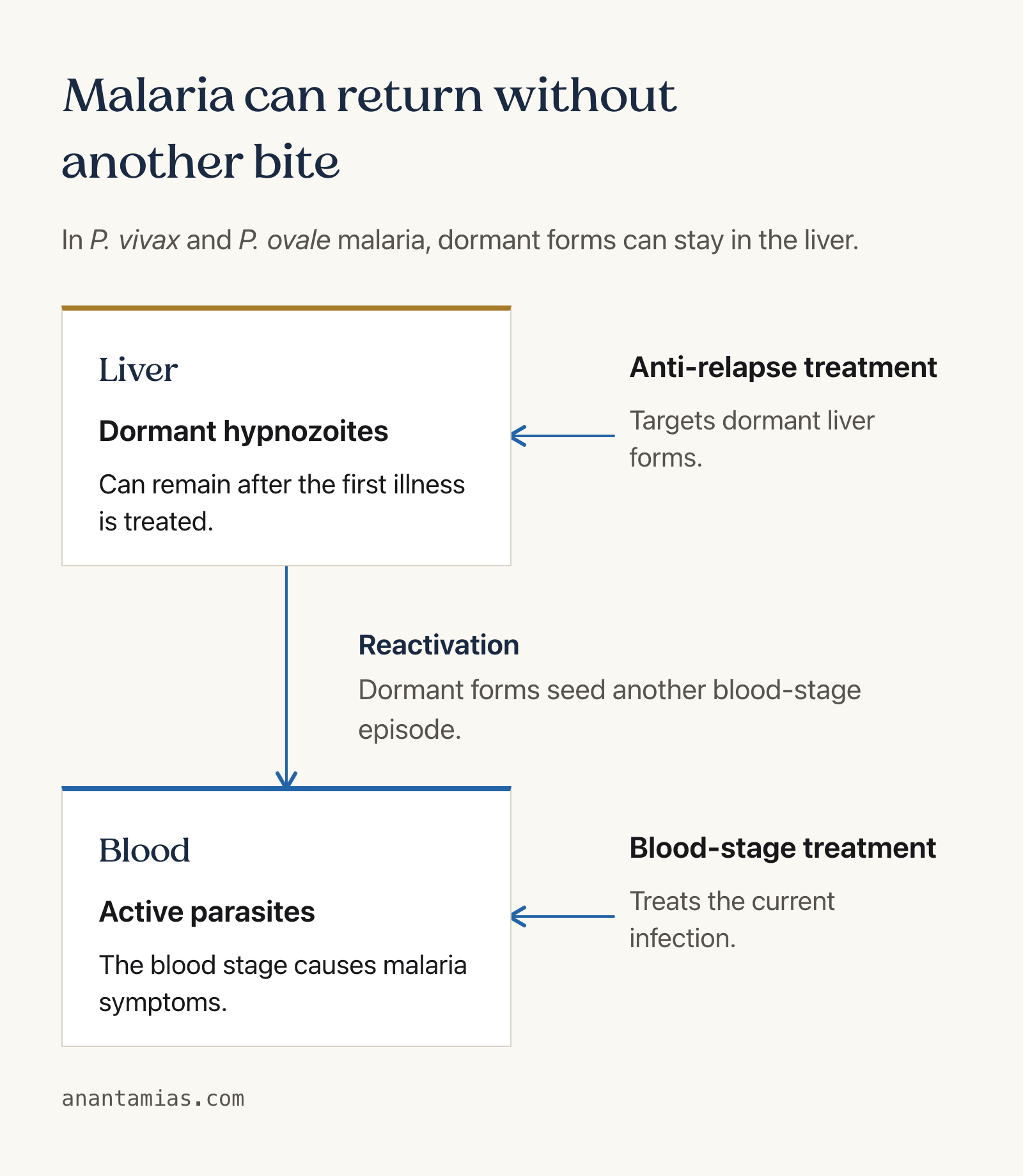
Why Malaria Can Return Without Another Bite
Relapse depends on parasites left in the body after an earlier infection, so prevention must address more than the symptoms of the first episode.
- P. vivax and P. ovale can leave dormant forms called hypnozoites in the liver. These forms can later reactivate, creating a route back to illness even without another infective mosquito bite.
- Blood-stage parasites cause the clinical symptoms of malaria, as explained by the CDC. Clearing that stage addresses the current illness, while dormant liver forms create a separate reason for considering anti-relapse treatment.
- Relapse describes renewed infection arising from reactivated liver stages. Reinfection follows a fresh infection, while recrudescence involves blood-stage parasites that were not fully cleared; these mechanisms should not be treated as interchangeable explanations for recurrence.
- Anti-relapse treatment targets the dormant reservoir that can restart infection. Its purpose complements treatment of the initial blood-stage illness; describing primaquine simply as another fever medicine would miss the reason it is used.
- The parasite species matters when interpreting recurrence. The dormant liver-stage mechanism discussed here concerns P. vivax and P. ovale; it should not be generalized to every malaria episode or used to diagnose a returning fever.
What Product Prequalification Establishes
WHO prequalification provides a product-level assessment, while national regulation, procurement and local service delivery remain separate parts of access.
- WHO medicines prequalification includes assessment of product dossiers, inspection of relevant manufacturing and clinical sites, and quality-control testing. These activities support confidence in evaluated products and help purchasers make informed choices about their medicine supplies.
- The newly listed paediatric tablet strengths broaden the assessed product options for relapse prevention. The announcement identifies specific products; it does not establish measured improvements in adherence, recovery or population-level malaria control from their use.
- National registration remains a separate regulatory task. WHO technical assessments can support regulators, including through collaborative procedures, but inclusion on the prequalified list should not be described as automatic authorization in every country.
- Procurement and distribution determine whether a listed product reaches a service. Budgeting, purchasing and reliable supply must follow product selection; the WHO announcement does not show that these steps have been completed in India.
- Product quality and patient suitability answer different questions. A quality-assured medicine still needs an appropriate clinical decision for the person receiving it, with the required assessment and follow-up available where care is actually delivered.
Why G6PD Assessment Remains Essential
Safe anti-relapse care must account for how the medicine interacts with the patient, including inherited differences that affect red blood cells.
- G6PD deficiency is an inherited condition that can make red blood cells vulnerable to acute haemolysis from certain anti-relapse medicines. WHO identifies this as a safety challenge associated with primaquine and related treatment decisions.
- G6PD testing supplies information for clinical selection of an appropriate anti-relapse regimen. The WHO diagnostic assessment connects reliable testing with safer care; it does not remove the need to interpret results in clinical context.
- Testing access is a service requirement, not a property of the tablet. Supplying a medicine without the capacity to assess patients can leave a major barrier unresolved, even when the product itself meets quality standards.
- Clinical responsibility includes patient selection, explaining treatment and monitoring safety. Community workers may support access and follow-up, but the distinction between support and prescribing remains important, as discussed in JOSH teams and clinical boundaries.
- Programme assessment should examine the whole care pathway: suitable medicines, dependable diagnostics, trained staff and continuing contact with patients. Tablet availability alone cannot demonstrate that relapse prevention is being delivered safely or consistently.
Way Forward
Connect Supply With Safe Care
- Align medicine procurement and diagnostic access so treatment services can assess patients before making clinical decisions.
- Train staff to distinguish product strength, patient selection and prescribed treatment, with clear responsibilities for counselling and follow-up.
- Review service gaps and safety reporting alongside stock availability, identifying where a patient cannot complete the required assessment or obtain continuing care.
Conclusion
- Paediatric primaquine prequalification strengthens the available quality-assurance information for product selection. Its public-health value depends on the services that connect an appropriate medicine with an assessed patient and safe continuing care.
- For an answer on health-system capacity, connect the biology of relapse with delivery: clearing blood-stage infection, addressing dormant liver parasites and assessing G6PD-related risk are distinct tasks that must work together.
UPSC Practice Questions
Prelims MCQ 1
With reference to malaria relapse and primaquine, consider the following statements:
- P. vivax and P. ovale can leave dormant liver-stage parasites that later reactivate.
- A relapse necessarily requires a fresh infective mosquito bite.
- WHO prequalification automatically establishes national authorization and supply at every clinic.
How many of the above statements are correct?
(a) Only one (b) Only two (c) All three (d) None
Answer: (a) Only one
Explanation:
Only statement 1 is correct. Dormant liver parasites can reactivate without another bite, while product prequalification does not itself establish national registration or local availability.
Prelims MCQ 2
Why is G6PD assessment relevant to the safe use of primaquine for relapse prevention?
(a) It identifies the number of mosquitoes near the patient’s home (b) It determines whether a pharmaceutical factory meets manufacturing standards (c) It helps clinicians assess susceptibility to treatment-related destruction of red blood cells (d) It proves that all liver-stage parasites have already been eliminated
Answer: (c) It helps clinicians assess susceptibility to treatment-related destruction of red blood cells
Explanation:
G6PD deficiency can increase the risk of acute haemolysis with primaquine. Test information supports clinical treatment selection; it does not measure mosquito exposure or certify parasite clearance.
UPSC Mains Questions
- Explain how the biology of malaria relapse creates demands on diagnosis, medicine supply and clinical follow-up. (150 words)
- Quality-assured medicines require capable health services to produce public-health benefits. Discuss with reference to paediatric primaquine and G6PD assessment. (250 words)
Sources: WHO Prequalification and WHO, G6PD Testing and Anti-Relapse Treatment.
Frequently Asked Questions
What did WHO announce on 27 October 2026?
WHO added three Macleods paediatric primaquine tablet products to its prequalified list for preventing relapse of P. vivax and P. ovale malaria. The listed strengths describe products and are not individual treatment instructions.
Can malaria relapse occur without another mosquito bite?
Yes. P. vivax and P. ovale can leave dormant parasites in the liver. Their later reactivation can cause renewed illness without a new bite, which explains why relapse prevention has a separate treatment purpose.
Does prequalification mean the medicine is available everywhere?
No. Prequalification supports product quality assurance and selection. National regulatory processes, procurement and distribution remain necessary, and the announcement does not establish availability in every country or health facility.
Why does G6PD assessment matter?
G6PD deficiency can increase susceptibility to acute haemolysis with certain anti-relapse medicines. Reliable test information and clinical assessment help guide appropriate treatment decisions; a quality-assured tablet alone does not resolve this patient-specific risk.
What should a malaria programme assess beyond medicine stocks?
It should examine diagnostic access, trained clinical staff, patient selection, counselling and follow-up. These capabilities determine whether an available medicine can be used safely and whether gaps in the care pathway are addressed.
Tell Google you want more of this.
Add Anantam IAS as a preferred sourceOne tap, and this site shows up more often in your own Top Stories, AI Overviews and AI Mode. Remove it any time.