Why in News?
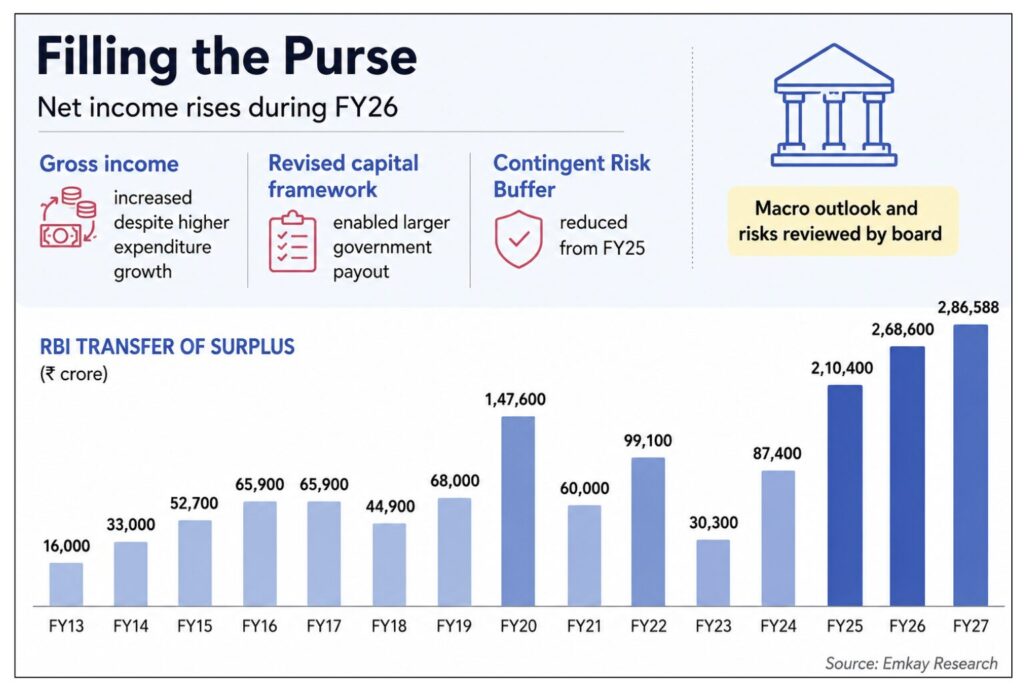
The Reserve Bank of India’s Central Board of Directors approved the transfer of a record surplus of ₹2,86,588.46 crore to the Central Government for the accounting year 2025-26. This marks the highest-ever dividend payout by the RBI.
The record transfer was driven by robust earnings, particularly large-scale US dollar sales in the foreign exchange market to defend the rupee, and higher returns on foreign currency assets amid elevated global interest rates.
The RBI simultaneously raised the Contingency Risk Buffer (CRB) significantly in view of geopolitical tensions (especially the West Asia conflict) and global financial market volatility.
| UPSC Relevance: GS-3 Economy: Fiscal Policy, Mobilisation of Resources Prelims: Contingency Risk Buffer, Source of Earnings for RBI, Surplus Transfer, Economic Capital Framework |
Source of Earnings for RBI:
RBI’s income arises from its role as the monetary authority and banker to the government. The key sources are:
- Interest on Government Securities held as domestic investments
- Interest on Loans & Advances to banks and financial institutions
- Interest earned on Liquid Adjustment Facility (LAF) operations
- Interest income from Foreign Currency Assets held
- Earnings from Forex Swaps
- Seigniorage profit from issuing currency notes (the difference between the face value and the cost of production)
Composition of RBI’s Balance Sheet:
- Liabilities: Capital & Reserves (incl. Contingency Fund, Asset Development Fund), Revaluation Accounts (CGRA, IRA, FCVA), Deposits of Banks & Government and Currency Notes in Circulation.
- Assets: Foreign Currency Assets (FCA), Gold, Investments in Domestic Securities, Loans & Advances to banks/government.
Mechanism of Surplus Transfer by RBI to the Central Government:
After meeting the risk provisions and other operational expenditures (salaries, etc.) from the earnings of RBI, the surplus is transferred to the central government in the form of dividends.
The surplus transferred to the Central Government is determined as follows:
- RBI earns income from all sources (interest, forex operations, seigniorage, etc.) Operational expenditures (staff costs, establishment, etc.) are deducted.
- Provisions are made for risk buffers — primarily the Contingency Risk Buffer (CRB). The remaining amount is the transferable surplus, and is transferred to the Central Government under Section 47 of the RBI Act, 1934.
- This surplus is classified under Non-Tax Revenue in the Union Budget, making it a crucial source of funding for government expenditure without additional borrowing.
Contingency Risk Buffer (CRB):
- Contingency Risk Buffer is the reserved fund within the Economic Capital Framework (ECF) maintained by RBI to address potential financial disruptions or crises. It is the country’s savings for a ‘rainy day’ (financial stability crisis) which the RBI consciously maintains in view of its role as the Lender of Last Resort.
- In FY26, the RBI significantly raised the CRB from ₹44,861.70 crore (FY25) to ₹1,09,379.64 crore (more than doubled), while maintaining the CRB at 6.5% of its balance sheet under the revised Economic Capital Framework.
- RBI adopted a Revised ECF in 2025, widening the CRB range to 4.5%-7.5%.
- Reasons for raising CRB:
- Ongoing geopolitical tensions, particularly the West Asia conflict and associated risks of energy price spikes.
- Heightened volatility in global bond and currency markets.
- Need to preserve RBI’s capacity to intervene as Lender of Last Resort.
- Building resilience against external shocks amid uncertain global macro conditions.
Why was the FY26 Dividend so high?
- Large Dollar Sales: RBI actively intervened in forex markets to defend the rupee, generating trading income.
- Higher Global Interest Rates: Returns on foreign assets increased significantly.
- Expansion of RBI Balance Sheet: The RBI balance sheet expanded by over 20% to ₹91.97 lakh crore.
- Strong Liquidity Operations: Higher domestic monetary operations increased interest earnings.
Significance & Fiscal Impact:
Fiscal Relief:
- Provides the government with non-debt, non-tax revenue, reducing pressure on borrowing targets.
- Could ease the fiscal deficit and help contain bond yields (10-year benchmark at ~7.09%).
- Represents ~90.8% of budgeted dividend/surplus non-tax revenue for FY27 (BE).
Expenditure Flexibility:
- Allows higher infrastructure & capital expenditure in transport, energy, and urban development.
- Provides a buffer against higher fertiliser and fuel subsidy requirements amid geopolitical tensions
Practice MCQ:
Q. Which of the following is/are considered assets of the Reserve Bank of India?
1. Loans given to Banks
2. Foreign Currency Assets
3. Currency Notes in Circulation
Select the correct answer using the code given below:
(a) 2 only
(b) 1 and 2 only
(c) 1 and 3 only
(d) 1, 2 and 3
Answer: (b)
Tell Google you want more of this.
Add Anantam IAS as a preferred sourceOne tap, and this site shows up more often in your own Top Stories, AI Overviews and AI Mode. Remove it any time.