Why in News?
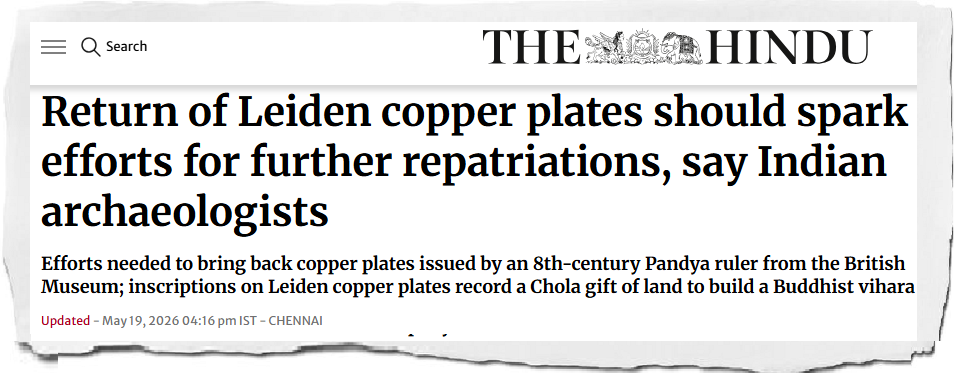
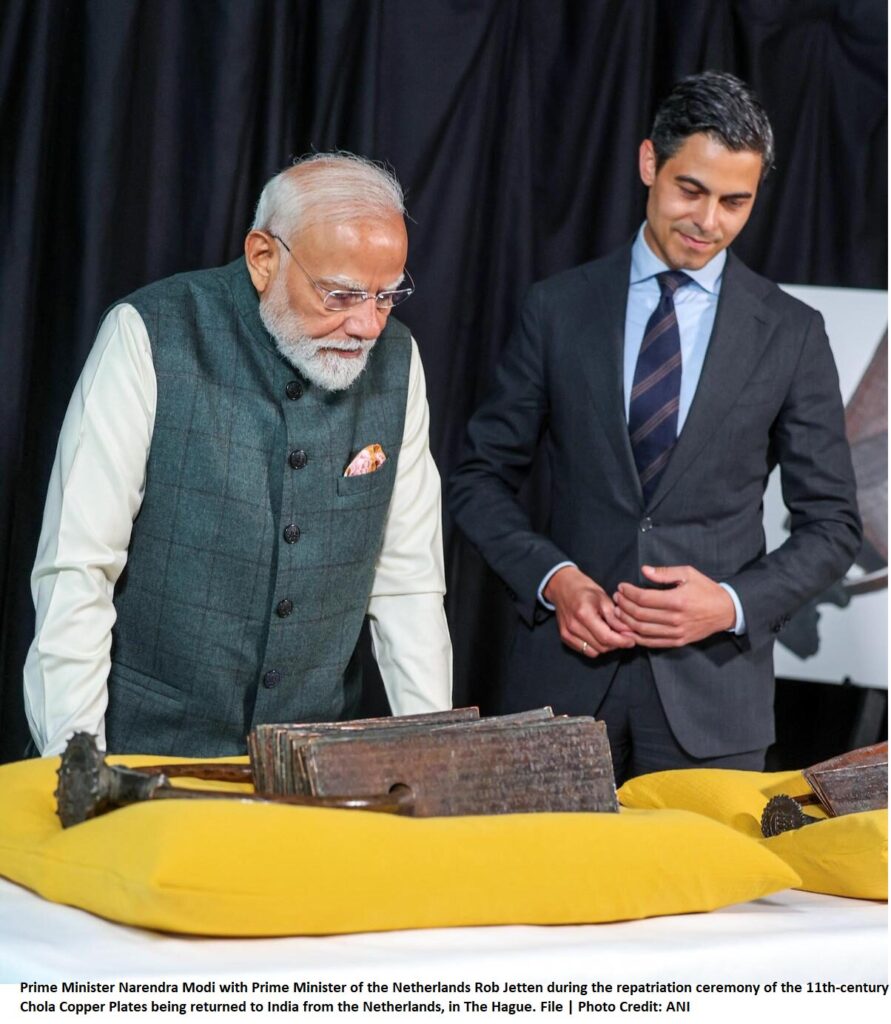
The Netherlands has returned the 11th-century Chola-era Anaimangalam Copper Plates, popularly known as the Leiden Copper Plates, to India during Prime Minister Narendra Modi’s visit. The development marks an important milestone in India’s efforts to recover cultural artefacts removed during the colonial period and has renewed discussions on broader heritage repatriation initiatives.
UPSC Relevance
Prelims: Chola administration, Copper plate inscriptions, Cultural heritage, UNESCO and heritage protection, Ancient Indian history;
Mains:
GS I: (Indian culture and history, Conservation and management of heritage),
GS II: (International relations and cultural diplomacy),
Background
Copper plate inscriptions constituted one of the most important administrative instruments in ancient and medieval India. Kings used them to record land grants, tax exemptions, religious donations, and administrative decisions.
The Leiden Copper Plates belong to the Chola period and are among the most significant surviving documentary records of South Indian history. The collection consists of 21 large plates and three smaller plates carrying inscriptions in Sanskrit and Tamil. They were preserved in Leiden University in the Netherlands for nearly two centuries before their return.
Historical Significance of the Leiden Copper Plates
Record of Chola Administration
The inscriptions provide detailed information regarding royal administration, land grants, taxation systems, and governance structures under the Chola Empire.
Evidence of Maritime Networks
The plates reveal links between the Chola Empire and Southeast Asian kingdoms, highlighting India’s historical maritime and commercial engagement.
Religious Pluralism
The inscriptions document land grants made to the Chudamanivarma Vihara at Nagapattinam, a Buddhist institution. They illustrate how Chola rulers patronised institutions beyond their own religious traditions.
Source of Tamil Historical Studies
The plates serve as primary evidence for reconstructing political and social history of South India.
Chola Empire and Copper Plate Tradition
Chola Dynasty
The Cholas emerged as one of the most powerful dynasties in South India between the ninth and thirteenth centuries CE.
Major rulers included:
• Rajaraja Chola I
• Rajendra Chola I
• Kulottunga Chola I
Important features of Chola administration included:
• Strong local self-government through village assemblies
• Extensive maritime trade networks
• Efficient revenue administration
• Large temple-based socio-economic systems
Cultural Repatriation and its Importance
Restoration of Historical Ownership
Returning cultural objects recognises the historical connection between communities and their heritage.
Correcting Colonial-Era Dispossession
Many artefacts were transferred during colonial rule without meaningful consent of local communities.
Strengthening Cultural Identity
Recovered artefacts help preserve collective memory and reinforce cultural continuity.
Enhancing Research and Public Access
Repatriated artefacts can support academic studies and improve public engagement through museums and educational institutions.
India’s Efforts Towards Repatriation
India has intensified diplomatic and legal efforts to recover antiquities and cultural objects from foreign institutions and private collections.
Major measures include:
• Antiquities and Art Treasures Act, 1972
• Bilateral cooperation agreements with several countries
• Collaboration through international organisations such as UNESCO
• Greater use of digital databases and provenance tracking
India has successfully recovered several idols, sculptures and manuscripts in recent years.
Challenges in Repatriation
Legal and Ownership Complexities
Establishing historical ownership often becomes difficult because of incomplete records and unclear acquisition histories.
Provenance Documentation Issues
Many artefacts moved across multiple institutions over centuries, making documentary evidence difficult to establish.
International Legal Differences
Countries differ in their heritage laws and restitution frameworks.
Museum and Academic Resistance
Some institutions argue that globally shared collections ensure wider preservation and access.
Way Forward
Strengthen Provenance Research
Systematic documentation and digitisation of archaeological records can help establish stronger ownership claims.
Expand Cultural Diplomacy
India can integrate heritage recovery into broader diplomatic engagements.
Develop World-Class Preservation Infrastructure
Museums and conservation institutions should be strengthened for proper storage, restoration and display.
Build International Cooperation Mechanisms
Greater cooperation under international conventions can facilitate transparent restitution processes.
Conclusion
The return of the Leiden Copper Plates represents more than the transfer of historical artefacts. It reflects the restoration of cultural memory and historical continuity. It also highlights the growing importance of cultural diplomacy in international relations. As India pursues further repatriation efforts, balancing heritage conservation with global collaboration will remain essential.
Practice Questions
1. Consider the following statements regarding copper plate inscriptions in ancient India:
- They were commonly used to record royal grants and administrative decisions.
- They served as important primary sources for reconstructing historical events.
- They were exclusively written in Sanskrit.
Which of the statements given above is/are correct?
(a) 1 and 2 only
(b) 2 and 3 only
(c) 1 only
(d) 1, 2 and 3
Correct Answer: (a)
Explanation: Copper plate inscriptions recorded grants and administrative decisions and serve as important historical sources. They were written in various languages, including Tamil and Sanskrit.
2. With reference to the Chola Empire, consider the following statements:
- The Cholas maintained extensive maritime links with Southeast Asia.
- Village self-government institutions formed part of Chola administration.
- Rajendra Chola I established the Chola Empire before Rajaraja Chola I.
Which of the statements given above are correct?
(a) 1 and 2 only
(b) 2 and 3 only
(c) 1 only
(d) 1, 2 and 3
Correct Answer: (a)
Explanation: Rajaraja Chola I preceded Rajendra Chola I. The Cholas had strong maritime engagement and village-level institutions.
Mains Questions
- Examine the historical importance of copper plate inscriptions as sources for reconstructing ancient and medieval Indian history.
- Discuss the significance of cultural repatriation in strengthening national identity and preserving civilisational heritage.
Tell Google you want more of this.
Add Anantam IAS as a preferred sourceOne tap, and this site shows up more often in your own Top Stories, AI Overviews and AI Mode. Remove it any time.