
Why in News?
The Securities and Exchange Board of India (SEBI) has notified the SEBI (Alternative Investment Funds) (Amendment) Regulations 2026. The amendment reduces the minimum investment for Social Impact Funds from ₹2 lakh earlier to ₹1,000. It aims to boost retail participation in the Social Stock Exchange.
| UPSC Relevance: GS-3 Economy: Capital Markets; Financial Regulation Prelims: Alternative Investment Funds; Social Stock Exchange; Zero Coupon Zero Principle Instruments; SEBI AIF Amendment 2026. |
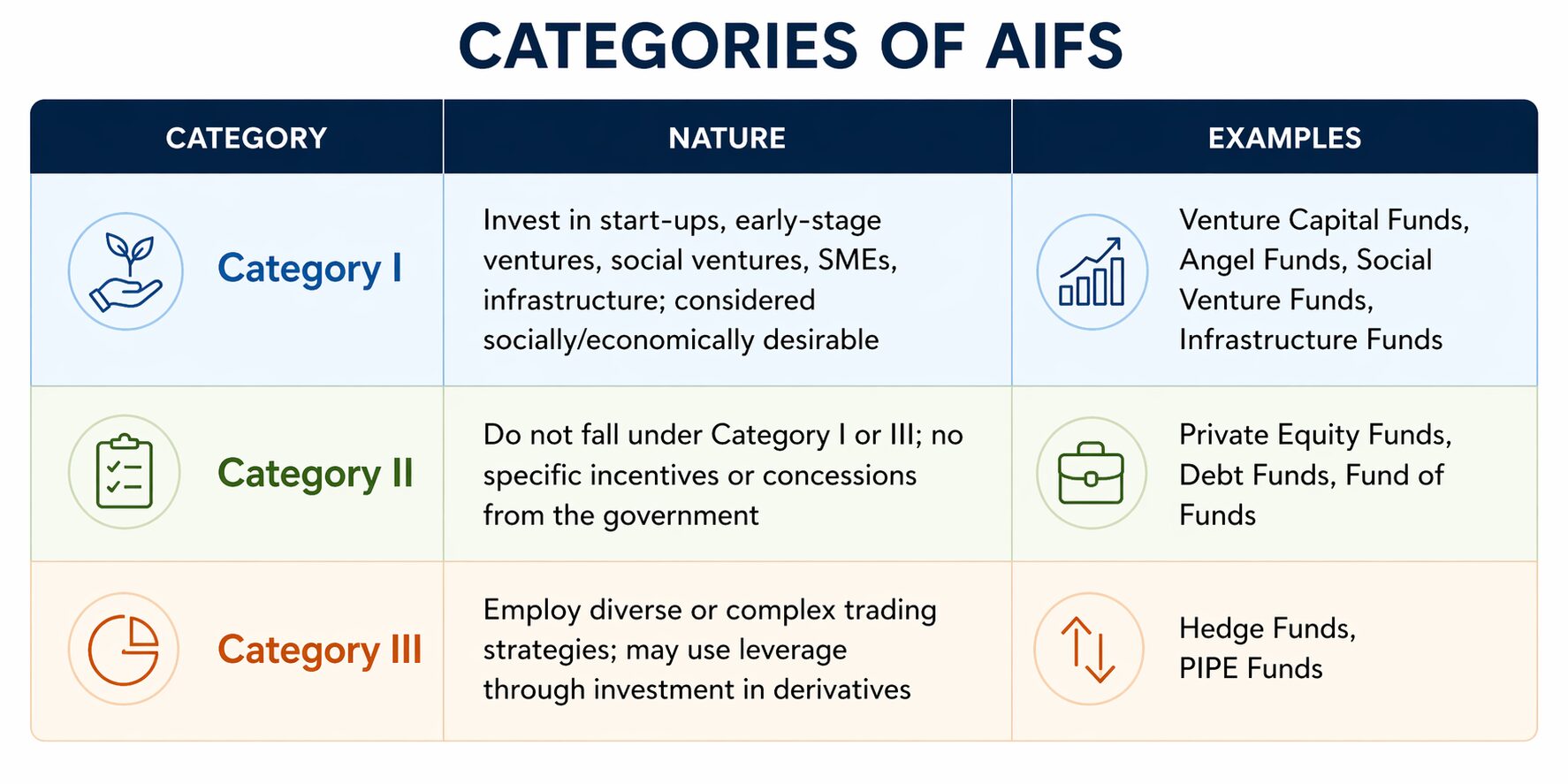
What are Alternative Investment Funds (AIFs)?
- AIFs are privately pooled investment vehicles that collect funds from investors to invest in assets beyond traditional avenues like stocks and bonds.
- Regulated by SEBI under the SEBI (Alternative Investment Funds) Regulations, 2012.
- Investors: High-net-worth individuals (HNIs), institutional investors, and family offices.
- Eligibility: Minimum fund corpus of ₹20 crore; Individual investments must exceed ₹1 crore per investor, and a tenure of at least 3 years.
- Risk: High-risk investments, typically targeting categories with high returns.
India’s Social Stock Exchange:
- Social Stock Exchange (SSE) is a SEBI-regulated platform in India that allows Not-for-Profit Organisations (NPOs/NGOs) and For-Profit Enterprises (FPEs) to raise funds for social impact projects. These projects focus on areas like education, livelihood, healthcare, and infrastructure (water, housing, sanitation, etc.).
- Purpose: To bridge the gap between social enterprises and donors/investors, enabling access to capital beyond traditional grants and Corporate Social Responsibility (CSR).
- Fundraising Mechanisms: NPOs can list on exchanges like the Bombay Stock Exchange (BSE) and the National Stock Exchange (NSE). Enables NPOs to raise funds via Zero Coupon Zero Principal (ZCZP) instruments. Social Venture Funds (SVFs) under Category I AIFs are the primary conduit for retail money into the SSE.
Zero Coupon Zero Principal (ZCZP) instruments:
- ZCZP instruments are specialised financial instruments designed for registered NPOs to raise funds on the SSE for specific social projects.
- Recognised as securities by the Indian government in 2022. They are listed on SSE and regulated by SEBI.
- No Returns: They do not pay interest, and the principal amount is not returned at maturity. They are effectively donations.
- Eligibility: Only registered NPOs that comply with SEBI regulations can issue these instruments to raise funds.
- Minimum Issue Size: Rs 50 Lakhs
- Minimum Application Size: ₹1,000 (Amendment 2026).
- Transferability: Generally non-transferable (no secondary market trading), but can be transferred to legal heirs.
SEBI (Alternative Investment Funds) (Amendment) Regulations 2026:
- Reduced Minimum Investment: The minimum investment requirement for individuals in social impact funds is slashed to ₹1000 from ₹2 lakh earlier.
- Inoperative status: AIFs that have exhausted their funds can now request “inoperative” status, providing a cleaner exit mechanism.
- ‘AI Only’ Funds: A new category of funds exclusively using Artificial Intelligence (AI) for investment decision-making. It will have a relaxed regulatory framework to foster fintech-driven innovation.
- Registration Validity: Not-for-Profit Organisations (NPOs) on the Social Stock Exchange can now remain registered for 3 years (from 2 years earlier) without raising funds.
- SEBI lowered the minimum subscription requirement for Zero Coupon Zero Principal (ZCZP) instruments from 75% to 50%.
Significance of the Amended Rules:
- Democratisation of Impact Investing: By reducing the investment floor to ₹1000, SEBI enables ordinary citizens to participate in socially driven capital formation. This broadens the capital base available for NPOs on the SSE.
- Strengthens SSE Ecosystem: Greater retail investment in SSE can unlock significant dormant capital for sectors like rural healthcare, affordable education, and micro-livelihoods.
- Easing regulatory burden: The inoperative status for dormant AIFs reduces unnecessary compliance costs and improves resource allocation within SEBI.
- Recognising AI in Financial Regulation: The introduction of “AI-Only” funds signals SEBI’s proactive approach to regulating emerging technologies.
- Lowering the minimum subscription requirement for ZCZP instruments aims to enhance fundraising flexibility for NPOs listed on the SSE.
The amendment supports India’s voluntary and mandatory ESG disclosure framework and moves capital towards enterprises delivering measurable social and environmental returns. This is consistent with the UN Sustainable Development Goals (SDGs).
Practice MCQ:
Q. Consider the following statements:
1. Social Stock Exchange (SSE) allows both NPOs and for-profit enterprises to raise funds.
2. Minimum investment in Social Impact Funds is ₹1000.
3. Zero-Coupon Zero Principal (ZCZP) instruments provide fixed interest returns to investors.
Which of the statements given above is/are correct?
(a) 2 only
(b) 1 and 2 only
(c) 2 and 3 only
(d) 1, 2 and 3
Answer: (b)
Tell Google you want more of this.
Add Anantam IAS as a preferred sourceOne tap, and this site shows up more often in your own Top Stories, AI Overviews and AI Mode. Remove it any time.