

Why in News?
Former Bangladesh Prime Minister Sheikh Hasina , who has been living in India since leaving Bangladesh on 5 August 2024, participated in a question-taking media interaction from New Delhi on 5 August 2026.
- The interaction coincided with the second anniversary of the uprising that ended Hasina’s government in August 2024.
- The Associated Press reported that Hasina announced a plan to return voluntarily in December 2026; her statement is an intention, not confirmation that travel or surrender arrangements have been agreed.
- Dhaka said its repeated requests for Hasina’s return under the 2013 India-Bangladesh Extradition Treaty had not produced the outcome it sought.
- India has treated the extradition question as a legal issue. No public statement establishes that New Delhi has accepted, rejected or fixed a timetable for the request.
- The episode matters beyond one individual because public activity by an exiled former leader can affect sovereignty sensitivities, domestic legitimacy and trust between neighbouring governments.
- India must distinguish its legal handling of an individual from its wider relationship with the Bangladeshi state and people.
- Bangladesh must pursue accountability through treaty procedures and credible due process, rather than assuming that a diplomatic demand produces automatic extradition.
- Both sides have practical interests in border management, connectivity, power trade, water cooperation and regional security that should not become hostage to a single political dispute.
UPSC Relevance
Prelims Relevance
- India and Bangladesh signed a bilateral Extradition Treaty in 2013; it entered into force on 23 October 2013.
- An extradition request under the treaty is made through the diplomatic channel between the designated central authorities.
- Extradition is a formal process for surrendering a person to another state for prosecution or enforcement of a sentence; it is distinct from deportation.
- The treaty uses the principle of dual criminality: the alleged conduct must constitute an extraditable offence under the laws of both states, subject to the treaty’s terms.
- The requested state examines the treaty conditions, supporting documents and applicable grounds for refusal; a request is not self-executing.
- The treaty provides for consultation when the requested state considers the material supplied insufficient to decide the request.
Mains Relevance
GS Paper 2
- India and its neighbourhood: managing a partner’s political transition without appearing aligned permanently with one party or leader.
- Bilateral treaties and legal diplomacy: separating the existence of an extradition framework from the merits and procedure of an individual request.
GS Paper 3
- Security effects of bilateral mistrust on border management, transnational crime and cooperation in India’s eastern neighbourhood.
- The strategic importance of Bangladesh for Northeast connectivity, Bay of Bengal access, energy links and resilient regional supply chains.
Essay
- Geography makes neighbours permanent; political alignments are temporary.
Background and Context
From Hasina's departure to the present dispute
The August 2026 row is the latest stage of a problem that began with Bangladesh’s abrupt political transition two years earlier.
- Hasina left Bangladesh and arrived in India on 5 August 2024 after a student-led movement and wider unrest ended her government.
- Her continued presence in India acquired diplomatic weight as Bangladeshi authorities initiated legal proceedings and sought her return. Any account of those proceedings must distinguish court findings, government claims and Hasina’s denials.
- Hasina has issued political messages from India before, but the question-taking interaction gave the episode a sharper public profile and prompted Dhaka to ask why such activity was occurring on Indian soil.
- The dispute is not proof that India organised or endorsed her remarks. The diplomatic question is whether New Delhi can prevent a private individual’s political activity from being interpreted as state alignment.
- The event also shows how an unresolved individual case can become a recurring symbol through which broader suspicions about the bilateral relationship are expressed.
What the extradition treaty does and does not decide
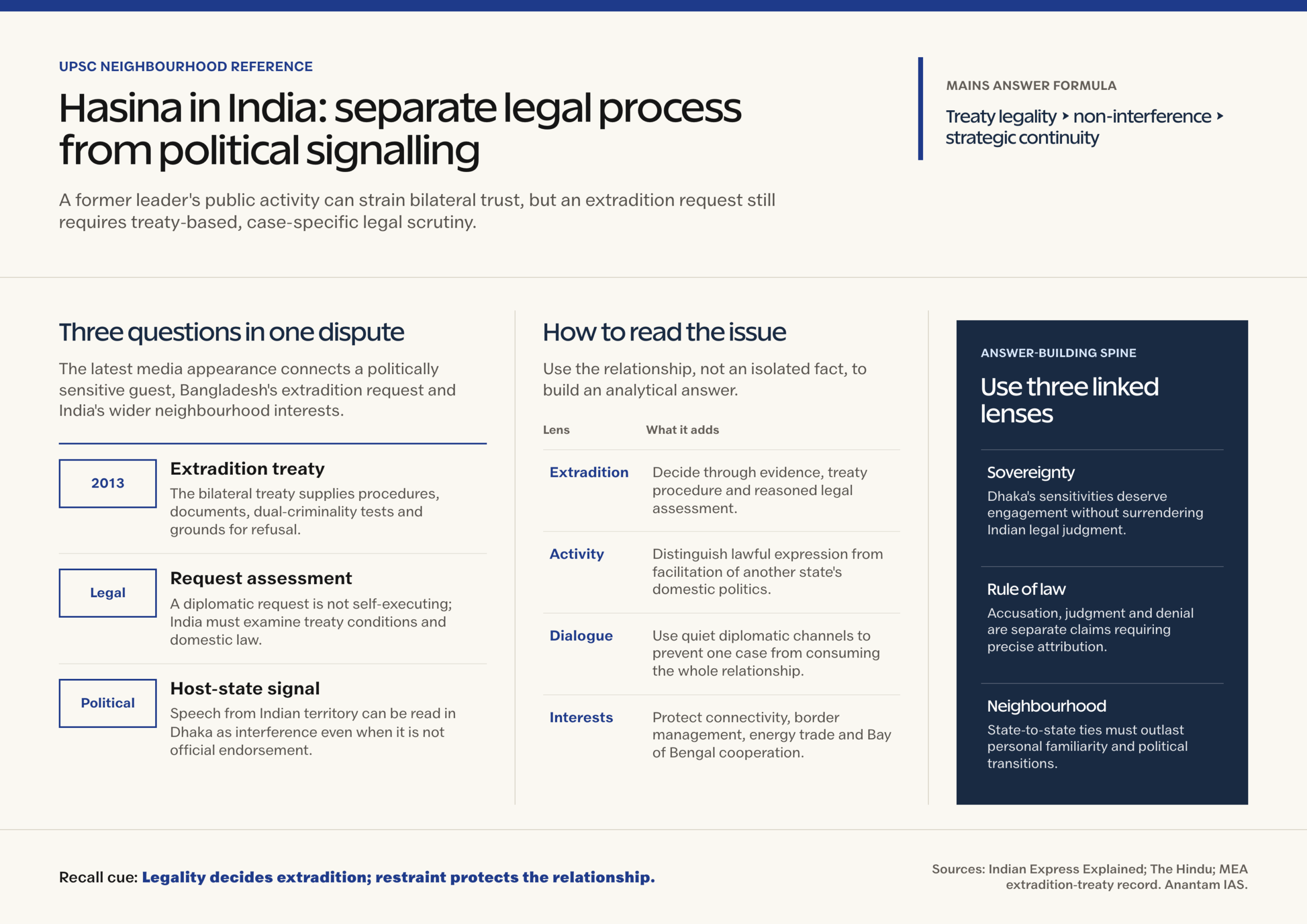
The treaty creates a legal route for a request, but the treaty’s existence does not answer the case by itself.
- The official MEA list of extradition treaties records the India-Bangladesh treaty as a 2013 instrument. It supplies procedures, evidentiary requirements and legal tests for surrender.
- A request travels through the diplomatic channel and must be accompanied by the material required for an accused or a convicted person under the treaty.
- The requested state evaluates whether the conduct is extraditable, whether the papers are sufficient and whether any treaty-based refusal ground applies. That evaluation is case-specific.
- The treaty also allows the requested state to seek additional information. Diplomatic silence or delay cannot safely be read, without an official decision, as legal acceptance or rejection.
- Students should not infer the outcome from labels such as political offence, conviction in absentia or severity of punishment. Their legal effect depends on the treaty text, domestic law, record supplied and competent authorities’ assessment.
Why speech from the host state's territory becomes diplomatic
A media appearance by a private or protected individual is not automatically an official act, yet its location can carry political meaning.
- Dhaka views hostile political messaging from India as an issue of sovereignty and non-interference, especially when the speaker is a former prime minister seeking to influence Bangladesh’s politics.
- New Delhi must also protect its own legal process and avoid treating another government’s accusation as a substitute for an independent decision.
- The central diplomatic distinction is between permission, facilitation and endorsement. These are different factual categories and should not be collapsed without evidence.
- Host states commonly manage such situations through conditions on public activity, discreet communication and clarification of their official position. The appropriate measure depends on the person’s legal status and domestic law, which India has not fully.
- Escalatory public language may satisfy domestic audiences but narrows the room for confidential legal and diplomatic problem-solving.
India's strategic stakes in Bangladesh
Bangladesh is not a single-issue relationship for India; it is central to the security and economic geography of eastern South Asia.
- Cooperation with Dhaka supports connectivity to India’s Northeast through road, rail, inland waterways and access to Bangladeshi ports.
- The relationship includes border coordination, action against transnational crime, power and energy trade, development partnerships and management of shared rivers.
- Bangladesh’s location connects the Ganga-Brahmaputra-Meghna region with the Bay of Bengal, giving the bilateral relationship wider relevance to BIMSTEC and India’s Indo-Pacific outlook.
- The long period of close cooperation under Hasina produced security and connectivity gains, but it also contributed to a perception among some Bangladeshis that India was unusually invested in one political formation.
- India’s durable interest is a stable, sovereign and cooperative Bangladesh, not the permanent dominance of any one party. The India-Bangladesh relations overview provides the wider bilateral foundation.
Way Forward
Clarify India's official position
- India should state that remarks by a person on its territory do not represent the Government of India’s position.
- Without disclosing protected legal material, New Delhi can explain the procedural stage at which the extradition request stands.
- Future public activity should be managed consistently with Indian law and India’s interest in avoiding use of its territory for destabilising political campaigns.
Conclusion
- Sheikh Hasina’s presence in India has become a test of whether New Delhi can combine legal consistency with political sensitivity.
- India and Bangladesh should process the individual case on its legal record and protect the wider relationship through candid communication, restraint and continued cooperation.
UPSC Practice Questions
Prelims MCQ 1
With reference to extradition between India and Bangladesh, consider the following statements:
- India and Bangladesh have a bilateral extradition treaty signed in 2013.
- A request under the treaty is made through the diplomatic channel.
- The existence of the treaty makes every extradition request automatically enforceable.
How many of the above statements are correct?
(a) Only one (b) Only two (c) All three (d) None
Answer: (b) Only two
Explanation:
Statements 1 and 2 are correct. Statement 3 is incorrect because the requested state must examine the treaty conditions, supporting material and any applicable grounds for refusal; a request is not automatically enforceable.
Prelims MCQ 2
Which one of the following best distinguishes extradition from deportation?
(a) Extradition is a treaty or law-based surrender for prosecution or sentence, while deportation is removal under immigration law. (b) Extradition can occur only within a regional organisation, while deportation is always bilateral. (c) Extradition applies only to citizens, while deportation applies only to stateless persons. (d) Extradition is ordered by the United Nations, while deportation is ordered by an embassy.
Answer: (a) Extradition is a treaty or law-based surrender for prosecution or sentence, while deportation is removal under immigration law.
Explanation:
Extradition responds to another state’s criminal-justice request under the applicable legal framework. Deportation or removal arises from immigration law and has a different purpose and procedure.
UPSC Mains Questions
- Sheikh Hasina’s continued presence in India tests both treaty-based legal cooperation and India’s neighbourhood diplomacy. Discuss how India should balance due process, non-interference and its long-term interests in Bangladesh. (250 words)
- Political transitions in neighbouring countries reveal the limits of leader-centric foreign policy. Examine with reference to recent strains in India-Bangladesh relations. (250 words)
Sources: The Indian Express Explained and The Hindu.
Frequently Asked Questions
Why did Sheikh Hasina’s August 2026 media appearance upset Bangladesh?
The interaction occurred from New Delhi on the second anniversary of the 2024 uprising and allowed Hasina to make political claims about Bangladesh. Dhaka treated political messaging from Indian territory as an affront to its sovereignty and linked the episode.
Does the India-Bangladesh Extradition Treaty require India to hand over Sheikh Hasina automatically?
No. The 2013 treaty creates procedures and legal obligations, but each request must be assessed against its conditions, required documents and applicable refusal grounds. Without the complete request and an official Indian decision, the outcome in Hasina’s individual case should.
What is dual criminality in extradition law?
Dual criminality means the conduct underlying the request must amount to a qualifying offence under the laws of both the requesting and requested states. The comparison focuses on the substance of the conduct, while the precise treaty text and domestic.
Why is Bangladesh strategically important for India?
Bangladesh is vital for border security, Northeast connectivity, trade routes, inland waterways, energy exchange and management of shared rivers. Its Bay of Bengal location also supports India’s BIMSTEC and Indo-Pacific interests. These durable stakes make it important to prevent one.
How is extradition different from deportation?
Extradition is the formal surrender of a person to another state for prosecution or enforcement of a sentence under a treaty or domestic law. Deportation is removal under immigration law. They have different purposes, authorities and safeguards, even if both.
Tell Google you want more of this.
Add Anantam IAS as a preferred sourceOne tap, and this site shows up more often in your own Top Stories, AI Overviews and AI Mode. Remove it any time.






