On 28 December 2025, the Ministry of Ports, Shipping and Waterways quietly released the operational guidelines for the country’s biggest-ever bet on building its own ships. The two flagship schemes covered by those guidelines — a revamped Shipbuilding Financial Assistance Scheme and a new Shipbuilding Development Scheme — carry a combined outlay of about Rs 44,700 crore. And they are only part of a larger maritime package, worth roughly Rs 69,725 crore as announced, that the Union Cabinet had cleared on 24 September 2025. With the rulebook now out, the money can finally start to move, and an industry that has spent decades watching the world’s order book sail past it has something concrete to work with.
It matters because the gap India is trying to close is enormous. The country sits at under one per cent of the global shipbuilding market while China, South Korea and Japan together hold close to ninety per cent of it. For a nation with a 7,500-kilometre coastline that already carries about 95 per cent of its trade by volume over the sea, that is a strange and costly weakness — almost every large ship flying an Indian flag is built abroad. So the package is being pitched as far more than an industrial subsidy. It is a test of Atmanirbhar Bharat, or self-reliant India, in one of the hardest manufacturing sectors there is, and a topic that sits squarely in the economy and infrastructure parts of the UPSC syllabus.
Why It’s in the News
The trigger is the 28 December 2025 release of operational guidelines, which turned a Cabinet decision into a working scheme. Until guidelines exist, a shipyard can’t actually apply for assistance or plan a project around it, so this step is what makes the September approval real on the ground. The Ports, Shipping and Waterways ministry framed it as the start of a decade-long programme, with the financial-assistance scheme now running all the way to 31 March 2036.
There’s a second reason the timing draws attention. The earlier Shipbuilding Financial Assistance Policy, notified back in 2016, was due to expire in 2026, and on its own it had failed to move the needle — India’s share of world shipbuilding stayed near zero through its entire run. So the new package isn’t a fresh idea so much as a much larger, redesigned second attempt, arriving just as the old scheme runs out. And it lands against a noisy global backdrop: shipbuilding has become a strategic contest, with the United States and Europe openly worried about China’s dominance of the yards that build both commercial and naval vessels. A credible Indian alternative is suddenly of interest well beyond India.
India’s Shipbuilding Gap and Why It Matters
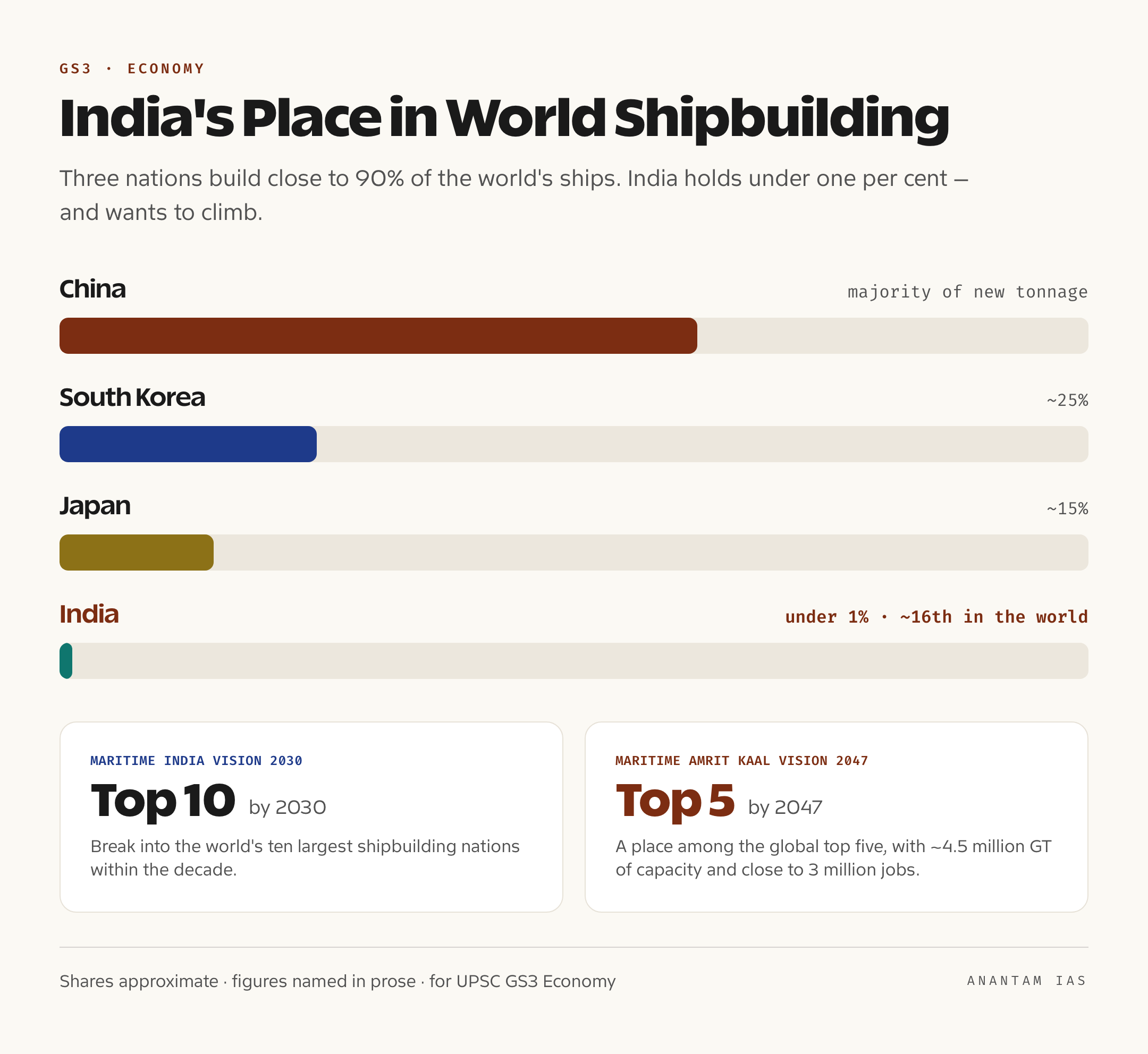
To see why the government is spending this much, start with how far behind India is. Shipbuilding is one of those industries where scale and experience compound for decades, and three countries have been compounding theirs for two generations. China now builds the majority of the world’s commercial tonnage — by some measures more than half, by others close to three-quarters of new orders. South Korea holds roughly a quarter, specialising in high-value vessels like large gas carriers, and Japan a further slice in the mid-teens. Put those together and the rest of the planet, India included, is fighting over the scraps. India’s own share is often cited at well under one per cent — by some counts a fraction of a single per cent, leaving it somewhere around sixteenth in the world.
Why does that matter so much for India in particular? Three reasons stack on top of each other. The first is economic: shipping moves the overwhelming bulk of India’s foreign trade, yet the country pays out large sums in foreign exchange to charter and buy foreign-built ships, and a thin domestic fleet leaves trade exposed whenever global freight rates spike. The second is jobs and industry: shipbuilding is unusually labour-intensive and pulls in a long supply chain — steel, engines, electronics, paint, marine equipment — so a yard is really an anchor for a whole cluster of manufacturing. The government’s own estimate is that the package could eventually unlock about 4.5 million gross tonnage of capacity and support close to 3 million jobs across that chain. The third reason is strategic. A country that cannot build large ships cannot easily build or sustain a serious navy or coast guard in a crisis, and it stays dependent on others for the vessels that carry its energy and its exports. Self-reliance in shipbuilding is, in that sense, a security question as much as an economic one.
This is also where India’s stated ambitions come in, because the package is the means to a set of targets that have been on paper for years. Maritime India Vision 2030 set the near-term goal of pushing India into the world’s top ten shipbuilding nations by the end of this decade. The longer-horizon Maritime Amrit Kaal Vision 2047 — the maritime strand of India’s “developed nation by 2047” plan — aims higher still, at a place among the top five global shipbuilders by 2047, with sharp improvements in port turnaround times and daily ship output along the way. Those numbers had no real funding behind them until now. The December 2025 guidelines are, in effect, the cheque that the visions had been waiting for.
The Scheme Components and the Outlay
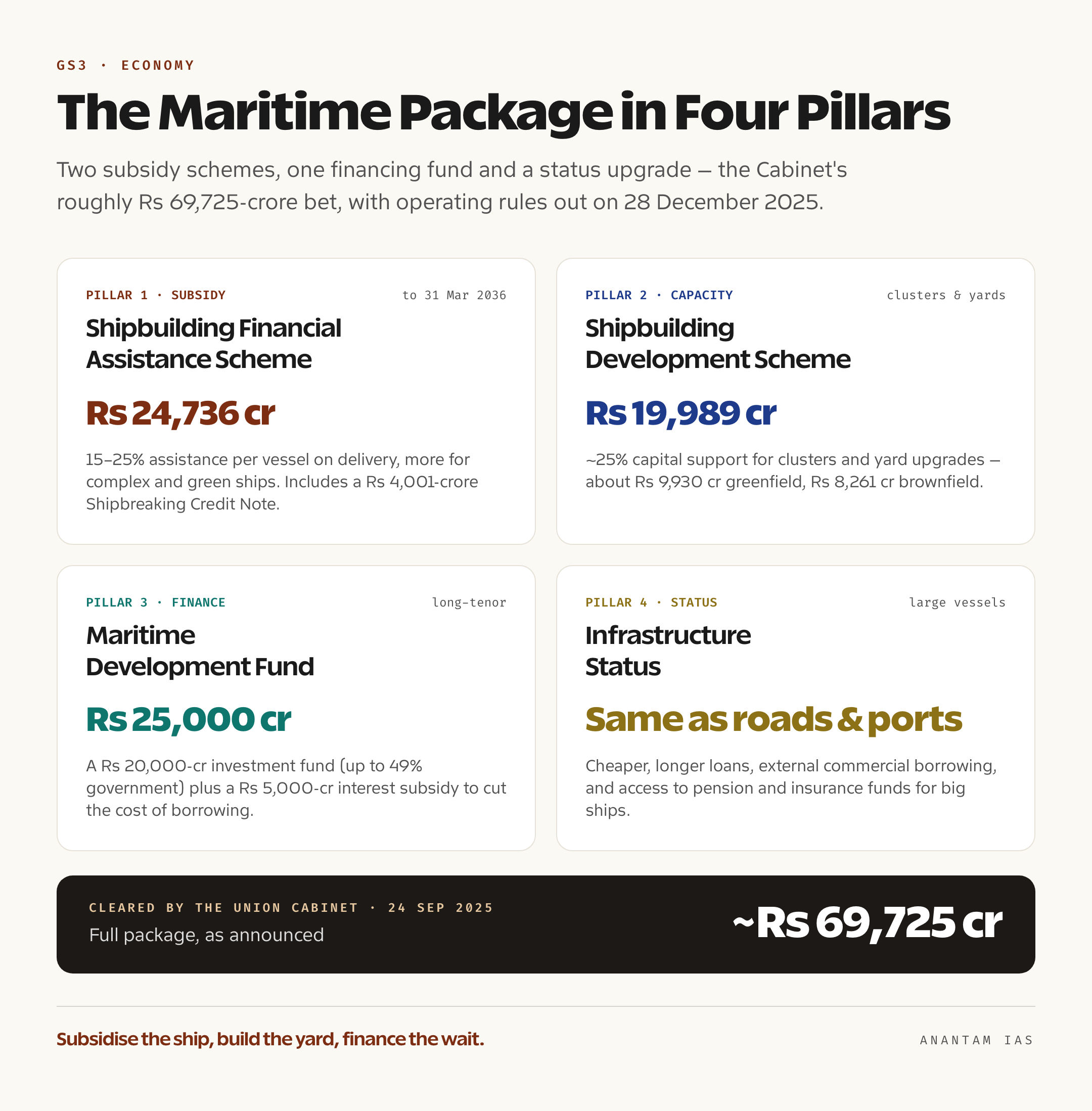
The package is best understood as four pillars, three of them new money and one a change of status. The first pillar is the revamped Shipbuilding Financial Assistance Scheme, sometimes called SBFAS 2.0, with a corpus of about Rs 24,736 crore running to 31 March 2036. This is the direct subsidy that goes to a shipyard once it builds and delivers a vessel in India. The old 2016 version paid 20 per cent of the contract or fair price, whichever was lower, and that rate was designed to shrink by three percentage points every three years — a tapering, declining subsidy that gave yards less and less help over time. The new scheme reworks that into a tiered structure giving roughly 15 to 25 per cent assistance per vessel, with more support for complex, green and strategically important ships, so the incentive now leans toward the kinds of vessels India most wants to make rather than fading away mechanically. Folded inside this pillar is a Shipbreaking Credit Note of about Rs 4,001 crore, which lets ship-recyclers earn credits when they scrap old vessels and channel that value toward buying new Indian-built ones — a neat way to link the dismantling end of the cycle to the building end.
The second pillar is the Shipbuilding Development Scheme, with an outlay of about Rs 19,989 crore, aimed not at individual ships but at the yards and clusters that make them. It offers capital support to build shipbuilding clusters — large integrated zones, each targeting roughly a million-plus gross tonnage of capacity — and to modernise existing yards, with around 25 per cent capital assistance for upgrades. The scheme splits its support broadly between new greenfield clusters (about Rs 9,930 crore) and the expansion of existing brownfield yards (about Rs 8,261 crore), and it funds the unglamorous infrastructure a yard needs, from breakwaters and dredging to long rent holidays on land. The third pillar is the Maritime Development Fund, a Rs 25,000-crore financing vehicle that sits behind both schemes. It is built as a roughly Rs 20,000-crore investment fund, with the government putting in up to 49 per cent and private and institutional money the rest, plus a Rs 5,000-crore interest-subsidy component to bring down the cost of borrowing. Because shipbuilding ties up huge capital for years before a ship is sold, cheap, patient, long-tenor finance is exactly what Indian yards have lacked, and the fund is meant to supply it.
The fourth pillar is the simplest to state and potentially the most powerful. Large ships above a certain size have been granted infrastructure status, the same official label given to roads, ports and power plants. That sounds like paperwork, but it unlocks real benefits: access to longer-term and cheaper loans from specialised lenders, the ability to tap external commercial borrowings, and the eligibility to draw on long-horizon money from pension and insurance funds. Add the four pillars together and the headline figure is the roughly Rs 69,725 crore the Cabinet approved in September 2025, of which the two subsidy schemes worth about Rs 44,700 crore are the ones whose operating rules came out in December.
Significance for the Maritime Economy
So what does all this buy India if it works? The clearest gain is import substitution and a stronger balance of payments. Every large ship built in an Indian yard instead of bought from Asia is foreign exchange saved and value added at home, and over a decade of orders that can add up to a meaningful dent in the import bill. A bigger domestic fleet, built domestically, also makes India’s trade less hostage to the volatile global charter market, where freight costs can swing wildly during a crisis or a conflict.
Then there’s the multiplier. Shipbuilding has one of the longest supply chains in heavy manufacturing — a single large vessel pulls in tens of thousands of tonnes of specialised steel, big engines, pumps, electronics, cabling and coatings, much of which can be made by Indian firms. That is why the government talks about millions of jobs rather than the few thousand who work directly in the yards: the real employment sits in the ancillary industries that grow up around a cluster. This is also where the scheme connects to Atmanirbhar Bharat in a way that is more than a slogan. Building ships forces a country to master a deep stack of engineering capabilities at once, and those capabilities spill over into other strategic sectors, defence shipbuilding included. A nation that can build a commercial bulk carrier is a long step closer to building, repairing and sustaining its own warships.
The strategic timing helps too. With Western governments anxious about depending on Chinese yards for both commercial and naval ships, there is a genuine opening for a trusted, non-Chinese builder to win export and partnership orders. India has been courting exactly that role, including talks with established shipbuilding nations about technology and joint ventures. And the package fits a wider maritime push — modern ports, coastal shipping, inland waterways and ship-repair hubs — so that the ships India builds have a domestic ecosystem to operate within. Done right, the scheme isn’t just a subsidy for a few yards; it’s the manufacturing core of a much larger blue-economy strategy.
Challenges and the Way Forward
But the gap with China, South Korea and Japan didn’t appear by accident, and money alone won’t close it. The first challenge is the sheer scale and cost disadvantage. Indian yards are smaller, build fewer ships and so pay more per vessel, while the leaders enjoy decades of accumulated scale, a mature local supplier base and, in China’s case, substantial state support. A 15-to-25 per cent subsidy narrows that gap but may not erase it, especially for the simplest, most price-sensitive vessels. The second challenge is the ecosystem. India still imports many key components — engines, specialised steel, marine equipment — so a ship “built in India” can carry a lot of imported content unless the ancillary industry grows alongside the yards. Without that deepening, the subsidy risks funding assembly rather than true manufacturing.
The third challenge is the record of the old policy. The 2016 scheme had similar intentions and largely failed to lift India’s share, which is a warning that the same headwinds — slow approvals, financing gaps, a thin skilled-labour pool and competition from heavily backed rivals — can blunt even a generous package. Execution will decide everything: whether the clusters actually get built on time, whether the Maritime Development Fund’s money reaches yards at genuinely low cost, and whether the guidelines stay simple enough that mid-sized yards, not just the giants, can use them. There are environmental considerations as well, since shipbuilding and ship-recycling are heavy, polluting activities that India will have to green to stay credible in export markets that increasingly demand it.
The way forward, then, is less about the size of the cheque and more about follow-through. The sensible markers to watch are concrete: orders actually placed at Indian yards, clusters breaking ground, the share of locally made components rising, and whether India climbs measurably toward the top-ten-by-2030 target. If those move, the December 2025 guidelines will be remembered as the moment India’s shipbuilding ambition finally got real funding and a real timetable. If they don’t, this risks becoming a bigger version of a familiar story — a bold target, a generous outlay, and a market share that stubbornly refuses to grow.
For Your Mains Answer
This topic maps cleanly onto GS Paper 3, which covers the Indian economy, infrastructure, mobilisation of resources, manufacturing and the growth of related sectors. It works for questions on industrial policy, Make in India and Atmanirbhar Bharat, infrastructure financing, the blue economy, and even on internal security and strategic autonomy through the defence-shipbuilding link. It also gives the Essay paper a concrete, data-backed example of self-reliance and economic sovereignty. The skill examiners reward here is pairing exact figures with a clear chain of cause and effect, and always linking the domestic policy to the global context.
How to Build the Answer
Open with the problem, not the scheme — India holds under one per cent of world shipbuilding while three countries hold nearly ninety per cent, despite a 7,500-kilometre coastline and trade that moves by sea. Then move through a logical chain: why the gap matters (forex, jobs, strategy), what the package does (the four pillars and their outlays), why it should help (subsidy, clusters, cheap finance, infrastructure status), and finally a balanced verdict on whether money can overcome decades of accumulated disadvantage. Close by judging execution risk. That arc — problem, stakes, response, evaluation — fits almost any scheme-based question.
Common Mistakes to Avoid
Don’t treat the package as a single scheme; it has four distinct pillars and naming them earns marks. Don’t confuse the dates — the Cabinet approved the roughly Rs 69,725-crore package in September 2025, while the operational guidelines for the two subsidy schemes came in December 2025. Don’t claim India is a strong shipbuilder; its share is under one per cent. And don’t present the scheme as guaranteed success — the 2016 policy had similar aims and failed, so a balanced answer must flag execution risk.
A Compact Answer Spine
India under 1% of global shipbuilding vs China + South Korea + Japan ≈ 90% → costly weakness for a coastal trading nation → December 2025 guidelines operationalise a roughly Rs 69,725-crore package → four pillars: SBFAS 2.0 (~Rs 24,736 cr, 15-25% per-vessel subsidy, includes shipbreaking credit) + Shipbuilding Development Scheme (~Rs 19,989 cr for clusters and modernisation) + Maritime Development Fund (~Rs 25,000 cr long-term finance) + infrastructure status for large vessels → goals: top 10 by 2030, top 5 by 2047, ~4.5 million GT and ~3 million jobs → risks: scale gap, import dependence, execution, the 2016 precedent → verdict: necessary and well-designed, but success depends on follow-through.
Diagram or Flowchart Idea
Draw a simple bar comparing global shares — China, South Korea, Japan as tall bars and India as a sliver — beside a four-box panel of the package pillars with their outlays. A clean two-part visual like this captures both the problem and the response at a glance and is quick to sketch in the margin.
A Balanced-Conclusion Line
A line that lands the marks: “The new shipbuilding push is the right response to a real strategic weakness, but whether India climbs from under one per cent toward the global top five will be decided less by the size of the outlay than by the patience of its execution.”
How to Use Data Without Cramming
You need only a handful of anchors, not a balance sheet: under 1 per cent (India’s global share), ~90 per cent (the big three combined), ~Rs 69,725 crore (the full package), and the two horizons — top ten by 2030 and top five by 2047. Attribute them plainly, for instance “as the Ports and Shipping Ministry’s December 2025 guidelines set out,” rather than scattering numbers without a source.
FAQ
What is the Shipbuilding Financial Assistance Scheme and how much does it pay? It is a direct subsidy paid to Indian shipyards once they build and deliver a vessel in India, with a corpus of about Rs 24,736 crore running to 31 March 2036. The revamped version, sometimes called SBFAS 2.0, gives roughly 15 to 25 per cent assistance per vessel depending on the type, with more support for complex, green and strategically important ships — an improvement on the old 2016 policy, which started at 20 per cent and tapered down over time.
What else is in the maritime package besides SBFAS? Three more pillars. The Shipbuilding Development Scheme (about Rs 19,989 crore) funds shipbuilding clusters and yard modernisation; the Maritime Development Fund (about Rs 25,000 crore) provides long-term, low-cost financing; and large vessels have been granted infrastructure status, which opens up cheaper, longer loans and access to pension and insurance funds. Together with SBFAS, the Cabinet approved the package at roughly Rs 69,725 crore in September 2025.
How small is India’s share of global shipbuilding? Very small — under one per cent of the world market, by some counts a fraction of a single per cent, leaving India around sixteenth globally. China, South Korea and Japan together hold close to ninety per cent, with China alone building the majority of new commercial tonnage. The new package is meant to start closing that gap.
What are India’s shipbuilding targets? Maritime India Vision 2030 aims to put India among the world’s top ten shipbuilding nations by 2030, and the Maritime Amrit Kaal Vision 2047 targets a place in the top five by 2047. The government also expects the package to eventually unlock about 4.5 million gross tonnage of capacity and support close to 3 million jobs across the supply chain.
Practice Questions
Prelims MCQs
- With reference to the maritime package whose operational guidelines were released in December 2025, which of the following are components?
(a) Shipbuilding Financial Assistance Scheme and Shipbuilding Development Scheme only
(b) Shipbuilding Financial Assistance Scheme, Shipbuilding Development Scheme, Maritime Development Fund and infrastructure status for large vessels
(c) Maritime Development Fund and Sagarmala only
(d) Shipbuilding Development Scheme and a National Shipping Board
Answer: (b) The package rests on four pillars — two subsidy schemes, a financing fund, and infrastructure status for large vessels. - The Maritime Development Fund approved as part of the package has a corpus of about:
(a) Rs 5,000 crore
(b) Rs 19,989 crore
(c) Rs 24,736 crore
(d) Rs 25,000 crore
Answer: (d) The Maritime Development Fund is a roughly Rs 25,000-crore financing vehicle, built as a Rs 20,000-crore investment fund plus a Rs 5,000-crore interest-subsidy component. - Which statement about India’s position in global shipbuilding is correct?
(a) India is among the top five shipbuilding nations
(b) India holds under one per cent of the global shipbuilding market
(c) India and China together build most of the world’s ships
(d) India builds about a quarter of the world’s commercial tonnage
Answer: (b) India’s share is under one per cent, while China, South Korea and Japan together hold close to ninety per cent. - Granting “infrastructure status” to large vessels primarily helps the sector by:
(a) Exempting shipyards from all taxes
(b) Giving access to longer-term, cheaper financing including external commercial borrowings and pension and insurance funds
(c) Banning the import of foreign-built ships
(d) Guaranteeing export orders for Indian yards
Answer: (b) Infrastructure status unlocks longer-tenor, lower-cost finance from specialised lenders and long-horizon funds, the same treatment given to roads and ports. - Which two visions set India’s shipbuilding targets of the global top ten by 2030 and top five by 2047 respectively?
(a) Sagarmala and Bharatmala
(b) Maritime India Vision 2030 and Maritime Amrit Kaal Vision 2047
(c) Make in India and Digital India
(d) National Logistics Policy and Gati Shakti
Answer: (b) Maritime India Vision 2030 targets the top ten by 2030 and Maritime Amrit Kaal Vision 2047 targets the top five by 2047.
Mains Practice Questions
- India holds under one per cent of the global shipbuilding market despite being a major maritime trading nation. Examine the reasons for this gap and assess how the recent shipbuilding package seeks to close it. (15 marks, 250 words)
- Discuss the four pillars of India’s latest shipbuilding and maritime financing package. To what extent does its design address the failures of the earlier 2016 policy? (15 marks, 250 words)
- “Self-reliance in shipbuilding is a security question as much as an economic one.” Critically analyse this statement in the context of Atmanirbhar Bharat. (15 marks, 250 words)
- Examine the role of the Maritime Development Fund and infrastructure status for large vessels in overcoming the financing constraints of Indian shipyards. (10 marks, 150 words)
- Shipbuilding has one of the longest supply chains in heavy manufacturing. Evaluate the employment and industrial multiplier potential of India’s shipbuilding push, along with the challenges to realising it. (15 marks, 250 words)
Tell Google you want more of this.
Add Anantam IAS as a preferred sourceOne tap, and this site shows up more often in your own Top Stories, AI Overviews and AI Mode. Remove it any time.