Why in news?
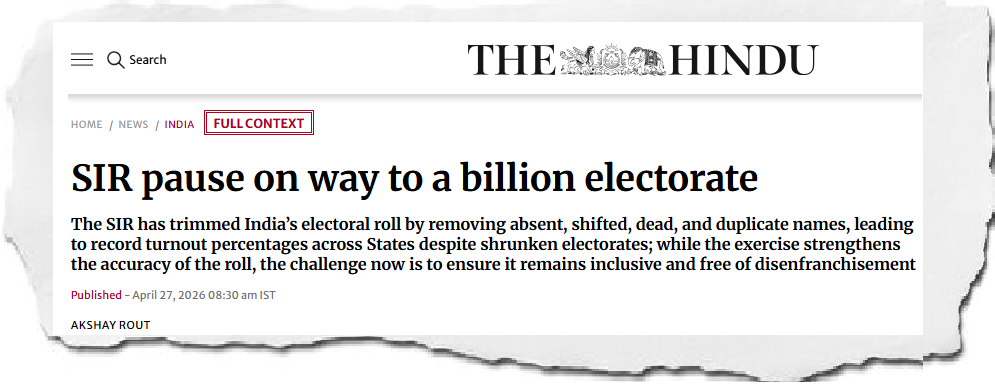
Recent Assembly elections in States such as Tamil Nadu and West Bengal have recorded very high voter turnout, coinciding with a reduction in total electorate size after the Special Intensive Revision (SIR) of electoral rolls. This has brought attention to a key issue in electoral governance — balancing accuracy of rolls with inclusive democracy.
UPSC Relevance
GS-II: Polity, Election Commission, Electoral Reforms, Representation of People
What is Special Intensive Revision (SIR)?
SIR is a comprehensive revision of electoral rolls, unlike routine annual revisions. It involves:
- Fresh enumeration of voters
- Verification of eligibility
- Removal of ASDD categories (Absent, Shifted, Dead, Duplicate)
- Addition of new eligible voters
It is conducted periodically when the Election Commission deems that existing rolls require deep correction.
Changing Trends in India’s Electorate
India’s electorate has historically grown alongside population:
- From about 17 crore voters (1951) to over 96 crore (2024)
- Faster growth than population due to improved registration
However, post-SIR:
- Electorate size has declined in several States
- Example trend:
- Significant reduction (often >10%) in major States
- Overall drop of around 6 crore voters (aggregate so far)
This marks a temporary reversal in the long-term expansion trend.
What are the Reasons Behind Decline in Electorate?
1. Removal of Ineligible Names (ASDD)
A major objective of SIR is to clean rolls by removing:
- Dead voters
- Migrated individuals
- Duplicate entries
This is particularly relevant in States with:
- High migration (e.g., Uttar Pradesh, Bihar)
- Outdated rolls (last SIR conducted in early 2000s)
2. Non-Response and Documentation Gaps
Some deletions arise due to:
- Non-submission of enumeration forms
- Inability to verify residence or identity
- Failure to meet eligibility criteria
Here, the burden of proof shifts to the citizen, which can create exclusion risks.
3. Administrative and Verification Processes
Unlike summary revisions, SIR involves:
- Door-to-door verification
- Objections through formal processes (e.g., Form 7)
This increases accuracy but may also:
- Lead to exclusion of marginal groups
- Create procedural hurdles
Impact on Elections
1. Higher Turnout Percentages
With a reduced denominator (total voters):
- Turnout percentages appear higher
- Example: Tamil Nadu recorded over 85% turnout
However, this does not necessarily mean:
- More participation in absolute terms
2. Perception of “Cleaner” Rolls
SIR helps:
- Improve credibility of electoral rolls
- Reduce chances of electoral malpractice
But perception depends on:
- Whether exclusions are seen as legitimate or unfair
Core Democratic Concern: Inclusion vs Accuracy
Positive Aspects
- Ensures integrity of electoral rolls
- Removes duplication and outdated entries
- Strengthens trust in electoral outcomes
What are the Concerns?
1. Risk of Disenfranchisement
Vulnerable groups may be disproportionately affected:
- Migrant workers
- Urban poor
- Informal sector workers
These groups often lack:
- Stable residence proof
- Documentation continuity
2. Burden on Citizens
Instead of automatic inclusion:
- Citizens may have to re-establish eligibility
- This can weaken the principle of universal adult franchise
3. Narrative of Deletion vs Inclusion
While additions do occur:
- Public discourse focuses more on deletions
- This affects trust in the process
What are the Constitutional and Institutional Dimensions?
Key Constitutional Provisions
- Article 326: Universal adult suffrage
- Article 325: No exclusion based on religion, caste, etc.
Role of Election Commission of India
- Preparation and revision of electoral rolls
- Ensuring free and fair elections
SIR must therefore align with:
- Accuracy (free and fair elections)
- Inclusiveness (democratic participation)
Way Forward
1. Shift Focus from Deletion to Inclusion
After cleansing rolls, emphasis must be on:
- Ensuring all eligible voters are added
- Active outreach to underrepresented groups
This restores confidence in the system.
2. Simplify Documentation Requirements
Rigid documentation norms should be relaxed by:
- Accepting alternative proofs of residence
- Using self-declaration with verification
This is essential in a country with high mobility.
3. Strengthen Appeal and Grievance Mechanisms
- Provide easy and time-bound processes for restoration of names
- Ensure transparency in deletions
This protects voter rights.
4. Use Technology for Inclusive Registration
- Online registration and tracking systems
- Integration with other databases (with safeguards)
- Real-time updates
Technology should reduce exclusion, not increase it.
5. Targeted Inclusion Campaigns
Focus on:
- Youth voters
- Women
- Migrants
- Persons with disabilities
Campaign-mode enrolment can ensure last-mile inclusion.
6. Continuous Updating Instead of Periodic Shock
Rather than large-scale revisions:
- Move towards continuous updating of rolls
- Reduces disruption and sudden exclusions
Conclusion
The Special Intensive Revision represents an important effort to improve the quality of India’s electoral rolls, but it also highlights a fundamental tension in democracy — between purity of rolls and inclusiveness of participation. The credibility of elections depends not only on removing ineligible voters but equally on ensuring that no eligible citizen is left out. Sustaining this balance will be critical as India approaches one of the largest electorates in the world.
Practice Questions
Prelims
- With reference to electoral roll revision in India, consider the following statements:
- The Election Commission of India conducts Special Intensive Revision (SIR) periodically.
- SIR involves only deletion of duplicate voters.
- Article 326 of the Constitution provides for adult suffrage.
Which of the statements given above is/are correct?
(a) 1 and 3 only
(b) 1 only
(c) 2 and 3 only
(d) 1, 2 and 3
Answer: (a)
Mains
Examine the challenges associated with electoral roll management in a highly mobile and urbanising society like India. Suggest suitable reforms.
“Accuracy of electoral rolls should not come at the cost of inclusiveness.” Discuss in the context of Special Intensive Revision (SIR) in India.
Tell Google you want more of this.
Add Anantam IAS as a preferred sourceOne tap, and this site shows up more often in your own Top Stories, AI Overviews and AI Mode. Remove it any time.