Why in News?
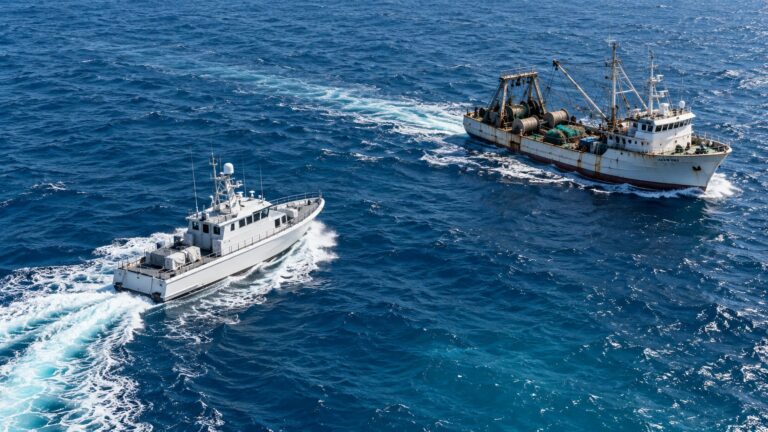
The Hindu reported on 21 August 2026 that a cargo ship with six Indian crew members had been hijacked off Somalia’s Puntland coast on 17 August.
- The Cameroon-flagged M/V LUTUF reportedly carried a 10-member crew, including six Indians, when armed men seized it near Puntland.
- The reported seizure point was about 3.5 nautical miles offshore, and the vessel was taken toward the Nugaal coast.
- The ship’s cargo reportedly included weapons and communications equipment bound for a Turkish military training facility in Mogadishu.
- The crew’s condition and vessel’s status were not immediately clear; several incident details remained independently unverified when the report was published.
- The episode renews attention to seafarer safety, coastal enforcement and coordinated maritime surveillance around Somalia and the Gulf of Aden.
- The Gulf of Aden links the Arabian Sea with the Red Sea route toward the Suez Canal, making disruption relevant to trade, energy movement and shipping insurance.
- Indian nationals serve on both Indian- and foreign-flagged vessels, so protection can require coordination among the flag State, coastal State, employer, India and regional forces.
- Precise legal classification matters because jurisdiction, reporting and prosecution differ between piracy on the high seas and armed robbery within territorial waters.
UPSC Relevance
Prelims Relevance
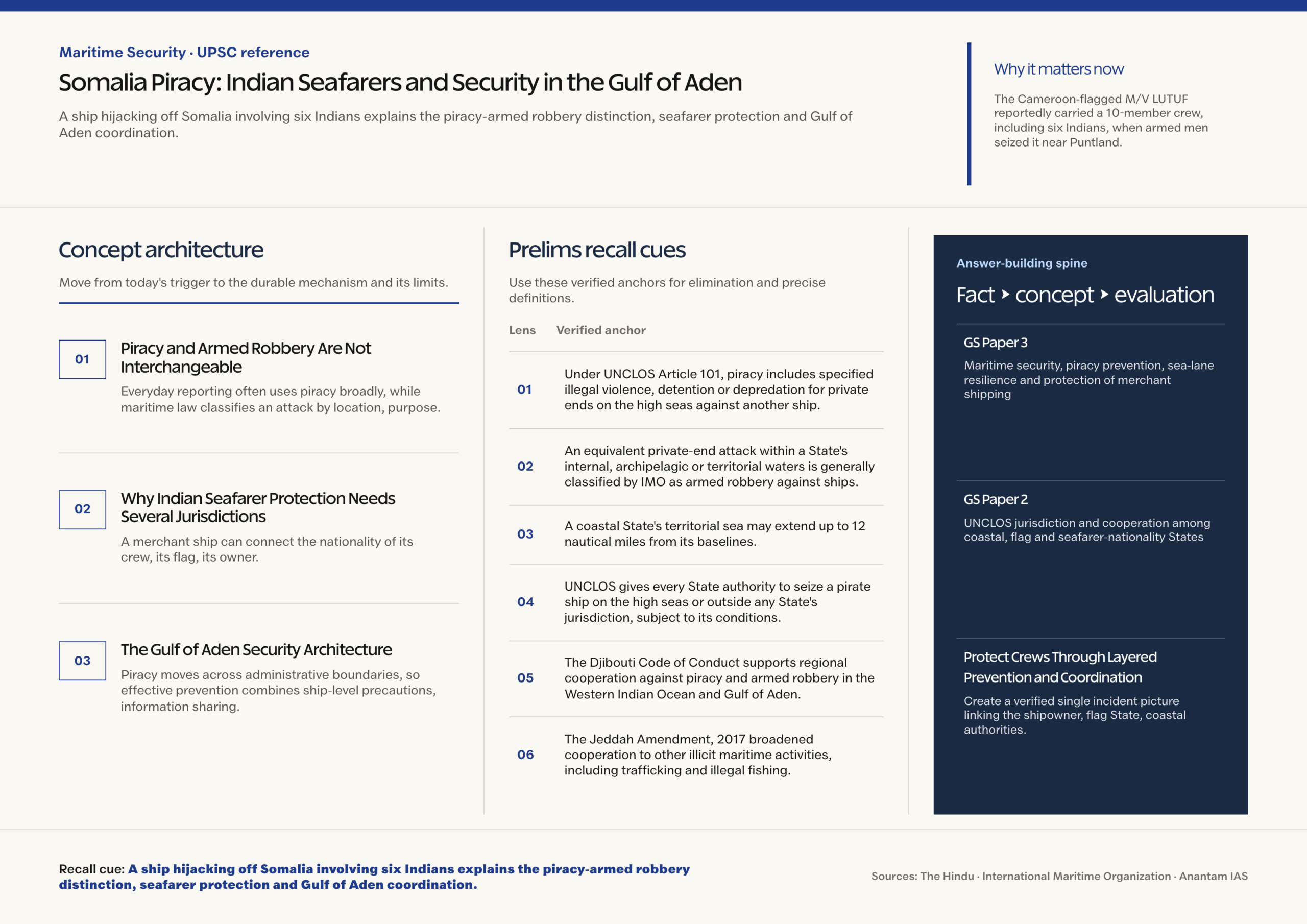
- Under UNCLOS Article 101, piracy includes specified illegal violence, detention or depredation for private ends on the high seas against another ship.
- An equivalent private-end attack within a State’s internal, archipelagic or territorial waters is generally classified by IMO as armed robbery against ships.
- A coastal State’s territorial sea may extend up to 12 nautical miles from its baselines.
- UNCLOS gives every State authority to seize a pirate ship on the high seas or outside any State’s jurisdiction, subject to its conditions.
- The Djibouti Code of Conduct supports regional cooperation against piracy and armed robbery in the Western Indian Ocean and Gulf of Aden.
- The Jeddah Amendment, 2017 broadened cooperation to other illicit maritime activities, including trafficking and illegal fishing.
Mains Relevance
GS Paper 3
- Maritime security, piracy prevention, sea-lane resilience and protection of merchant shipping
- Risk assessment, ship hardening, reporting networks and coordinated surveillance in the Western Indian Ocean
GS Paper 2
- UNCLOS jurisdiction and cooperation among coastal, flag and seafarer-nationality States
- India’s consular responsibility and regional partnerships for protecting nationals aboard foreign-flagged ships
Essay
- Freedom of navigation is sustained not only by naval power but also by law, regional trust and protection of the people who operate global supply chains.
Background and Context
Piracy and Armed Robbery Are Not Interchangeable
Everyday reporting often uses piracy broadly, while maritime law classifies an attack by location, purpose, actors and the ships involved.
- UNCLOS Article 101 covers illegal violence, detention or depredation committed for private ends by people aboard a private ship and directed against another ship on the high seas.
- It also covers voluntary participation in operating a pirate ship and intentional facilitation of a qualifying act, preventing organisers and enablers from escaping the definition.
- IMO defines armed robbery against ships as comparable private-end conduct within a State’s internal, archipelagic or territorial waters, placing primary enforcement responsibility on that coastal State.
- Because the reported LUTUF seizure occurred about 3.5 nautical miles offshore, it would ordinarily fall within Somalia’s territorial sea if measured from the applicable baseline.
- This is an exam trap: a violent boarding at sea is not automatically UNCLOS piracy, and the exact coordinates and legal maritime zone must be established.
Why Indian Seafarer Protection Needs Several Jurisdictions
A merchant ship can connect the nationality of its crew, its flag, its owner, its cargo and the coastal waters where an incident occurs.
- The flag State exercises jurisdiction and control over its ship, while the coastal State investigates and enforces law when an attack occurs inside its territorial waters.
- India’s immediate concern is the safety of its nationals, requiring verified crew information, contact with the employer and flag State, diplomatic coordination and communication with families.
- Rescue or interdiction must follow a clear operational picture; unverified action around a detained ship can increase risks to hostages, nearby vessels and responding personnel.
- Shipowners retain preventive duties: voyage-specific threat assessment, crew drills, secure communications, lookout discipline, physical barriers and timely reporting under recognised Best Management Practices.
- Armed guards are not a universal substitute for prevention. Their carriage depends on flag, port and coastal-State law and requires rules on weapons, accountability and escalation.
The Gulf of Aden Security Architecture
Piracy moves across administrative boundaries, so effective prevention combines ship-level precautions, information sharing, coastal capacity and coordinated patrols.
- The Gulf of Aden is the approach between the Arabian Sea and Bab el-Mandeb, connecting Indian Ocean shipping with the Red Sea and the route toward the Suez Canal.
- The Djibouti Code of Conduct promotes information sharing, national legislation, interdiction capability, training and coordination among States in the Western Indian Ocean and Gulf of Aden.
- Its 2017 Jeddah Amendment recognises that piracy overlaps with trafficking, illegal fishing and other organised maritime crime, widening the institutional lens beyond ship hijacking alone.
- Merchant vessels support collective awareness by registering or reporting through recognised maritime-security channels and rapidly transmitting position, attack method and crew-risk information.
- Naval presence can deter and respond, but durable control also needs accountable coastal policing, courts, prisons, economic alternatives and prosecution based on admissible evidence.
Way Forward
Protect Crews Through Layered Prevention and Coordination
- Create a verified single incident picture linking the shipowner, flag State, coastal authorities, Indian agencies and regional maritime-security centres.
- Require route-specific threat assessments, crew drills, citadel and communication readiness, enhanced watchkeeping and prompt reporting for vessels entering exposed waters.
- Expand information sharing and joint training under the Djibouti Code framework while strengthening Somali coastal enforcement and evidence-led prosecution.
- Maintain family liaison, medical and psychological support, wage protection and post-release rehabilitation as core parts of seafarer protection, not afterthoughts.
Conclusion
- The new hijacking shows that reduced attack levels do not eliminate Somalia-linked maritime risk; prevention must connect prepared ships, protected crews, coastal enforcement and regional information sharing.
- In a Mains answer, first classify the incident by maritime zone, then map responsibilities across the coastal State, flag State, seafarer-nationality State, shipowner and coordinating security mechanisms.
- India’s maritime-security approach should treat merchant seafarers as essential human infrastructure, combining consular readiness and naval coordination with enforceable industry safeguards and long-term regional capacity.
UPSC Practice Questions
Prelims MCQ 1
With reference to piracy under the United Nations Convention on the Law of the Sea, consider the following statements:
- It includes specified private-end violence or detention by persons aboard a private ship against another ship on the high seas.
- It includes voluntary participation in operating a ship with knowledge that it is a pirate ship.
- Every armed attack against a ship inside territorial waters is classified as piracy under Article 101.
How many of the above statements are correct?
(a) Only one (b) Only two (c) All three (d) None
Answer: (b) Only two
Explanation:
Statements 1 and 2 reflect UNCLOS Article 101. A comparable private-end attack within territorial waters is generally treated by IMO as armed robbery against ships, not UNCLOS piracy.
Prelims MCQ 2
What was the principal effect of the 2017 Jeddah Amendment to the Djibouti Code of Conduct?
(a) It replaced UNCLOS rules on the breadth of the territorial sea (b) It abolished coastal-State jurisdiction over armed robbery against ships (c) It broadened regional cooperation to cover other illicit maritime activities beyond piracy and armed robbery (d) It created a single permanent navy for all Western Indian Ocean States
Answer: (c) It broadened regional cooperation to cover other illicit maritime activities beyond piracy and armed robbery
Explanation:
The amendment expanded cooperation to threats such as maritime terrorism, trafficking, illegal fishing and other organised maritime crime while retaining the regional anti-piracy framework.
UPSC Mains Questions
- The legal distinction between piracy and armed robbery against ships is operationally significant, not merely semantic. Explain with reference to jurisdiction and enforcement off Somalia.
- Protecting Indian seafarers in the Western Indian Ocean requires action beyond naval deployment. Discuss the preventive, consular, legal and regional-cooperation measures needed.
Sources: The Hindu and International Maritime Organization.
Frequently Asked Questions
How many Indians were reportedly aboard the hijacked vessel?
The reported 10-member crew included six Indian nationals. At publication, the vessel’s status and the crew’s condition had not been independently confirmed.
What is piracy under UNCLOS?
Article 101 covers specified private-end violence, detention or depredation by people aboard a private ship against another ship on the high seas or outside any State’s jurisdiction.
How does armed robbery against ships differ from piracy?
The conduct may look similar, but armed robbery occurs within internal, archipelagic or territorial waters, where the coastal State ordinarily has primary enforcement jurisdiction.
Why is the Gulf of Aden strategically important?
It connects Arabian Sea shipping with Bab el-Mandeb and the Red Sea route toward the Suez Canal, making security there important for trade and seafarer safety.
What does the Djibouti Code of Conduct do?
It supports regional information sharing, legal development, training and enforcement cooperation against piracy and armed robbery across the Western Indian Ocean and Gulf of Aden.
Tell Google you want more of this.
Add Anantam IAS as a preferred sourceOne tap, and this site shows up more often in your own Top Stories, AI Overviews and AI Mode. Remove it any time.