
Supreme Court’s Directive: Stray Dogs to Shelters Permanently
Context: Expressing concern over the “disturbing increase” in dog-bite incidents across the country, the Supreme Court on Friday directed all the States and the Union Territories to “forthwith” remove stray dogs from educational institutions, hospitals, sports complexes, bus stands and depots, and railway stations, and relocate them “to a designated shelter”. The dogs have to be sterilised and vaccinated in accordance with the Animal Birth Control (ABC) Rules, 2023 before relocation.
Earlier a two-judge bench of Justices J.B. Pardiwala and R. Mahadevan issued a sweeping order on August 11, 2025 to make Delhi-NCR “stray dog free” within eight weeks. All street dogs across Delhi and its suburbs (Noida, Gurugram, Ghaziabad, etc.) are to be captured, sterilized, vaccinated, and housed in dedicated shelters, with no dog released back onto the streets. Authorities were directed to create sufficient dog shelters (initially for about 5,000 dogs) staffed for ongoing sterilization and immunization. The Court even warned that any individual or group obstructing the dog-catching drive would face contempt proceedings.

Stray dogs kept in cages at a New Delhi shelter following the Supreme Court’s order (August 2025).
Background & Trigger
Case: In Re: “City Hounded by Strays, Kids Pay Price” – Suo motu writ petition (C) No. 5 of 2025.
Trigger: Surge in dog bites & rabies cases; 25,210 bites in Delhi in 2024; 3,196 in January 2025 alone.
Legal backdrop: Conflict with Animal Birth Control Rules, 2023 which mandate sterilization and release at the same location.
Court’s Rationale (previously)
- Fundamental Rights: Stray dog menace = infringement of Articles 19(1)(d) (freedom of movement) and 21 (right to life & safety).
- Public safety prioritized over the ABC Rules’ release-back provision.
- Systemic failure of authorities under 2001 & 2023 ABC Rules to control population and bites.
Reference to Animal Welfare Board of India v. Union of India (2023): Constitution does not confer fundamental rights on animals; statutory rights are subject to human safety.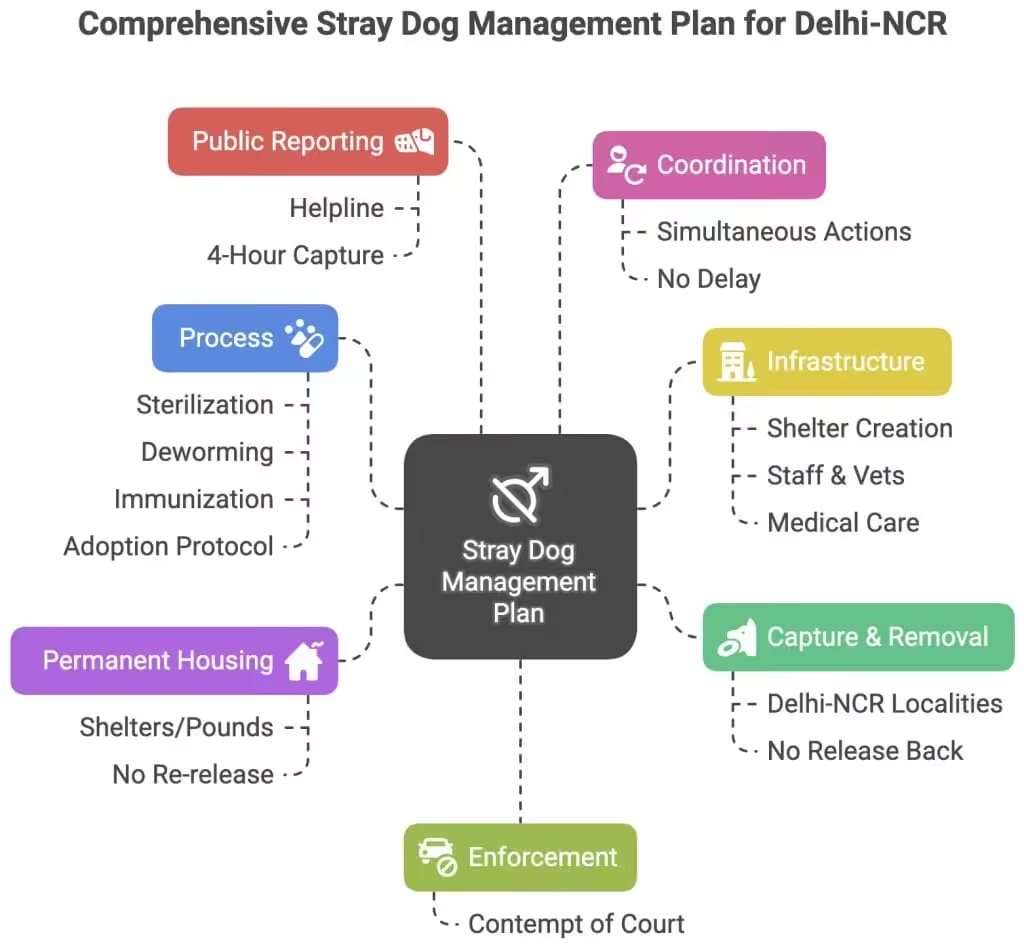
In Re: “City Hounded by Strays, Kids Pay Price” – Suo motu writ petition (C) No. 5 of 2025.
Legal and constitutional Basis
- Prevention of Cruelty to Animals Act, 1960 — read with exceptions permitting removal for human safety.
- Articles 19(1)(d) & 21 – citizens’ right to move freely & live safely.
- Directive Principles: Art. 47 – state duty to improve public health.
- Municipal laws (e.g., Section 399, Delhi Municipal Corporation Act) allowing confinement/destruction of strays.
Public Safety Rationale
The Court underscored citizens’ right to safety, pointing to a surge in dog-bite incidents and fatal rabies cases. Terming the situation “extremely grim,” it stressed immediate action “in larger public interest”. The judges noted that infants, children and the elderly must be able to move freely without fear of stray dog attacks.
Media reports cited nearly 2,000 dog bite incidents per day in Delhi and dozens of rabies deaths in recent months, lending urgency to the Court’s intervention. The bench explicitly stated that “no sentiments should be involved” in removing strays – prioritizing human life and public health over emotional appeals.
Why This Legal Basis is Contentious
- This conflict with the 2024 SC verdict is why the CJI has ordered judicial re-examination by a larger bench.
- The PCA Act + ABC Rules form a statutory framework for stray dog management that explicitly prohibits killing or permanent removal (except in specific situations).
- The Court’s order effectively supersedes delegated legislation without formally striking it down — raising questions about judicial overreach and separation of powers.
Infrastructure Shortfall
The ambitious order starkly exposes an infrastructure gap. Various estimates put Delhi’s stray dog population between 500,000 to 1,000,000 animals. In contrast, the existing shelter capacity (even after urgent expansion) is only a few thousand spots – the Court initially called for around 5,000 shelter slots to be created. This implies over 100× more dogs on the streets than can be housed. Municipal authorities have no precedent or ready facilities for accommodating hundreds of thousands of dogs. Indeed, Delhi has virtually no government-run dog shelters currently, and building the 1,000+ new shelters that would be required (with staff, kennels, food, healthcare, etc.) would cost an estimated ₹10,000–15,000 crore (over $1.2–1.8 billion) – funds the city does not have. Officials and experts are concerned that without massive resources and planning, the order is logistically “unworkable”.
Backlash from Animal Welfare Groups
Animal rights organizations and public figures reacted with outrage, calling the blanket removal order “impractical,” “inhumane” and even illegal. Activists argue the Court’s directive violates India’s long-standing Animal Birth Control (ABC) Rules – most recently updated in 2023 – which mandate that stray dogs be sterilized and returned to their original locations, not permanently caged or killed. Justice Pardiwala’s bench flatly dismissed these rules as “absurd” and ineffective, a stance that animal welfare groups fiercely dispute. PETA India condemned the “large-scale displacement” of dogs as unscientific, warning that “jailing” street dogs has never worked. They point out that Delhi has ~10 lakh (1,000,000) community dogs with under half sterilized – removing them en masse could backfire without addressing root causes. The Federation of Indian Animal Protection Organisations (FIAPO) likewise slammed the move as cruel and counter-productive, urging authorities to focus instead on mass sterilization, vaccination, waste management and public awareness to humanely reduce stray populations. Many critics see the order as a knee-jerk reaction that ignores the “neuter-vaccinate-release” method globally regarded as the only sustainable, humane solution.
Ecological and Health Concerns
Beyond compassion issues, experts warn the mass dog removal could upset the urban ecological balance. Former Union minister and animal advocate Maneka Gandhi castigated the judgment as “not doable” and “potentially harmful”. She cautioned that street dogs play a role in controlling other pests – for example, Delhi’s dogs keep rats and monkeys in check.
Gandhi drew a historical parallel to Paris in the 1880s:
When authorities eliminated stray dogs (and cats) there, the city was soon overrun by rats. She warned that within days of Delhi’s dogs being removed, monkeys from surrounding areas would “come down to the ground” searching for food, and “three lakh new dogs will come” from neighboring districts to fill the void– creating a larger problem. This so-called “vacuum effect” is a well-documented phenomenon: removing territorial stray dogs opens space for other unsterilized, possibly more aggressive dogs to migrate in, drawn by the same food waste and open garbage that fueled the original population. In other words, any gains could be temporary.
Furthermore, packing thousands of dogs into makeshift shelters carries significant health risks. Animal experts note that overcrowded shelters can become hotbeds for infectious and zoonotic diseases. Past instances in India saw outbreaks of leptospirosis, mange, parvovirus and other illnesses when large numbers of stray dogs were confined together without proper biosecurity. If shelters are not adequately designed and maintained, the court’s remedy might swap an outdoor stray problem for indoor disease outbreaks, endangering both animals and caretakers. These concerns underscore why veterinarians and activists insist on community-based, in-situ management (sterilize-release and public hygiene) rather than mass relocation.
Legal Conflict and Judicial Review
The August 11 order has also triggered a legal paradox. Observers point out it directly contradicts a Supreme Court verdict from July 2024, in which another bench had affirmed the ABC Rules and explicitly forbade any wholesale culling or removal of strays. That 2024 judgment (by Justices S. Karol and J.K. Maheshwari) held that “under all circumstances, there cannot be any indiscriminate killing of canines”, emphasizing that showing compassion to all living beings is a constitutional value. In stark contrast, the new two-judge bench in 2025 took a hardline stance to “forget the rules” and remove all dogs for public safety. This dueling precedent – one SC order mandating sterilize-and-return vs. another ordering capture-and-remove – has created confusion over which law now applies.
Acknowledging the conflict, Chief Justice B.R. Gavai intervened on August 14. The CJI withdrew the matter from the original bench and assigned it to a new, larger bench for fresh consideration. He assured that the Court will “look into” the stray dog issue more deeply, taking into account the earlier rulings and current objections. Essentially, the August 11 directives are now under a partial stay/review, and further implementation will be subject to the outcome of this judicial re-examination. The episode highlights an unusual instance of the Supreme Court seemingly revisiting its own order within days, due to concerns of legal inconsistency and public outcry.
Issues involved
- Human Safety vs. Animal Welfare: Provokes the age-old question of rights – protecting human life and safety (an inalienable right) versus providing humane treatment to animals. Under what circumstances should policy weigh citizen safety against animal rights?
- Policy Effectiveness & Top-Down Decisions: The case is an experiment in testing the boundaries of mandating through the courts. It raises the question of whether top-down court fiat (without regard to logistics, infrastructure or cost) can remedy what is fundamentally an administrative problem. It defies examination of policy implementation shortcomings and the necessity of comprehensive planning in place of instant fiat.
- Precedent – Jallikattu Analogy: Draw an analogy with the Jallikattu case (traditional bull-taming sport vs animal cruelty issue). Both present cultural/social pressure against animal welfare legislation. The stray dog ruling also pits community sentiment (pro- and anti-stray) against legal principles – a fascinating side-by-side comparison of how the judiciary weighs public opinion and welfare legislation in India.
- Governance and Urban Responsiveness: The incident demonstrates a failure in governance – there are legislation and court rulings (ABC Rules, civic duties to manage strays) but weren’t enforced by city governments. This loophole allowed the problem to continue and escalate to a crisis. The incident indicates that capacity building in local governance institutions, municipal officials’ accountability, and sustained policy enforcement on the ground, rather than employing extreme measures after decades of doing nothing, is necessary.
What changed on Nov 7, 2025 (new directions)
- Road safety add-on: NHAI, transport & municipal authorities told to remove cattle/stray animals from highways/expressways; next hearing on Jan 13, 2026. The Economic Times+1
- Targeted removal zones: All States/UTs must forthwith remove stray dogs from
schools/colleges, hospitals, sports complexes/grounds, bus stands/depots, and railway stations and relocate them to designated shelters. The Indian Express+2Live Law+2 - Sterilise + vaccinate first (ABC-compliant): Dogs are to be sterilised and vaccinated under ABC Rules, 2023 before relocation. The Indian Express
- No release-back to the same spot (for these institutional/public premises): Dogs removed from such premises shall not be released back to the same locality; purpose is to keep institutional areas free of strays. Live Law
Compliance & oversight:
- Local bodies to act immediately and file compliance reports within 8 weeks.
- State survey (within 2 weeks) to list all institutions requiring removal.
- Each institution must appoint a nodal officer; quarterly inspections mandated.
- Fencing/gates to prevent ingress; effective waste management to cut food sources.
- Hospitals must maintain constant stock of anti-rabies vaccine.
- AWBI to frame uniform SOPs for bite prevention & stray management, to be implemented nationwide. The Indian Express
Overall, the Supreme Court’s stray dog order and its aftermath provide rich material for discussing public policy formulation, humane urban management, legal frameworks vs. executive action, and the interplay between judiciary directives and ground reality – all highly pertinent to UPSC exam themes in governance, law, and ethics.
Tell Google you want more of this.
Add Anantam IAS as a preferred sourceOne tap, and this site shows up more often in your own Top Stories, AI Overviews and AI Mode. Remove it any time.