The TARA weapon system isn’t a missile, isn’t a smart bomb in the traditional sense, and isn’t a new aircraft. It’s something quieter and arguably more important. TARA is a glide kit. Bolt it onto a standard unguided bomb sitting in an Indian Air Force armoury, and that dumb iron suddenly behaves like a precision-guided munition. It glides, it steers, it hits within meters of a designated coordinate. DRDO’s first public confirmation of the program in early May 2026 marks a shift in how India thinks about air-to-ground firepower, because the economics of conversion kits are very different from the economics of new-build PGMs.
Glide kits matter because they multiply existing inventory. The Indian Air Force sits on thousands of legacy 250 kg, 450 kg, and 1000 kg general-purpose bombs that were procured over decades. Most are unguided. Strapping a TARA kit onto each one turns a stockpile that would otherwise rust into a stockpile of stand-off weapons. The aircraft doesn’t have to enter dense air-defense zones to drop them. The pilot releases from a safer altitude and stand-off distance, and the bomb steers itself the rest of the way using GNSS plus inertial guidance.
The deeper story is about self-reliance. India still imports a meaningful share of its precision strike munitions from Israel, Russia, and the US. The Spice 2000 strikes during Balakot used Israeli kits. TARA, if it scales, replaces that dependency with a domestically engineered solution.
Quick Facts at a Glance
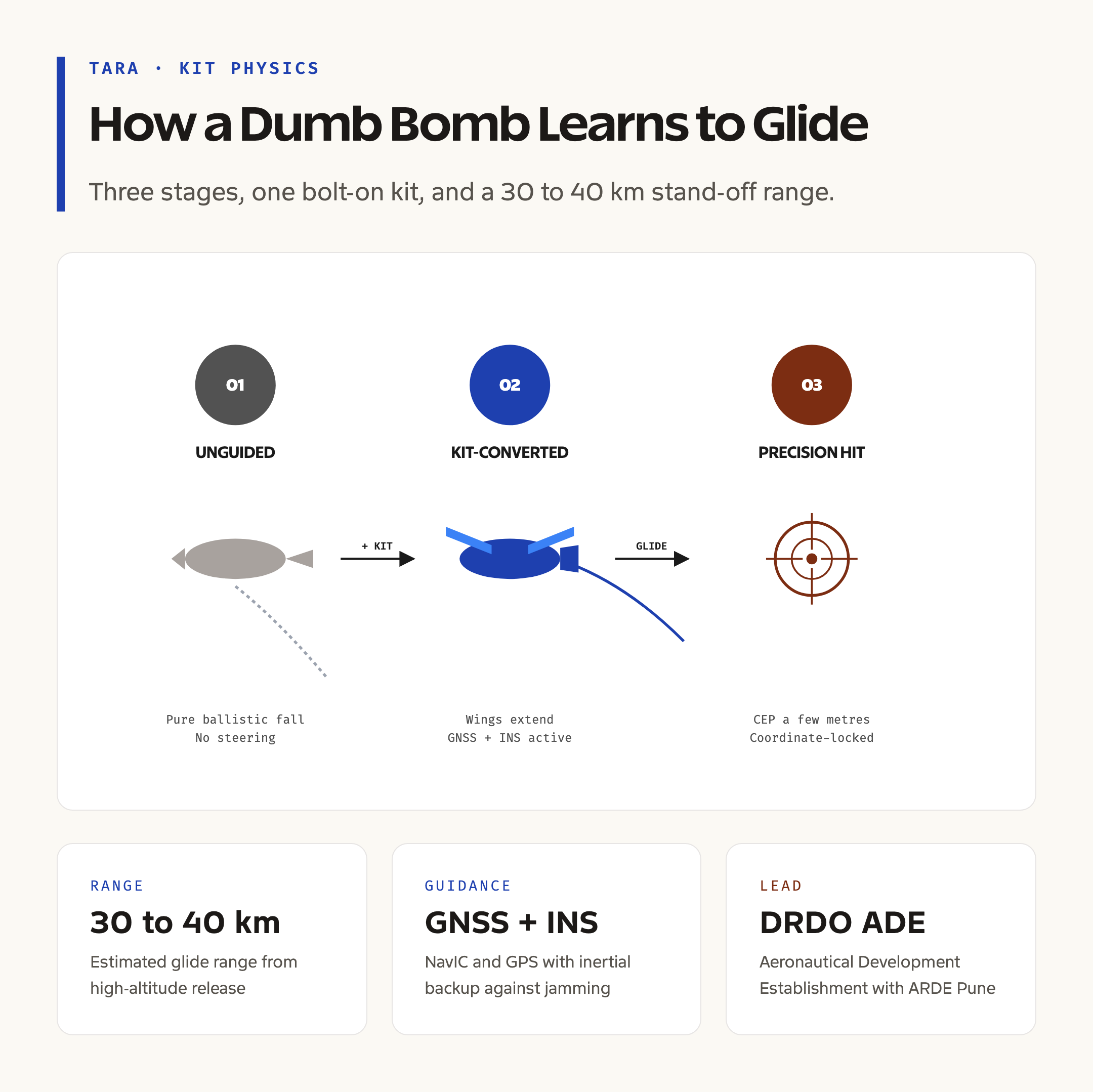
- System name: TARA (DRDO glide weapon kit; full acronym not yet officially expanded)
- Type: Add-on glide kit for unguided general-purpose bombs
- Guidance: GNSS (likely NavIC + GPS) with INS backup
- Compatible payloads: Reported integration with 450 kg and 1000 kg class bombs
- Estimated glide range: 30 to 40 km when released from high altitude
- Lead agency: DRDO Aeronautical Development Establishment (ADE) with Armament Research and Development Establishment (ARDE) support
- First public disclosure: Early May 2026
- Strategic role: Converts legacy inventory into precision stand-off munitions
What Just Happened
DRDO disclosed details of the TARA weapon system in early May 2026, confirming that the indigenous glide kit had progressed through captive-carriage and release trials on a fighter-class platform. The development is significant because it places India in a small group of nations that field a domestically produced glide kit capable of converting unguided bombs into precision-guided munitions. The United States operates the SDB and the JDAM-ER family. Russia operates the UMPK kit. Israel operates the Spice glide kit family. China operates the LS-series. India, until TARA, did not have a serial-production glide kit of its own.
The disclosure coincides with broader Indian Air Force interest in stand-off engagement following lessons from recent regional conflicts where glide bombs proved decisive against fortified positions and air-defense networks. The Russian use of UMPK-equipped FAB bombs during the Ukraine conflict was a particular reference point in Indian planning circles, because it showed how a low-cost glide kit can transform tactical aviation effectiveness at battlefield scale.
Background and Historical Context
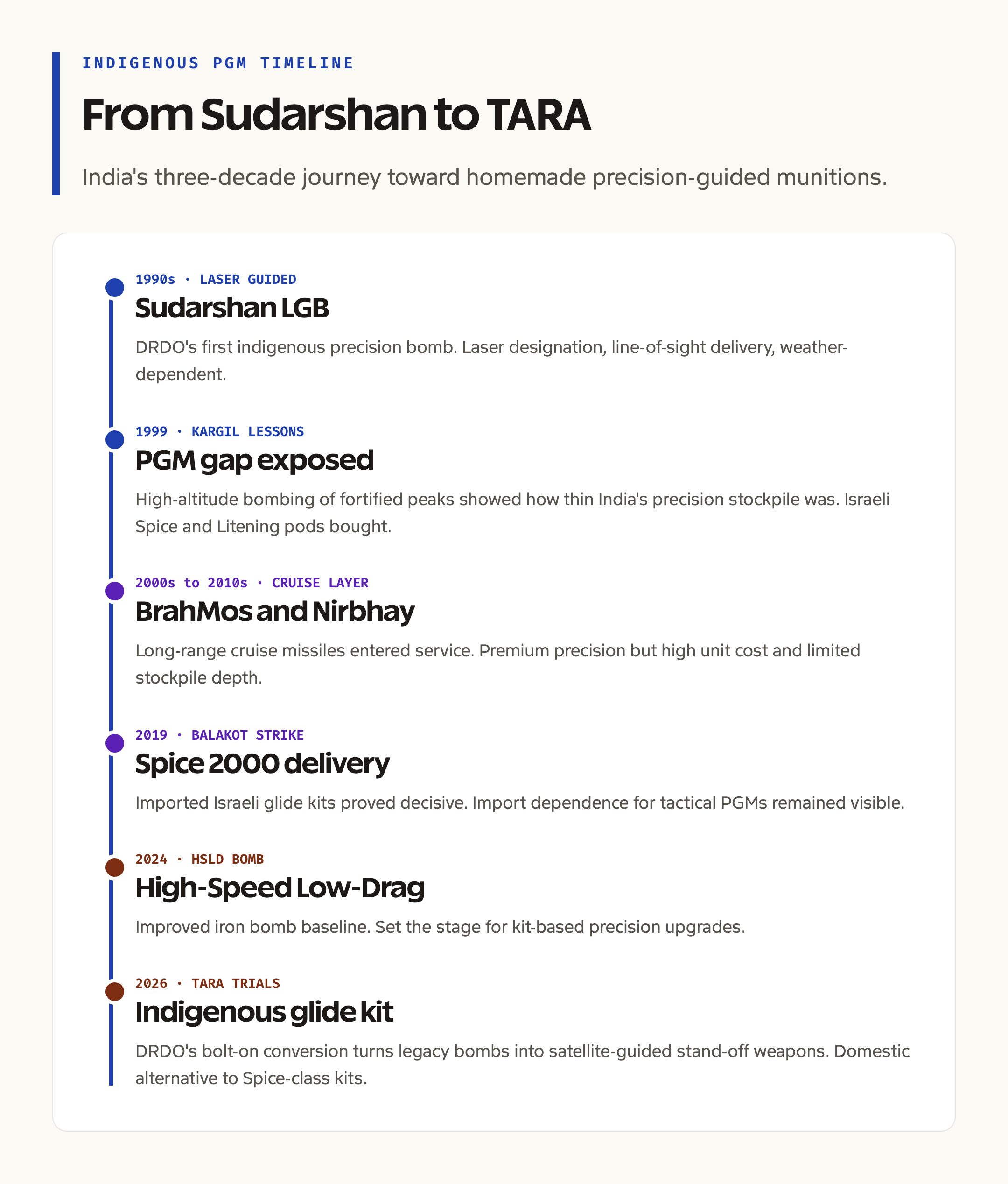
India’s precision-strike journey began seriously in the 1990s. The Sudarshan laser-guided bomb, developed by DRDO with input from the Indian Air Force, was the first serious indigenous PGM. Sudarshan worked, but it had limits. Laser guidance needs a designator, either airborne or ground-based. In dense weather or contested airspace, laser guidance becomes unreliable.
The Kargil conflict in 1999 exposed how thin India’s PGM inventory was. Pilots dropped unguided bombs from high altitude against fortified peaks, and accuracy suffered. India responded by buying Israeli Spice kits and Litening targeting pods, integrating Paveway-series weapons, and later acquiring the Russian KAB family. Each procurement closed a gap but deepened import dependency.
The TARA weapon system represents the third generation of indigenous response. First came laser-guided iron (Sudarshan). Then came stand-off cruise missiles (BrahMos, Nirbhay, Agni-series for strategic roles). TARA fills the middle layer: cheap, mass-producible, satellite-guided glide weapons that turn existing stockpiles into precision tools.
Key Features of the TARA Weapon System
The TARA kit is best understood as a wraparound module that bolts onto an existing bomb body. It adds four core capabilities the unguided bomb lacked:
Foldable wings: Pop-out aerodynamic surfaces that extend after release, generating lift and converting fall trajectory into glide trajectory. This is what extends range from a few kilometers (free-fall) to 30 or 40 km (gliding).
Guidance package: A combined GNSS and inertial navigation unit. GNSS uses NavIC and GPS satellites for absolute position. INS handles signal-denied environments using onboard accelerometers and gyroscopes. The combination resists jamming better than GNSS alone.
Tail control unit: Steerable fins at the rear that adjust pitch and yaw during glide, correcting trajectory toward a pre-programmed coordinate.
Mission computer: A small flight controller that runs the guidance algorithm, accepts target coordinates before release, and commands the fins in flight.
The pilot’s workflow is simple. Load coordinates before takeoff or update them in-flight via the cockpit. Approach to within glide range of the target. Release. The bomb then handles everything autonomously. Nothing about the aircraft’s avionics needs major modification beyond a coordinate-uplink interface.
Why the TARA Weapon System Matters
Precision-guided munitions used to cost roughly ten to twenty times more than unguided equivalents. That math made PGMs precious. Squadrons rationed them, used them only for high-value targets, and reverted to unguided ordnance for area suppression. Glide kits collapse that price gap. A glide kit costs a fraction of a new-build PGM because it reuses the warhead, fuze, and bomb body the air force already owns. India’s stockpile of legacy iron bombs becomes a precision arsenal overnight if TARA is fielded at scale.
The strategic implications run further. Stand-off range means aircraft can release weapons before entering modern integrated air defense bubbles. That matters in any scenario involving advanced surface-to-air systems like the Chinese HQ-9 or HQ-22 deployed across the LAC. The pilot survives, the airframe survives, and the target still gets hit. TARA effectively buys back some of the tactical aircraft survivability that high-end SAMs have eroded.
There’s also an industrial-base argument. Glide kits are mechanically simpler than missiles. They have no rocket motor, no propellant, no warhead beyond what’s already in the bomb. That simplicity means private Indian defense firms can plug into TARA production. The defense indigenization push under recent defence manufacturing initiatives finds a natural fit here.
Detailed Analysis
The technical heart of TARA is the integration between guidance and aerodynamics. A glide bomb has limited control authority. It can’t accelerate, can’t loiter, can’t perform sharp evasive maneuvers. Everything depends on releasing the weapon along the right ballistic vector and then making small corrections during the glide phase to land on coordinates.
Two design choices define how well that works. The first is wing geometry. Higher aspect ratio wings glide further but suffer more in crosswinds. Lower aspect ratio wings are stable but range-limited. TARA’s reported 30 to 40 km glide range suggests a moderate aspect ratio similar to the SDB-II rather than the longer-winged JDAM-ER, which trades range against a heavier wing assembly.
The second is the guidance algorithm. GNSS is precise to a few meters under good conditions but vulnerable to jamming. INS drifts over time but resists jamming. Modern glide kits use a Kalman filter that blends both sources continuously, weighing GNSS more when the signal is clean and INS more when it’s degraded. TARA’s resistance to electronic warfare will determine its real-world effectiveness against adversaries with capable EW assets.
A third consideration, often overlooked, is launch integration. The kit has to clear the host aircraft cleanly during release. Pre-launch alignment between the aircraft’s INS and the bomb’s INS is essential for accuracy. The integration trials reportedly conducted on a fighter-class platform indicate this work is largely done.
Comparative Perspective
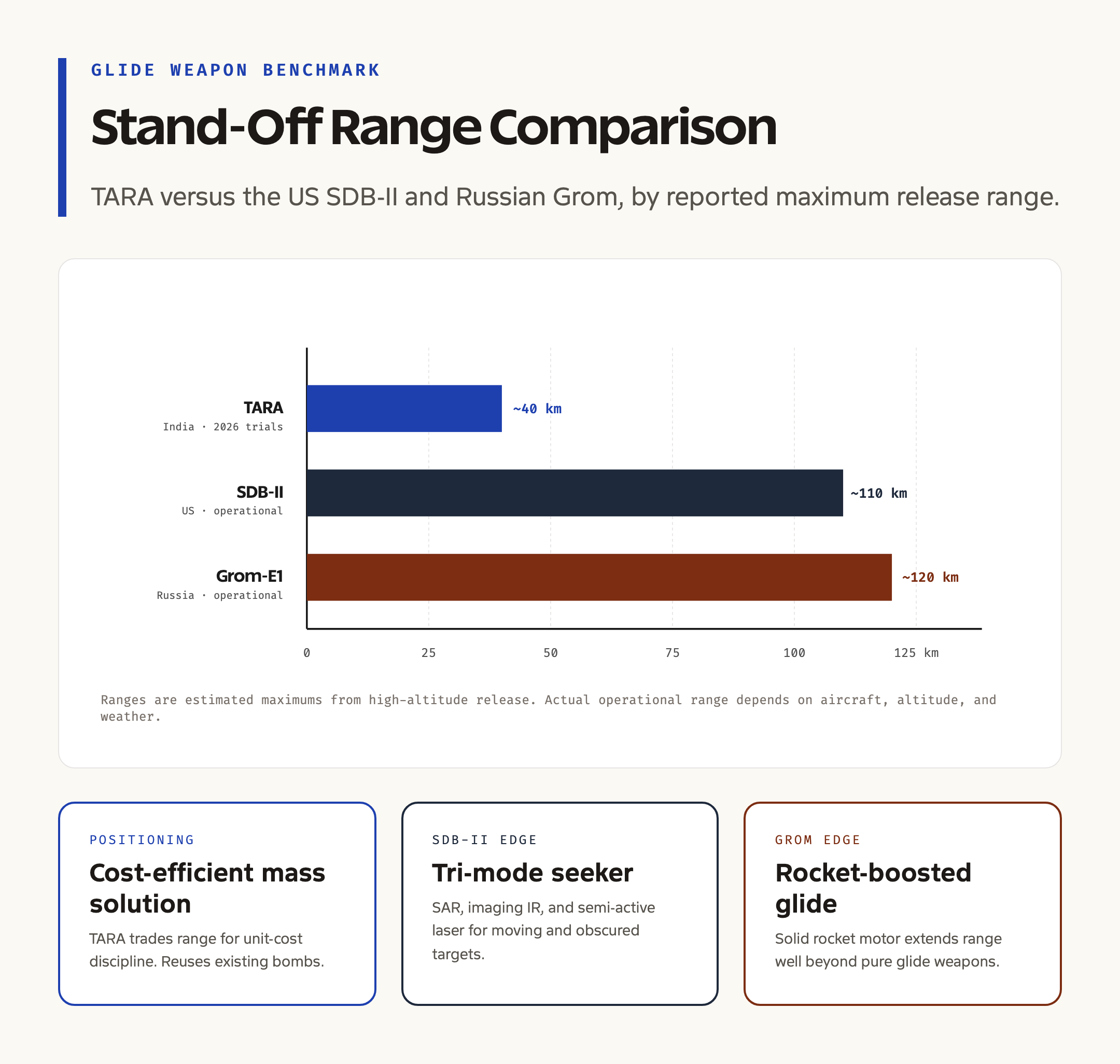
| Parameter | TARA (India) | SDB-II / GBU-53/B (US) | Grom / Grom-E1 (Russia) |
|---|---|---|---|
| Type | Glide kit for legacy bombs | Purpose-built winged bomb | Cruise-glide hybrid |
| Range | 30 to 40 km (estimated) | 70 to 110 km | 50 to 120 km |
| Guidance | GNSS + INS | GPS + INS + tri-mode seeker | GLONASS + INS |
| Warhead | Adapted from existing bomb | 105 kg multi-effect | 250 to 500 kg |
| Approx unit cost | Low (kit only) | High (full munition) | Medium |
| Operational status | Trials in 2026 | Operational | Operational |
The TARA weapon system isn’t trying to match the SDB-II’s tri-mode seeker or its longer range. It’s positioned as a cost-efficient mass solution rather than a premium top-shelf munition. That positioning is correct for India’s threat environment, where the priority is having enough PGMs to sustain a campaign rather than having the world’s most exquisite individual round.
Challenges and Concerns
The TARA program faces real engineering and operational hurdles. GNSS jamming is the obvious one. China and Pakistan both operate jammers capable of denying or spoofing satellite signals over significant areas. TARA’s accuracy in a jammed environment depends entirely on INS quality and how the guidance algorithm handles degraded inputs.
Cost discipline is the second issue. Indian defense programs have a history of cost overruns and schedule slippage. The discipline DRDO maintains during productionization will determine whether TARA actually arrives at squadrons in numbers that matter.
Integration breadth is the third. A glide kit’s value scales with the number of platforms cleared to drop it. Su-30 MKI, Mirage 2000, Jaguar, MiG-29 UPG, Tejas Mk1A and Mk2, and the future AMCA all carry different weapon stations and stores management systems. Each integration costs money and time.
Prelims Pointers
- TARA is an indigenous glide weapon kit developed by DRDO
- It converts unguided general-purpose bombs into precision-guided munitions
- Guidance uses GNSS (NavIC + GPS) combined with inertial navigation
- Estimated glide range is 30 to 40 km from high-altitude release
- Comparable foreign systems include the US SDB-II and Russian Grom
- DRDO lead labs are ADE Bengaluru and ARDE Pune
- Public disclosure of the program came in early May 2026
- TARA contributes to defence indigenization under Atmanirbhar Bharat
Mains-Style Questions
- GS-III (Internal Security): Examine the strategic significance of indigenous glide weapon systems like TARA in modernising India’s stand-off strike capability. (250 words)
- GS-III (Science and Technology): Discuss how guidance kits that convert unguided ordnance into precision-guided munitions alter the economics of air-delivered firepower. Illustrate with the case of the TARA weapon system. (250 words)
- GS-III (Defence): Indigenous defence manufacturing has progressed unevenly across sectors. Analyse the role of DRDO-led programs like TARA in closing critical capability gaps. (150 words)
- GS-II (International Relations): Stand-off precision munitions affect regional escalation dynamics. Critically evaluate this proposition in the context of South Asian deterrence stability. (150 words)
Way Forward
The TARA weapon system is a useful step, but it has to translate from successful trials into operational squadrons quickly. Three priorities matter. First, accelerate productionisation by bringing private partners into the supply chain for sub-assemblies like fins, mission computers, and GNSS modules. Second, fund a credible upgrade path that adds a terminal seeker, either imaging infrared or millimeter-wave radar, for moving targets and jamming-heavy environments. Third, integrate TARA across the full fast-jet fleet, including the Tejas family, rather than restricting it to a single platform.
A glide kit doesn’t deliver decisive effects by itself. It scales the lethality of an existing aircraft and an existing bomb stockpile. That scaling effect, if pursued seriously, is the kind of leverage that changes operational planning more than any single shiny missile program.
Frequently Asked Questions
What exactly is the TARA weapon system?
TARA is an indigenous glide kit developed by DRDO that bolts onto unguided general-purpose bombs and converts them into precision-guided munitions. It adds wings, a guidance unit, control fins, and a mission computer to a standard iron bomb, giving it the ability to glide 30 to 40 km after release and steer toward GPS coordinates.
How does the TARA glide kit work in flight?
After release, foldable wings extend, the bomb starts gliding instead of falling vertically, and the onboard mission computer reads GNSS and inertial sensors to figure out where it is. The computer then commands tail fins to steer the bomb toward pre-programmed coordinates, achieving impact within a few meters of the target.
Which Indian Air Force aircraft will carry TARA?
DRDO has not officially confirmed the full integration list. Captive-carry and release trials have been conducted on a fighter-class platform. Eventual integration is expected across Su-30 MKI, Jaguar, Tejas variants, and potentially Mirage 2000 in the long term.
How does TARA compare with the US SDB-II and Russian Grom?
TARA has a shorter glide range (30 to 40 km versus 70 to 110 km for SDB-II) and a simpler guidance package without a terminal seeker. It’s positioned as a cost-efficient mass solution rather than a premium precision strike weapon. The Russian Grom is closer in spirit but uses a rocket-boosted glide profile for longer range.
Why does India need a glide kit when it already has BrahMos and other missiles?
BrahMos and cruise missiles are expensive and limited in stock. Glide kits cost a fraction of new-build PGMs because they reuse existing warheads and bomb bodies. They turn a country’s legacy bomb stockpile into a precision arsenal, which is exactly the mass-affordable layer India’s missile inventory currently lacks.
Is the TARA system jam-resistant?
TARA uses both GNSS (NavIC plus GPS) and inertial navigation. The INS provides backup when satellite signals are denied or spoofed, but accuracy degrades over the flight time. Future upgrades involving a terminal seeker would further improve resistance to electronic warfare.
What is the strategic significance of TARA for the Indian Air Force?
TARA gives the IAF stand-off precision strike capability at scale. Pilots can release the weapon from outside dense air-defense bubbles, the bomb glides to the target, and the aircraft survives to fly another mission. Combined with existing legacy bomb inventory, TARA multiplies the IAF’s precision-strike depth without proportional cost.
When will the TARA weapon system enter operational service?
DRDO has not announced an induction date. Following successful trials in early 2026, productionisation and final user trials with the Indian Air Force are the next steps. Realistic operational fielding likely begins in the second half of the decade.
Tell Google you want more of this.
Add Anantam IAS as a preferred sourceOne tap, and this site shows up more often in your own Top Stories, AI Overviews and AI Mode. Remove it any time.