
Why in News?
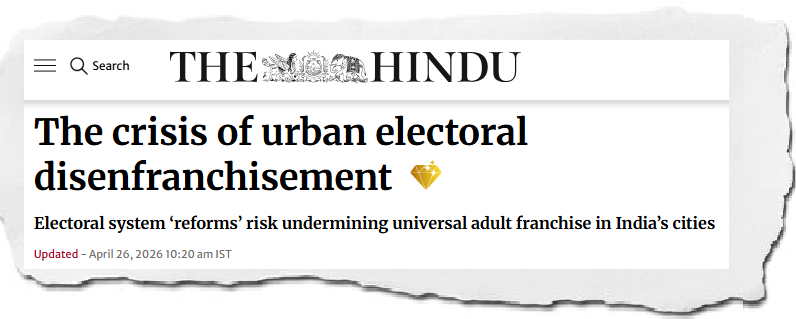
India’s constitutional vision of universal adult franchise (Articles 325 & 326) aims to ensure equal political participation. However, recent debates around electoral roll revisions, especially in urban areas, highlight concerns of systematic exclusion, particularly among vulnerable groups such as migrants, informal workers, and slum dwellers.
UPSC Relevance
GS-I: Urbanisation, Social Issues
GS-II: Polity, Representation of People, Electoral Reforms, Governance
Nature of the Problem
1. Structural Exclusion in Urban Areas
Urbanisation in India is characterised by high mobility, informality, and insecure housing. These features clash with electoral registration systems that depend on:
- Stable residence proof
- Documentary evidence
- Periodic verification
As a result, large sections of the urban poor struggle to either get registered or retain their names on electoral rolls.
2. Impact of Special Intensive Revision (SIR)
The Special Intensive Revision process, intended to clean electoral rolls, has led to:
- Large-scale deletions of voters in cities
- Disproportionate impact on:
- Migrant workers
- Slum residents
- Informal sector labour
For instance, high deletion rates in cities like Patna, Ghaziabad, Lucknow, and Mumbai indicate that mobility and informality are being penalised within the electoral system.
3. Dual Burden on the Urban Poor
Urban marginalised groups face a two-fold challenge:
- Difficulty in initial voter registration due to lack of documents
- Risk of deletion during verification drives
This creates a cycle of chronic disenfranchisement, weakening their political voice.
4. Documentation and Residency Issues
Urban India is defined by:
- Seasonal migration
- Informal housing (slums, rented rooms, pavement dwellings)
Requiring:
- Long-term address proof
- Historical documentation (e.g., past voter records)
becomes unrealistic, effectively excluding those who are most dependent on public policy decisions.
5. Secrecy of Voting and Booth-level Data Concerns
While India follows secret ballot principles, concerns arise due to:
- Booth-level voting data disclosure
- Small booth sizes in urban pockets
This may allow inference of voting patterns of specific communities, potentially affecting:
- Voter autonomy
- Electoral integrity
Broader Democratic Implications
1. Weakening of Representative Democracy
When large sections are excluded:
- Electoral outcomes may not reflect true demographic realities
- Policy priorities may shift away from urban poor and informal workers
2. Reinforcement of Inequality
Disenfranchisement compounds existing socio-economic inequalities:
- Those already marginalised lose political bargaining power
- Leads to policy invisibility of vulnerable groups
3. Tension with Constitutional Principles
The situation raises concerns regarding:
- Article 14 (Equality before law)
- Article 19 (Freedom of expression – indirectly through political participation)
- Article 326 (Universal adult suffrage)
What are the Key Underlying Causes?
Administrative Rigidities
Electoral systems are designed for stable populations, whereas urban India is fluid and dynamic.
Migration and Informality
Internal migration (economic, seasonal) leads to frequent change in residence, making voter registration unstable.
Lack of Inclusive Mechanisms
Limited use of:
- Digital portability of voter registration
- Simplified documentation norms
Way Forward
1. Flexible Voter Registration Mechanisms
Electoral systems must adapt to urban realities by:
- Allowing self-declaration models with verification
- Accepting alternative proofs of residence (ration cards, employer certificates, etc.)
This ensures inclusion without compromising integrity.
2. Portability of Voting Rights
Introduce systems enabling:
- Easy transfer of voter registration across cities
- Exploration of remote voting mechanisms for migrants
This aligns voting rights with labour mobility.
3. Strengthening Institutional Safeguards
- Ensure transparency in voter deletions
- Provide advance notice and appeal mechanisms
- Strengthen oversight by the Election Commission of India (ECI)
4. Use of Technology with Safeguards
- Digital electoral rolls with real-time updating
- Data integration with Aadhaar (with privacy safeguards)
- AI-based duplication checks without arbitrary deletions
5. Inclusive Urban Governance Approach
Urban policy must integrate electoral inclusion with:
- Housing policies
- Labour registration systems
- Social welfare databases
This ensures that governance and democracy reinforce each other.
6. Protecting Secrecy of Voting
- Reassess booth-level data disclosures
- Increase booth size or anonymisation measures
- Strengthen voter confidence in electoral privacy
Conclusion
Urban electoral disenfranchisement reflects a deeper mismatch between India’s democratic ideals and its urban realities. Ensuring inclusive electoral participation is not merely an administrative task but a constitutional obligation. As urbanisation accelerates, the credibility of Indian democracy will increasingly depend on how effectively it includes its most mobile and vulnerable citizens.
Practice Questions
Prelims
- With reference to electoral rolls in India, consider the following statements:
- The Election Commission of India is responsible for preparation and revision of electoral rolls.
- Proof of permanent residence is mandatory for inclusion in electoral rolls.
- Article 326 of the Constitution provides for universal adult suffrage.
Which of the statements given above is/are correct?
(a) 1 and 3 only
(b) 2 and 3 only
(c) 1 only
(d) 1, 2 and 3
Answer: (a)
Mains
Discuss the causes and consequences of urban electoral disenfranchisement in India. Suggest measures to ensure inclusive political participation.
“Urbanisation in India has created new challenges for electoral inclusion.” Examine in the context of recent electoral roll revisions.
Tell Google you want more of this.
Add Anantam IAS as a preferred sourceOne tap, and this site shows up more often in your own Top Stories, AI Overviews and AI Mode. Remove it any time.