Why in News?
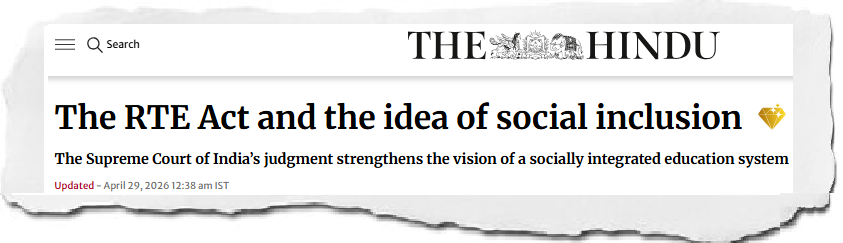
In January 2026, the Supreme Court reaffirmed the constitutional importance of Section 12(1)(c) of the Right of Children to Free and Compulsory Education (RTE) Act, 2009. The Court highlighted that the provision enables children from economically weaker and socially disadvantaged backgrounds to study alongside children from privileged families in the same classroom.
- The judgment renewed national debate on equality in education, social inclusion, the role of private schools in fulfilling constitutional obligations, and the broader objective of reducing social segregation through schooling.
UPSC Relevance
GS-II: Education, Welfare Schemes, Vulnerable Sections, Social Justice, Constitutional Provisions, Fundamental Rights
What is the RTE Act?
The Right of Children to Free and Compulsory Education Act, 2009 operationalises Article 21A of the Constitution, which guarantees free and compulsory education to children between 6 and 14 years of age.
The Act came into force on April 1, 2010.
Key Features of the RTE Act
- Free and compulsory elementary education for children aged 6–14 years.
- Neighbourhood school concept.
- Norms for pupil-teacher ratio and school infrastructure.
- Ban on physical punishment and mental harassment.
- Prohibition of screening tests and capitation fees.
- Continuous and Comprehensive Evaluation (CCE).
- Reservation of 25% seats in private unaided schools for children from disadvantaged groups and economically weaker sections under Section 12(1)(c).
Understanding Section 12(1)(c)
Section 12(1)(c) mandates private unaided non-minority schools to reserve at least 25% of entry-level seats for:
- Economically Weaker Sections (EWS)
- Socially disadvantaged groups such as Scheduled Castes, Scheduled Tribes, and other vulnerable categories
The State reimburses schools for these admissions to a prescribed extent.
Constitutional Objective
The provision is not merely an educational policy measure. It represents a constitutional strategy aimed at:
- Promoting equality of status.
- Reducing social segregation.
- Creating shared public spaces across class and caste divisions.
- Advancing substantive equality under the Constitution.
The Supreme Court emphasised that the provision helps create integrated classrooms where children from vastly different socio-economic backgrounds learn together.
Constitutional Basis of the Provision
Article 21A
Provides the fundamental right to free and compulsory education for children aged 6–14 years.
Article 14
Guarantees equality before law and equal protection of laws.
Article 15(4) and 15(5)
Enable special provisions for socially and educationally backward classes, including reservations in educational institutions.
Directive Principles of State Policy
Articles 38 and 46 direct the State to reduce inequalities and promote educational interests of weaker sections.
Social Inclusion Through Education
Breaking Social Barriers
India’s education system has historically reflected inequalities based on:
- Class
- Caste
- Religion
- Geography
- Language
Section 12(1)(c) seeks to reduce these divisions by ensuring children study in shared institutional spaces.
Building Social Cohesion
Mixed classrooms can:
- Reduce prejudice and discrimination.
- Encourage empathy and social interaction.
- Promote democratic values and constitutional morality.
Research cited in the article suggests that socially integrated classrooms improve pro-social behaviour without negatively affecting academic performance.
Expanding Social Capital
Children from disadvantaged families gain exposure to:
- Better institutional culture.
- Peer learning networks.
- Higher aspirations.
- Improved confidence and communication skills.
This helps break intergenerational cycles of poverty and exclusion.
Common Criticisms and Counterarguments
Criticism: It Encourages Privatisation of Education
Some argue that the provision weakens government schools and indirectly promotes private education.
Counterargument
The movement towards private schooling began much before the RTE Act due to concerns regarding:
- Infrastructure quality
- Teacher absenteeism
- Learning outcomes
The provision does not reduce the State’s responsibility towards public education.
Instead, it recognises the reality that private schools are now major actors in India’s schooling ecosystem and should contribute to constitutional goals.
Challenges in Implementation
Resistance from Private Schools
Some schools continue to:
- Discourage admissions.
- Impose hidden costs.
- Segregate students informally within campuses.
Hidden Financial Burdens
Even when tuition is reimbursed, families often struggle with:
- Uniform costs
- Transport expenses
- Books and stationery
- Extracurricular charges
Uneven State-Level Implementation
Implementation quality differs across States due to:
- Weak monitoring mechanisms
- Delayed reimbursements
- Lack of awareness among beneficiaries
- Poor grievance redressal systems
Social Stigma and Discrimination
Children admitted under the quota may sometimes face:
- Social exclusion
- Labelling
- Psychological discrimination
This undermines the objective of genuine inclusion.
Positive Developments
Digital Admission Systems
States such as Rajasthan, Gujarat, and Delhi have introduced online admission systems to:
- Improve transparency.
- Reduce discretion.
- Streamline reimbursements.
- Increase accountability.
Improved Monitoring
Use of Management Information Systems (MIS) has strengthened:
- Tracking of admissions
- Verification processes
- Financial reimbursements
High Retention Rates
The article notes retention rates above 90%, indicating that students are continuing their education successfully.
Broader Significance for Indian Democracy
Education is not only about literacy or employment; it is also about citizenship formation.
Integrated educational spaces help:
- Strengthen constitutional values.
- Promote fraternity.
- Reduce social alienation.
- Deepen democratic culture.
The provision reflects the constitutional vision that equality must be experienced in everyday life rather than remain merely a legal principle.
Way Forward
Strengthening Government Schools
The State must continue investing in:
- Teacher quality
- School infrastructure
- Digital learning
- Foundational literacy and numeracy
Public education remains central to educational equity.
Ensuring Genuine Inclusion
Governments should strictly monitor schools to prevent:
- Informal discrimination
- Segregation within classrooms
- Hidden fee collection
Inclusion must extend beyond admission.
Timely Reimbursements
Delayed reimbursements discourage school participation. Efficient financial mechanisms are necessary for smoother implementation.
Awareness and Outreach
Many eligible families remain unaware of their rights under Section 12(1)(c). Local campaigns and community engagement are essential.
Strengthening Grievance Redressal
Accessible complaint mechanisms should be established to address:
- Admission denials
- Discrimination
- Financial exploitation
Promoting Constitutional Values
Schools should actively promote:
- Diversity
- Inclusion
- Equality
- Respect for dignity
Education should become a tool for social transformation rather than reproduction of inequalities.
Prelims Practice Questions
1. With reference to the Right to Education (RTE) Act, 2009, consider the following statements:
- Article 21A provides the constitutional basis for the RTE Act.
- Section 12(1)(c) mandates reservation of seats in all private schools, including minority institutions.
- The RTE Act guarantees free and compulsory education to children between 6 and 14 years of age.
Which of the statements given above are correct?
(a) 1 and 2 only
(b) 1 and 3 only
(c) 2 and 3 only
(d) 1, 2 and 3
Answer: (b)
2. Which of the following Articles enable the State to make special provisions for socially and educationally backward classes in educational institutions?
- Article 15(4)
- Article 15(5)
- Article 21A
Select the correct answer using the code below:
(a) 1 and 2 only
(b) 2 and 3 only
(c) 1 and 3 only
(d) 1, 2 and 3
Answer: (a)
3. The primary objective of Section 12(1)(c) of the RTE Act is to:
(a) Privatise school education in India
(b) Promote merit-based admissions in private schools
(c) Advance social inclusion and equality through integrated classrooms
(d) Increase revenue generation for private schools
Answer: (c)
Mains Practice Questions
How can integrated educational spaces contribute to strengthening constitutional morality and democratic citizenship in India?
“Education is not merely a welfare measure but a constitutional instrument for achieving social justice.” Discuss in the context of the Right to Education Act.
Critically examine the role of Section 12(1)(c) of the RTE Act in promoting social inclusion in India.
Discuss the challenges in implementing inclusive education policies in India. Suggest measures to strengthen equitable access to quality education.
Tell Google you want more of this.
Add Anantam IAS as a preferred sourceOne tap, and this site shows up more often in your own Top Stories, AI Overviews and AI Mode. Remove it any time.