Why in news?
Several Indian banks, particularly public sector lenders, are actively planning or in the process of raising funds through Tier II bonds, with the banking system expected to mobilize up to ₹25,000 crore via these instruments in the current financial year driven by favorable market conditions and the need to strengthen capital adequacy.
UPSC Relevance
Knowledge of Banking Sector is often tested in Prelims
What are Tier II Bonds?
- Tier II bonds are subordinated debt instruments issued for a minimum of 5 years that form part of a bank’s supplementary capital.
- Subordinated debt instruments are loans or bonds that rank lower than senior debt in terms of repayment priority, meaning they are paid back only after senior debt holders are fully compensated in the event of a company’s liquidation.
- Shareholders are paid last, if any funds are left after all debts are settled.
- Hence they are considered riskier than senior debt and they offer higher interest rates (coupon rates) to compensate investors for this risk.
- They are an attractive option for banks as they allow them to raise capital without diluting existing equity and also allow banks to add some extra buffers to their CRARs (capital to risk-weighted assets ratio),
What is Bank Capital?
- A bank must keep some amount of its own money aside to absorb losses and protect depositors. Bank capital is divided into:
- Tier I Capital (Core Capital)
- Tier II Capital (Supplementary Capital)
- It includes Tier II bonds (subordinated debt), Revaluation reserves, General provisions, Hybrid debt instruments.
- Both together form the CRAR (Capital to Risk-Weighted Assets Ratio) under Basel III norms.
- The terms “capital adequacy ratio” (CAR) and “capital to risk-weighted assets ratio” (CRAR) are interchangeable; they are both measures of a bank’s financial strength.
- CRAR – This ratio compares a bank’s capital to its risk-weighted assets to gauge its ability to absorb losses and protect depositors. It is calculated by dividing a bank’s capital (Tier 1 plus Tier 2 capital) by its risk-weighted assets, and the result is expressed as a percentage. Calculation: The formula is:
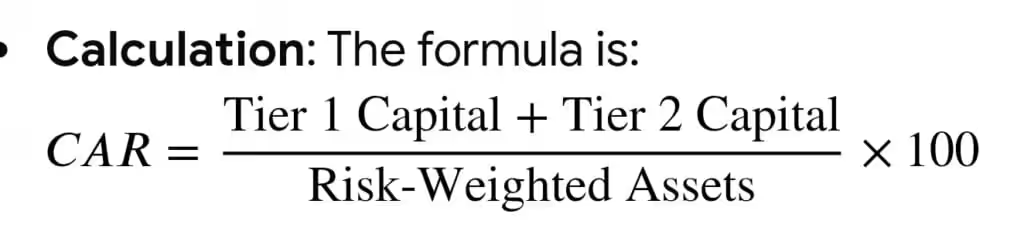
- The ratio ensures a bank has enough capital to cover potential losses from its assets and other risks, such as credit, market, and operational risks. A higher ratio indicates a more financially stable bank that is better able to protect depositors’ funds.
- Risk-Weighted Assets (RWA): These are the bank’s total assets, but each asset is assigned a risk weight based on its riskiness (e.g., a government bond is less risky than a corporate loan). This determines the minimum capital a bank must hold.
Why Are Banks Issuing Tier II Bonds?
- To Maintain Capital Adequacy (Basel III Norm)
- Banks must maintain CRAR (Capital to Risk-Weighted Assets Ratio).
- Tier II bonds form part of supplementary capital -> strengthens CRAR.
This helps banks absorb future credit losses.
- Market Conditions: Softening bond yields (Interest rates (yields) on bonds in the market are falling) as RBI may cut interest rates in December and stable market conditions, make it a strategic time to lock in long-term funds at lower costs.
- Market bond yields ↓ Investors accept lower returns ➡️ Banks can issue bonds at lower coupon rates (interest rates) ➡️ So banks get money more cheaply ➡️ Borrowing becomes cheaper for banks.
- Long-term Investor Demand: There is strong demand for high-quality, long-duration papers, particularly from Provident and pension funds are expected to accelerate investments over the next couple of months to meet their regulatory investment quotas in corporate bonds. Long-term investors are now looking to deploy funds before the December monetary policy amid expectations of a 25-basis-point repo rate cut by the Reserve Bank of India, which is fueling demand for quality long-term instruments.
- Refinancing: Banks are using this opportunity to refinance older, higher-cost debts with new cheaper bonds.
Practice Questions:
With reference to the recent rise in Tier II bond issuances by Indian banks, consider the following statements:
- Softening long-term bond yields makes Tier II bonds more attractive for banks to issue.
- Tier II bonds help banks strengthen their CRAR under Basel III norms.
- Tier II bonds are used by banks mainly to refinance older long-term borrowings.
- Tier II bonds can be issued for a minimum maturity of three years.
How many of the above statements are correct?
(a) Only one
(b) Only two
(c) Only three
(d) All four
Correct Answer: (c) Only three
Consider the following statements regarding Tier II bonds issued by banks in India:
- Tier II bonds are typically purchased by long-term institutional investors such as provident funds and pension funds.
- Expectations of a repo rate cut by the RBI can increase demand for Tier II bonds in the market.
- Tier II bonds allow banks to raise capital without issuing additional equity shares.
- Tier II bonds are repaid before senior secured creditors during a liquidation process.
Which of the statements given above are correct?
(a) 1 and 2 only
(b) 1, 2 and 3 only
(c) 2, 3 and 4 only
(d) 1, 3 and 4 only
Correct Answer: (b) 1, 2 and 3 only
Tell Google you want more of this.
Add Anantam IAS as a preferred sourceOne tap, and this site shows up more often in your own Top Stories, AI Overviews and AI Mode. Remove it any time.