Why in News?
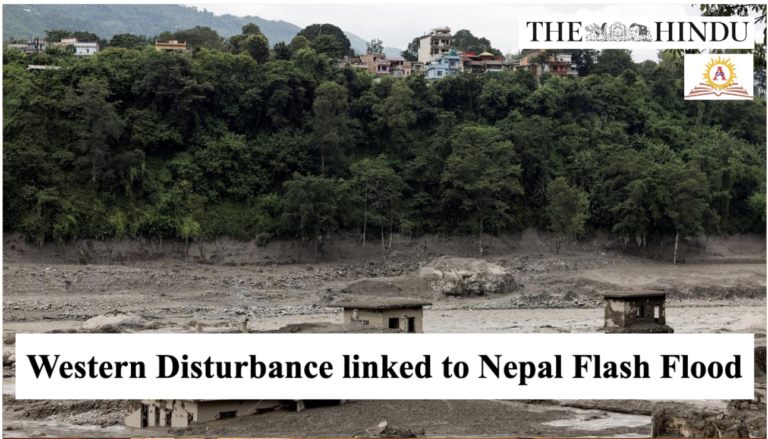
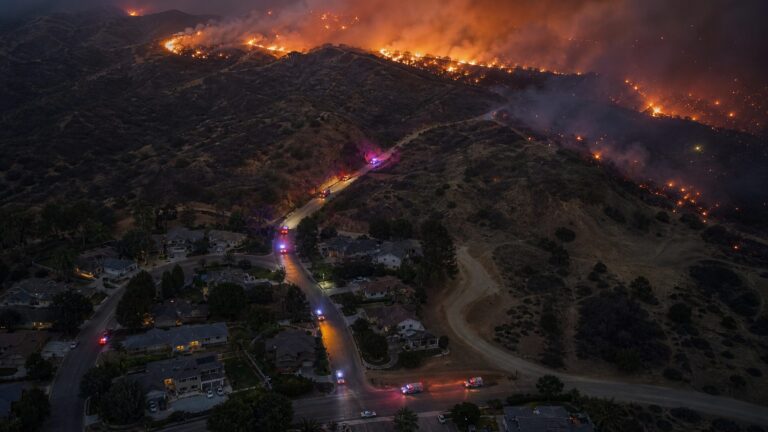
The recent devastating floods in Nepal have renewed attention on hanging glaciers and cascading Himalayan hazards. Scientists warn that rising temperatures, permafrost thaw and changing precipitation are destabilising steep ice-covered slopes.
A 2026 study identified 219 hanging glaciers in Uttarakhand’s Alaknanda basin, with simulations showing that their collapse could generate avalanche flows exceeding 50 metres in the Badrinath-Mana sector, threatening settlements and critical infrastructure.
| UPSC Relevance: GS-1 Geography: Physical Geography; GS-3: Climate Change and Disaster Management Prelims: Hanging glaciers, GLOF Mains: India’s vulnerability to climate events; Transboundary disaster management |
What are Hanging Glaciers?
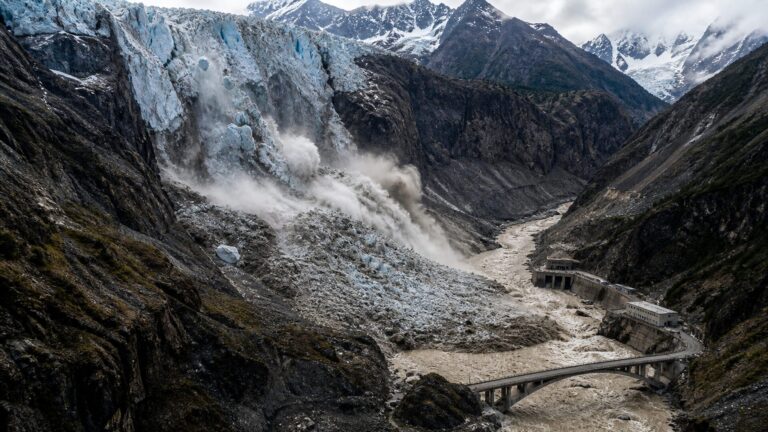
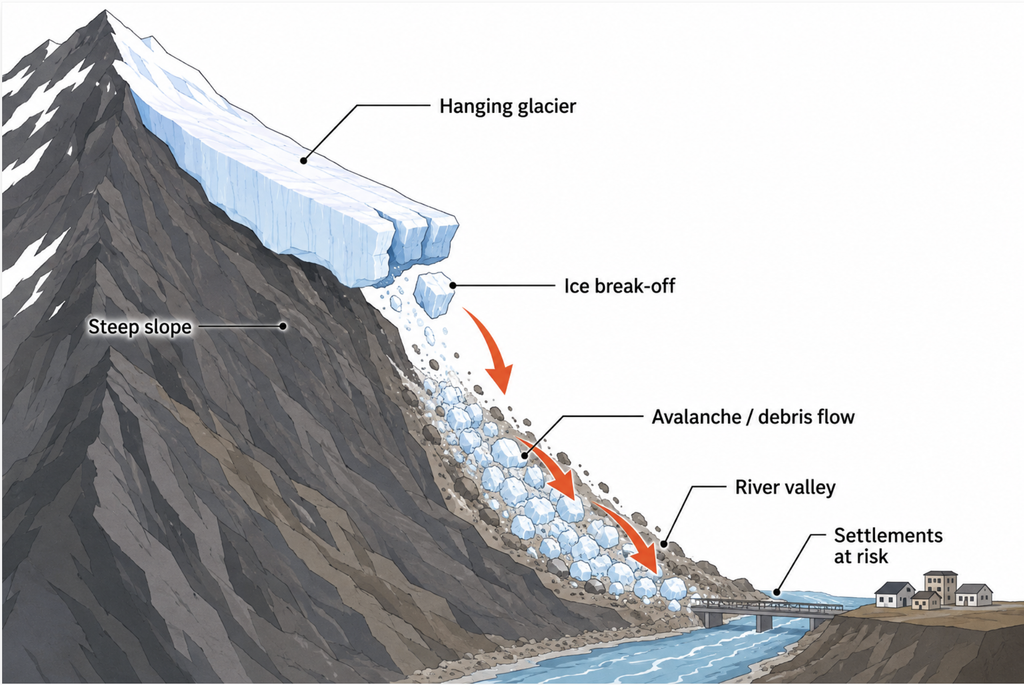
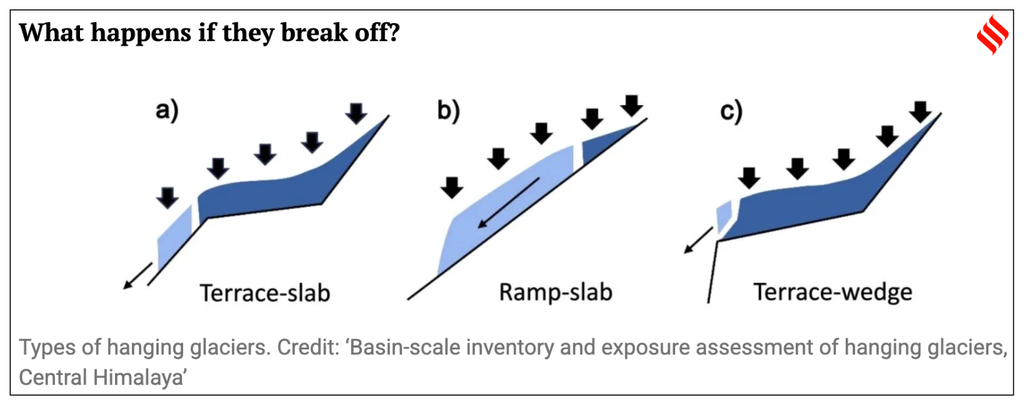
- Hanging glaciers are masses of ice situated on steep mountain slopes, cliffs or elevated tributary valleys, often above a larger glacier, river valley or settlement.
- Unlike relatively stable valley glaciers, they are vulnerable to sudden break-off under gravity due to their steep gradient and partly unsupported position.
- As a trunk glacier retreats, its tributary glacier may become detached and remain “hanging” above the deepened main valley.
Why are they becoming unstable?
A combination of influences their stability:
- Rising temperatures and accelerated ice loss
- Thawing permafrost, which weakens the frozen ground anchoring ice and rocks
- Meltwater entering crevasses and lubricating the glacier bed
- Extreme or erratic precipitation and heavy snowfall
- Steep, fractured Himalayan geology; and
- Earthquakes, rockfalls and changes in glacier geometry.
Climate change is thus an important destabilising factor, but individual collapses may involve several interacting triggers.
What happens when they break off?
A hanging-glacier failure can release enormous quantities of ice and rock within seconds. The falling mass may:
- Produce a high-speed ice-rock avalanche
- Entrap water, boulders and sediments
- Transform into a destructive debris flow
- Temporarily block a river, creating an unstable lake
- Breach the blockage and generate a flash flood; or
- Fall into a glacial lake and trigger a Glacial Lake Outburst Flood (GLOF).
Thus, it is a cascading hazard, rather than merely an avalanche. The 2021 Chamoli disaster, in which a rock-ice avalanche entered the Rishiganga valley and killed over 200 people, illustrates this process. It was initially misidentified as a GLOF.
Alaknanda Basin: Key Findings
A 2026 basin-scale study identified:
- 219 hanging glaciers in the Alaknanda basin
- Total area of approximately 71.7 sq km
- Total ice volume of 2.39 cubic km
- Around 0.74 cubic km classified as hanging ice
- Nearly 30% of hanging-ice volume concentrated in the Upper Alaknanda basin.
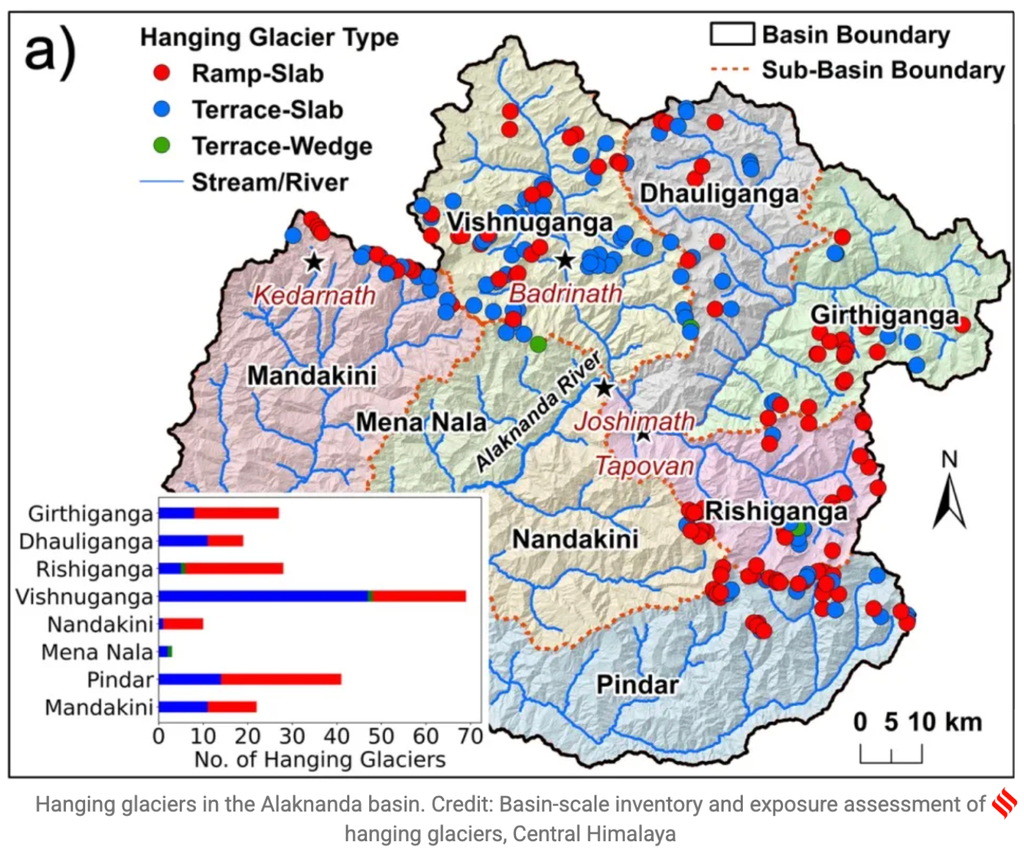
Worst-case simulations for selected glaciers indicated avalanche-flow heights exceeding 50 metres in the Badrinath-Mana sector, potentially affecting settlements, highways, pilgrimage routes and other infrastructure. These simulations indicate potential exposure, not that a collapse is certain.
Why is India particularly vulnerable?
- High exposure: Settlements, hydropower projects, roads and pilgrimage centres occupy narrow river valleys.
- Rapid infrastructure expansion: Construction is increasingly entering potential avalanche-runout zones.
- Cascading impacts: Avalanches can damage dams, block rivers and generate floods far downstream.
- Difficult monitoring: Many unstable slopes lie in remote, inaccessible areas.
- Short warning time: Once collapse begins, flood-like flows may travel rapidly through steep valleys.
- Transboundary character: Hazards originating in Nepal, Bhutan, Tibet or India can affect downstream countries.
- Ecological fragility: Debris flows damage forests, river habitats, farmland and geomorphological stability.
Way Forward:
- Prepare a comprehensive inventory of hanging glaciers across the Indian Himalayas.
- Combine satellite monitoring with drones, ground sensors, seismic instruments and automatic weather stations.
- Identify precursors such as accelerating ice movement, widening crevasses, slope deformation and temperature changes.
- Establish basin-level, multi-hazard early-warning systems.
- Integrate cryospheric risks into environmental impact assessments of dams, roads and tourism projects.
- Restrict construction in avalanche-runout and river-blockage zones.
- Develop last-mile alerts, evacuation routes and community-based disaster drills.
- Strengthen data-sharing among Himalayan countries.
- Reduce long-term risk through climate mitigation and ecosystem-sensitive development.
Hanging glaciers exemplify how climate change converts gradual cryospheric change into sudden, high-impact disasters. India must move from responding to “unexpected” Himalayan calamities towards anticipatory monitoring, risk-sensitive development and cascading-hazard preparedness.
Tell Google you want more of this.
Add Anantam IAS as a preferred sourceOne tap, and this site shows up more often in your own Top Stories, AI Overviews and AI Mode. Remove it any time.