
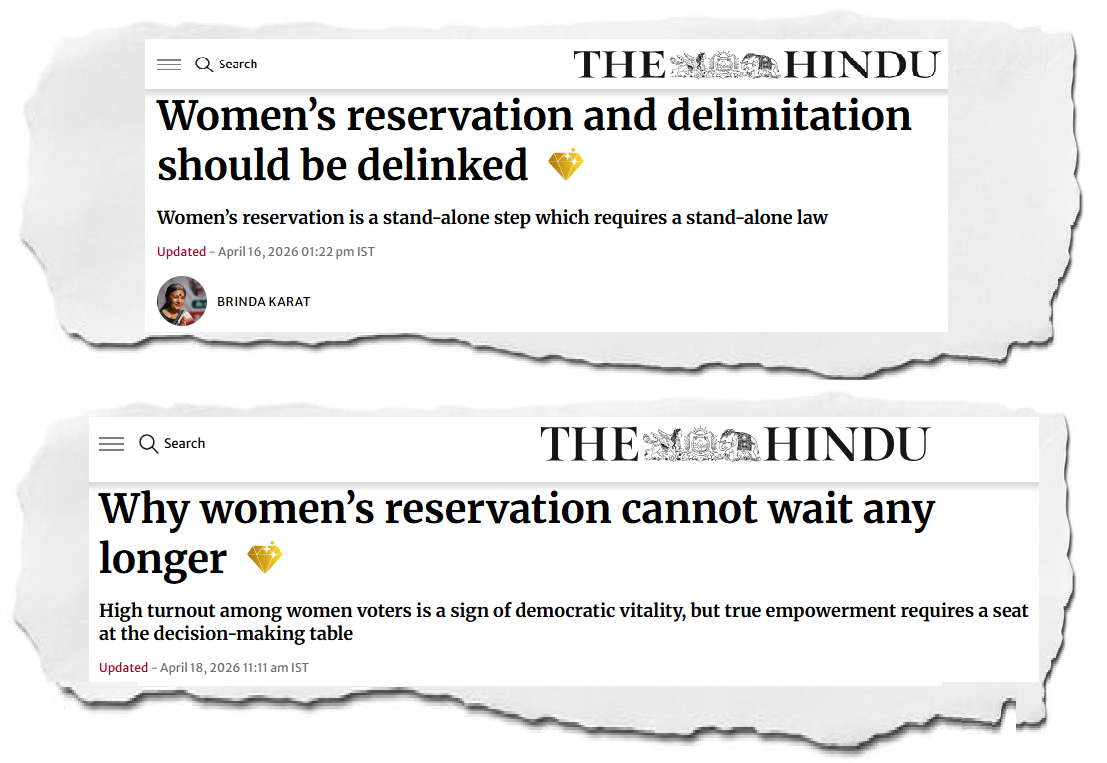
Why in News?
The Constitution (131st Amendment) Bill, 2026 and the Delimitation Bill, 2026 sought to operationalise one-third reservation for women in legislatures, but linked its implementation with delimitation and Census, raising concerns about delays and structural implications.
UPSC Relevance
GS-II: Parliament, Representation, Women’s Reservation, Delimitation, Constitutional Amendments, Social Justice
Background: Women’s Representation in India
Women’s political participation has increased significantly, but representation remains low.
| Level | Women Representation |
| Parliament | ~14–15% |
| State Assemblies | ~9% |
| Population Share | ~50% |
This reflects a gap between participation and representation.
What is the Current Proposal?
The recent legislative framework links women’s reservation with three conditions:
- Delimitation exercise must be completed
- Latest Census data must be available
- Increase in total seats (Lok Sabha expansion)
This makes implementation conditional, not immediate.
Core Issue: Should Women’s Reservation be Linked to Delimitation?
Nature of the Linkage
- Reservation will be implemented only after delimitation.
- Delimitation itself depends on Census completion and seat redistribution.
This creates a multi-layer dependency, delaying implementation.
Problems with Linking Reservation to Delimitation
1. Delay in Implementation
- Census delays and delimitation complexity can postpone reservation indefinitely.
- Women’s representation remains stagnant in the meantime.
2. Complexity of Delimitation Process
- Delimitation is a time-consuming and sensitive exercise.
- Example: Previous delimitation (2002–2008) took ~6 years.
Linking a social reform to such a process increases uncertainty.
3. Impact on SC/ST Representation
- Reservation of SC/ST seats depends on population proportions.
- Using outdated Census data may:
- Distort representation
- Affect sub-reservation for SC/ST women
Raises concerns of equity within reservation.
4. Federal and Regional Concerns
- Delimitation may alter state-wise seat distribution.
- States with lower population growth fear relative disadvantage.
Linking both issues complicates consensus.
5. Administrative Overload
- Combining:
- Census
- Delimitation
- Reservation
Creates a policy bottleneck, instead of phased reform.
Why Women’s Reservation is Necessary (Independent of Delimitation)
1. Structural Barriers in Politics
Women face systemic constraints:
- Limited access to resources and networks
- Lower representation in party nominations
- Social and cultural barriers
This makes voluntary reforms ineffective.
2. Evidence from Local Governance
- Panchayati Raj institutions with reservation show:
- Higher participation of women
- Focus on health, education, sanitation
Demonstrates positive governance outcomes.
3. Democratic Legitimacy
- High female voter participation is not matched by representation.
- A representative democracy must reflect social diversity.
4. Developmental Impact
- Gender-inclusive governance leads to:
- Better social indicators
- More inclusive policymaking
5. Time Sensitivity
- Women’s socio-economic participation is increasing rapidly.
- Delay in representation creates a democratic lag.
Participation vs Representation Gap
India has achieved: High female electoral participation
But lacks: Proportionate legislative representation
Bridging this gap is the next stage of democratic deepening.
Way Forward
1. Delink Reservation from Delimitation
- Implement reservation through a stand-alone law.
- Avoid dependency on long administrative processes.
2. Phased Reform Strategy
- Step 1: Implement women’s reservation immediately
- Step 2: Conduct Census and delimitation separately
- Step 3: Adjust reservation framework post-delimitation
3. Use Updated and Reliable Data
- Ensure delimitation is based on latest Census figures.
- Maintain fairness in SC/ST and women’s representation.
4. Build Political Consensus
- Delimitation and reservation both require broad agreement.
- Avoid combining multiple sensitive reforms simultaneously.
Conclusion
Women’s reservation is a critical step toward inclusive democracy, but its effectiveness depends on timely implementation. Linking it with delimitation and Census introduces delays and complexities that may undermine its purpose. A phased and independent approach can ensure both equitable representation and institutional stability, thereby strengthening India’s democratic framework.
Practice Questions
- “Women’s political participation in India has not translated into adequate representation.” Examine the reasons and suggest measures.
- Discuss the implications of linking women’s reservation with delimitation in India.
- “Reservation is a structural solution to structural inequalities.” Analyse in the context of women’s representation in legislatures.
Tell Google you want more of this.
Add Anantam IAS as a preferred sourceOne tap, and this site shows up more often in your own Top Stories, AI Overviews and AI Mode. Remove it any time.