Why in News?
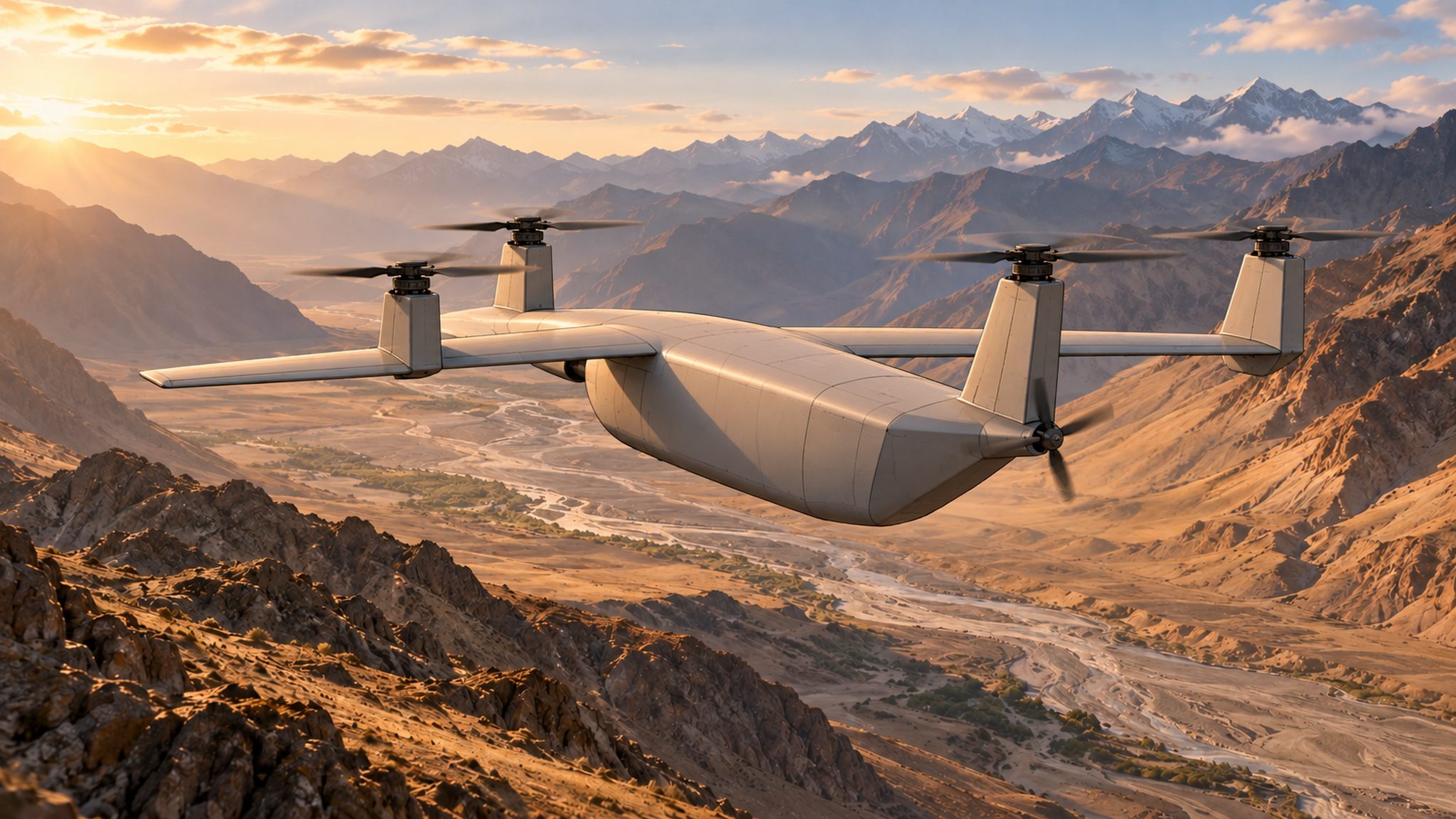
On 14 October 2026, the Technology Development Board signed an agreement with ideaForge to support development of YETI, an autonomous cargo aircraft combining vertical take-off and fixed-wing flight.
- YETI is proposed as a heavy-lift, long-range unmanned aerial vehicle for logistics where conventional transport faces difficult terrain or limited infrastructure.
- The announced design targets include payloads up to 200 kg and range up to 200 km; these are development objectives, not demonstrated simultaneous capabilities.
- The PIB release identifies distributed, redundant propulsion and power, with proposed navigation capability when satellite-navigation signals are unavailable.
- Further engineering, integration, testing and validation remain necessary; the agreement does not establish certification, operational deployment or unrestricted autonomous flight.
- Remote logistics needs both access at the destination and reliable transport between locations; solving only the runway problem leaves the mission incomplete.
- Flight transition connects two different lift regimes, making control and safety as important as headline payload or range.
UPSC Relevance
Prelims Relevance
- VTOL: vertical take-off and landing.
- UAV: unmanned aerial vehicle.
- Wing-borne flight: aerodynamic lift supports the aircraft during forward motion.
- GNSS: global navigation satellite systems, distinct from communication links.
- Redundancy: alternate capability intended to preserve essential functions after specified failures.
Mains Relevance
GS Paper 3
- Indigenous unmanned aviation and difficult-terrain supply chains.
- Flight-control reliability, navigation resilience and operational safety.
Essay
- Access depends on reliable systems, not merely ambitious machines.
Background and Context
Why Combine Vertical Lift and Fixed Wings?
The design brings together access without a runway and a different way of sustaining flight over the journey.
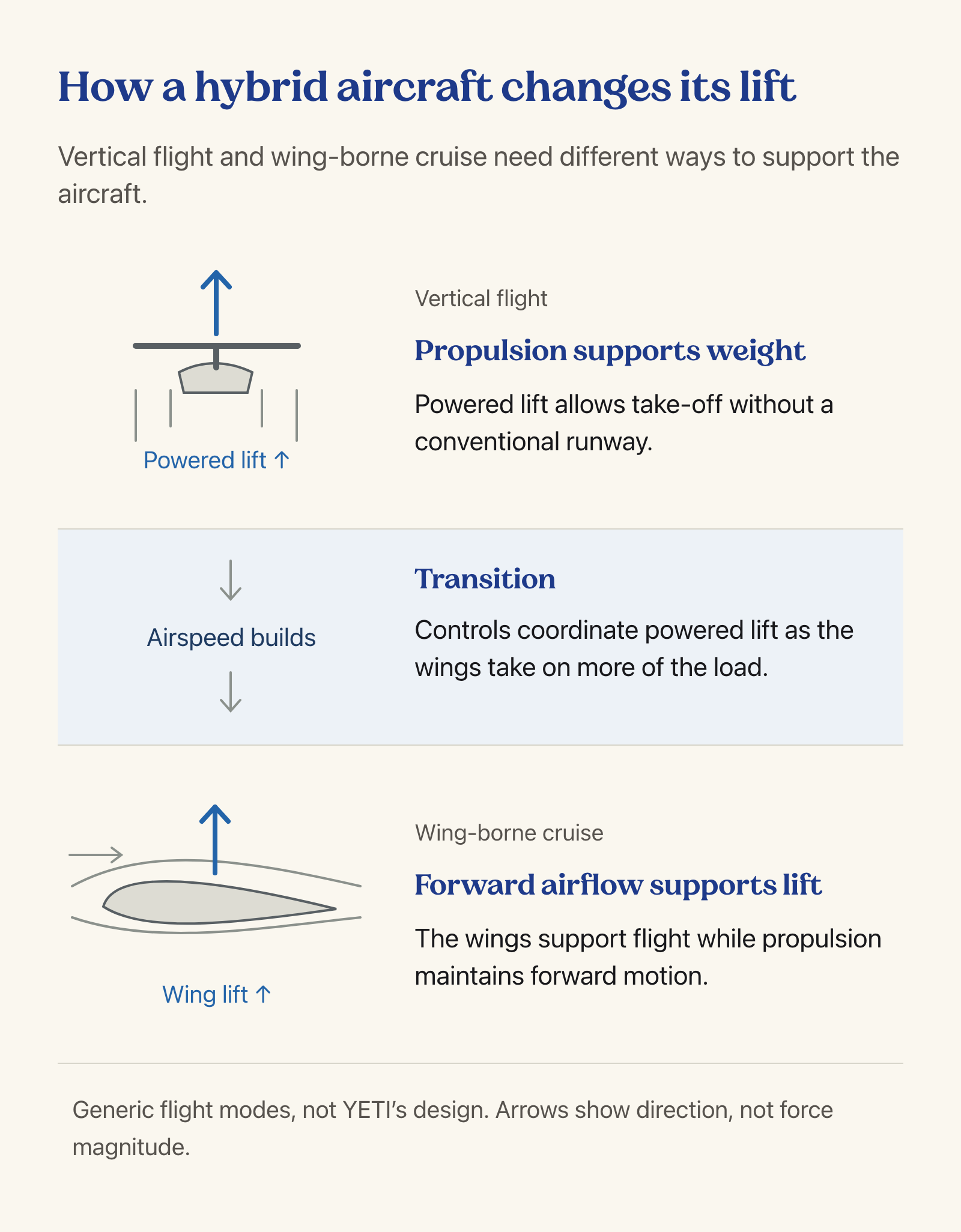
- Vertical take-off uses powered lift to leave the ground without a conventional runway. For a cargo mission, this can reduce dependence on long prepared strips near the receiving location.
- Wing-borne cruise relies on airflow over wings to support the aircraft while propulsion maintains forward motion. It changes how lift is produced during travel rather than eliminating the need for power.
- Unlike a rotor-only aircraft, a VTOL fixed-wing hybrid seeks to use wings during cruise. The useful comparison is its flight mechanism, not an unsupported claim that every hybrid carries more cargo.
- The term hybrid here describes the combination of vertical-lift and fixed-wing flight capabilities. The release does not establish a particular fuel-battery arrangement, rotor count or detailed geometry for the vehicle.
- Runway independence does not mean landing anywhere. A logistics assessment must still examine clear approaches, stable landing surfaces, nearby people and safe loading; these remain operating questions rather than proven YETI capabilities.
Transition Is a Control Problem
The aircraft must change how it supports its weight while keeping its motion controlled; adding wings alone cannot solve that task.
- During transition, an aircraft moves between powered vertical lift and wing-borne flight. Control commands must coordinate the changing contribution of propulsion and aerodynamics, rather than treat take-off and cruise as disconnected events.
- NASA transition research describes the need for specialised trajectories and commands between rotor-borne and wing-borne flight. This explains the general engineering challenge; it does not validate any YETI control system.
- NASA’s lift equation relates lift to air density, airspeed, wing area and lift coefficient. Wing shape and inclination affect the coefficient, so forward speed alone does not determine available lift.
- Distributed propulsion spreads propulsion functions across multiple units. Redundant power and propulsion can improve fault tolerance, but the exact failures a design tolerates must be established through its architecture and testing.
- Redundancy also creates a coordination problem: several actuators may contribute to the same movement. NASA research examines this allocation challenge; its findings are background principles, not evidence of YETI’s specific implementation.
Read Mission Targets as Conditional Claims
A useful aerial supply system must complete a defined mission safely; a list of maximum specifications cannot establish that result.
- Payload and range need a stated mission profile. The announcement does not show that maximum cargo, maximum range and the most demanding environment can all be achieved together on one flight.
- High-altitude operation changes the aerodynamic problem because lift depends partly on air density. A claimed operating ceiling cannot, by itself, establish how much cargo can be carried from a particular landing site.
- GNSS-denied navigation means navigating when satellite-positioning signals are unavailable. It is distinct from maintaining a communications link: knowing position and exchanging commands are separate functions with potentially different failure modes.
- Weather resistance is a design intention, not an all-weather guarantee. Evaluating the intended environment requires explicit operating limits and evidence, especially before describing a developmental aircraft as dependable for essential supplies.
- Autonomous describes proposed control capability, not exemption from oversight. The official announcement expressly leaves development subject to technical, safety and regulatory requirements; prospective applications should not be reported as already authorised services.
Way Forward
Validate the Complete Logistics Mission
- Publish mission-specific performance with cargo, route, weather and operating conditions identified, instead of presenting separate maxima as a single capability.
- Test transition and failure responses across representative conditions, with clear limits on what redundancy can protect.
- Define ground procedures and contingency actions alongside aircraft performance, including loading, landing-site safety and interrupted missions.
Conclusion
- YETI’s central idea is to combine vertical access with wing-borne transport; the difficult link is safe, controlled transition between those flight regimes.
- For policy analysis, connect remote access to demonstrated mission reliability. A development agreement and proposed specifications are the starting point for evaluation, not proof of deployment.
UPSC Practice Questions
Prelims MCQ 1
With reference to VTOL fixed-wing unmanned aerial vehicles, consider the following statements:
- They combine vertical take-off capability with wing-borne flight.
- Their wing lift is independent of air density.
- The word hybrid necessarily means diesel-electric propulsion.
How many of the above statements are correct?
(a) Only one (b) Only two (c) All three (d) None
Answer: (a) Only one
Explanation:
Only statement 1 is correct. Lift depends partly on air density. VTOL fixed-wing hybrid describes flight capabilities and does not necessarily specify an energy arrangement.
Prelims MCQ 2
Which best describes the transition-control challenge in a VTOL fixed-wing aircraft?
(a) Replacing all navigation functions with a communication link (b) Coordinating powered lift and aerodynamic forces as flight mode changes (c) Ensuring every maximum specification is achieved simultaneously (d) Removing the need for safety oversight
Answer: (b) Coordinating powered lift and aerodynamic forces as flight mode changes
Explanation:
Transition requires coordinated commands while the contributions of powered lift and wing aerodynamics change. It is not simply the addition of a wing to a rotorcraft.
UPSC Mains Questions
- Explain how combining vertical take-off with wing-borne flight can address difficult-terrain logistics. Examine the importance of transition control.
- Distinguish a developmental autonomous cargo aircraft’s advertised capabilities from evidence of operational reliability. Suggest priorities for evaluation.
Sources: PIB, Ministry of Science and Technology and NASA, flight transition research.
Frequently Asked Questions
What is YETI?
YETI is a proposed autonomous cargo UAV being developed by ideaForge with Technology Development Board support. It combines vertical take-off and landing with fixed-wing flight for difficult-terrain logistics.
Has YETI entered operational service?
The cited announcement concerns a development agreement. It describes proposed capabilities and further engineering, integration, testing and validation, subject to technical, safety and regulatory requirements; it does not establish operational deployment.
Why is transition important?
Transition changes the balance between powered lift and wing aerodynamics. The control system must coordinate propulsion and aircraft motion during that change; successful vertical take-off alone does not demonstrate safe transition.
Does hybrid describe YETI’s fuel system?
In this announcement, hybrid refers to vertical-lift and fixed-wing flight capabilities. It does not establish a particular fuel-battery arrangement or justify inferring the exact aircraft geometry from the term alone.
Tell Google you want more of this.
Add Anantam IAS as a preferred sourceOne tap, and this site shows up more often in your own Top Stories, AI Overviews and AI Mode. Remove it any time.