
Opens in a new tab
Join Anantam IAS Channel on Telegram

Daily Digest · Sunday

31 August 2025 Current Affairs for UPSC

3 current affairs published on Sunday, 31 August 2025

31 August 2025 Current Affairs for UPSC — every Why-in-News article AnantamIAS published on Sunday, 31 August 2025, broken down with Why in News?, the exact GS paper it feeds, sub-topic mapping, MCQ-ready facts and a UPSC-style practice question. 3 articles in total, covering Polity, Economy, Environment, S&T, IR, Geography, History, Society and Internal Security — the same Why-in-News + GS-paper-mapping + practice-question format the Compass uses across every daily digest on the site.

Daily current affairs for UPSC is where new material enters your prep stream. Read this 31 August 2025 digest end-to-end in 25–35 minutes, attempt the practice question at the foot of each article (it's MCQ for some, 10/15-marker for others), then bookmark the entries that fall inside your active revision window. Everything stays cross-linked: tap any subject pill to jump to that subject's hub, or use the table of contents above to skip straight to a specific story.

Use this page three ways. Read sequentially for a one-sitting scan of everything that mattered on 31 August 2025. Download the 31 August 2025 PDF below for offline study or print revision. Or use the August 2025 Current Affairs compilation to see this day in the month's full context. For the previous day's reading, see 30 August 2025 Current Affairs; the next day's is 1 September 2025 Current Affairs.

Why we publish daily current affairs separately from the monthly compilation: daily is learning, monthly is revision. Use the daily page to add fresh material to your notes the day it breaks; come back to the August 2025 compilation 60 days before Prelims when the noise has settled and only the lasting takeaway is worth re-reading.

Modi at SCO Tianjin Summit 2025: Multipolar India and the Eurasian Pivot

Open article →Download PDF
Modi at SCO Tianjin Summit 2025: Multipolar India and the Eurasian Pivot

Introduction

The Shanghai Cooperation Organisation (SCO) is a Eurasian political, economic and security grouping that today binds ten full members — India, China, Russia, Pakistan, Iran, Belarus, Kazakhstan, Kyrgyzstan, Tajikistan and Uzbekistan — across roughly forty per cent of the world’s population and a quarter of global GDP. The organisation traces its origin to the Shanghai Five mechanism of 1996 and was formally constituted in 2001. India was admitted as a full member at the Astana Summit of 2017. The 24th Heads of State Council Summit, hosted by China at Tianjin on 31 August and 1 September 2025, became the largest gathering in the bloc’s history and the first visit to mainland China by Prime Minister Narendra Modi since the Galwan clash of June 2020. For the UPSC aspirant, the summit opens onto Paper II international relations — bilateral, regional and global groupings — Paper III economy and internal security, and Paper IV ethics in foreign-policy decision-making.

The headline outcomes anchor the rest of the discussion. The Tianjin Declaration issued on 1 September 2025 reaffirmed an evolving multipolar order, condemned by name the Pahalgam terror attack of 22 April 2025, endorsed the SCO counter-terror cooperation programme for 2025-2027, and committed members to a ten-year SCO Development Strategy. On the sidelines, Modi held substantive bilaterals with President Xi Jinping and President Vladimir Putin, agreed to resume the Kailash Manasarovar Yatra and direct flights with China, and confirmed that Putin would visit New Delhi in December 2025. The summit unfolded against the backdrop of Washington’s announcement of a 50% secondary tariff on countries importing Russian crude oil, lending the Tianjin optics a sharp geopolitical edge. This article unpacks the institutional architecture of the SCO, India’s seven-year journey inside the bloc, the Tianjin Declaration text, and the structural meaning of Modi’s Eurasian pivot.
Modi at SCO Tianjin Summit 2025: Multipolar India and the Eurasian Pivot

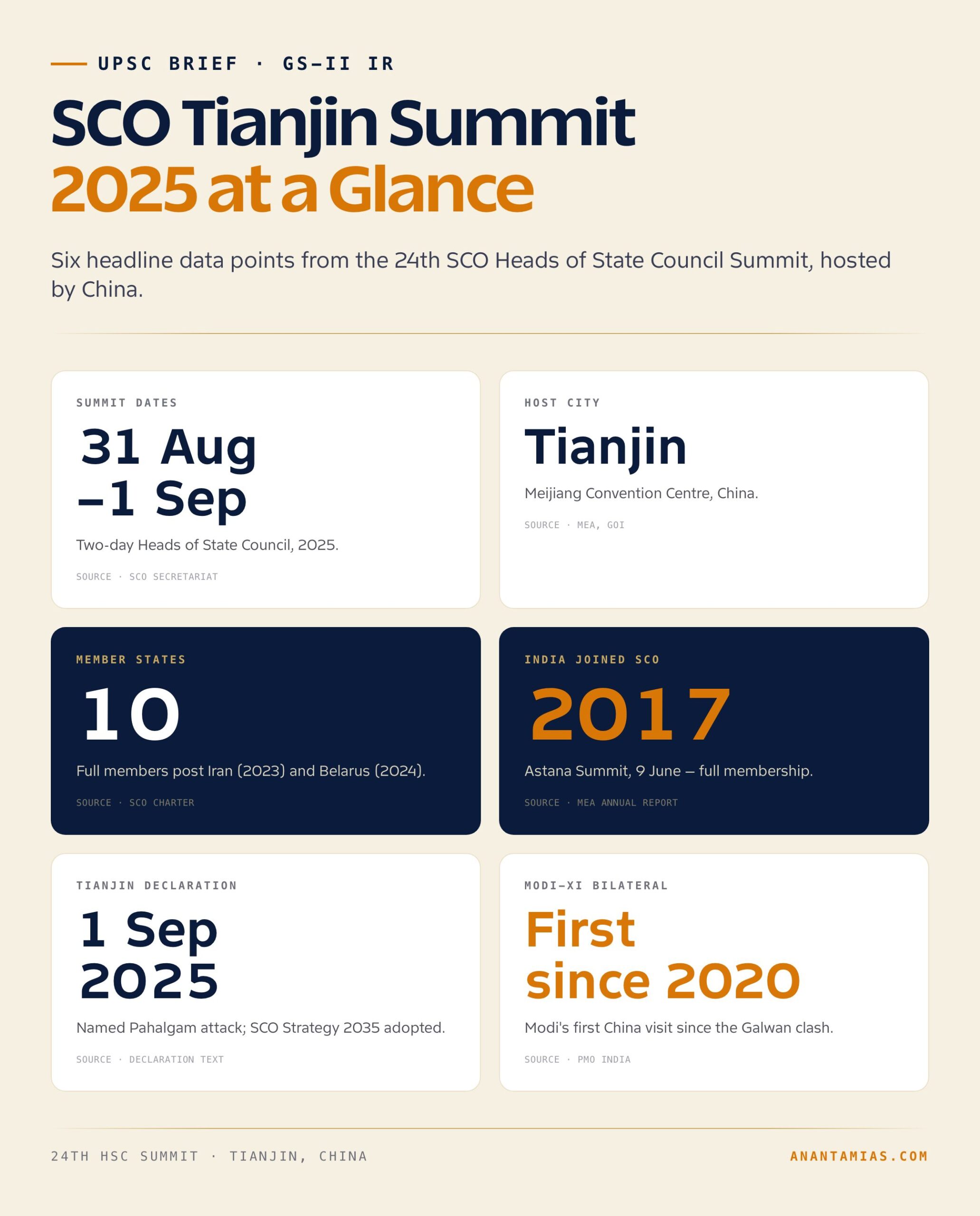
Quick Facts at a Glance

IndicatorValueSource
Summit edition and host24th SCO Heads of State Council Summit, hosted by ChinaSCO Secretariat / MEA Press Release
Summit dates31 August – 1 September 2025Ministry of External Affairs, Government of India
Host cityTianjin, People’s Republic of ChinaSCO Secretariat
Indian delegation headPrime Minister Narendra ModiPMO India
Modi’s first visit to China sinceGalwan Valley clash, 15 June 2020MEA, Government of India
SCO full members (post 2023 Iran, 2024 Belarus accession)10 member statesSCO Charter (2002) and Heads-of-State communiqués
India’s year of full SCO membership2017 (Astana Summit, 9 June 2017)MEA Annual Report 2017-18
Tianjin Declaration adoption date1 September 2025Tianjin Declaration text, SCO Secretariat
Headline strategic documentSCO Development Strategy through 2035Tianjin Declaration, Section V

Background and Historical Context

The institutional pre-history of the SCO begins with the Shanghai Five — a confidence-building mechanism launched in 1996 between China, Russia, Kazakhstan, Kyrgyzstan and Tajikistan to demarcate the long Sino-Soviet frontier inherited from the Cold War. With the accession of Uzbekistan in 2001 and the simultaneous adoption of the Shanghai Convention on Combating Terrorism, Separatism and Extremism, the grouping was rebranded as the Shanghai Cooperation Organisation. The SCO Charter was signed at the St Petersburg summit of 2002 and entered into force in 2003. From its inception, the bloc was conceived as a Eurasian counterweight to the post-Cold-War unipolar moment — a role its founders described in the language of “comprehensive security” rather than the narrow military-pact framing of NATO.

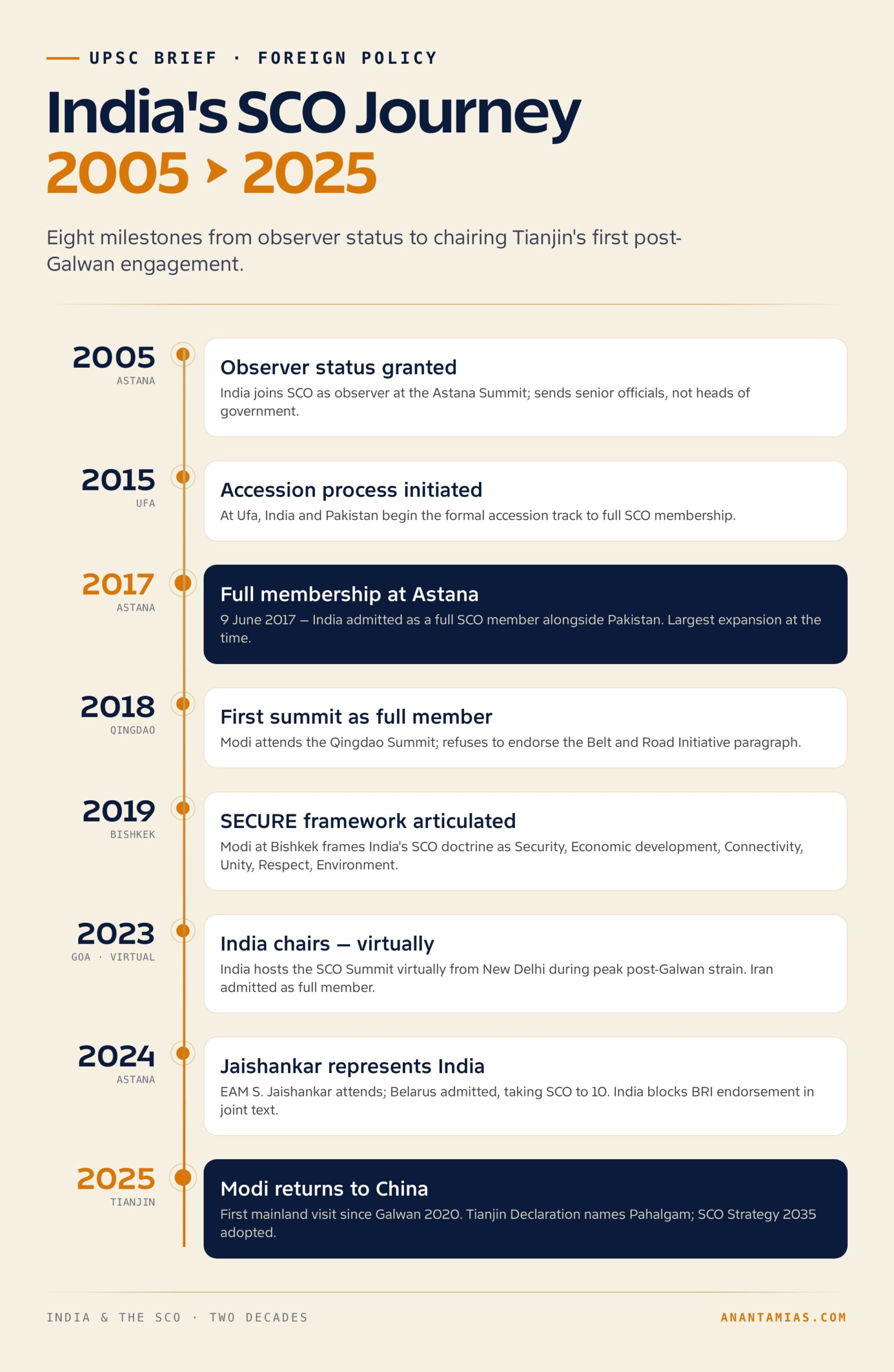
India’s relationship with the SCO has moved through three distinct phases. From 2005 to 2017, New Delhi held observer status, sending senior officials but not heads of government to the annual heads-of-state summits. The decisive turn came at the Ufa Summit of 2015, where India’s accession process was formally initiated alongside Pakistan’s. Both states were admitted as full members at the Astana Summit on 9 June 2017, the largest expansion in the organisation’s history at the time. The Kazan Council of Heads of Government in 2024 followed the admission of Belarus at the Astana 2024 Summit, taking the membership count to ten. Through 2023 India hosted the SCO summit virtually from New Delhi at a moment of extreme bilateral strain with both Beijing and Islamabad.

The Tianjin summit therefore unfolded at an inflection. India’s accession to the SCO in 2017 had always carried an implicit tension: the same year that New Delhi joined the Eurasian bloc, the Doklam stand-off with China unfolded along the trijunction with Bhutan. Three years later the Galwan Valley clash of 15 June 2020 killed twenty Indian soldiers and an undisclosed number of Chinese troops, freezing high-level political contact for almost five years. The Disengagement Agreement of October 2024 along the Line of Actual Control, finalised on the eve of the BRICS Kazan summit, reopened the door. The ground in Eurasia had also shifted: the Russia-Ukraine war entered its fourth year, US-China strategic competition had hardened under the renewed Trump administration (which returned to office in January 2025), and the global trade architecture absorbed a fresh wave of tariffs. The 50% US secondary tariff on Russian-oil buyers, announced in early August 2025 and explicitly aimed at India, made Modi’s Tianjin attendance a strategic statement rather than a routine summit cameo.

The summit was also unprecedented in scale. Chinese state media described Tianjin 2025 as the largest gathering in SCO history, with more than twenty heads of state and government in attendance, including SCO observer states Mongolia and Afghanistan‘s representatives, and dialogue partners ranging from Turkey to the United Arab Emirates. The host country had spent the better part of 2025 preparing the optics — a refurbished Tianjin Meijiang Convention Centre, a one-thousand-strong press contingent, and a parallel SCO Plus outreach format that brought Southeast Asian and West Asian observer delegations into the same hall as the ten members. China’s ambition for the summit was made explicit by President Xi Jinping in his opening address: that the SCO should evolve from a regional confidence-building mechanism into a “model for a new type of international relations”. For New Delhi, the calibration challenge was to participate in this expanded format without endorsing the Sino-centric framing of multipolarity that Beijing was advancing.

Key Features of the SCO Tianjin Summit 2025

SCO as a Eurasian Bloc — Architecture and Mandate

The SCO operates through three permanent organs: the Council of Heads of State, which meets annually and is the supreme decision-making body; the Council of Heads of Government, which handles economic and budgetary matters; and the Council of Foreign Ministers. The SCO Secretariat is headquartered in Beijing, while the Regional Anti-Terrorist Structure (RATS) is based in Tashkent. The bloc’s working languages are Russian and Chinese — a configuration that itself signals the founding bargain. The mandate has steadily widened from border confidence-building and counter-terror cooperation to encompass connectivity, energy, trade, agriculture and digital cooperation. The 2017 expansion to include India and Pakistan, the 2023 admission of Iran at the Goa-virtual summit, and the 2024 admission of Belarus have transformed the SCO into a genuine intercontinental platform stretching from the European fringe of Belarus to South Asia and the Persian Gulf.

India’s SCO Journey since 2017

India’s eight-year membership has tracked four distinct purposes. The first is access to the Regional Anti-Terrorist Structure intelligence-sharing mechanism, which gives Indian security agencies a documentary trail on cross-border terror financing flowing through Central Asia. The second is the strategic optics of being inside a non-Western forum that includes both rivals and partners — an embodiment of strategic autonomy. The third is connectivity: the SCO has consistently endorsed the International North-South Transport Corridor (INSTC) running through Chabahar Port in Iran, which India operationalised through a long-term contract in 2024. The fourth is normative: India has used the SCO to publicly oppose cross-border terrorism and the China-Pakistan Economic Corridor (CPEC) component that traverses Pakistan-occupied Kashmir. New Delhi’s most prominent moment of dissent inside the bloc came at the Astana 2024 Summit, where External Affairs Minister S. Jaishankar represented India and the joint statement omitted the Belt and Road Initiative endorsement at India’s insistence — a precedent the Tianjin Declaration also respects.

Tianjin Declaration — Key Outcomes

The Tianjin Declaration, issued on 1 September 2025, runs across five thematic sections. It commits members to actively implement the SCO Cooperation Programme on Combating Terrorism, Separatism and Extremism for 2025-2027, names and condemns the 22 April 2025 Pahalgam attack in Jammu and Kashmir alongside the 11 March 2025 Jaffar Express attack in Balochistan and the 21 May 2025 Khuzdar attack, reaffirms the centrality of the UN Charter, and endorses an “evolving multipolarity”. Members also adopted the SCO Development Strategy through 2035, established four new permanent bodies — including a Universal Centre for Countering Challenges and Threats to Security — and committed to expanded local-currency settlement. India’s signature was conditional on the inclusion of Pahalgam by name in the terror-attacks paragraph and on the absence of any direct endorsement of the BRI by name; both conditions were met.

Bilaterals on the Sidelines — Modi-Xi and Modi-Putin

The Modi-Xi bilateral on 31 August was the substantive headline. The two leaders agreed that the relationship should advance on a foundation of “mutual respect, mutual interest and mutual sensitivity” — language drawn directly from the Wuhan and Mamallapuram informal-summit framework of 2018-2019. They confirmed the resumption of the Kailash Manasarovar Yatra after a five-year hiatus, the restoration of direct passenger flights between India and China, and the activation of a Special Representatives’ dialogue on the boundary question. The Modi-Putin meeting earlier the same day ran for nearly an hour inside the Russian presidential limousine. The two confirmed the schedule for Putin’s December 2025 visit to New Delhi and reviewed the S-400 deliveries, the Vostochny energy cooperation track, and the rouble-rupee settlement framework. Modi also reiterated India’s call for an early end to the Ukraine conflict.
Modi at SCO Tianjin Summit 2025: Multipolar India and the Eurasian Pivot

Significance for UPSC and General Knowledge

  • Direct GS2 syllabus hit on bilateral, regional and global groupings and their effect on India’s interests — the SCO is named explicitly in the UPSC syllabus.
  • GS2 anchor on India-China and India-Russia relations, including the post-Galwan disengagement and the December 2025 Putin visit calendar.
  • GS3 internal security overlap on cross-border terror financing, the Regional Anti-Terrorist Structure (RATS), and the Pahalgam attack referenced by name.
  • GS3 economy linkage on local-currency settlement, the rupee-rouble framework, and the secondary-tariff regime imposed by the United States in August 2025.
  • Prelims static fodder on SCO membership year by year, host cities, the Shanghai Convention of 2001, and the location of the SCO Secretariat and RATS.
  • Essay paper data bank — multipolarity, strategic autonomy, and the Eurasian rebalancing all feature in recent UPSC essay prompts.
  • GS4 ethics linkage on the dilemmas of engaging adversarial powers in shared multilateral fora without compromising on sovereignty and counter-terror principles.

Detailed Analysis: India’s Multi-Alignment Strategy at SCO 2025

The Tianjin summit is best understood not as a single diplomatic event but as the convergence point of three distinct Indian strategic vectors: the post-Galwan recalibration with China, the defence and energy continuity with Russia, and the public assertion of strategic autonomy against a hardening US tariff regime. The Modi government’s foreign-policy doctrine since 2014 has been described as “multi-alignment” — the simultaneous deepening of partnerships with the United States, Russia, Europe, the Gulf and a re-engaged China without entering any formal alliance system. Tianjin made that doctrine visible. Within seventy-two hours, Modi was photographed walking hand-in-hand with Putin and Xi, attended a Eurasian bloc summit attended by every major adversary of the United States, and yet retained an active Quad engagement track and an India-EU trade negotiation calendar.

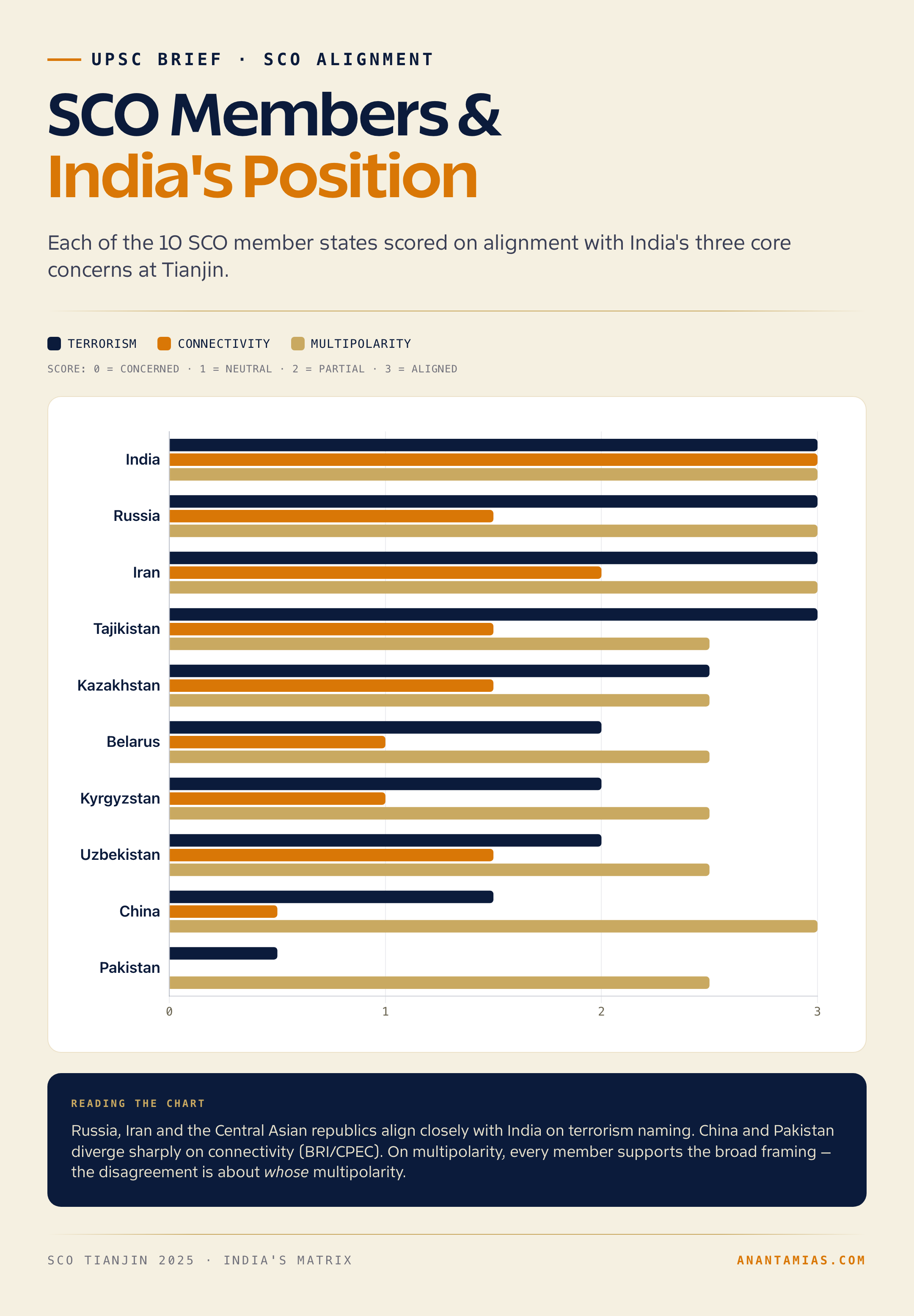
The bilateral architecture inside the bloc is uneven, and the Tianjin meetings reflected those asymmetries. Of the ten member states, India shares a frontier with three (China, Pakistan, and through historic claims with the Tajikistan-bordering Wakhan Corridor), maintains deep defence and energy ties with Russia, and pursues connectivity through Iran and Central Asia. The Indian position on the major SCO agenda items — counter-terrorism naming conventions, BRI endorsement, local currency settlement, and the Iran nuclear question — was negotiated on a member-by-member basis in the run-up to the summit. The granular table below records the position of each member state on the three agenda items most consequential for India.

Member StatePosition on Naming PahalgamPosition on BRI EndorsementLocal Currency Settlement
IndiaInsisted on inclusion by nameOpposed direct endorsementSupports rupee-bilateral arrangements
ChinaAccepted after negotiationPushed for renewed endorsementStrong proponent (yuan-lead)
RussiaSupported India’s positionNeutral with Russian preference for EAEU framingStrong proponent (rouble-yuan-rupee)
PakistanReluctantly acquiescedStrong proponent (CPEC stakeholder)Conditional support
IranSupported India’s positionSupportive without exclusivityStrong proponent (sanctions context)
BelarusFollowed Russian leadGenerally supportiveSupportive
KazakhstanSupportive of clear namingConditional, balancing roleSupportive with USD continuity
KyrgyzstanFollowed consensusBeneficiary, supportiveSupportive
TajikistanStrongly supportive (terror-victim state)Beneficiary, supportiveSupportive
UzbekistanSupportiveConditional, multi-vectorCautiously supportive

The most consequential structural shift visible at Tianjin was the implicit reset of the India-China bilateral. Five years of frozen high-level contact, an additional brigade-equivalent troop deployment along the Line of Actual Control, and a screening regime that effectively curtailed Chinese FDI into India had crystallised into a steady-state hostility that neither capital could afford indefinitely. The Modi-Xi handshake at Tianjin did not resolve the underlying boundary dispute, but it formalised what diplomats have called “managed competition”. On the connectivity front, the Indian position on BRI remained unchanged; what shifted was the procedural language around the SCO Connectivity Programme, which now references both the BRI and the INSTC without making either the privileged framework. The MEA’s post-summit briefing emphasised that the Tianjin Declaration “respects the sovereignty and territorial integrity of all member states” — a formulation read in New Delhi as a quiet acknowledgement of the Pakistan-occupied Kashmir question.

The Russia track at Tianjin operated along a different logic. The August 2025 announcement by the Trump administration of a 50% secondary tariff on countries importing Russian crude was timed and calibrated to pressure India and China into curtailing Urals-grade purchases. India had become the largest sea-borne buyer of Russian crude after the 2022 G7 price cap, with Russian oil rising from below 2% of Indian imports in early 2022 to roughly 35-40% by mid-2025. The Modi-Putin meeting in the Aurus limousine — described by Russian sources as running for nearly an hour — was a calibrated public signal that the energy and defence continuum with Moscow would not be subordinated to Washington’s tariff calendar. Putin’s confirmed December 2025 visit to New Delhi, the activation of the 21st India-Russia Annual Summit agenda, and the continuation of the rupee-rouble settlement experiment all fed into the same message.

The Pakistan dimension of Tianjin deserves separate attention. Prime Minister Shehbaz Sharif was present, and the seating choreography placed the Indian and Pakistani delegations within the same plenary hall for the first time since the Pahalgam attack and the subsequent Operation Sindoor military exchange of May 2025. The Indian position, formally communicated through the Ministry of External Affairs ahead of the summit, was that there would be no Modi-Sharif bilateral and no acknowledgement of Pakistan beyond the formal multilateral protocol. The Tianjin Declaration’s explicit naming of Pahalgam — and the parallel naming of the Jaffar Express and Khuzdar attacks within Balochistan, which Pakistani officials privately attribute to Indian-supported actors — produced an unusual paragraph in which both states agreed to language that condemned violence inside the other’s claimed territorial sphere. The MEA spokesperson Randhir Jaiswal in his post-summit briefing called the paragraph “an example of why the SCO consensus rule, when worked carefully, can produce outcomes no bilateral framework currently can”.

The deeper analytical takeaway, however, lies in what Tianjin did not produce. There was no joint communique on the Ukraine war, no consolidated SCO position on the Israel-Gaza conflict, and no operational framework for an alternative payments architecture that would credibly displace the dollar in the medium term. The bloc remains, as the Stimson Center noted in its post-summit assessment, a concert of disagreement — a stage on which member states perform multipolarity for their respective domestic audiences and a hedge for individual capitals against the volatility of the US-led order, but not yet a coherent strategic actor. For India, this ambiguity is the feature, not the bug: a tightly-aligned SCO would force a choice that New Delhi has constitutionally declined to make for seven decades. The summit’s true achievement, accordingly, was the preservation of strategic optionality — the explicit affirmation that India can sit in Tianjin one week and at a Quad foreign ministers’ meeting the next without either appearance compromising the other.
Modi at SCO Tianjin Summit 2025: Multipolar India and the Eurasian Pivot

Comparative Perspective

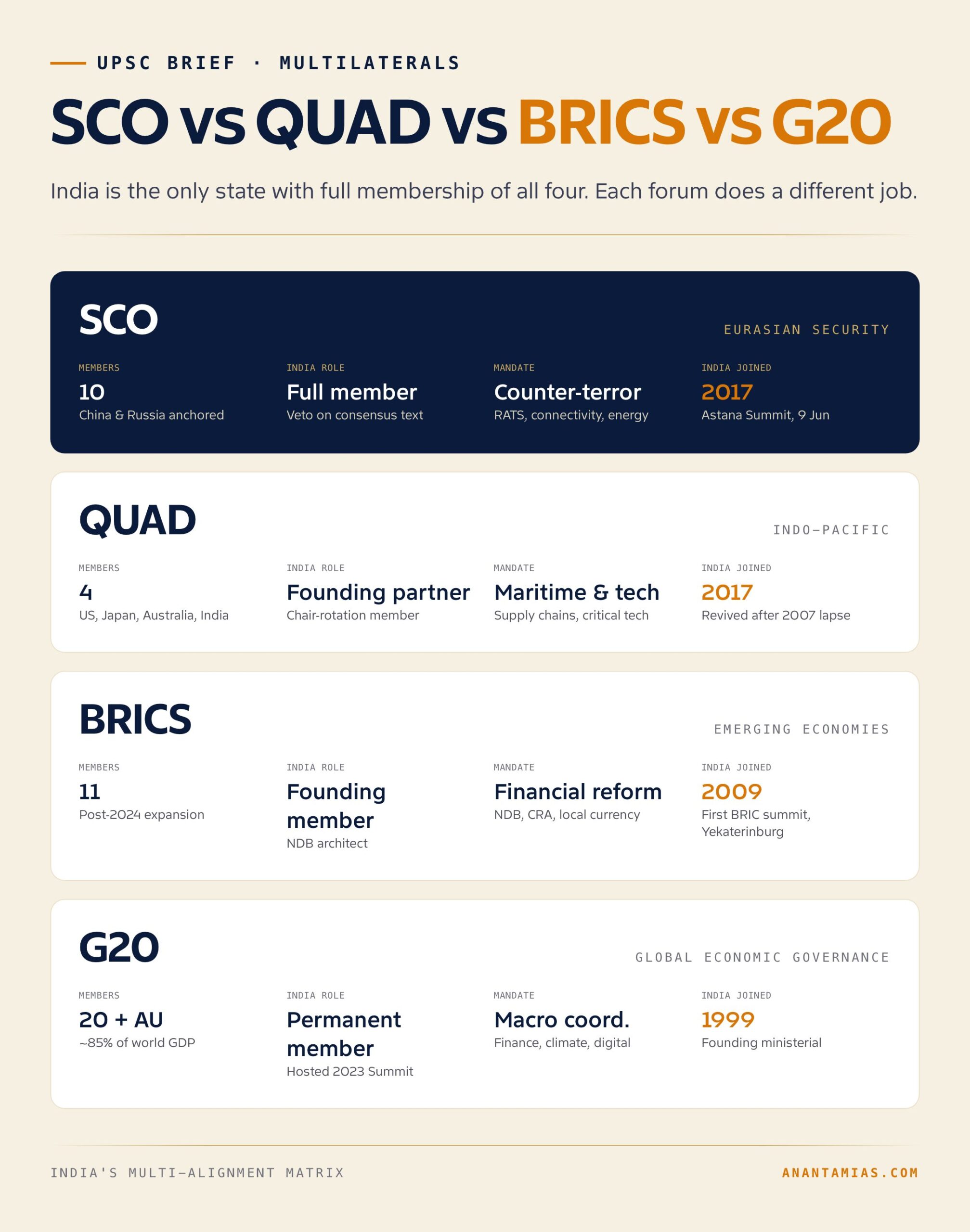
India is the only country in the world that simultaneously holds full membership in the SCO, the Quad, BRICS, the G20 and the I2U2. This unique cross-membership is the operational definition of strategic autonomy as practised by the Modi government. Each forum has a distinct mandate, geography, and treatment of the China question — and Tianjin can only be read accurately when placed alongside its peers.

ForumCore Pillars / MembershipIndia’s Role
SCOEurasian security and connectivity; 10 members; China and Russia anchoredFull member since 2017; voice on counter-terror naming and INSTC
QUADIndo-Pacific maritime, technology and supply-chain cooperation; US, Japan, Australia, IndiaFounding partner of the revived 2017 grouping; chair-rotation member
BRICSEmerging-economy political and financial cooperation; 11 members post-2024 expansionFounding member (2009); architect of the New Development Bank
G20Global economic governance; 20 major economies plus AUHosted the 2023 New Delhi Summit; permanent troika seat through 2024
I2U2India, Israel, UAE, US — food, water, energy, technology cooperationFounding member (2022); West Asia connectivity anchor

The structural insight from the comparison is that the SCO, unlike the Quad, is not a like-minded grouping. Its strategic value to India is precisely that it is not. The Quad gives India a shared values platform with three treaty allies of the United States; BRICS gives it an emerging-economy financial leverage point; the SCO gives it an instrument for managing — not eliminating — the friction with China and Pakistan. Each forum is selected for what it can do, and none is permitted to define the totality of Indian foreign policy.

Challenges and Criticisms

The dominant Indian narrative around Tianjin — Modi-as-multipolar-statesman walking with Xi and Putin — has not gone uncontested. The Observer Research Foundation argued in a post-summit brief by Harsh V. Pant that the SCO remains, in practice, a Sino-Russian condominium in which India’s voice is structurally constrained by the consensus rule and by the bloc’s working languages of Russian and Chinese. The Pant critique notes that India’s nominal achievements at Tianjin — the naming of Pahalgam, the omission of BRI by name — are negative wins, achieved by withholding consent rather than by setting the agenda. The deeper question, as the Institute for Defence Studies and Analyses (IDSA) has noted, is whether India’s continued participation lends legitimacy to a forum whose other members structurally undercut Indian interests in Pakistan-occupied Kashmir, in Afghanistan policy, and in the Indian Ocean.

The China question is the most acute. The Modi-Xi bilateral did not produce a roadmap for the resolution of the Line of Actual Control friction at Depsang or Demchok, nor any commitment to roll back the Chinese troop build-up that has continued in the rear areas. The October 2024 Disengagement Agreement covered only patrolling rights at two specific friction points; the broader question of force-deployment levels along the LAC remains unaddressed. Critics inside the strategic community, including former Foreign Secretary Vijay Gokhale, have warned that the symbolic warmth of the Tianjin handshake risks normalising a status quo in which Chinese troop presence on what India considers its own side of the LAC is treated as a fait accompli. The Brookings India and Carnegie Endowment assessments have similarly cautioned against reading the resumption of the Kailash Manasarovar Yatra and the direct flights as proxies for genuine de-escalation.

The third critique is economic. The local-currency settlement framework endorsed at Tianjin remains, in operational terms, a yuan-led architecture. Rouble-yuan-rupee triangulation has worked for crude oil but has accumulated an estimated $40 billion stock of unrepatriated rupees in Russian accounts since 2022 — a figure that the RBI‘s November 2024 Financial Stability Report flagged as a structural mismatch. Without convertibility, the rupee cannot perform the role the SCO Declaration assigns to it. The Stimson Center‘s post-summit analysis put the criticism plainly: the SCO has produced a vocabulary of multipolarity but not the financial plumbing to sustain it. A fourth strand of criticism, advanced by analysts at RAND Corporation in a September 2025 commentary, points to the asymmetry between the bloc’s expanding declaratory ambition and its stagnant institutional capacity — a Secretariat with a small permanent staff, a RATS framework that lacks operational reach beyond Central Asia, and a budget that remains a fraction of either the EU’s or ASEAN’s. Without an enforcement architecture, the Tianjin Declaration’s commitments on counter-terror cooperation, infrastructure financing, and digital cooperation remain aspirational rather than binding.
Modi at SCO Tianjin Summit 2025: Multipolar India and the Eurasian Pivot

Prelims Pointers

  • The SCO traces its origin to the Shanghai Five mechanism of 1996 between China, Russia, Kazakhstan, Kyrgyzstan and Tajikistan.
  • The SCO was formally constituted in 2001 with the accession of Uzbekistan and the adoption of the Shanghai Convention on Combating Terrorism, Separatism and Extremism.
  • The SCO Charter was signed at the St Petersburg Summit of 2002 and entered into force in 2003.
  • India and Pakistan were admitted as full members at the Astana Summit on 9 June 2017.
  • Iran joined as a full member at the Goa-virtual summit of 2023; Belarus joined at the Astana 2024 Summit, taking membership to 10.
  • The SCO Secretariat is headquartered in Beijing; the Regional Anti-Terrorist Structure (RATS) is based in Tashkent.
  • The official working languages of the SCO are Russian and Chinese.
  • The 24th SCO Heads of State Council Summit was hosted by China at Tianjin on 31 August – 1 September 2025.
  • The Tianjin Declaration, adopted on 1 September 2025, named the Pahalgam attack of 22 April 2025 by name.
  • The Tianjin Summit adopted the SCO Development Strategy through 2035 and the Cooperation Programme on Combating Terrorism, Separatism and Extremism for 2025-2027.
  • Modi’s visit to Tianjin was his first to mainland China since the Galwan Valley clash of 15 June 2020.
  • The October 2024 Disengagement Agreement at the Line of Actual Control covered Depsang and Demchok patrolling rights.
  • The International North-South Transport Corridor (INSTC) connects India to Russia via Iran’s Chabahar Port; India signed a 10-year operating contract for Chabahar in 2024.
  • The 50% US secondary tariff on Russian-oil buyers was announced in August 2025 by the Trump administration.
  • Putin’s December 2025 visit to New Delhi will be the 21st India-Russia Annual Summit.

Mains Practice Questions

  • The Shanghai Cooperation Organisation has been described as a “concert of disagreement”. Examine India’s strategic interests in the bloc in the light of the 2025 Tianjin Summit. (15 marks, 250 words)
  • Critically assess the proposition that the Tianjin Declaration of 2025 represents a substantive shift in the global order toward multipolarity. (15 marks, 250 words)
  • Discuss the significance of Prime Minister Narendra Modi’s first visit to China since the Galwan clash of 2020 in the context of the post-disengagement India-China relationship. (10 marks, 150 words)
  • India is the only state with simultaneous full membership of the SCO, the Quad, BRICS and the G20. Evaluate the costs and gains of this multi-alignment posture. (15 marks, 250 words)
  • Explain the architecture of the SCO Regional Anti-Terrorist Structure (RATS) and its utility for Indian internal-security agencies. (10 marks, 150 words)
  • “India’s gains at the SCO have been negative wins — achieved by withholding consent rather than by setting the agenda.” Comment with reference to the Tianjin Declaration. (15 marks, 250 words)
  • The local-currency settlement framework endorsed at Tianjin has been called a vocabulary of multipolarity without the financial plumbing. Critically examine. (15 marks, 250 words)
  • Compare the SCO with the Quad and BRICS in terms of their utility to Indian foreign policy. (10 marks, 150 words)

Conclusion

The Tianjin summit will be remembered less for what it produced on paper and more for what it signalled about the texture of the emerging global order. The image of Modi, Xi and Putin walking together in the second-largest city of northern China — with the United States having that same week imposed a 50% secondary tariff aimed at India’s energy choices — was the most concise statement of a multipolar architecture the post-Cold-War period has yet seen. The Tianjin Declaration, with its explicit naming of the Pahalgam attack, its endorsement of the SCO Development Strategy through 2035, and its careful omission of any direct BRI endorsement, captured both the genuine convergences and the persistent fault lines of the bloc. India’s diplomatic craft was visible throughout: the substance was extracted, the consensus held, and the symbolism was permitted to do its own work.

What the aspirant should monitor over the next eighteen months is whether the procedural openings of Tianjin translate into structural change. Three calendars matter. The first is the December 2025 Putin visit to New Delhi, which will test whether the rupee-rouble framework can absorb the post-tariff trade volumes without further accumulation of unrepatriated balances. The second is the next India-China Special Representatives’ dialogue and the question of whether the Disengagement Agreement extends from patrolling rights at Depsang and Demchok to broader force-deployment normalisation along the Line of Actual Control. The third is the implementation timeline of the SCO Development Strategy through 2035 and the operationalisation of the Universal Centre for Countering Challenges and Threats to Security — the litmus test for whether the bloc evolves from declaratory architecture into operational machinery.

The deeper lesson Tianjin offers the Indian foreign-policy student is that strategic autonomy is not a slogan but a practice — exercised summit by summit, communique by communique, in the precise wording of paragraphs and the calibrated choreography of bilateral handshakes. India did not abandon the Quad to attend the SCO, did not endorse the BRI to secure a Modi-Xi meeting, and did not soften the Pahalgam reference to ease consensus. The aspirant who learns to read these procedural details — and to distinguish them from the photo-opportunities that travel through the news cycle — will arrive at the only durable summary of Tianjin: that India remained, as it has for seven decades, an actor whose foreign policy is best read in the documents it does not sign as much as in the ones it does.

Frequently Asked Questions

What is the Shanghai Cooperation Organisation?

The Shanghai Cooperation Organisation (SCO) is a Eurasian political, economic and security bloc founded in 2001. Its full members are India, China, Russia, Pakistan, Iran, Belarus, Kazakhstan, Kyrgyzstan, Tajikistan and Uzbekistan, with several observer and dialogue states. Its mandate centres on counter-terrorism, regional connectivity, and Eurasian multipolarity.

When did India join the SCO?

India was an observer at the SCO from 2005 and became a full member at the Astana summit on 9 June 2017, alongside Pakistan. India is the only SCO member that is also a Quad partner — making its position structurally distinct from the China-Russia core.

What was the SCO Tianjin Summit?

The 24th SCO Heads of State Council summit was hosted by China at Tianjin on 31 August – 1 September 2025. It produced the Tianjin Declaration on terrorism, multipolarity and Eurasian connectivity, and was Prime Minister Modi’s first visit to China since the Galwan clash of 2020.

Why was the Modi-Xi bilateral significant?

Modi and Xi met on the Tianjin sidelines for the first formal bilateral since the 2020 Galwan stand-off. The talks signalled a managed reset on border disengagement, trade resumption and people-to-people exchanges, while leaving deeper strategic divergences (CPEC, Quad) intact.

What did the Tianjin Declaration say?

The Tianjin Declaration reiterated SCO consensus on counter-terrorism, condemned unilateral economic sanctions and tariff measures, called for a multipolar global order, and endorsed deeper Eurasian connectivity. India’s signature came with reservations on the China-Pakistan Economic Corridor reference.

How does SCO compare with QUAD and BRICS?

SCO is a continental Eurasian security and connectivity bloc, QUAD is a maritime Indo-Pacific democracy framework, and BRICS is a developing-economy coordination platform. India is a founding or full member of all three — a deliberate multi-alignment strategy not adopted by any other major power.

What were the key India concerns at Tianjin?

India pushed back on terror financing language soft on Pakistan, refused to sign on to CPEC connectivity references, and used the platform to flag the US 50% secondary tariff on Russian oil that hurt India’s energy security calculations.

Why is the SCO summit important for UPSC?

The Tianjin summit is high-yield for GS-II International Relations: it tests India’s multi-alignment doctrine, the SCO’s institutional architecture, India’s Eurasian connectivity stake, and the post-Galwan India-China reset. Prelims regularly tests SCO membership, founding year and observer states.

Modi-Xi Tianjin Bilateral 2025: Border Disengagement, Trade Reset and the Indo-China Reset

Open article →Download PDF

The handshake between Prime Minister Narendra Modi and President Xi Jinping on the sidelines of the Shanghai Cooperation Organisation (SCO) summit in Tianjin on 31 August 2025 closed a five-year diplomatic ice age that had begun with the bloody clash on the banks of the Galwan River in June 2020. It was the first formal, structured bilateral meeting between the two leaders since the standoff froze every line of substantive engagement between New Delhi and Beijing — political, military, economic, consular and cultural. For Indian foreign-policy observers raised on the doctrine that “relations cannot be normal as long as the border is not normal” — a phrase repeated by External Affairs Minister S. Jaishankar through 2021, 2022 and 2023 — the Tianjin meeting represented something more than a diplomatic photograph. It was the visible apex of a slow, sequenced, deliberately engineered reset that began with the Demchok and Depsang disengagement understandings of October 2024, was tested in the Modi-Xi pull-aside at the Kazan BRICS summit a few days later, and was operationalised through the revival of the dormant Special Representatives mechanism across 2024-25. This essay reads the Tianjin bilateral as the third phase in a doctrinal evolution that has stretched from the Wuhan and Mahabalipuram informal summits, through the post-Galwan rupture, to a cautious, conditional, and visibly hedged accommodation in 2025. It examines the border architecture that made the meeting possible, the trade asymmetry that made it necessary, and the strategic rationale that made it inevitable for both capitals as the Trump 2.0 administration’s tariff war and an unsettled Indo-Pacific reordered everyone’s calculations.

Modi and Xi shake hands at the Tianjin SCO summit, August 2025
The Modi-Xi handshake at Tianjin (31 August 2025) marked the first formal bilateral since Galwan.

Quick Facts: Modi-Xi Tianjin Bilateral 2025

  • Event: Modi-Xi bilateral on the sidelines of the SCO Heads of State Council summit, Tianjin.
  • Dates: 31 August – 1 September 2025; bilateral held on 31 August 2025.
  • Significance: First formal Modi-Xi bilateral after the Galwan Valley clash of 15-16 June 2020; the Kazan BRICS meeting of 23 October 2024 was the precursor, but Tianjin was the first dedicated, agenda-driven engagement.
  • Border trigger: The 21 October 2024 agreement on patrolling and disengagement at Depsang Plains and Demchok in Eastern Ladakh.
  • Diplomatic mechanism: Revival of the Special Representatives (SR) framework on the boundary question; NSA Ajit Doval and Foreign Minister Wang Yi have held the 23rd and subsequent SR meetings, with Hyderabad House rounds in December 2024 and August 2025.
  • Trade context: India-China bilateral trade stood at roughly $118 billion (FY 2023-24), with India’s trade deficit at approximately $85 billion — making China India’s largest single-country merchandise partner.
  • Operational deliverables: Resumption of direct flights, easing of business and journalist visas, restart of the Kailash Mansarovar Yatra via Nathu La and Lipulekh, partial relaxation of curbs on Chinese technical personnel for Apple/Foxconn and electronics manufacturing.
  • GS papers: GS-II International Relations (primary); GS-III Internal Security (border infrastructure); GS-III Economy (trade deficit, supply-chain dependencies).

Background: From Five Fingers to Five Years of Frost

To understand why Tianjin matters, one has to begin with what Indian strategic literature has called the “Five Finger Doctrine” — the framework, attributed to Mao Zedong, that imagines Tibet as the palm of China’s western hand and Ladakh, Nepal, Sikkim, Bhutan and Arunachal Pradesh (which Beijing labels “Zangnan” or “Southern Tibet”) as five fingers that complete the geographical and political integrity of that hand. Whether or not the doctrine was ever a literal directive, its operational logic has been visible across decades — from the 1962 War, through the Sumdorong Chu incident of 1986-87, to the Doklam trijunction crisis of 2017, and finally the multi-sector intrusions of April-May 2020 at Galwan, Hot Springs, Gogra, Pangong Tso, Depsang and Demchok.

The 1993 Agreement on Maintenance of Peace and Tranquility, the 1996 Agreement on Confidence Building Measures, the 2005 Political Parameters and Guiding Principles, the 2012 Working Mechanism for Consultation and Coordination on India-China Border Affairs (WMCC), and the 2013 Border Defence Cooperation Agreement (BDCA) together formed what diplomats called the “border peace architecture.” For nearly three decades, despite hundreds of patrol-face-offs, no shot was fired and no soldier died on the Line of Actual Control (LAC). Galwan shattered that 45-year-old taboo: 20 Indian soldiers, including Colonel B. Santosh Babu, were martyred; Chinese casualties — later officially acknowledged at four by Beijing — were widely assessed as significantly higher.

What followed was a structural reset of the relationship. India banned over 200 Chinese apps beginning with TikTok, WeChat, UC Browser and later PUBG Mobile; tightened Press Note 3 (April 2020) to mandate prior government approval for FDI from countries sharing a land border; effectively froze new investments by Huawei and ZTE from 5G trials; subjected Chinese firms like Xiaomi, Vivo and Oppo to Enforcement Directorate scrutiny; and accelerated the Production Linked Incentive (PLI) scheme to substitute Chinese imports across electronics, pharmaceuticals, telecom, solar and APIs. The Quad — India, the United States, Japan, Australia — was elevated to leaders’ level in March 2021; I2U2 was launched in 2022; the India-Middle East-Europe Economic Corridor (IMEC) was unveiled at the G20 New Delhi summit in September 2023.

Through this rupture, twenty-one rounds of Corps Commander-level talks at Chushul-Moldo produced disengagement at PP-14 Galwan, the north and south banks of Pangong Tso (February 2021), PP-17A Gogra (August 2021), and PP-15 Hot Springs (September 2022). But two friction points — Depsang Bulge blocked at the Y-junction and the legacy claim line dispute at Charding Ninglung Nallah (CNN) Track Junction in Demchok — remained unresolved. They were the bottlenecks that the 21 October 2024 understanding finally cleared.

Galwan to Tianjin — A Five-Year Reset Timeline

The arc from Galwan to Tianjin is best read in five distinct phases. Phase one (June 2020 – February 2021) was acute crisis management: the deployment of nearly 50,000 additional troops by each side along the 1,597-km Western Sector LAC, the deployment of T-90 tanks, BMP-2 ICVs and K-9 Vajra howitzers at altitudes of 14,000-17,000 feet, and the Pangong Tso disengagement brokered after the eighth and ninth Corps Commander rounds. Phase two (2021-2022) was sequential disengagement at Gogra and Hot Springs, paired with India’s quiet but rapid acceleration of border infrastructure under the Border Roads Organisation (BRO).

Phase three (2023) was the diplomatic plateau: Foreign Secretary Vinay Mohan Kwatra and his Chinese counterparts maintained channels through the WMCC; Modi and Xi exchanged courtesies at the Bali G20 (November 2022) and were photographed in conversation at Johannesburg BRICS (August 2023), but no formal bilateral occurred. The Indian position, articulated in Jaishankar’s book Why Bharat Matters (January 2024) and across innumerable interviews, was unambiguous: until the LAC issue was resolved, the relationship could not return to “normal.”

Phase four (October 2024) was the breakthrough. On 21 October 2024, two days before the BRICS summit at Kazan, then Foreign Secretary Vikram Misri announced that an agreement had been reached on patrolling arrangements at Depsang and Demchok. Modi met Xi on 23 October 2024 in Kazan — their first structured conversation since the Mahabalipuram informal summit of October 2019. The Kazan readout authorised the resumption of the Special Representatives mechanism, the resumption of the Foreign Secretary-Vice Foreign Minister dialogue, and signalled the gradual normalisation of consular and economic ties.

Phase five (November 2024 – August 2025) operationalised the reset. NSA Doval travelled to Beijing in December 2024 for the 23rd round of Special Representatives talks — the first in five years — followed by the 24th round hosted in New Delhi. Wang Yi visited Hyderabad House in August 2025, days before the SCO summit. Foreign Secretary Misri visited Beijing in January 2025; Jaishankar attended the SCO Council of Foreign Ministers in Qingdao in July 2025 and visited Beijing for bilateral consultations. The Kailash Mansarovar Yatra resumed in summer 2025 after a five-year suspension. Direct flights between IndiGo‘s and Chinese carriers’ hubs were cleared for resumption. By the time Modi‘s plane touched down in Tianjin on 31 August 2025, the diplomatic ground was ready for a meeting that would have been politically untenable even a year earlier.

LAC Disengagement at Demchok and Depsang (2024)

The October 2024 agreement was, technically, an understanding on “patrolling and disengagement” rather than a formal de-escalation or de-induction accord. Three concentric circles describe what the LAC standoff has involved since 2020: disengagement (creating buffer zones where neither side patrols), de-escalation (drawing down the heavy weapons forward of established staging areas), and de-induction (returning the additional 50,000-plus troops to peacetime locations). The October 2024 understanding addressed only the first circle, and only at two specific friction points.

At Depsang Plains, the Y-junction (locally called the “Bottleneck”) had been the site at which Chinese People’s Liberation Army (PLA) patrols had blocked Indian access to traditional patrolling points PP-10, PP-11, PP-11A, PP-12 and PP-13, located east of the junction toward the Limit of Patrolling (LoP). The Depsang plateau, sometimes called the “Daulat Beg Oldi (DBO) sector,” overlooks the Karakoram Pass, the strategic Karakoram-Saser ridge, and the Sub-Sector North that protects the Siachen Glacier‘s southern approach. Loss of access to those patrolling points would have effectively shrunk India’s perceived LAC by several kilometres — a serious territorial concession even if the underlying claim remained intact.

At Demchok, the Charding Ninglung Nallah (CNN) Track Junction dispute involved temporary tents and grazing-rights claims that had crystallised around 2020-21. Resolution here was symbolically as well as militarily significant because Demchok features in the 1842 Treaty of Chushul between Maharaja Gulab Singh of Jammu and the Tibetan-Chinese Qing emissaries — one of the foundational documents of any historical Indian claim line in the western sector.

Under the agreement, both sides verified the dismantling of forward structures, agreed on coordinated patrolling schedules to prevent face-offs (a method previously used at Pangong Tso), and reaffirmed the buffer zone principle. By 29 October 2024, Indian Army patrols had reached PP-10 and PP-11 after a four-and-a-half-year hiatus — a development confirmed by Defence Minister Rajnath Singh and reported by Lt Gen Rajiv Ghai‘s 14 Corps command in Leh. Critics of the agreement — including some retired generals and strategic commentators — pointed out three caveats: first, that buffer zones inherently mean both sides giving up access to ground each had previously patrolled; second, that there was no return to the April 2020 status quo ante in the “finger areas” at Pangong Tso; and third, that the much larger questions of de-escalation and de-induction had been deferred indefinitely. Supporters — including the Ministry of External Affairs (MEA) — argued that managing the LAC pragmatically was more honest than insisting on a maximalist restoration that was militarily and politically unachievable.

Trade, Visas and Market Access — The Economic Track

The economic asymmetry between the two countries explains much of the urgency on India’s side and much of the leverage on China’s side. By FY 2023-24, India-China two-way trade was approximately $118 billion, with Indian exports at roughly $16-17 billion and imports from China at $101 billion — generating a trade deficit close to $85 billion, the largest single-country deficit India runs. If the European Union is treated not as a bloc but as 27 component states, China is unambiguously India’s largest trading partner. The composition of that trade is structurally damaging: India sends iron ore, cotton yarn, petroleum products, marine products and spices; it receives electronics components, active pharmaceutical ingredients (APIs), solar cells and modules, industrial machinery, fertilisers and specialty chemicals. India imports roughly 70% of its bulk drug and API requirement from China and an even higher share of certain solar PV inputs.

This dependency has policy consequences. Two of India’s flagship programmes — Aatmanirbhar Bharat (announced May 2020) and the Production Linked Incentive (PLI) schemes (across 14 sectors with outlays totalling roughly ₹1.97 lakh crore) — were designed in significant part to substitute Chinese imports. The Semicon India Mission, the Bulk Drug Parks, and the National Programme on High Efficiency Solar PV Modules are all China-substitution programmes in their underlying logic, even when they are not described that way. Yet substitution takes a decade, and in the interim India’s largest electronics manufacturers — Apple’s contract manufacturer Foxconn, Tata Electronics, Dixon Technologies, Bharat FIH — have lobbied for the relaxation of restrictions on Chinese technical personnel and capital equipment.

The Tianjin reset addressed precisely this tension. In the months preceding the bilateral, the Department for Promotion of Industry and Internal Trade (DPIIT) and Ministry of Home Affairs (MHA) began clearing visa applications for Chinese engineers travelling to Foxconn‘s Sriperumbudur and Devanahalli facilities. NITI Aayog reportedly recommended permitting up to 24% non-controlling Chinese equity in non-sensitive sectors, framed as a calibrated softening of Press Note 3. Direct flights — completely suspended since early 2020 — were authorised for resumption. Tourist e-visas for Chinese nationals, frozen since 2020, were partially restored. Journalist visas for Chinese state media (Xinhua, People’s Daily, CCTV) and reciprocally for Indian outlets (PTI, Hindustan Times, The Hindu) — frozen during 2020-23 — were eased.

What India did not concede was equally telling. Restrictions on Huawei, ZTE and Chinese telecom equipment in 5G backbones remained. Chinese participation in critical-infrastructure tenders — power transmission, ports, data centres — remained walled off. The Trusted Telecom Portal mechanism, which screens vendors for “trusted source” status, continued to exclude Chinese OEMs. The boundary on Chinese FDI in start-ups, while softened in language, retained its case-by-case prior-approval architecture.

Special Representatives Mechanism Revived

The Special Representatives (SR) mechanism on the boundary question was created in 2003 following Prime Minister Atal Bihari Vajpayee‘s visit to China. Its remit is broader than the technical WMCC or military Corps Commander talks: the SRs are mandated to seek a “political settlement of the boundary question” within the framework of the 2005 Political Parameters and Guiding Principles agreement. Twenty-two rounds were held between 2003 and 2019; the mechanism then went dormant after Galwan. India’s SR seat has historically been held by the National Security Adviser — first Brajesh Mishra, then J.N. Dixit, M.K. Narayanan, Shivshankar Menon, and from 2014 onward Ajit Doval. China’s SR seat passed from Dai Bingguo to Yang Jiechi and now to Wang Yi, who simultaneously holds the post of Foreign Minister and Director of the Office of the CCP Central Foreign Affairs Commission.

The 23rd round in Beijing (December 2024) was symbolically the most important. It re-opened a channel that had survived Doklam (2017) but did not survive Galwan. The agenda explicitly de-linked, at least notionally, the boundary settlement track from the day-to-day LAC management track, allowing the SRs to discuss the long-term question of a final settlement while the WMCC and military commanders managed the immediate frictions. The 24th round in New Delhi followed in 2025, and a further round was held around the time of the Tianjin summit.

Map showing LAC friction points at Demchok and Depsang in Eastern Ladakh
The October 2024 agreement restored Indian patrolling at PP-10 to PP-13 in the Depsang sector and resolved the CNN Track Junction issue at Demchok.

Significance of the Tianjin Bilateral

The significance of the Tianjin meeting can be parsed across at least five vectors — diplomatic signalling, strategic hedging, economic recalibration, the SCO institutional dimension, and the question of Asian multipolarity. Diplomatically, the meeting confirmed that India had operationally moved past the “abnormal relations” formulation while preserving its rhetorical core: peace and tranquility on the border are, in Jaishankar‘s phrasing, “the basis of normal relations,” not a precondition that has been waived. The October 2024 understanding allowed New Delhi to claim, plausibly, that the precondition had been met — at least at the two friction points that had remained unresolved.

Strategically, the meeting was a hedge against the volatility of the Trump 2.0 administration‘s tariff regime. Beginning in February 2025, the United States had imposed escalating tariffs on Indian exports, ranging from 10% baseline reciprocal tariffs in April to 50% punitive tariffs announced in August 2025 citing India’s continued purchase of Russian crude oil. The “India is dead” rhetoric from Peter Navarro and the public chastisement of Modi over Russian oil by Trump on Truth Social created the worst moment in U.S.-India trade relations in two decades. Tianjin was, unmistakably, a signal: India’s strategic autonomy is not a slogan, and a relationship with China — however circumscribed — is part of the hedging portfolio.

Economically, the bilateral validated the case made by Indian electronics, pharma and renewable-energy industries that complete decoupling was implausible without crippling domestic supply chains. The cautious relaxation of visa and equipment-import restrictions for Apple, Foxconn and the broader Electronics Manufacturing Services (EMS) ecosystem reflected that case being conceded at the highest political level. For China, the calibration was equally important: Xi Jinping‘s economy was navigating a property-sector crisis, deflation, weak consumer demand, and a renewed U.S.-China tariff confrontation under Trump. Stabilising the southwestern flank of China’s geopolitical position by reducing tension with India was tactically valuable.

Institutionally, the SCO summit setting mattered. SCO, founded in Shanghai in 2001, today comprises ten member states — China, Russia, Kazakhstan, Kyrgyzstan, Tajikistan, Uzbekistan (the founding six), and India and Pakistan (admitted 2017), Iran (admitted 2023), and Belarus (admitted 2024). India has historically used SCO with deliberate ambivalence — engaging on counter-terrorism through the Regional Anti-Terrorist Structure (RATS) in Tashkent, but resisting the bloc’s anti-Western drift and refusing to endorse the Belt and Road Initiative (BRI) in any joint declaration. The Tianjin Declaration (1 September 2025) carried strong language on multipolarity, opposition to “unilateral” protectionist measures and economic coercion — diplomatic shorthand for U.S. tariffs — and committed members to expanding the share of national currencies in mutual settlements and to the establishment of an SCO Development Bank. As in previous declarations, all member states except India reaffirmed support for China’s Belt and Road Initiative (BRI), and India’s footnote dissent on BRI was preserved.

Detailed Analysis: Reading the Reset

The Tianjin bilateral becomes legible only when placed in the longer arc of Modi-Xi meetings, each conducted in a different regional and global context. The Wuhan informal summit (April 2018) followed Doklam: a 73-day standoff at the Bhutan-China-India trijunction that ended in disengagement in August 2017. Wuhan, hosted by Xi at the Hubei Provincial Museum and East Lake guesthouse, was unstructured by design — no formal agenda, no joint statement, only a “strategic communication” between leaders. It produced the “Wuhan Spirit” phrase and was followed by the Mahabalipuram informal summit (October 2019), during which Modi hosted Xi at the Pallava-era shore temples in Tamil Nadu. The “Chennai Connect” was meant to extend the Wuhan template; instead, eight months later, Galwan shattered it.

The Kazan meeting of October 2024 was structurally different from Wuhan and Mahabalipuram. It was a formal bilateral on the sidelines of a multilateral summit, agenda-driven, and explicitly tied to a prior territorial agreement. Kazan also delivered a deliverable beyond rhetoric: the authorisation to revive the SR mechanism. Tianjin takes the next step — a structured bilateral built on operational deliverables already in motion, hosted on Chinese soil for the first time since Modi‘s last visit to China in June 2018 for the SCO Qingdao summit.

BilateralFormatOutcomesStatus of BorderTrade Context
Wuhan (Apr 2018)Informal, no joint statement, “strategic communication”“Wuhan Spirit”; strategic guidance to militaries; Naval dialogue revivedOne year after Doklam (Aug 2017); LAC calm but unresolvedTwo-way trade ~$84 bn; deficit ~$57 bn
Mahabalipuram (Oct 2019)Informal, Pallava heritage backdrop, “Chennai Connect”Trade-deficit working group; cultural ties; high-level economic dialoguePre-Galwan; LAC nominally peacefulTwo-way trade ~$92 bn; deficit ~$57 bn
Kazan (Oct 2024)Formal bilateral on BRICS sidelinesEndorsement of Demchok-Depsang agreement; SR revival authorisedDisengagement at last two friction points completedTrade ~$118 bn; deficit ~$85 bn (FY24)
Tianjin (Aug 2025)Formal bilateral on SCO sidelines, on Chinese soilVisa easing; flights resumed; Mansarovar Yatra restart; SR continuityLAC managed; de-escalation/de-induction deferredTrade trending higher; FDI calibrated relaxation

The table makes visible a doctrinal evolution. In Wuhan and Mahabalipuram, the framework was “strategic communication between civilizational states” — an attempt by both leaders to insulate the bilateral from incidents and from third-party pressures. That framework collapsed in 2020 because it had no enforcement mechanism. In Kazan and Tianjin, the framework has shifted to “managed competition with sequenced deliverables” — closer to the Henry Kissinger formulation of competition without rupture, and conceptually similar to what Sun Yun and other Chinese-affairs analysts have called the “new normal” of an India-China relationship that is neither friend nor enemy but a structured rival.

India’s strategic doctrine has evolved in parallel. The Modi government‘s post-Galwan posture combined four elements: hard military deterrence (revoked Article 370 reorganisation of Ladakh as a Union Territory in 2019, the S-400 Triumf deployment, the Rafale induction, the rapid ramp-up of border roads), economic decoupling at the margins (Press Note 3, app bans, PLI), diplomatic plurilateralism (Quad, I2U2, IMEC), and rhetorical firmness on the LAC linkage. The Tianjin bilateral does not abandon any of these. What it does is acknowledge that absent a path to recovering the pre-2020 status quo at Pangong, the relationship cannot be permanently held hostage to a maximalist demand. That is a pragmatic recalibration, not a strategic surrender.

The infrastructure dimension on India’s side is critical to understanding why the recalibration could happen on relatively confident terms. Under the Border Roads Organisation (BRO), the Darbuk-Shyok-Daulat Beg Oldi (DSDBO) road — completed in April 2019 — gave India year-round connectivity to the northernmost reaches of Sub-Sector North. The Atal Tunnel at Rohtang (inaugurated October 2020) cut travel time to Lahaul-Spiti. The Sela Tunnel in Arunachal Pradesh (inaugurated March 2024 by Modi) provided the first all-weather road access to Tawang, eliminating the Sela Pass bottleneck that closes for months in winter. The Vibrant Villages Programme (announced in Budget 2022-23, with ₹4,800 crore outlay over 2022-26) targets 2,967 border villages in Ladakh, Himachal Pradesh, Uttarakhand, Sikkim and Arunachal Pradesh for road, telecom, electrification and livelihood interventions — explicitly reversing the historical “buffer zone neglect” doctrine that had treated border villages as drainage points for migration. The Bharatmala Pariyojana and PM Gati Shakti National Master Plan have integrated border-area connectivity into the broader logistics-and-infrastructure framework. Cumulatively, the BRO had built over 55,000 km of roads, more than 450 permanent bridges and 19 strategic airfields by the early 2020s, and the Ministry of Defence has reported roughly 4,595 km of additional General Staff (GS) roads in forward areas across FY 2020-21 to FY 2024-25 — a pace of border-area road construction substantially higher than the pre-2014 baseline.

Border infrastructure milestones: DSDBO road, Atal Tunnel, Sela Tunnel
India’s border infrastructure surge — DSDBO road, Atal Tunnel, Sela Tunnel, Vibrant Villages — has reshaped the LAC’s logistical equilibrium since 2019.

Comparative Perspective: How Other Major Powers Read the Reset

The Tianjin bilateral reverberated across capitals in characteristically different ways. In Washington, the Trump administration’s reaction was a mixture of frustration and rhetorical exaggeration. Trump‘s public threats and Navarro‘s “Brahmin-led oligarchy” jibes had already alienated New Delhi; the optics of Modi at Tianjin with Xi and Putin were widely read in Washington commentary as the predictable consequence of weaponised tariffs. Yet the structural Quad and defence-technology cooperation — the iCET framework, the GE F414 jet engine technology transfer, the MQ-9B SeaGuardian deal worth roughly $3.5 billion, the U.S.-India Defence Acceleration Ecosystem (INDUS-X) — continued. The reset with China is, in Indian articulation, additive rather than substitutive: a hedge, not a swap.

In Moscow, the meeting was welcomed as a vindication of the multipolar logic Vladimir Putin has long argued. The Russia-India-China (RIC) trilateral, dormant since the pandemic, was reportedly considered for revival. For Russia, India’s reset with China lowers the cost of Moscow’s dependence on Beijing post-Ukraine; for India, Moscow’s diplomatic centrality in convening RIC and BRICS makes the reset more politically palatable than a direct bilateral overture would have been.

Tokyo and Canberra watched warily but pragmatically. Both governments understand that India’s Act East policy and Quad commitments are independent of the China bilateral, and that strategic autonomy has been the constant in Indian doctrine since Jawaharlal Nehru. Japan‘s Free and Open Indo-Pacific framework continues to align with India’s SAGAR (Security and Growth for All in the Region) doctrine. Australia‘s decision to lift restrictions on Indian uranium exports and the long-running Indian Ocean Rim Association (IORA) work are unchanged.

Islamabad read the Tianjin meeting through its own anxieties: a stable India-China equilibrium reduces Pakistan’s leverage as a Chinese ally on the western flank. Beijing‘s investment in the China-Pakistan Economic Corridor (CPEC) and the Gwadar port remains, but the prospect of a more functional India-China bilateral makes the Pakistani argument that “India is the regional spoiler” harder to sustain. Dhaka‘s post-Sheikh Hasina reorientation under the Muhammad Yunus caretaker government has tilted Bangladesh closer to Beijing and Islamabad; the Tianjin reset complicates the Indian effort to draw Dhaka back. Kathmandu, Colombo and Malé all observe that South Asia‘s strategic geometry is no longer a binary “India versus China” contest, but a triangulation in which their own choices have widened.

For ASEAN, the reset is generally welcome. Vietnam, Philippines, Indonesia, Singapore have all consistently argued that they do not wish to choose between Washington and Beijing, and India’s parallel posture — engagement with both — provides diplomatic cover. The Code of Conduct negotiations on the South China Sea and the broader UNCLOS-based maritime order remain Indian priorities, but they are not sabotaged by a managed competition with China at the LAC.

Challenges: What Tianjin Did Not Resolve

For all its symbolic weight, the Tianjin bilateral left a number of structural problems untouched. The first and most consequential is de-escalation and de-induction. Roughly 50,000-60,000 additional troops remain on each side of the LAC in the western sector, sustained by an enormously expensive logistics chain. India’s 14 Corps at Leh and the newly raised forces under the Northern Command continue to maintain forward postures. The Mountain Strike Corps — 17 Corps headquartered at Panagarh in West Bengal, raised in 2013 with sanctioned strength of over 90,000 personnel — has been progressively reoriented to the Eastern Theatre. None of this de-induction is on the table at Tianjin.

Second, the boundary settlement itself remains far from resolution. The 2005 Political Parameters and Guiding Principles agreement had committed both sides to “reach a fair, reasonable and mutually acceptable settlement” taking into account the “meaningful and mutually acceptable adjustments to their respective positions on the boundary question, so as to arrive at a package settlement of the boundary question.” Around 2007-08, China is widely believed to have walked back from the implicit “east-west swap” framework — that is, India accepting Chinese sovereignty over Aksai Chin in the western sector in return for Chinese acceptance of Indian sovereignty over Arunachal Pradesh in the eastern sector — by reasserting claims over Tawang and the Buddhist Monpa heartland. No movement on the boundary settlement is realistically expected from the SR mechanism in the short term.

Third, the Brahmaputra (Yarlung Tsangpo) hydrological question is unresolved. China’s announcement of a 60 GW mega-dam project at the Great Bend of the Yarlung Tsangpo in Medog County — formally approved in late 2024 — is a profound concern for downstream India and Bangladesh. The Expert Level Mechanism (ELM) on trans-border rivers, established in 2006, has had limited substantive output. Tianjin produced no breakthrough on hydrological data sharing or dam consultation, although diplomatic sources indicated that the issue was raised by India.

Fourth, the technology and supply-chain question remains structurally uneven. India’s dependence on Chinese APIs, solar PV cells, lithium-ion battery components, rare earths, and electronics intermediates continues to widen even as PLI investments mature. The Critical Minerals Mission, announced in Budget 2024-25, identifies 30 critical minerals including lithium, cobalt, nickel, graphite and rare earths — virtually all of which have Chinese-dominated supply chains. The Tianjin reset includes no commitment from Beijing to ease export controls on rare-earth processing equipment or critical mineral concentrates, nor any reciprocal visibility into China’s “unreliable entity list” or export-licensing regime.

Fifth, the Tibet and Dalai Lama succession question hovers over the bilateral. The 14th Dalai Lama Tenzin Gyatso, who turned 90 in July 2025, has reaffirmed that the institution of the Dalai Lama will continue and that the recognition of his successor will be conducted through traditional means by the Gaden Phodrang Trust, not by the People’s Republic of China. China has predictably asserted that any recognition of a successor is a Chinese sovereign matter under the 2007 State Religious Affairs Bureau Order No. 5. The U.S. Resolve Tibet Act (2024) formally rejects the Chinese claim that Tibet has historically been part of China. Indian policy on Tibet — formally recognising the Tibet Autonomous Region as part of the People’s Republic since the 1954 Panchsheel Agreement while hosting the Central Tibetan Administration (CTA) at Dharamshala — will be tested when the succession question becomes acute.

Sixth, the Chinese-Pakistani axis persists. Operation Sindoor in May 2025 — India’s punitive cross-border strikes on terror infrastructure in Pakistan and PoK following the Pahalgam attack of 22 April 2025 — exposed the depth of Chinese military supply to Pakistan: PL-15 air-to-air missiles, HQ-9 surface-to-air systems, J-10C and JF-17 Block-III fighters. In a notable diplomatic outcome for India, the Tianjin Declaration explicitly condemned the 22 April 2025 Pahalgam terrorist attack, expressed condolences to the families of the victims, and demanded that the perpetrators, organisers and sponsors of such attacks be brought to justice — language that External Affairs Minister S. Jaishankar and the Indian establishment underscored as a rejection of “double standards” in the fight against terrorism. The declaration nonetheless stopped short of naming specific groups such as the Lashkar-e-Taiba-linked Resistance Front (TRF) or state sponsors, and the broader Chinese-Pakistani military-industrial linkage was not a subject the SCO platform was ever going to address.

Finally, the bilateral did not address the question of information warfare and influence operations. People’s Liberation Army Strategic Support Force activity — recently reorganised as the Information Support Force in April 2024 — and broader Chinese cyber and information capabilities continue to operate in the “grey zone” across South Asia. The Indian Computer Emergency Response Team (CERT-In) and the National Critical Information Infrastructure Protection Centre (NCIIPC) have repeatedly logged Chinese-attributed intrusion attempts on power, telecom and government targets. None of this is on a Tianjin-style negotiating table.

Outstanding India-China issues: Brahmaputra dam, rare earths, Tibet succession, China-Pakistan axis
What Tianjin did not resolve: Brahmaputra hydropolitics, critical-mineral dependencies, Tibet succession, and the China-Pakistan strategic nexus.

Prelims Pointers

  • The Modi-Xi Tianjin bilateral took place on 31 August 2025 on the sidelines of the SCO Heads of State Council Summit.
  • SCO was founded in 2001; current members include China, Russia, Kazakhstan, Kyrgyzstan, Tajikistan, Uzbekistan, India, Pakistan, Iran and Belarus.
  • The Galwan Valley clash occurred on the night of 15-16 June 2020; 20 Indian soldiers, including Colonel B. Santosh Babu (16 Bihar), were martyred.
  • The Demchok-Depsang patrolling agreement was announced on 21 October 2024 by Foreign Secretary Vikram Misri.
  • The Special Representatives mechanism on the boundary question was created in 2003; current SRs are NSA Ajit Doval and Chinese Foreign Minister Wang Yi.
  • Key border-management agreements: 1993 Peace and Tranquility, 1996 CBMs, 2005 Political Parameters and Guiding Principles, 2012 WMCC, 2013 BDCA.
  • Press Note 3 (April 2020) mandates prior government approval for FDI from countries sharing a land border with India.
  • Vibrant Villages Programme (Budget 2022-23) targets 2,967 border villages across Ladakh, Himachal Pradesh, Uttarakhand, Sikkim, Arunachal Pradesh.
  • The DSDBO road connects Darbuk-Shyok-Daulat Beg Oldi; the Sela Tunnel in Arunachal Pradesh was inaugurated in March 2024.
  • Wuhan informal summit: April 2018; Mahabalipuram informal summit: October 2019; Kazan BRICS bilateral: 23 October 2024.
  • India-China bilateral trade in FY 2023-24: approximately $118 billion; trade deficit approximately $85 billion.
  • The 1842 Treaty of Chushul is a foundational document for India’s claim line at Demchok.
  • RATS — Regional Anti-Terrorist Structure of SCO — is headquartered in Tashkent, Uzbekistan.
  • The Yarlung Tsangpo becomes the Brahmaputra after entering Arunachal Pradesh; the Great Bend mega-dam is planned at Medog County.
  • The 14th Dalai Lama Tenzin Gyatso turned 90 in July 2025; the Gaden Phodrang Trust manages succession.

Mains Practice Questions

  1. “The Tianjin bilateral of August 2025 marks the third doctrinal phase in India-China relations after the Wuhan-Mahabalipuram informal summitry and the post-Galwan rupture.” Critically examine. (GS-II, 250 words, 15 marks)
  2. Discuss the role of border infrastructure — DSDBO road, Atal Tunnel, Sela Tunnel, Vibrant Villages Programme — in shaping India’s strategic posture vis-à-vis China. (GS-III Internal Security, 250 words, 15 marks)
  3. “India’s $85 billion trade deficit with China is a strategic vulnerability that no diplomatic reset can fully address.” Examine in the context of the Production Linked Incentive scheme and Aatmanirbhar Bharat. (GS-III Economy, 250 words, 15 marks)
  4. Evaluate the Special Representatives mechanism on the India-China boundary question. What are its limitations and what reforms could enhance its effectiveness? (GS-II, 150 words, 10 marks)
  5. “India’s strategic autonomy doctrine allows simultaneous deepening of Quad-IMEC partnerships and a managed reset with China.” Analyse with reference to the Tianjin bilateral and the Trump tariff context. (GS-II, 250 words, 15 marks)

Conclusion

The Modi-Xi Tianjin bilateral of 31 August 2025 is most accurately read not as a normalisation but as a recalibration — the visible apex of a sequenced reset that began at Demchok and Depsang, was authorised at Kazan, was operationalised through the revived Special Representatives mechanism, and was embedded in a broader Indian strategic doctrine that combines hard deterrence at the LAC, calibrated economic decoupling at the margins, and plurilateral hedging across Quad, IMEC, I2U2, SCO and BRICS. It does not abandon the post-Galwan formulation that border tranquility is foundational; it claims, plausibly, that the formulation has been operationally satisfied at the most acute friction points. It does not concede on critical-infrastructure security, telecom sovereignty, or the China-Pakistan military axis; it does concede on visas, flights, electronics-sector personnel, and the practical resumption of cultural and consular ties. It does not resolve the boundary settlement, the Brahmaputra dam, the Tibet succession, or the rare-earth dependency; it creates space — measured, hedged, reversible — for those issues to be discussed without the relationship collapsing.

The deeper question Tianjin raises is whether India and China can sustain a “managed competition” framework over the next decade. Henry Kissinger, in one of his last interviews before his death in November 2023, argued that the United States and China would have to learn to coexist as “rivals who are not enemies” if the twenty-first century was not to be defined by catastrophic conflict. The Indo-Chinese variant of that question is sharper because the territorial dispute is unresolved, the asymmetry of capabilities is wide, and the third-party shadow of Pakistan overhangs every bilateral conversation. Yet the Tianjin meeting demonstrates that New Delhi and Beijing have, for now, chosen the harder, slower path of structured rivalry over the easier, more dangerous path of structural rupture. For Indian foreign policy — schooled in the doctrines of strategic autonomy, multi-alignment, and civilizational realism — the choice is consistent with a long tradition. For Chinese foreign policy under Xi Jinping‘s third term, it is a tactical accommodation in a global moment when the United States is the more pressing antagonist. Tianjin will be remembered, then, less as a turning point than as a vantage point — the moment at which the asymmetry of the post-Galwan years was visibly converted into a manageable, if uncomfortable, asymmetry of the next decade. Whether the reset endures will depend less on the choreography of the next bilateral than on whether the underlying capabilities — Indian border infrastructure, supply-chain resilience, and plurilateral partnerships on the one hand, Chinese strategic patience and economic recalibration on the other — continue to evolve in directions that make managed competition cheaper than open contestation.

Frequently asked questions

What happened at the Modi-Xi bilateral in Tianjin on 31 August 2025?

Prime Minister Narendra Modi and President Xi Jinping held a structured bilateral meeting on the sidelines of the Shanghai Cooperation Organisation Heads of State Council summit at Tianjin, which ran on 31 August and 1 September 2025. It was the first dedicated, agenda-driven engagement between the two leaders since the Galwan Valley clash of 15-16 June 2020, following their meeting on the BRICS sidelines at Kazan on 23 October 2024. The meeting rested on deliverables already in motion rather than fresh breakthroughs: eased business and journalist visas, authorisation for direct flights to resume, the restart of the Kailash Mansarovar Yatra, and continuity in the Special Representatives talks. Separately, the summit’s Tianjin Declaration of 1 September 2025 condemned the Pahalgam terrorist attack of 22 April 2025 and demanded that its perpetrators, organisers and sponsors be brought to justice.

What did the 21 October 2024 Depsang and Demchok agreement actually settle?

It was an understanding on patrolling and disengagement at two friction points, not a de-escalation or de-induction accord. Then Foreign Secretary Vikram Misri announced it on 21 October 2024, two days before the Kazan BRICS summit, and under it both sides verified the dismantling of forward structures, agreed on coordinated patrolling schedules to prevent face-offs, and reaffirmed the buffer zone principle. By 29 October 2024 Indian Army patrols had reached PP-10 and PP-11 after a gap of four and a half years, a development confirmed by Defence Minister Rajnath Singh. Critics, including some retired generals and strategic commentators, argued that buffer zones mean both sides give up access to ground each had previously patrolled, that there was no return to the April 2020 position in the finger areas at Pangong Tso, and that de-escalation and de-induction had been deferred; the Ministry of External Affairs argued that managing the LAC pragmatically was more honest than insisting on a maximalist restoration.

Why are the Depsang Plains and Demchok strategically important?

At Depsang, the Y-junction, locally called the Bottleneck, was where People’s Liberation Army patrols had blocked Indian access to the traditional patrolling points PP-10, PP-11, PP-11A, PP-12 and PP-13, which lie east of the junction toward the Limit of Patrolling. The Depsang plateau, sometimes called the Daulat Beg Oldi sector, overlooks the Karakoram Pass, the Karakoram-Saser ridge and the Sub-Sector North that protects the southern approach to the Siachen Glacier. At Demchok, the dispute at the Charding Ninglung Nallah Track Junction involved temporary tents and grazing-rights claims that had built up around 2020-21. Demchok also figures in the 1842 Treaty of Chushul, agreed between Maharaja Gulab Singh of Jammu and Tibetan-Qing emissaries, which is cited as a foundational document for India’s claim line in the western sector.

How large is India’s trade deficit with China, and why does it limit decoupling?

India-China two-way trade stood at roughly 8 billion in FY 2023-24, with Indian exports at about -17 billion against imports of about 1 billion, leaving a deficit close to billion, the largest India runs with any single country. The composition matters as much as the size: India sends iron ore, cotton yarn, petroleum products, marine products and spices, and receives electronics components, active pharmaceutical ingredients, solar cells and modules, industrial machinery, fertilisers and specialty chemicals. India sources roughly 70% of its bulk drug and API requirement from China, and an even higher share of certain solar PV inputs. Aatmanirbhar Bharat and the Production Linked Incentive schemes, spread across 14 sectors with outlays of about 1.97 lakh crore rupees, were designed in large part to substitute those imports, but substitution takes years, which is why manufacturers including Foxconn, Tata Electronics, Dixon Technologies and Bharat FIH lobbied for easier access to Chinese technical personnel and capital equipment.

What did the reset ease on visas and flights, and what did India keep restricted?

On the easing side, the Department for Promotion of Industry and Internal Trade and the Ministry of Home Affairs began clearing visas for Chinese engineers travelling to Foxconn’s Sriperumbudur and Devanahalli facilities; direct flights, suspended since early 2020, were authorised for resumption; tourist e-visas for Chinese nationals were partially restored; journalist visas were eased for Chinese state media and reciprocally for Indian outlets; and NITI Aayog was reported to have recommended permitting up to 24% non-controlling Chinese equity in non-sensitive sectors. The Kailash Mansarovar Yatra also resumed in the summer of 2025 after a five-year suspension, using the Nathu La and Lipulekh routes. What stayed in place was equally deliberate: restrictions on Huawei, ZTE and Chinese telecom equipment in 5G backbones, the walling off of Chinese participation in critical-infrastructure tenders for power transmission, ports and data centres, and the Trusted Telecom Portal screening that continued to exclude Chinese original equipment manufacturers. Press Note 3 of April 2020, which requires prior government approval for FDI from countries sharing a land border with India, was softened in language but retained its case-by-case prior-approval architecture.

What is the Special Representatives mechanism, and what has it done since its revival?

The Special Representatives mechanism on the boundary question was created in 2003 after Prime Minister Atal Bihari Vajpayee’s visit to China, and its remit is broader than the technical WMCC or the military Corps Commander talks: the SRs are mandated to seek a political settlement of the boundary question within the framework of the 2005 Political Parameters and Guiding Principles agreement. Twenty-two rounds were held between 2003 and 2019, after which the channel went dormant following Galwan. National Security Adviser Ajit Doval, who has held India’s SR seat since 2014, travelled to Beijing in December 2024 for the 23rd round, the first in five years, opposite Wang Yi, who is China’s Foreign Minister and Director of the Office of the CCP Central Foreign Affairs Commission; the 24th round followed in New Delhi in 2025, and Wang Yi came to Hyderabad House in August 2025, days before the SCO summit. The revived agenda notionally separates the long-term boundary settlement track from day-to-day LAC management, which stays with the WMCC and the military commanders.

Why did the India-China reset gather pace in 2025?

Two pressures converged. From February 2025 the Trump administration imposed escalating tariffs on Indian exports, moving from a 10% baseline reciprocal tariff in April to 50% punitive tariffs announced in August 2025 over India’s continued purchase of Russian crude oil, producing the worst phase in US-India trade relations in two decades. On the Chinese side, Xi Jinping’s economy was navigating a property-sector crisis, deflation, weak consumer demand and a renewed tariff confrontation with Washington, so reducing tension with India carried tactical value. New Delhi has presented the reset as additive rather than substitutive: the Quad, the iCET framework, the GE F414 jet engine technology transfer, the MQ-9B SeaGuardian deal worth roughly .5 billion and the INDUS-X defence ecosystem all continued alongside it.

What did the Tianjin bilateral leave unresolved?

Most of the hard problems. De-escalation and de-induction were not on the table, and roughly 50,000 to 60,000 additional troops remain on each side of the LAC in the western sector, with 14 Corps at Leh and the Northern Command holding forward postures. No early movement on the boundary settlement itself is realistically expected from the Special Representatives mechanism. There was also no breakthrough on the Yarlung Tsangpo, where China’s 60 GW mega-dam at the Great Bend in Medog County was formally approved in late 2024, though diplomatic sources indicated India raised the issue, and no Chinese commitment on rare-earth or critical-mineral export controls, no movement on the Dalai Lama succession question, and no engagement with Chinese military supply to Pakistan, which Operation Sindoor in May 2025 had brought into focus.

US Imposes 50% Tariff on India over Russian Oil Imports 2025

Open article →Download PDF

On 27 August 2025, an additional 25 per cent ad valorem duty stacked on top of an earlier 25 per cent reciprocal tariff to push the cumulative United States levy on most Indian merchandise exports to 50 per cent, the highest peacetime tariff Washington has imposed on a major democratic trading partner since the Smoot-Hawley era. The trigger, as articulated in Executive Order 14329 (signed 6 August 2025) and reiterated in subsequent White House readouts, was India’s continued purchase of discounted Russian crude oil, which the Trump administration argued helped finance the Kremlin’s war in Ukraine. For New Delhi, the move represented a rupture: a country branded a “defining partner of the twenty-first century” in successive joint statements found itself penalised more harshly than rivals, including China, which buys far larger volumes of Russian energy. The implementation that began at 12:01 a.m. EDT on 27 August 2025 — the moment when shipments not yet entered for consumption at US Customs first attracted the doubled levy — transformed what had begun as coercive diplomacy in early August into a structural shock for Indian exporters, a stress test for the bilateral relationship, and a referendum on the durability of the Indo-Pacific coalition.

US 50 per cent tariff on India over Russian oil imports timeline August 2025

Quick Facts

  • Headline measure: Cumulative 50 per cent US tariff on most Indian goods exports, comprising a 25 per cent “reciprocal” duty (effective 7 August 2025) and an additional 25 per cent “Russian-oil penalty” (effective end-August 2025).
  • Legal instrument: Executive Order 14329 (signed 6 August 2025) invoking the International Emergency Economic Powers Act (IEEPA) and the National Emergencies Act; layered atop the reciprocal-tariff regime created by Executive Order 14257 and the India-specific reciprocal rate set by EO 14326 (effective 7 August 2025).
  • Trade exposure: Goods trade ~$129 billion in 2024 (US Census basis); broader bilateral trade with services ~$200 billion; Indian merchandise surplus ~$45 billion.
  • Sectors hit hardest: textiles and apparel, gems and jewellery, leather and footwear, shrimp and seafood, carpets, auto components, engineering goods.
  • Carve-outs: pharmaceuticals (largely), semiconductors, smartphones and certain electronics under earlier Section 232 reviews; IT services partially exempted as services trade falls outside the customs tariff schedule.
  • Indian response: WTO consultation request under the Dispute Settlement Understanding; diversification of crude sourcing to West Asia, the United States and Latin America; PLI top-ups; export-credit support via ECGC and interest-equalisation extension.
  • Strategic backdrop: First major bilateral rupture since the 2008 civil-nuclear deal; coincides with stalled Bilateral Trade Agreement (BTA) negotiations launched February 2025.

Background: How a Discount on Urals Crude Became a Diplomatic Crisis

To understand why the August 2025 tariff matters, one must rewind to the February 2022 invasion of Ukraine and the price-cap regime that followed. When the G7 and the European Union imposed a $60 per barrel price cap on seaborne Russian crude in December 2022 — later tightened — the policy was deliberately designed to keep Russian oil flowing to non-aligned buyers while squeezing the Kremlin’s revenue. India, which had imported less than 2 per cent of its crude from Russia in 2021, became the largest non-Chinese buyer of discounted Urals and ESPO grades, with Russian volumes climbing to between 35 per cent and 40 per cent of total Indian crude imports through 2023 and most of 2024. State refiners Indian Oil Corporation, Bharat Petroleum and Hindustan Petroleum, joined by Reliance Industries and Nayara Energy, captured discounts that ran from $25 to $30 a barrel at peak and narrowed to single digits by mid-2024. The arithmetic was straightforward: every dollar saved on a barrel of imported crude translated into roughly $5 billion a year for a country importing nearly 5 million barrels per day.

The Biden administration tolerated this arrangement because it served the price-cap’s twin objectives — stable global oil markets and a discount mechanism that diluted Russian revenue. Treasury Secretary Janet Yellen publicly endorsed Indian buying of capped Russian crude on her March 2024 visit to New Delhi. The arithmetic shifted, however, when Donald Trump returned to the White House on 20 January 2025. Frustrated by the failure of the Riyadh and Istanbul rounds of his Ukraine ceasefire diplomacy, the Trump White House began searching for non-military levers to pressure Moscow. In late July 2025, the President signalled “secondary tariffs” on countries continuing to purchase Russian energy, naming India as the most prominent target. On 6 August 2025, the operative executive order — EO 14329 — was signed, and on 27 August 2025, the additional 25 per cent layer took effect, stacking on top of the reciprocal tariff already in force since 7 August. The Hindu and Indian Express editorials at the time captured the consternation: New Delhi had been singled out for behaviour that Beijing was performing at greater scale.

From Threat (Aug 6) to Implementation (Aug 27)

The progression from rhetorical threat to operational tariff unfolded over roughly three weeks, a compressed timeline by trade-policy standards. On 6 August 2025, Trump signed Executive Order 14329 — “Addressing Threats to the United States by the Government of the Russian Federation” — with India identified by name and a 21-day window for compliance before the 25 per cent additional duty would attach. Commerce Minister Piyush Goyal, briefing Parliament’s Standing Committee on External Affairs, characterised the order as “unjustified and unreasonable.” External Affairs Minister S. Jaishankar, in a measured statement, distinguished between disagreement on a specific transaction and the “structural foundations” of the relationship. The Ministry of External Affairs (MEA) noted in its 4 August briefing that India had begun importing Russian oil only after traditional Middle Eastern suppliers were redirected to Europe to replace Russian flows — a redirection encouraged at the time by Washington itself.

Between 4 and 25 August, two parallel diplomatic tracks ran. On the negotiation side, US Trade Representative Jamieson Greer and Indian Commerce Secretary Sunil Barthwal exchanged drafts on phased reductions in Russian-oil offtake, expanded US LNG purchases, and Indian tariff cuts on bourbon, almonds and motorcycles. On the deterrent side, the White House signalled it would not accept anything short of a verifiable phase-out calendar. New Delhi’s position, articulated by Foreign Secretary Vikram Misri, was that any phase-out had to be commercial rather than policy-mandated, lest it set a precedent allowing extraterritorial dictation of Indian energy choices. The talks failed to bridge that gap. On 26 August, the White House confirmed the additional duty would take effect at 00:01 EDT on 27 August 2025, with the first cargoes affected being those that had not been entered for consumption at US Customs and Border Protection by that hour. By 31 August, the cumulative 50 per cent rate was being applied to virtually all in-bound Indian goods outside the carve-out lists, and Indian exporters reported a 30-40 per cent collapse in fresh orders within the first week.

Sectors Affected — Textiles, Gems, Auto Components

The sectoral incidence of the 50 per cent tariff is uneven and reveals the fragility of India’s export basket. Three clusters absorb the brunt. The textiles and apparel sector, which exported about $10 billion to the United States in FY2024-25 and supports an estimated 45 million direct and indirect jobs across Tamil Nadu, Gujarat, Punjab and the NCR, faces an effective duty differential of roughly 30 percentage points against Bangladesh, Vietnam and Cambodia. Tirupur’s knitwear cluster, which sends nearly 40 per cent of its exports to American buyers including Walmart, Target and Gap, reported within days that buyers had invoked “tariff pass-through” clauses, demanding price rollbacks of 15-20 per cent or shifting orders to Dhaka and Hanoi. The Confederation of Indian Textile Industry (CITI) estimated that without relief, India could lose $3-4 billion in textile exports over twelve months and shed an estimated 800,000 jobs.

Gems and jewellery, the second-largest export category to the US at roughly $11 billion, suffered an even sharper jolt because the sector operates on razor-thin margins of 2-4 per cent. Surat, which polishes nearly 90 per cent of the world’s small diamonds, watched the spot price of cut-and-polished diamonds destined for the US fall by 11 per cent in two weeks as American jewellers paused new orders. The Gem and Jewellery Export Promotion Council (GJEPC) estimated that 200,000 polishers faced reduced shifts. Auto components, where India had built a $7 billion US-bound business in pistons, gears, steering systems and electricals, ran into immediate margin compression because component buyers like Stellantis, Ford and Cummins operate on multi-year contracts with limited price flexibility. Companies such as Bharat Forge, Sundaram-Clayton, Sona BLW and Motherson indicated that the tariff effectively wiped out their US margin pool. Other exposed segments include shrimp and seafood (over $2 billion, hitting Andhra Pradesh’s aquaculture corridor), leather and footwear (Kanpur, Agra, Vellore), carpets (Bhadohi) and handicrafts (Moradabad, Jaipur).

The carve-outs are equally instructive. Pharmaceuticals, where Indian generics supply about 40 per cent of US prescription volume worth roughly $9 billion, were exempted because the White House could not afford to disrupt the supply chain for affordable medicines — a politically sensitive issue under the Inflation Reduction Act’s drug-pricing provisions. Smartphones and consumer electronics escaped through a separate Section 232 review tied to Apple’s India manufacturing strategy. Semiconductors were excluded by reference to the CHIPS and Science Act trajectory. IT services — the bedrock of the bilateral relationship at over $30 billion a year flowing from American buyers to firms like TCS, Infosys, Wipro and HCLTech — were technically untouched because services do not pass through customs. Yet the sector faced a parallel pressure point: a presidential proclamation signed on 19 September 2025 imposing a $100,000 supplemental fee on new H-1B petitions for beneficiaries outside the United States, effective 12:01 a.m. EDT on 21 September 2025. Mint and The Economic Times reported that the H-1B announcement was widely read in Bengaluru as the “second tariff” — a labour-mobility tariff layered atop the goods tariff.

India’s Diplomatic and WTO Response

India’s response unfolded along four tracks — rhetorical, diplomatic, legal and structural — and reflected the conviction in the South Block that overreaction would be as damaging as underreaction. Rhetorically, Prime Minister Narendra Modi in his Independence Day address on 15 August 2025 framed the tariff as an opportunity to deepen Atmanirbhar Bharat, declaring that India would not compromise on the welfare of its farmers, fishers and dairy producers — a pointed reference to the agricultural concessions Washington had been seeking. He revisited the theme in subsequent Mann Ki Baat episodes and at the SCO summit in Tianjin on 31 August-1 September 2025, where his joint appearance with Vladimir Putin and Xi Jinping sent a deliberate signal that India retained strategic alternatives.

Diplomatically, New Delhi pursued de-escalation rather than escalation. EAM Jaishankar avoided personalised criticism of Trump and instead emphasised the “long arc” of the partnership. NSA Ajit Doval travelled to Moscow in late August to coordinate energy, defence and Eurasian connectivity files, while Commerce Minister Goyal kept open channels to USTR Greer. India avoided retaliatory tariffs — a sharp departure from its 2019 response to the GSP withdrawal, when New Delhi had imposed counter-duties on twenty-eight US products including almonds and walnuts. The reasoning, articulated by Foreign Secretary Misri in a 7 September background briefing, was that retaliation would foreclose the negotiating window the BTA still offered.

Legally, India initiated formal WTO consultations under Article 4 of the Dispute Settlement Understanding (DSU) on 3 September 2025, arguing that the United States had violated Article I (most-favoured-nation treatment), Article II (tariff bindings), and Article XI of GATT 1994. The Indian submission also contested the US invocation of the Article XXI national-security exception, citing the panel reasoning in Russia — Traffic in Transit (DS512, 2019), which had held that the security exception is justiciable and cannot be invoked in bad faith. The challenge faced a structural problem: with the WTO Appellate Body dysfunctional since December 2019, even a favourable panel ruling could be appealed “into the void.” New Delhi nonetheless chose to lay down a legal marker; India is not a party to the Multi-Party Interim Appeal Arbitration Arrangement (MPIA), but the dispute reopened domestic debate over whether to accede.

Structurally, the most consequential response was on the energy side. Within ten days of the additional duty taking effect, Indian Oil, BPCL and HPCL reduced spot purchases of Russian Urals by an estimated 40 per cent for September-loading cargoes, redirecting demand to Saudi Aramco, the Abu Dhabi National Oil Company (ADNOC), Iraq’s SOMO, and increased lifts of US WTI and Brazilian grades. The Ministry of Petroleum and Natural Gas characterised this not as a policy concession but as a “commercial adjustment” reflecting the narrowed Urals discount. Reliance Industries and Nayara Energy — both private and partly subject to separate sanctions exposures — took different paths, with Reliance trimming Russian volumes and Nayara, in which Rosneft holds a 49 per cent stake, continuing as before. The diversification was politically sufficient to preserve the negotiating space without conceding the principle.

Strategic Implications for Quad and Indo-Pacific

The strategic costs of the tariff dispute extend well beyond the customs schedule. The Quadrilateral Security Dialogue (Quad) — comprising the United States, India, Japan and Australia — had been scheduled to hold its leaders’ summit in New Delhi in late 2025, the first to be hosted by India. The tariff dispute forced a postponement, with the summit eventually rescheduled. Officials in Tokyo and Canberra expressed private concern that the US was undercutting the very partner whose role in the Indo-Pacific architecture had been carefully cultivated since the 2017 revival of the Quad. Japanese Prime Minister and Australian PM Anthony Albanese separately reached out to PM Modi to reaffirm bilateral commitments, including the Japan-India Special Strategic and Global Partnership and the India-Australia Economic Cooperation and Trade Agreement (ECTA). The contrast with Washington’s posture was unmistakable.

The Indo-Pacific Economic Framework for Prosperity (IPEF), launched in May 2022, also took collateral damage. India had joined three of IPEF’s four pillars — supply chains, clean economy, fair economy — while staying out of the trade pillar. The tariff dispute hollowed out the political logic of even the three pillars India had joined: a country imposing punitive tariffs is an awkward partner for a “trusted supply chains” framework. ASEAN capitals, watching closely, drew their own conclusions. The iCET (Initiative on Critical and Emerging Technologies) launched by NSA Doval and his US counterpart Jake Sullivan in May 2022 had been the technological flagship of the relationship; its successor framework under the new administration, the TRUST initiative announced in February 2025, became harder to operationalise once goods trade was under siege. Foreign Affairs and The Diplomat commentaries through September 2025 argued that the tariff had inflicted greater damage on US strategic objectives in the Indo-Pacific than on India’s economy.

Sectoral exposure of Indian exports to US 50 per cent tariff textiles gems auto components

Significance: Why the August 2025 Tariff Is a Watershed

The 50 per cent tariff is significant on at least five distinct registers, each of which deserves separate analytical attention. First, it represents the weaponisation of secondary sanctions against a fellow democracy. The United States has long imposed secondary sanctions on entities trading with Iran, North Korea or Cuba, but extending the logic to a tariff measure against a major treaty-aligned partner is novel. The principle implicit in the move — that the United States may unilaterally penalise countries whose trade choices it disapproves of — if accepted, would alter the foundational premise of WTO-era trade governance. Indian negotiators have therefore framed the dispute as having implications for Brazil, Indonesia, South Africa and the entire BRICS+ grouping, all of which trade with Russia.

Second, the tariff exposes the asymmetry of dependence in the bilateral economic relationship. India runs a goods surplus, but its exporters have invested heavily in US-specific certifications, distribution and brand relationships, while American buyers can substitute toward Vietnam, Bangladesh or Mexico relatively quickly. The asymmetry is sharpest in sectors with low brand-pricing power — textiles, gems, leather — and weakest in sectors with embedded ecosystems, such as generics and IT services. The lesson for Indian policymakers, articulated in the Niti Aayog and Finance Ministry post-mortems leaked to Business Standard, is that concentration risk — over 17 per cent of India’s merchandise exports going to a single market — is itself a strategic vulnerability.

Third, the episode accelerates the geo-economic re-architecture already under way. India had been moving toward freer trade with willing partners since 2022 — the India-UAE CEPA (May 2022), the India-Australia ECTA (December 2022), the India-EFTA TEPA (March 2024) — and the August 2025 tariff sharpened the political case for finalising the India-EU FTA and the long-pending India-UK FTA. By early 2026, both negotiations had moved into final-stage drafting, and the India-EU FTA was concluded ahead of schedule, an outcome at least partly attributable to the urgency injected by Washington’s tariff. The BRICS ecosystem — expanded in January 2024 to include Egypt, Ethiopia, the UAE and Iran — gained renewed political relevance for New Delhi without India formally aligning with its de-dollarisation rhetoric.

Fourth, the tariff is significant for what it reveals about energy security as foreign policy. India’s decision to maintain Russian oil purchases in 2022-2024 had been celebrated domestically as a vindication of strategic autonomy. The August 2025 tariff exposed the price of that autonomy: continued purchases generated economic costs that fell on textile workers in Tirupur and diamond polishers in Surat rather than on the refiners who had banked the discount. The resulting political question — who pays for strategic autonomy — is one Indian commentary has not yet resolved. Fifth, and most subtly, the tariff has reshaped domestic political economy. The Modi government’s pivot toward GST 2.0 reform in September 2025, the Mission Manufacturing push, and the renewed emphasis on Aatmanirbhar Bharat 2.0 all bear the imprint of the tariff shock.

Detailed Analysis: A Timeline of India-US Trade Frictions

To place the August 2025 tariff in proper perspective, it helps to read it against the longer trajectory of bilateral economic friction. The relationship has rarely been frictionless, but the cadence of disputes has accelerated since 2018. The table below sets out five major flashpoints across a seven-year arc, each of which contributed cumulative grievances that fed into the 2025 rupture.

YearTriggerUS ActionIndia’s ResponseOutcome
2018Section 232 (national security)25% tariff on steel, 10% on aluminiumCounter-tariffs on 28 US products (almonds, walnuts, apples, lentils) effective June 2019WTO panel (DS547) ruled against US in 2022; US appealed into the void; tariffs persisted
2019GSP review under Trade Act 1974Withdrawal of Generalised System of Preferences on $5.6 bn Indian exports (effective 5 June 2019)Counter-tariffs imposed 16 June 2019; engagement on market access for medical devices and dairyGSP not restored; bilateral talks shifted to mini-trade-deal track that lapsed in 2020
2020Digital Services TaxUSTR Section 301 investigation into India’s 2% Equalisation Levy on non-resident digital servicesIndia argued levy applied uniformly and was not discriminatory; declined to repealUSTR found levy actionable but suspended retaliation pending OECD/G20 Pillar One; India scrapped levy on goods (April 2025)
2023Critical & Emerging TechnologiesiCET launched (May 2022) and operationalised through 2023; export controls on advanced semiconductors and quantum techIndia aligned partially; pushed for technology transfer in jet engines (GE F414) and semiconductorsMixed: GE-HAL engine deal advanced; broader tech access remained restricted
2025Russian oil purchasesEO 14329: 25% reciprocal + 25% additional = 50% cumulative tariff (effective August 2025)WTO consultations under DSU; partial diversification of crude; no retaliatory tariffs; pursued BTA windowFramework for an interim BTA announced 7 February 2026; reciprocal rate cut to 18 per cent and additional 25 per cent Russian-oil tariff revoked effective 7 February 2026

The pattern across these episodes is instructive. In 2018, India responded with calibrated retaliation and a WTO challenge. In 2019, the GSP withdrawal was treated as a manageable irritant, with India absorbing the loss of preferential access on goods like leather, chemicals and engineering products. The 2020 digital services tax dispute illustrated that frictions had migrated from goods to digital trade and tax sovereignty. The 2023 iCET phase showed that even cooperative frameworks generated friction when India sought genuine technology access rather than ceremonial photo-ops. The 2025 rupture differs from each of its predecessors in scale and in the willingness of the United States to use third-party (Russian) considerations as the pretext.

An additional dimension worth scrutinising is the macro-economic transmission of the tariff shock. Reserve Bank of India (RBI) Deputy Governor Michael Patra in his September 2025 monetary policy commentary estimated the direct impact at between 0.4 and 0.6 percentage points off GDP growth in FY2025-26 if the tariff persisted at 50 per cent through the fiscal year, with a corresponding rupee depreciation pressure of 2-3 per cent. The current account deficit, projected to widen from 0.7 per cent of GDP to roughly 1.1-1.3 per cent, would still remain manageable. The Ministry of Finance’s mid-year economic review noted that the export shock would be partially offset by lower oil import costs (since global crude prices softened on Saudi-led OPEC+ supply increases through Q3 2025) and by services-export resilience. The macro picture, in other words, was uncomfortable but not catastrophic; the micro picture — for the specific exporting clusters — was severe.

The fiscal response deserves separate attention. The Centre, in coordination with affected states, rolled out a three-part relief package: an extension of the Interest Equalisation Scheme for MSME exporters at 3 per cent; an enhanced RoDTEP (Remission of Duties and Taxes on Exported Products) corridor for textile and gems exporters; and an additional ECGC (Export Credit Guarantee Corporation) cover for buyer-default risk in tariff-affected markets. Finance Minister Nirmala Sitharaman announced these measures on 15 September 2025, alongside a quiet acceleration of pending PLI disbursements in textiles, electronics and auto components. The Ministry of Commerce simultaneously expanded the Market Access Initiative for non-US destinations — the EU, Latin America, Africa and ASEAN — while reactivating dormant lines of credit through EXIM Bank.

India-US trade frictions timeline 2018 to 2025 Section 232 GSP digital services tax

Comparative Perspective: How Other Countries Handled US Tariff Coercion

India is not the first major economy to face coercive US tariff diplomacy, and the comparative record offers both warnings and templates. The most instructive cases are China (2018-2020), Mexico (2019), Turkey (2018) and the European Union (2018-2021). Each handled its tariff confrontation differently, with different outcomes that map onto the choices before New Delhi.

China’s response to the 2018-2019 tariff escalation, which eventually covered roughly $370 billion of Chinese exports to the US, combined retaliatory tariffs, currency depreciation, export-market diversification and a phase-one trade deal in January 2020. The deal committed China to additional purchases of US agricultural and energy goods that were largely unmet, but it nonetheless paused the escalation. The lesson: a credible retaliatory threat created negotiating space. Mexico’s May 2019 confrontation, when Trump threatened 5 per cent escalating tariffs unless Mexico curbed migration flows, ended within ten days as Mexico accepted heightened enforcement obligations. The lesson: small partners with deep US dependence concede quickly.

Turkey’s August 2018 tariff dispute, when Trump doubled steel and aluminium tariffs amid the Pastor Brunson detention, triggered a 30 per cent lira collapse and forced Ankara into a humiliating climbdown. The lesson: domestic financial fragility transmits tariff shocks lethally. The European Union’s 2018-2021 disputes, especially over Airbus-Boeing and steel-aluminium, were resolved through a five-year suspension agreement in June 2021. The lesson: institutionally cohesive blocs with comparable bargaining weight reach durable compromises.

India’s positioning differs from each of these comparators. It lacks China’s scale of retaliation, Mexico’s acute dependence, Turkey’s fragility and the EU’s institutional cohesion. The closest analytical match might be Brazil, which navigated Trump-era pressures through quiet diplomacy and selective concessions without spectacular retaliation. India’s preferred posture — legal challenge plus structural diversification plus negotiating window — resembles the Brazilian approach, calibrated for a far larger economy. The strategic question is whether this posture will produce a durable outcome or merely defer the next crisis. Trade economists at the Indian Council for Research on International Economic Relations (ICRIER) and Centre for WTO Studies have argued that the only sustainable answer is structural rebalancing of India’s export geography, not the search for an elusive bilateral détente.

Challenges & Concerns: The Hard Constraints on India’s Choices

The tariff dispute illuminates four hard constraints on India’s policy choices, each of which deserves frank acknowledgement. The first is the energy-security trilemma. India imports over 85 per cent of its crude, and the discounts on Russian crude over 2022-2024 saved an estimated $13 billion in import costs. Replacing Russian volumes with Middle Eastern and US barrels at full market prices imposes a recurring cost that ultimately surfaces in fuel prices, inflation and the current account. The trilemma between cheap energy, geopolitical alignment and strategic autonomy admits no clean resolution. The Ministry of Petroleum’s working assumption — articulated by Minister Hardeep Singh Puri — is that India will buy from whoever offers the best terms within Indian and applicable international law, but the August 2025 episode showed that “applicable international law” is itself contested when great-power tariffs are layered atop the WTO regime.

The second constraint is WTO institutional decay. The dispute settlement system that India relied upon in 2019 is partially defunct. The Appellate Body has been blocked since December 2019 because of US opposition to specific judicial appointments. Even if a panel rules in India’s favour on the August 2025 tariff — a process that typically takes 18-24 months — an American appeal would suspend implementation indefinitely. The Multi-Party Interim Appeal Arbitration Arrangement (MPIA) provides a workaround, but the United States is not a party. India faces the prospect of legal vindication without practical remedy — a recurring problem for middle powers in the post-AB era.

The third constraint is domestic political economy. Indian agriculture, dairy and small enterprise sectors retain political constituencies whose protection has been a red line in trade negotiations since the 2007 collapse of the Doha Round. The US BTA proposals seek market access in agriculture, dairy and digital services that, if conceded, would generate political costs out of proportion to the tariff relief obtained. PM Modi’s 15 August declaration on farmer welfare was less rhetoric than constraint. The political space for trade liberalisation toward the US has narrowed, not widened, because of the tariff shock. The fourth constraint is strategic-coherence risk: India’s deepening engagement with Russia (oil, S-400, BrahMos) and tactical convergence with China at Tianjin must not crowd out the still-substantial benefits of the US relationship in defence (predator drones, jet engines, intelligence-sharing), capital markets, education and diaspora. Walking this line requires diplomatic skill that is in finite supply.

An honest accounting must also flag credibility risks for India’s “rules-based order” rhetoric. India invokes the rules-based order in the Indo-Pacific maritime context against Chinese revisionism, but its WTO challenge against US tariffs invokes the same rules architecture against an erstwhile partner. Both invocations are legitimate, but the consistency challenge for Indian diplomacy is real, especially in capitals like Tokyo, Berlin and Canberra that prefer not to choose sides. Finally, there is a private-sector morale risk: years of effort to brand “Make in India” as a credible alternative to Chinese manufacturing for US importers can be eroded quickly if the US tariff regime appears to be politically arbitrary. Companies like Apple, Foxconn, Pegatron and the Tata Electronics-iPhone ecosystem in Hosur and Sriperumbudur are watching closely.

India response to US tariff WTO consultations crude diversification BTA negotiation

Prelims Pointers

  • Executive Order 14329 — signed 6 August 2025; invoked IEEPA and the National Emergencies Act to impose an additional 25 per cent tariff on imports from countries directly or indirectly importing Russian Federation oil; effective 27 August 2025; revoked with effect 7 February 2026.
  • Cumulative tariff: 25 per cent reciprocal (effective 7 August 2025) + 25 per cent Russian-oil penalty = 50 per cent on most Indian goods.
  • Carve-outs: pharmaceuticals, semiconductors, smartphones (under separate Section 232 reviews), IT services (services not covered by customs tariff).
  • Sectors hit hardest: textiles, gems and jewellery, auto components, leather, shrimp, carpets, handicrafts.
  • India’s WTO challenge: filed under Article 4 DSU on 3 September 2025; cited GATT Articles I, II, XI; challenged US Article XXI (national security) defence; precedent — Russia — Traffic in Transit (DS512, 2019).
  • Russian oil share in Indian crude basket: climbed from under 2 per cent in 2021 to 35-40 per cent through 2023-24; narrowed by ~40 per cent in spot purchases by September 2025.
  • G7 price cap: $60 per barrel introduced December 2022 on seaborne Russian crude.
  • Section 232 (Trade Expansion Act 1962): US national-security tariffs basis — 25 per cent steel, 10 per cent aluminium tariffs of 2018.
  • Section 301 (Trade Act 1974): USTR investigative basis — used in 2020 Equalisation Levy probe and 2018 China tariffs.
  • GSP (Generalised System of Preferences): US programme withdrawn from India on 5 June 2019; covered roughly $5.6 billion of exports.
  • iCET: Initiative on Critical and Emerging Technologies launched May 2022 by NSAs Doval and Sullivan; succeeded by TRUST initiative in February 2025.
  • IPEF (Indo-Pacific Economic Framework): launched 23 May 2022; four pillars — trade, supply chains, clean economy, fair economy; India joined three (not trade).
  • Quad: revived 2017; comprises US, India, Japan, Australia; 2025 New Delhi summit postponed amid the tariff dispute.
  • Rosneft holds 49 per cent in Nayara Energy (formerly Essar Oil).
  • WTO Appellate Body: non-functional since December 2019 due to US blockage of judicial appointments; MPIA created as an interim workaround.
  • RoDTEP, Interest Equalisation Scheme, ECGC, EXIM Bank: India’s principal export-support instruments deployed in the post-tariff relief package.
  • India’s FTA portfolio (active): UAE CEPA (2022), Australia ECTA (2022), EFTA TEPA (2024), India-EU FTA (concluded 2026), India-UK FTA (final stage).
  • Article XXI GATT 1994: security exception clause; held justiciable in DS512.
  • BRICS+ expansion: Egypt, Ethiopia, UAE, Iran joined January 2024; Saudi Arabia status pending.
  • SCO summit Tianjin: 31 August-1 September 2025; PM Modi attended alongside Putin and Xi.

Mains Practice Questions

  1. “The August 2025 US tariff on Indian exports for continued purchase of Russian oil is best understood as the weaponisation of secondary sanctions against a fellow democracy.” Critically examine. (GS-II, 250 words)
  2. Discuss how the 50 per cent US tariff exposes the asymmetries in India-US economic interdependence. What lessons does it hold for India’s export-diversification strategy? (GS-III, 250 words)
  3. Evaluate the implications of the August 2025 tariff dispute for the Quad, IPEF and the broader Indo-Pacific architecture. Has the United States undermined its own strategic objectives? (GS-II, 250 words)
  4. The decline of the WTO Appellate Body has rendered legal remedies for tariff disputes increasingly symbolic. Discuss with reference to India’s 2025 challenge to US tariffs. (GS-II, 150 words)
  5. Compare and contrast India’s response to the August 2025 tariff with its response to the 2019 GSP withdrawal. What does the difference reveal about the maturation of Indian trade diplomacy? (GS-II, 150 words)
  6. “Strategic autonomy in energy procurement is not free; the question is who pays its price.” Comment in the context of India’s Russian oil imports and the resulting US tariff on Indian textile and gem exporters. (GS-III, 150 words)

Conclusion

The August 2025 imposition of a cumulative 50 per cent tariff on Indian exports is the most consequential disruption to India-US economic relations in a generation. It is not a discrete crisis to be managed and forgotten; it is a structural inflection point that will shape Indian trade strategy, energy policy and grand-strategic posture for years to come. The episode exposed the cost of concentration risk in Indian exports, the fragility of WTO remedies in an age of weaponised tariffs, and the political economy of strategic autonomy when its costs fall disproportionately on textile workers in Tirupur, polishers in Surat and aquaculture farmers in Andhra Pradesh.

India’s measured response — legal challenge, energy diversification, fiscal cushioning, refusal to retaliate, accelerated FTA-portfolio expansion — reflects a maturity that contrasts favourably with the 2019 reflex. New Delhi has chosen the long game: preserving the negotiating window, deepening alternative partnerships, refusing the rhetorical confrontation that would foreclose options. Whether this game pays off depends on three variables: the durability of the tariff itself; the political space the BTA negotiations can carve; and India’s ability to reduce the share of any single market in its export basket below the threshold at which coercion becomes feasible.

The deeper lesson, however, lies beyond bilateral metrics. The 2025 tariff has accelerated the transition to a world in which trade is no longer a separate domain insulated from geopolitics but an extension of it. For India, navigating this world requires institutional capabilities that did not exist a decade ago: a sophisticated trade-defence cell, deep domestic export-credit infrastructure, agile FTA negotiation teams, and a foreign service trained in the technical grammar of customs schedules and rules of origin. The Modi government’s post-August response shows the beginnings of these capabilities. Their consolidation, not the resolution of any one tariff dispute, is the test that will define the next decade. The relationship with the United States — built painstakingly since the 2005 nuclear deal — remains too valuable to discard and too entangled to romanticise. The August 2025 episode is best read as a reminder that mature partnerships are tested by disputes, not by their absence; the measure of statecraft lies in the management of the test.

Frequently asked questions

What is the 50 per cent US tariff on Indian exports, and when did it take effect?

It is a cumulative levy made of two separate 25 per cent duties on most Indian merchandise entering the United States. The first was a 25 per cent reciprocal tariff effective 7 August 2025, set for India by Executive Order 14326 under the reciprocal-tariff regime created by Executive Order 14257. The second was an additional 25 per cent ad valorem duty imposed by Executive Order 14329, signed on 6 August 2025 with a 21-day compliance window, which attached at 12:01 a.m. EDT on 27 August 2025. The first cargoes affected were those not yet entered for consumption at US Customs and Border Protection by that hour, and by 31 August the combined 50 per cent rate was being applied to virtually all inbound Indian goods outside the carve-out lists.

Why did the United States impose an additional 25 per cent tariff on India?

The stated trigger was India’s continued purchase of discounted Russian crude oil, which the Trump administration argued helped finance the Kremlin’s war in Ukraine. Executive Order 14329, titled “Addressing Threats to the United States by the Government of the Russian Federation”, named India directly and invoked the International Emergency Economic Powers Act along with the National Emergencies Act. The measure followed the failure of the Riyadh and Istanbul rounds of ceasefire diplomacy, after which Washington began looking for non-military levers to pressure Moscow. New Delhi’s objection was that it was singled out for behaviour China was performing at greater scale, and that it had turned to Russian crude only after Middle Eastern suppliers were redirected to Europe at Washington’s own encouragement.

Which Indian export sectors were hit hardest by the 50 per cent tariff?

Textiles and apparel, gems and jewellery, and auto components absorbed the brunt. Textiles and apparel, which sent about billion to the United States in FY2024-25 and support an estimated 45 million direct and indirect jobs, faced a duty differential of roughly 30 percentage points against Bangladesh, Vietnam and Cambodia; the Confederation of Indian Textile Industry estimated a possible loss of -4 billion in exports and 800,000 jobs over twelve months without relief. Gems and jewellery, worth roughly billion, was exposed because the trade runs on margins of just 2-4 per cent, and the spot price of US-bound cut-and-polished diamonds fell 11 per cent in two weeks while GJEPC estimated 200,000 Surat polishers faced reduced shifts. Auto components, a billion US-bound business, lost its margin pool because buyers hold multi-year contracts with little price flexibility, and shrimp and seafood exports of over billion, leather and footwear, carpets and handicrafts were also caught. Exporters reported a 30-40 per cent collapse in fresh orders within the first week.

Which Indian exports were exempted from the tariff?

Pharmaceuticals were largely carved out, because Indian generics supply about 40 per cent of US prescription volume worth roughly billion and Washington could not afford to disturb that supply chain. Smartphones and consumer electronics escaped through a separate Section 232 review tied to Apple’s India manufacturing, and semiconductors were excluded by reference to the CHIPS and Science Act trajectory. IT services, worth over billion a year, were technically untouched because services do not pass through the customs tariff schedule. The sector still faced a parallel squeeze: a presidential proclamation signed on 19 September 2025 imposed a 0,000 supplemental fee on new H-1B petitions for beneficiaries outside the United States, effective 12:01 a.m. EDT on 21 September 2025, read in Bengaluru as a second tariff on labour mobility.

How did India respond, and did it impose retaliatory tariffs?

India deliberately did not retaliate, which marked a sharp departure from 2019, when it answered the GSP withdrawal with counter-duties on twenty-eight American products including almonds and walnuts. The reasoning, set out by Foreign Secretary Vikram Misri in a 7 September background briefing, was that retaliation would close the negotiating window that the Bilateral Trade Agreement talks still offered. Instead New Delhi worked four tracks at once: Prime Minister Modi used his 15 August Independence Day address to frame the tariff as a case for Atmanirbhar Bharat and to rule out concessions on farmers, fishers and dairy producers; EAM Jaishankar avoided personalised criticism and stressed the long arc of the partnership; India filed a WTO case; and it diversified crude sourcing. His joint appearance with Vladimir Putin and Xi Jinping at the SCO summit in Tianjin on 31 August-1 September 2025 signalled that India retained strategic alternatives.

What did India argue at the WTO, and could it actually win relief?

India requested formal consultations under Article 4 of the Dispute Settlement Understanding on 3 September 2025, arguing that the United States had violated Article I on most-favoured-nation treatment, Article II on tariff bindings and Article XI of GATT 1994. It also contested the American invocation of the Article XXI national-security exception, citing the panel reasoning in Russia – Traffic in Transit (DS512, 2019), which held that the security exception is justiciable and cannot be invoked in bad faith. Practical relief was always unlikely, because the WTO Appellate Body has been non-functional since December 2019 and a US appeal of any favourable panel ruling would go into the void, while India is not a party to the Multi-Party Interim Appeal Arbitration Arrangement. New Delhi filed anyway to lay down a legal marker, and the episode reopened the domestic debate over acceding to the MPIA.

Did India stop buying Russian crude oil after the tariff took effect?

India trimmed purchases but did not abandon them. Within ten days of the additional duty taking effect, Indian Oil, BPCL and HPCL cut spot purchases of Russian Urals by an estimated 40 per cent for September-loading cargoes, redirecting demand to Saudi Aramco, ADNOC, Iraq’s SOMO, and increased lifts of US WTI and Brazilian grades. The Ministry of Petroleum and Natural Gas framed this as a commercial adjustment reflecting the narrowed Urals discount rather than a policy concession, since the discount had fallen sharply from its peak. Private refiners diverged: Reliance Industries trimmed Russian volumes, while Nayara Energy, in which Rosneft holds a 49 per cent stake, continued as before. Russian grades had risen from under 2 per cent of India’s crude imports in 2021 to between 35 and 40 per cent through 2023 and most of 2024.

Is the 50 per cent tariff still in force?

No. The additional 25 per cent Russian-oil tariff imposed by Executive Order 14329 was revoked with effect from 7 February 2026, and the reciprocal rate on Indian goods was cut to 18 per cent from the same date. The revocation came alongside a framework for an interim Bilateral Trade Agreement announced on 7 February 2026, the deal track that had been stalled since negotiations were launched in February 2025. India’s refusal to retaliate, its legal challenge and its partial crude diversification were designed precisely to keep that negotiating window open.