Introduction
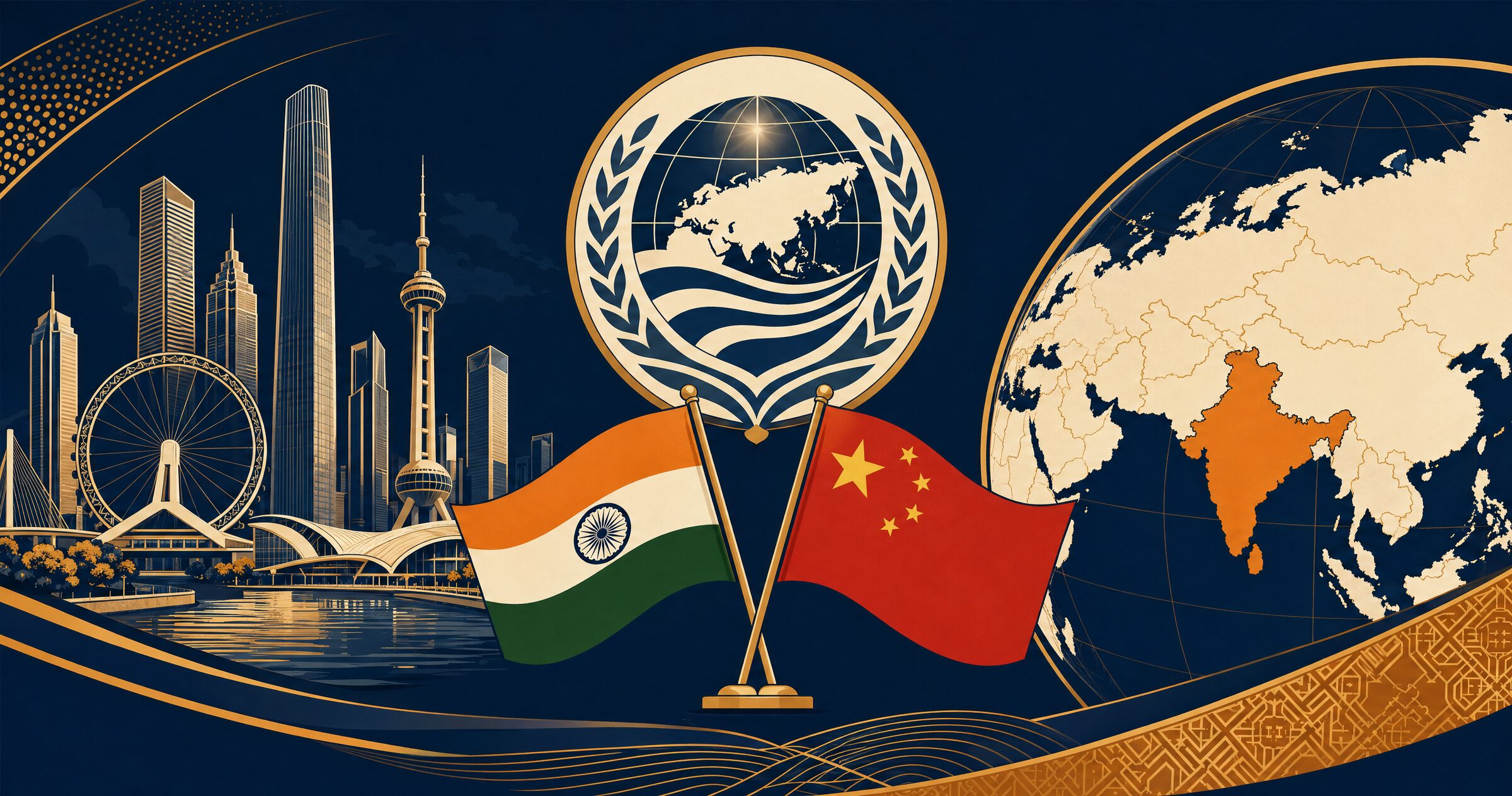
The Shanghai Cooperation Organisation (SCO) is a Eurasian political, economic and security grouping that today binds ten full members — India, China, Russia, Pakistan, Iran, Belarus, Kazakhstan, Kyrgyzstan, Tajikistan and Uzbekistan — across roughly forty per cent of the world’s population and a quarter of global GDP. The organisation traces its origin to the Shanghai Five mechanism of 1996 and was formally constituted in 2001. India was admitted as a full member at the Astana Summit of 2017. The 24th Heads of State Council Summit, hosted by China at Tianjin on 31 August and 1 September 2025, became the largest gathering in the bloc’s history and the first visit to mainland China by Prime Minister Narendra Modi since the Galwan clash of June 2020. For the UPSC aspirant, the summit opens onto Paper II international relations — bilateral, regional and global groupings — Paper III economy and internal security, and Paper IV ethics in foreign-policy decision-making.
The headline outcomes anchor the rest of the discussion. The Tianjin Declaration issued on 1 September 2025 reaffirmed an evolving multipolar order, condemned by name the Pahalgam terror attack of 22 April 2025, endorsed the SCO counter-terror cooperation programme for 2025-2027, and committed members to a ten-year SCO Development Strategy. On the sidelines, Modi held substantive bilaterals with President Xi Jinping and President Vladimir Putin, agreed to resume the Kailash Manasarovar Yatra and direct flights with China, and confirmed that Putin would visit New Delhi in December 2025. The summit unfolded against the backdrop of Washington’s announcement of a 50% secondary tariff on countries importing Russian crude oil, lending the Tianjin optics a sharp geopolitical edge. This article unpacks the institutional architecture of the SCO, India’s seven-year journey inside the bloc, the Tianjin Declaration text, and the structural meaning of Modi’s Eurasian pivot.
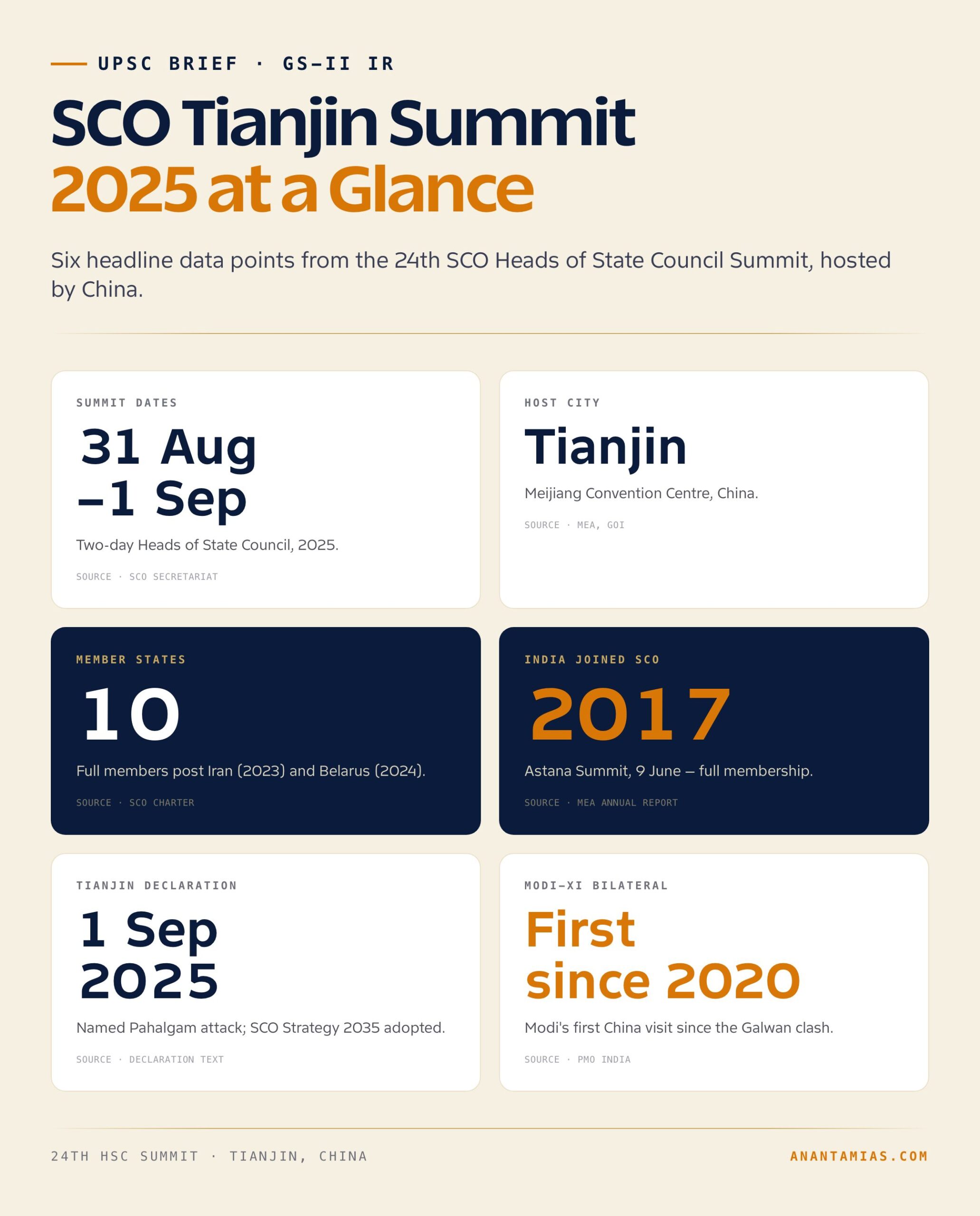
Quick Facts at a Glance
| Indicator | Value | Source |
|---|---|---|
| Summit edition and host | 24th SCO Heads of State Council Summit, hosted by China | SCO Secretariat / MEA Press Release |
| Summit dates | 31 August – 1 September 2025 | Ministry of External Affairs, Government of India |
| Host city | Tianjin, People’s Republic of China | SCO Secretariat |
| Indian delegation head | Prime Minister Narendra Modi | PMO India |
| Modi’s first visit to China since | Galwan Valley clash, 15 June 2020 | MEA, Government of India |
| SCO full members (post 2023 Iran, 2024 Belarus accession) | 10 member states | SCO Charter (2002) and Heads-of-State communiqués |
| India’s year of full SCO membership | 2017 (Astana Summit, 9 June 2017) | MEA Annual Report 2017-18 |
| Tianjin Declaration adoption date | 1 September 2025 | Tianjin Declaration text, SCO Secretariat |
| Headline strategic document | SCO Development Strategy through 2035 | Tianjin Declaration, Section V |
Background and Historical Context
The institutional pre-history of the SCO begins with the Shanghai Five — a confidence-building mechanism launched in 1996 between China, Russia, Kazakhstan, Kyrgyzstan and Tajikistan to demarcate the long Sino-Soviet frontier inherited from the Cold War. With the accession of Uzbekistan in 2001 and the simultaneous adoption of the Shanghai Convention on Combating Terrorism, Separatism and Extremism, the grouping was rebranded as the Shanghai Cooperation Organisation. The SCO Charter was signed at the St Petersburg summit of 2002 and entered into force in 2003. From its inception, the bloc was conceived as a Eurasian counterweight to the post-Cold-War unipolar moment — a role its founders described in the language of “comprehensive security” rather than the narrow military-pact framing of NATO.
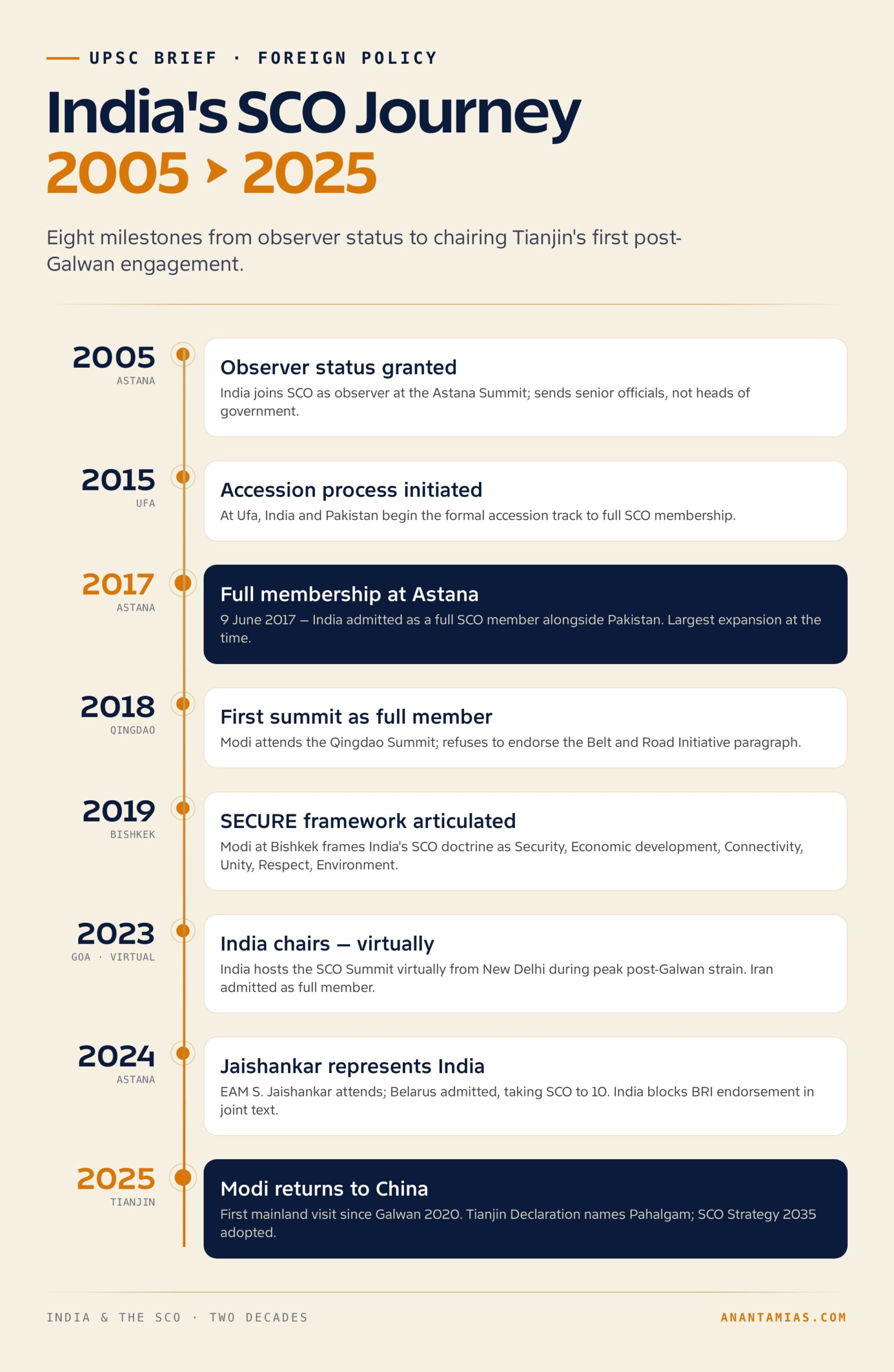
India’s relationship with the SCO has moved through three distinct phases. From 2005 to 2017, New Delhi held observer status, sending senior officials but not heads of government to the annual heads-of-state summits. The decisive turn came at the Ufa Summit of 2015, where India’s accession process was formally initiated alongside Pakistan’s. Both states were admitted as full members at the Astana Summit on 9 June 2017, the largest expansion in the organisation’s history at the time. The Kazan Council of Heads of Government in 2024 followed the admission of Belarus at the Astana 2024 Summit, taking the membership count to ten. Through 2023 India hosted the SCO summit virtually from New Delhi at a moment of extreme bilateral strain with both Beijing and Islamabad.
The Tianjin summit therefore unfolded at an inflection. India’s accession to the SCO in 2017 had always carried an implicit tension: the same year that New Delhi joined the Eurasian bloc, the Doklam stand-off with China unfolded along the trijunction with Bhutan. Three years later the Galwan Valley clash of 15 June 2020 killed twenty Indian soldiers and an undisclosed number of Chinese troops, freezing high-level political contact for almost five years. The Disengagement Agreement of October 2024 along the Line of Actual Control, finalised on the eve of the BRICS Kazan summit, reopened the door. The ground in Eurasia had also shifted: the Russia-Ukraine war entered its fourth year, US-China strategic competition had hardened under the renewed Trump administration (which returned to office in January 2025), and the global trade architecture absorbed a fresh wave of tariffs. The 50% US secondary tariff on Russian-oil buyers, announced in early August 2025 and explicitly aimed at India, made Modi’s Tianjin attendance a strategic statement rather than a routine summit cameo.
The summit was also unprecedented in scale. Chinese state media described Tianjin 2025 as the largest gathering in SCO history, with more than twenty heads of state and government in attendance, including SCO observer states Mongolia and Afghanistan‘s representatives, and dialogue partners ranging from Turkey to the United Arab Emirates. The host country had spent the better part of 2025 preparing the optics — a refurbished Tianjin Meijiang Convention Centre, a one-thousand-strong press contingent, and a parallel SCO Plus outreach format that brought Southeast Asian and West Asian observer delegations into the same hall as the ten members. China’s ambition for the summit was made explicit by President Xi Jinping in his opening address: that the SCO should evolve from a regional confidence-building mechanism into a “model for a new type of international relations”. For New Delhi, the calibration challenge was to participate in this expanded format without endorsing the Sino-centric framing of multipolarity that Beijing was advancing.
Key Features of the SCO Tianjin Summit 2025
SCO as a Eurasian Bloc — Architecture and Mandate
The SCO operates through three permanent organs: the Council of Heads of State, which meets annually and is the supreme decision-making body; the Council of Heads of Government, which handles economic and budgetary matters; and the Council of Foreign Ministers. The SCO Secretariat is headquartered in Beijing, while the Regional Anti-Terrorist Structure (RATS) is based in Tashkent. The bloc’s working languages are Russian and Chinese — a configuration that itself signals the founding bargain. The mandate has steadily widened from border confidence-building and counter-terror cooperation to encompass connectivity, energy, trade, agriculture and digital cooperation. The 2017 expansion to include India and Pakistan, the 2023 admission of Iran at the Goa-virtual summit, and the 2024 admission of Belarus have transformed the SCO into a genuine intercontinental platform stretching from the European fringe of Belarus to South Asia and the Persian Gulf.
India’s SCO Journey since 2017
India’s eight-year membership has tracked four distinct purposes. The first is access to the Regional Anti-Terrorist Structure intelligence-sharing mechanism, which gives Indian security agencies a documentary trail on cross-border terror financing flowing through Central Asia. The second is the strategic optics of being inside a non-Western forum that includes both rivals and partners — an embodiment of strategic autonomy. The third is connectivity: the SCO has consistently endorsed the International North-South Transport Corridor (INSTC) running through Chabahar Port in Iran, which India operationalised through a long-term contract in 2024. The fourth is normative: India has used the SCO to publicly oppose cross-border terrorism and the China-Pakistan Economic Corridor (CPEC) component that traverses Pakistan-occupied Kashmir. New Delhi’s most prominent moment of dissent inside the bloc came at the Astana 2024 Summit, where External Affairs Minister S. Jaishankar represented India and the joint statement omitted the Belt and Road Initiative endorsement at India’s insistence — a precedent the Tianjin Declaration also respects.
Tianjin Declaration — Key Outcomes
The Tianjin Declaration, issued on 1 September 2025, runs across five thematic sections. It commits members to actively implement the SCO Cooperation Programme on Combating Terrorism, Separatism and Extremism for 2025-2027, names and condemns the 22 April 2025 Pahalgam attack in Jammu and Kashmir alongside the 11 March 2025 Jaffar Express attack in Balochistan and the 21 May 2025 Khuzdar attack, reaffirms the centrality of the UN Charter, and endorses an “evolving multipolarity”. Members also adopted the SCO Development Strategy through 2035, established four new permanent bodies — including a Universal Centre for Countering Challenges and Threats to Security — and committed to expanded local-currency settlement. India’s signature was conditional on the inclusion of Pahalgam by name in the terror-attacks paragraph and on the absence of any direct endorsement of the BRI by name; both conditions were met.
Bilaterals on the Sidelines — Modi-Xi and Modi-Putin
The Modi-Xi bilateral on 31 August was the substantive headline. The two leaders agreed that the relationship should advance on a foundation of “mutual respect, mutual interest and mutual sensitivity” — language drawn directly from the Wuhan and Mamallapuram informal-summit framework of 2018-2019. They confirmed the resumption of the Kailash Manasarovar Yatra after a five-year hiatus, the restoration of direct passenger flights between India and China, and the activation of a Special Representatives’ dialogue on the boundary question. The Modi-Putin meeting earlier the same day ran for nearly an hour inside the Russian presidential limousine. The two confirmed the schedule for Putin’s December 2025 visit to New Delhi and reviewed the S-400 deliveries, the Vostochny energy cooperation track, and the rouble-rupee settlement framework. Modi also reiterated India’s call for an early end to the Ukraine conflict.
Significance for UPSC and General Knowledge
- Direct GS2 syllabus hit on bilateral, regional and global groupings and their effect on India’s interests — the SCO is named explicitly in the UPSC syllabus.
- GS2 anchor on India-China and India-Russia relations, including the post-Galwan disengagement and the December 2025 Putin visit calendar.
- GS3 internal security overlap on cross-border terror financing, the Regional Anti-Terrorist Structure (RATS), and the Pahalgam attack referenced by name.
- GS3 economy linkage on local-currency settlement, the rupee-rouble framework, and the secondary-tariff regime imposed by the United States in August 2025.
- Prelims static fodder on SCO membership year by year, host cities, the Shanghai Convention of 2001, and the location of the SCO Secretariat and RATS.
- Essay paper data bank — multipolarity, strategic autonomy, and the Eurasian rebalancing all feature in recent UPSC essay prompts.
- GS4 ethics linkage on the dilemmas of engaging adversarial powers in shared multilateral fora without compromising on sovereignty and counter-terror principles.
Detailed Analysis: India’s Multi-Alignment Strategy at SCO 2025
The Tianjin summit is best understood not as a single diplomatic event but as the convergence point of three distinct Indian strategic vectors: the post-Galwan recalibration with China, the defence and energy continuity with Russia, and the public assertion of strategic autonomy against a hardening US tariff regime. The Modi government’s foreign-policy doctrine since 2014 has been described as “multi-alignment” — the simultaneous deepening of partnerships with the United States, Russia, Europe, the Gulf and a re-engaged China without entering any formal alliance system. Tianjin made that doctrine visible. Within seventy-two hours, Modi was photographed walking hand-in-hand with Putin and Xi, attended a Eurasian bloc summit attended by every major adversary of the United States, and yet retained an active Quad engagement track and an India-EU trade negotiation calendar.
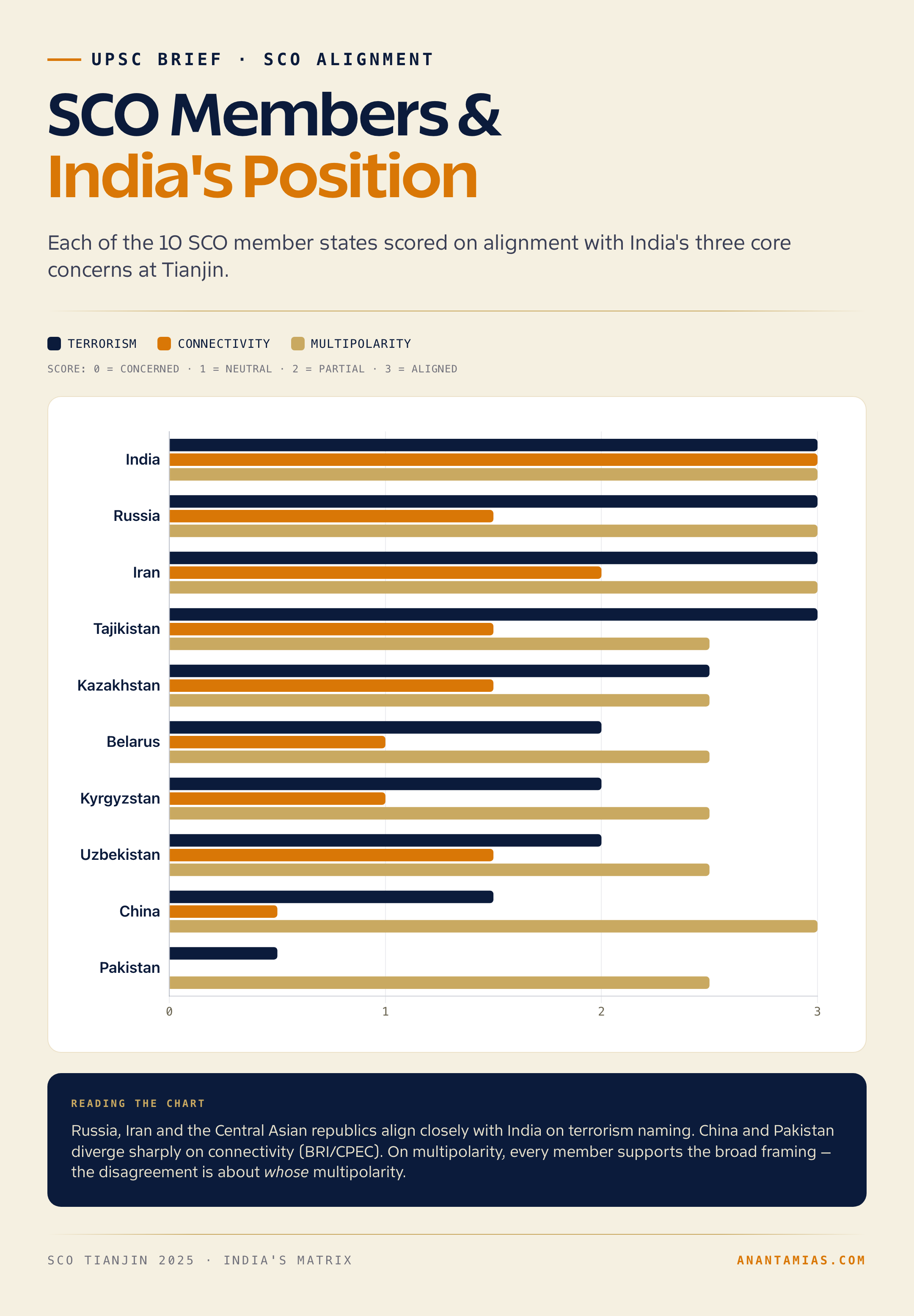
The bilateral architecture inside the bloc is uneven, and the Tianjin meetings reflected those asymmetries. Of the ten member states, India shares a frontier with three (China, Pakistan, and through historic claims with the Tajikistan-bordering Wakhan Corridor), maintains deep defence and energy ties with Russia, and pursues connectivity through Iran and Central Asia. The Indian position on the major SCO agenda items — counter-terrorism naming conventions, BRI endorsement, local currency settlement, and the Iran nuclear question — was negotiated on a member-by-member basis in the run-up to the summit. The granular table below records the position of each member state on the three agenda items most consequential for India.
| Member State | Position on Naming Pahalgam | Position on BRI Endorsement | Local Currency Settlement |
|---|---|---|---|
| India | Insisted on inclusion by name | Opposed direct endorsement | Supports rupee-bilateral arrangements |
| China | Accepted after negotiation | Pushed for renewed endorsement | Strong proponent (yuan-lead) |
| Russia | Supported India’s position | Neutral with Russian preference for EAEU framing | Strong proponent (rouble-yuan-rupee) |
| Pakistan | Reluctantly acquiesced | Strong proponent (CPEC stakeholder) | Conditional support |
| Iran | Supported India’s position | Supportive without exclusivity | Strong proponent (sanctions context) |
| Belarus | Followed Russian lead | Generally supportive | Supportive |
| Kazakhstan | Supportive of clear naming | Conditional, balancing role | Supportive with USD continuity |
| Kyrgyzstan | Followed consensus | Beneficiary, supportive | Supportive |
| Tajikistan | Strongly supportive (terror-victim state) | Beneficiary, supportive | Supportive |
| Uzbekistan | Supportive | Conditional, multi-vector | Cautiously supportive |
The most consequential structural shift visible at Tianjin was the implicit reset of the India-China bilateral. Five years of frozen high-level contact, an additional brigade-equivalent troop deployment along the Line of Actual Control, and a screening regime that effectively curtailed Chinese FDI into India had crystallised into a steady-state hostility that neither capital could afford indefinitely. The Modi-Xi handshake at Tianjin did not resolve the underlying boundary dispute, but it formalised what diplomats have called “managed competition”. On the connectivity front, the Indian position on BRI remained unchanged; what shifted was the procedural language around the SCO Connectivity Programme, which now references both the BRI and the INSTC without making either the privileged framework. The MEA’s post-summit briefing emphasised that the Tianjin Declaration “respects the sovereignty and territorial integrity of all member states” — a formulation read in New Delhi as a quiet acknowledgement of the Pakistan-occupied Kashmir question.
The Russia track at Tianjin operated along a different logic. The August 2025 announcement by the Trump administration of a 50% secondary tariff on countries importing Russian crude was timed and calibrated to pressure India and China into curtailing Urals-grade purchases. India had become the largest sea-borne buyer of Russian crude after the 2022 G7 price cap, with Russian oil rising from below 2% of Indian imports in early 2022 to roughly 35-40% by mid-2025. The Modi-Putin meeting in the Aurus limousine — described by Russian sources as running for nearly an hour — was a calibrated public signal that the energy and defence continuum with Moscow would not be subordinated to Washington’s tariff calendar. Putin’s confirmed December 2025 visit to New Delhi, the activation of the 21st India-Russia Annual Summit agenda, and the continuation of the rupee-rouble settlement experiment all fed into the same message.
The Pakistan dimension of Tianjin deserves separate attention. Prime Minister Shehbaz Sharif was present, and the seating choreography placed the Indian and Pakistani delegations within the same plenary hall for the first time since the Pahalgam attack and the subsequent Operation Sindoor military exchange of May 2025. The Indian position, formally communicated through the Ministry of External Affairs ahead of the summit, was that there would be no Modi-Sharif bilateral and no acknowledgement of Pakistan beyond the formal multilateral protocol. The Tianjin Declaration’s explicit naming of Pahalgam — and the parallel naming of the Jaffar Express and Khuzdar attacks within Balochistan, which Pakistani officials privately attribute to Indian-supported actors — produced an unusual paragraph in which both states agreed to language that condemned violence inside the other’s claimed territorial sphere. The MEA spokesperson Randhir Jaiswal in his post-summit briefing called the paragraph “an example of why the SCO consensus rule, when worked carefully, can produce outcomes no bilateral framework currently can”.
The deeper analytical takeaway, however, lies in what Tianjin did not produce. There was no joint communique on the Ukraine war, no consolidated SCO position on the Israel-Gaza conflict, and no operational framework for an alternative payments architecture that would credibly displace the dollar in the medium term. The bloc remains, as the Stimson Center noted in its post-summit assessment, a concert of disagreement — a stage on which member states perform multipolarity for their respective domestic audiences and a hedge for individual capitals against the volatility of the US-led order, but not yet a coherent strategic actor. For India, this ambiguity is the feature, not the bug: a tightly-aligned SCO would force a choice that New Delhi has constitutionally declined to make for seven decades. The summit’s true achievement, accordingly, was the preservation of strategic optionality — the explicit affirmation that India can sit in Tianjin one week and at a Quad foreign ministers’ meeting the next without either appearance compromising the other.
Comparative Perspective
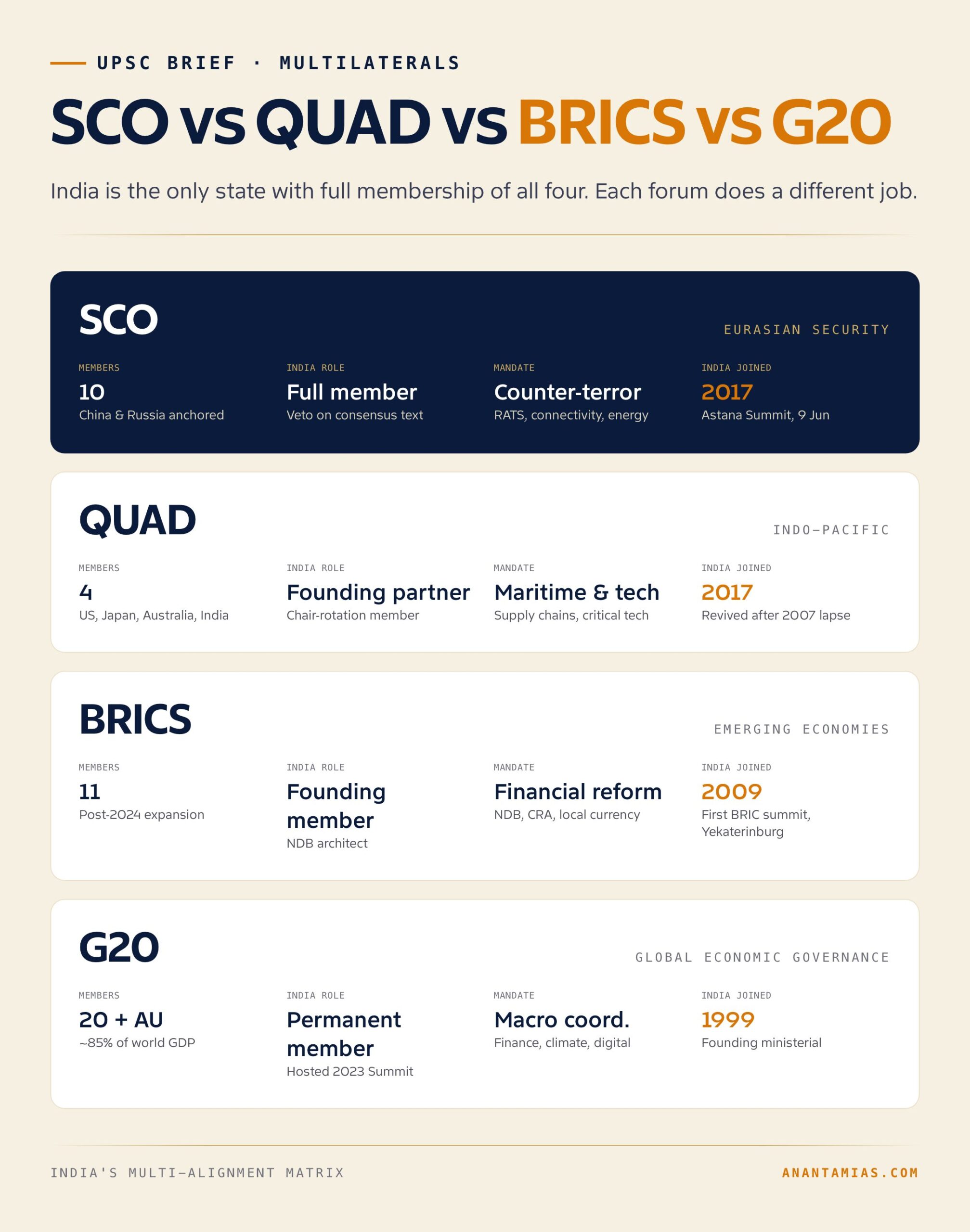
India is the only country in the world that simultaneously holds full membership in the SCO, the Quad, BRICS, the G20 and the I2U2. This unique cross-membership is the operational definition of strategic autonomy as practised by the Modi government. Each forum has a distinct mandate, geography, and treatment of the China question — and Tianjin can only be read accurately when placed alongside its peers.
| Forum | Core Pillars / Membership | India’s Role |
|---|---|---|
| SCO | Eurasian security and connectivity; 10 members; China and Russia anchored | Full member since 2017; voice on counter-terror naming and INSTC |
| QUAD | Indo-Pacific maritime, technology and supply-chain cooperation; US, Japan, Australia, India | Founding partner of the revived 2017 grouping; chair-rotation member |
| BRICS | Emerging-economy political and financial cooperation; 11 members post-2024 expansion | Founding member (2009); architect of the New Development Bank |
| G20 | Global economic governance; 20 major economies plus AU | Hosted the 2023 New Delhi Summit; permanent troika seat through 2024 |
| I2U2 | India, Israel, UAE, US — food, water, energy, technology cooperation | Founding member (2022); West Asia connectivity anchor |
The structural insight from the comparison is that the SCO, unlike the Quad, is not a like-minded grouping. Its strategic value to India is precisely that it is not. The Quad gives India a shared values platform with three treaty allies of the United States; BRICS gives it an emerging-economy financial leverage point; the SCO gives it an instrument for managing — not eliminating — the friction with China and Pakistan. Each forum is selected for what it can do, and none is permitted to define the totality of Indian foreign policy.
Challenges and Criticisms
The dominant Indian narrative around Tianjin — Modi-as-multipolar-statesman walking with Xi and Putin — has not gone uncontested. The Observer Research Foundation argued in a post-summit brief by Harsh V. Pant that the SCO remains, in practice, a Sino-Russian condominium in which India’s voice is structurally constrained by the consensus rule and by the bloc’s working languages of Russian and Chinese. The Pant critique notes that India’s nominal achievements at Tianjin — the naming of Pahalgam, the omission of BRI by name — are negative wins, achieved by withholding consent rather than by setting the agenda. The deeper question, as the Institute for Defence Studies and Analyses (IDSA) has noted, is whether India’s continued participation lends legitimacy to a forum whose other members structurally undercut Indian interests in Pakistan-occupied Kashmir, in Afghanistan policy, and in the Indian Ocean.
The China question is the most acute. The Modi-Xi bilateral did not produce a roadmap for the resolution of the Line of Actual Control friction at Depsang or Demchok, nor any commitment to roll back the Chinese troop build-up that has continued in the rear areas. The October 2024 Disengagement Agreement covered only patrolling rights at two specific friction points; the broader question of force-deployment levels along the LAC remains unaddressed. Critics inside the strategic community, including former Foreign Secretary Vijay Gokhale, have warned that the symbolic warmth of the Tianjin handshake risks normalising a status quo in which Chinese troop presence on what India considers its own side of the LAC is treated as a fait accompli. The Brookings India and Carnegie Endowment assessments have similarly cautioned against reading the resumption of the Kailash Manasarovar Yatra and the direct flights as proxies for genuine de-escalation.
The third critique is economic. The local-currency settlement framework endorsed at Tianjin remains, in operational terms, a yuan-led architecture. Rouble-yuan-rupee triangulation has worked for crude oil but has accumulated an estimated $40 billion stock of unrepatriated rupees in Russian accounts since 2022 — a figure that the RBI‘s November 2024 Financial Stability Report flagged as a structural mismatch. Without convertibility, the rupee cannot perform the role the SCO Declaration assigns to it. The Stimson Center‘s post-summit analysis put the criticism plainly: the SCO has produced a vocabulary of multipolarity but not the financial plumbing to sustain it. A fourth strand of criticism, advanced by analysts at RAND Corporation in a September 2025 commentary, points to the asymmetry between the bloc’s expanding declaratory ambition and its stagnant institutional capacity — a Secretariat with a small permanent staff, a RATS framework that lacks operational reach beyond Central Asia, and a budget that remains a fraction of either the EU’s or ASEAN’s. Without an enforcement architecture, the Tianjin Declaration’s commitments on counter-terror cooperation, infrastructure financing, and digital cooperation remain aspirational rather than binding.
Prelims Pointers
- The SCO traces its origin to the Shanghai Five mechanism of 1996 between China, Russia, Kazakhstan, Kyrgyzstan and Tajikistan.
- The SCO was formally constituted in 2001 with the accession of Uzbekistan and the adoption of the Shanghai Convention on Combating Terrorism, Separatism and Extremism.
- The SCO Charter was signed at the St Petersburg Summit of 2002 and entered into force in 2003.
- India and Pakistan were admitted as full members at the Astana Summit on 9 June 2017.
- Iran joined as a full member at the Goa-virtual summit of 2023; Belarus joined at the Astana 2024 Summit, taking membership to 10.
- The SCO Secretariat is headquartered in Beijing; the Regional Anti-Terrorist Structure (RATS) is based in Tashkent.
- The official working languages of the SCO are Russian and Chinese.
- The 24th SCO Heads of State Council Summit was hosted by China at Tianjin on 31 August – 1 September 2025.
- The Tianjin Declaration, adopted on 1 September 2025, named the Pahalgam attack of 22 April 2025 by name.
- The Tianjin Summit adopted the SCO Development Strategy through 2035 and the Cooperation Programme on Combating Terrorism, Separatism and Extremism for 2025-2027.
- Modi’s visit to Tianjin was his first to mainland China since the Galwan Valley clash of 15 June 2020.
- The October 2024 Disengagement Agreement at the Line of Actual Control covered Depsang and Demchok patrolling rights.
- The International North-South Transport Corridor (INSTC) connects India to Russia via Iran’s Chabahar Port; India signed a 10-year operating contract for Chabahar in 2024.
- The 50% US secondary tariff on Russian-oil buyers was announced in August 2025 by the Trump administration.
- Putin’s December 2025 visit to New Delhi will be the 21st India-Russia Annual Summit.
Mains Practice Questions
- The Shanghai Cooperation Organisation has been described as a “concert of disagreement”. Examine India’s strategic interests in the bloc in the light of the 2025 Tianjin Summit. (15 marks, 250 words)
- Critically assess the proposition that the Tianjin Declaration of 2025 represents a substantive shift in the global order toward multipolarity. (15 marks, 250 words)
- Discuss the significance of Prime Minister Narendra Modi’s first visit to China since the Galwan clash of 2020 in the context of the post-disengagement India-China relationship. (10 marks, 150 words)
- India is the only state with simultaneous full membership of the SCO, the Quad, BRICS and the G20. Evaluate the costs and gains of this multi-alignment posture. (15 marks, 250 words)
- Explain the architecture of the SCO Regional Anti-Terrorist Structure (RATS) and its utility for Indian internal-security agencies. (10 marks, 150 words)
- “India’s gains at the SCO have been negative wins — achieved by withholding consent rather than by setting the agenda.” Comment with reference to the Tianjin Declaration. (15 marks, 250 words)
- The local-currency settlement framework endorsed at Tianjin has been called a vocabulary of multipolarity without the financial plumbing. Critically examine. (15 marks, 250 words)
- Compare the SCO with the Quad and BRICS in terms of their utility to Indian foreign policy. (10 marks, 150 words)
Conclusion
The Tianjin summit will be remembered less for what it produced on paper and more for what it signalled about the texture of the emerging global order. The image of Modi, Xi and Putin walking together in the second-largest city of northern China — with the United States having that same week imposed a 50% secondary tariff aimed at India’s energy choices — was the most concise statement of a multipolar architecture the post-Cold-War period has yet seen. The Tianjin Declaration, with its explicit naming of the Pahalgam attack, its endorsement of the SCO Development Strategy through 2035, and its careful omission of any direct BRI endorsement, captured both the genuine convergences and the persistent fault lines of the bloc. India’s diplomatic craft was visible throughout: the substance was extracted, the consensus held, and the symbolism was permitted to do its own work.
What the aspirant should monitor over the next eighteen months is whether the procedural openings of Tianjin translate into structural change. Three calendars matter. The first is the December 2025 Putin visit to New Delhi, which will test whether the rupee-rouble framework can absorb the post-tariff trade volumes without further accumulation of unrepatriated balances. The second is the next India-China Special Representatives’ dialogue and the question of whether the Disengagement Agreement extends from patrolling rights at Depsang and Demchok to broader force-deployment normalisation along the Line of Actual Control. The third is the implementation timeline of the SCO Development Strategy through 2035 and the operationalisation of the Universal Centre for Countering Challenges and Threats to Security — the litmus test for whether the bloc evolves from declaratory architecture into operational machinery.
The deeper lesson Tianjin offers the Indian foreign-policy student is that strategic autonomy is not a slogan but a practice — exercised summit by summit, communique by communique, in the precise wording of paragraphs and the calibrated choreography of bilateral handshakes. India did not abandon the Quad to attend the SCO, did not endorse the BRI to secure a Modi-Xi meeting, and did not soften the Pahalgam reference to ease consensus. The aspirant who learns to read these procedural details — and to distinguish them from the photo-opportunities that travel through the news cycle — will arrive at the only durable summary of Tianjin: that India remained, as it has for seven decades, an actor whose foreign policy is best read in the documents it does not sign as much as in the ones it does.
Frequently Asked Questions
What is the Shanghai Cooperation Organisation?
The Shanghai Cooperation Organisation (SCO) is a Eurasian political, economic and security bloc founded in 2001. Its full members are India, China, Russia, Pakistan, Iran, Belarus, Kazakhstan, Kyrgyzstan, Tajikistan and Uzbekistan, with several observer and dialogue states. Its mandate centres on counter-terrorism, regional connectivity, and Eurasian multipolarity.
When did India join the SCO?
India was an observer at the SCO from 2005 and became a full member at the Astana summit on 9 June 2017, alongside Pakistan. India is the only SCO member that is also a Quad partner — making its position structurally distinct from the China-Russia core.
What was the SCO Tianjin Summit?
The 24th SCO Heads of State Council summit was hosted by China at Tianjin on 31 August – 1 September 2025. It produced the Tianjin Declaration on terrorism, multipolarity and Eurasian connectivity, and was Prime Minister Modi’s first visit to China since the Galwan clash of 2020.
Why was the Modi-Xi bilateral significant?
Modi and Xi met on the Tianjin sidelines for the first formal bilateral since the 2020 Galwan stand-off. The talks signalled a managed reset on border disengagement, trade resumption and people-to-people exchanges, while leaving deeper strategic divergences (CPEC, Quad) intact.
What did the Tianjin Declaration say?
The Tianjin Declaration reiterated SCO consensus on counter-terrorism, condemned unilateral economic sanctions and tariff measures, called for a multipolar global order, and endorsed deeper Eurasian connectivity. India’s signature came with reservations on the China-Pakistan Economic Corridor reference.
How does SCO compare with QUAD and BRICS?
SCO is a continental Eurasian security and connectivity bloc, QUAD is a maritime Indo-Pacific democracy framework, and BRICS is a developing-economy coordination platform. India is a founding or full member of all three — a deliberate multi-alignment strategy not adopted by any other major power.
What were the key India concerns at Tianjin?
India pushed back on terror financing language soft on Pakistan, refused to sign on to CPEC connectivity references, and used the platform to flag the US 50% secondary tariff on Russian oil that hurt India’s energy security calculations.
Why is the SCO summit important for UPSC?
The Tianjin summit is high-yield for GS-II International Relations: it tests India’s multi-alignment doctrine, the SCO’s institutional architecture, India’s Eurasian connectivity stake, and the post-Galwan India-China reset. Prelims regularly tests SCO membership, founding year and observer states.
Tell Google you want more of this.
Add Anantam IAS as a preferred sourceOne tap, and this site shows up more often in your own Top Stories, AI Overviews and AI Mode. Remove it any time.